By Priya Das
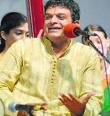 Margazhi Raagam, the “concert in cinema”, is many things packaged as a movie…It’s a kutcheri/ concert featuring two very popular artistes Bombay Jayashri and T. M. Krishna. It’s a film on digital steroids, with uncompressed six-track sound, audiographed by H. Sridhar, and captured on Red 4K cameras, cinematographed by P.C. Sreeram. It’s a dream of director Jayendra Panchapakesan come to life- of bringing an evocative, mass appeal to Carnatik music.
Margazhi Raagam is a concert on film, even though an actual concert was not filmed. Seven cameras were used as silent conspirators to capture every nuance as the music was acted out, so to speak. Every expression on the faces of the two main artistes is visible, making the viewing of the movie an intimate dialog between the audience and the musicians. The acoustics are brilliant; all the subtle cadences in T.M. Krishna’s rich voice are brought out in its full glory. Hearing Bombay Jayashri sing is like listening to the breaking of dawn.
I fell in conversation with T. M. Krishna at a press meet recently-
Didn’t the retakes kill the spontaneity of the performances?
T.M.K.: The entire shooting for the film was done in 2 days. Almost every performance was shot uninterrupted, except for one of mine, which we had to shoot in 2 parts because the lights went out! We wound up shooting till 2am that first day.
Have Bombay Jayashri and you performed together before?
T.M.K.:Certainly not for a full-fledged kutcheri. How we first sang together is an interesting story. Jayashri and I were collaborating on a coffee-table book on Carnatic music. We approached the then President of India, Abdul Kalam Azad for the unveiling. He agreed, on the condition that we sing together. It was then that we realized that we hadn’t ever sung together before! So we performed together for an invited audience at the Rashtrapati Bhavan. (The book is called Voices Within, published by Matrka, founded by TM Krishna and Bombay Jayashri, “to create a new platform to present Carnatic music.”)
How did the two of you prepare for Margazhi Raagam?
We didn’t prepare together as such. Jayashri and I have been friends for many years now, and are comfortable in giving each other the space required. We have only 2 duets, incidentally, one of them is without any music, just the two of us singing. Jayendra wanted the music to sound fresh, and gave us a free hand when it came to improvisation. In any case, preparation doesn’t work for me. I like to give in to the mood of the moment and raaga. Jayashri is more organized, on the other hand, and makes for a very appealing contrast in the movie.
Was it difficult to not have an audience during the shoot?
T.M.K.:Singing for Margazhi Raagam was like jamming with friends at home. We did have an audience about a 100, that’s the crew. The set was readied for us beforehand, and then there was a pindrop silence. It was a very intimate setting, very conducive to singing.
How was it to see yourself on film?
T.M.K.:Scary!! (laughs) When Jayashri and I saw the rough cut, I looked at her, nonplussed. I had never before seen myself sing, and this is in close-up! I wasn’t sure how the audience would like it.
And how did the audience like it- how has it been received in India?
T.M.K.:It has been received well. Of course there have been comments all over the spectrum, but I remember one particular incident. I was in Trichy. On a whim, I decided to see Margazhi Raagam in a theater there. When the owner heard that I was in the audience, he called me aside and said to me, “I am in my 70s. I would’ve died never having known the beauty in Carnatic music were it not for this movie, thanks for making it!”
Sarvamangala Mangalye and Jagadodhara are fairly accessible songs- Who selected the content?
T.M.K.:Jayendra, Jayashri and I unanimously selected the songs. Jayendra wanted this to be a common man’s music-movie. So the songs were selected first based on popular appeal, then on composition. We also wanted to choose different composers for each. The choice of the last song was particularly difficult- we felt it needed to hit the right resonance with the common man…our violinist came up with that one- Bharthiyar’s Vande Mataram. You can make the most commonplace song sound exotic and vice versa. It also depends on the rasika and the mood s/he is in- the same music can be enjoyed at 25 different levels.
Is this movie like a much-awaited democratization of Carnatica?
T.M.K.:I think so. I believe that for many centuries, music in South India belonged to the masses. It was during the British Raj that it got closeted into an auditorium, and ticketed, leaving out the common man. In Kerala during the temple season, right to this day, music is sung among the people, in temples, and anybody can come close and ask for requests. I remember a few years ago, there was this drunk rickshaw driver sitting right up front, smoking a beedi. I thought he was in a stupor, and had dismissed him as a serious rasika. Suddenly he gets up and says, “Saami, Todi padangey”! So you see, there is a rasika in every common man.
Margazhi Raagam is set to be released in the US in April and May this year. It was first released in India during the month of Margazhi or the winter month in the Hindu calendar, the time between Dec 15 and Jan 15. Margazhi is the time the Chennai music season is held every year, a time when tens of Carnatic concerts run concurrently, and every concert receives a critique by veteran rasikas and the layman masses. That the movie is named after this season and released first during this time is a gentle nudge to all rasikas to sit up and take notice of this new medium on the block.
Bay Area Dates –
Friday, April 24th at 7 pm, Dolby Labs Theater, 100 Potrero Avenue, San Francisco. Tickets are $25 and $40.
Sunday, May 31st at 3 pm, IMC6, The Alameda, San Jose. Tickets are $12 each or $10 if purchased in groups of 4 or more. For tickets and info contact Aruna Peri : 408.718.5261 | aruna.peri@gmail.com
The trailer can be seen at marghaziraagam.com
 The
The  The reason why it is so hard to teach self confidence to young children is because as they are growing up epically between the ages of 18 months to age 5, children get scolded or corrected for a zillion things. We tend to spend most of the early learning years using the word “No, don’t do that” all the time when in actual fact, we should extend the statement to telling them why they should not do it and try and spend time using and enforcing positive statements.
 Bay Area dance rasikas had a similar experience when four gurus of Kuchipudi and Bharatanatyam danced at the YuvaBharati concert at the Mission City Center in Santa Clara on Apr 12, 2009. Presented as a tribute in bells to Oothukkadu Venkata Subayyar and Maharaja Swathi Thirunal, it was a heady experience to see four stalwarts on stage together for the first piece: Himabindu Challa, artistic director Nrityananda (Kuchipudi), Jyothi Lakkaraju, artistic director of Natyalaya (Kuchipudi), Shreelata Suresh artistic director of Vishwa Shanthi (Bharatanatyam), and Vidhya Subramanian, artistic director of Lasya (Bharatanatyam).
 For her first solo presentation, Vidhya strung together 3 distinct pieces; Kaliya Nartana, Swagatham Krishna and Taye Yashoda. It would have been such a treat for Vidhya to have danced any one of these for the entire length of her solo. The pieces felt hurried, kind of like watching sunrays dimpled through the clouds, now here, now gone. Certainly, there were flashes of brilliance, both in the dancing (Kasturi tilakam, shame while complaining about Krishna’s kiss to Yashoda) and the vocals (the part in tandem by Asha Ramesh and Madhavi Cheruvu lent a dramatic effect for Kaliya Nartana), but one longed for a long stretch of warm light which Vidhya is otherwise so good at infusing.
 The conclusion at the end of the first half was: The similarities between Bharatanatyam and Kuchipudi are only in attire; the former seeks to electrify, the latter to enchant. If one were to comment on the style of love each dancer has for her art, Vidhya’s can be defined as a Veera Shringara, she approaches her dance as an equal, with respectful pride. Shreelatha’s is a lover’s shringara, she does not even need reciprocation, she’s enraptured, enamored. Jyothi’s is a mature and masterful Shringara, her path is sure, complete, and transcendental. Himabindu approaches her art with bhakti, willing to be led rather than make a statement.
 The finale with Dhanasri Thillana was good. It was thrilling to watch them share the stage, and one didn’t know who to look at. The choreography was balanced, but again, not path-breaking and the synchronization slipped in some places. However, one wants to give a long rope to the gurus, it must have been extremely difficult to juggle the schedules and approaches. Thanks though to all of them for seeing it through, the audience appreciates it!
 Akshaya Patra
 Dear readers,



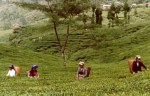 Some of my most cherished childhood memories are those of my grandmother’s tea estates, in the Dooars (foothills of Darjeeling) region of W.Bengal, sipping tea on the porch of the beautiful bungalow with a picture postcard view. Lush green tea shrubs cover the landscape, dotted with women workers picking tea leaves“ two leaves, a bud” with their nimble fingers and tossing them into the basket on their backs. I consider myself very lucky to have had the opportunity of tasting the freshness of that tea, and breathing that beautiful aroma.
 The best Darjeeling tea according to me is Makaibari
  Ingredients:
  If there’s one thing that is predictable about the 15th Lok Sabha elections, it is that it is unpredictable. Even those psephologists who consider their analyses incontestable are talking in terms of “if”.
 Water, No Ice