Monthly Archives: October 2009

Seeking Citizen Journalists

flip-video-cameraIndia Currents is pleased to announce a new initiative with San Jose Beez, an online collaboration of ethnic media organizations featuring hyper-local news content covering the San Jose area.

In addition to the general interest articles and calendar of events featured in our print magazine, we will be presenting online content of specific interest to the ethnic community in San Jose.

We are looking for citizen journalists who will identify and develop stories with an emphasis on the local Indian American community. In addition to excellent writing skills, applicants must have a lively sense of curiosity and a genuine interest in people.

To apply, please send your resume with a sample of your work to publisher[at]indiacurrents.com. Your work can be in the form of a written piece, photo or video essay.

Swine Flu – Prevention Tips

swine-fluNow that President Obama has declared swine flu a national emergency, I thought it made sense to put up these simple tips to help protect you. These are courtesy a chain mail from a friend via India, not the best of sources, I know, but the advice seems to make a lot of common sense, so here goes –

In a global epidemic of this nature, it’s almost impossible to avoid coming into contact with H1N1 in spite of all precautions.

While you are still healthy and not showing any symptoms of H1N1 infection, in order to prevent proliferation, aggravation of symptoms and development of secondary infections, some very simple steps, not fully highlighted in most official communications, can be practiced (instead of focusing on how to stock N95 or Tamiflu):

1. Frequent hand-washing .

2. “Hands-off-the-face” approach. Resist all temptations to touch any part of face (unless you want to eat, bathe or slap).

3. Gargle twice a day with warm salt water (use Listerine if you don’t trust salt). H1N1 takes 2-3 days after initial infection in the throat/nasal cavity to proliferate and show characteristic symptoms. Simple gargling prevents proliferation. In a way, gargling with salt water has the same effect on a healthy individual that Tamiflu has on an infected one. Don’t underestimate this simple, inexpensive and powerful preventative method.

4. Similar to 3 above, clean your nostrils at least once every day with warm salt water. Not everybody may be good at Jala Neti or Sutra Neti (very good Yoga asanas to clean nasal cavities), but blowing the nose hard once a day and swabbing both nostrils with cotton buds dipped in warm salt water is very effective in bringing down viral population.

5. Boost your natural immunity with foods that are rich in Vitamin C (citrus fruits). If you have to supplement with Vitamin C tablets, make sure that it also has Zinc to boost absorption.

6. Drink as much of warm liquids (tea, coffee, etc) as you can. Drinking warm liquids has the same effect as gargling, but in the reverse direction. They wash off proliferating viruses from the throat into the stomach where they cannot survive, proliferate or do any harm.

And here’s the CDC page for more information: http://www.cdc.gov/H1N1FLU/

Picture courtesy Artifex via Creative Commons attribution license.

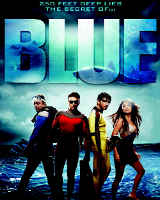
Blue – all wet

blue-1206The camera lovingly follows the contours of an underwater paradise. Incurious fish gently swim away from the light as the camera glides over sting rays, around coral and through populous grottos. As the credits roll, Shreya Ghoshal’s powerhouse voice begins the opening notes of the Bondesque song “Rehnuma.” It is a promising start for an underwater adventure, but when Shreya crescendos to “Katilana Adaaa” and it is not accompanied by a similar visual crescendo on screen, you first get the stirring of doubts about the competence of the filmmaker.

Set in the Bahamas, the titular Blue is the Lady in Blue, a British ship carrying Indian treasure that sank off the coast immediately after India’s independence. Sagar, a happy go lucky fisherman( Sanjay Dutt), is pressurized by his friend Aarav(Akshay Kumar) to help him look for the treasure. When Sagar’s young brother Sam gets into trouble with some Thai goons and has to come up with 50 million dollars ( an absurd sum that even the character demanding it seems to realize he’s pulling out of thin air) Sagar agrees to go on the treasure hunt.

The movie inexplicably spends only about 15 minutes on the actual treasure hunt; the rest is spent on motorcycle chases, boxing bouts and completely unnecessary songs and dances. This is especially true of the item number with Kylie Minogue, whose taut stretched face and body belie her age(41). (Farah Khan was probably busy enjoying the island atmosphere-the choreography is uninspiring.)

Director Antony D’Souza  was surely born with a silver spoon in his mouth; getting over a 100 crores to indulge in for one’s debut movie is an amazing achievement. Like a kid sent into a candy store with unlimited money, D’Souza just keeps gorging on the goodies. Like motorcycle chases? Here’s two. How about a bunch of helicopter shots of the beautiful Bahamas? And here’s a scene with jet-ski stunts.

But the phenomenal budget (Blue is reportedly the most expensive Hindi movie to make) obviously wasn’t enough. By the time the underwater scenes and the stunts were shot, and the stars paid, obviously there was no more money left over to pay for a good script or a screenplay writer. The actors seem to be improvising dialogues on the spot. Seriously. In one scene Aarav asks a Bahamanian hottie for a ride home. “Can I ride you,” he asks, a deliberate double entendre. Then he apologizes and asks, “Can you ride me home?” a Punjabi-ism if I’ve ever heard one. Other inane dialogues like, “Don’t worry, everything will be all right,” and “Just give me a gun, I will kill him” abound. The budget also apparently ran out before the props for the precious Indian treasure were purchased; there is, believe it or not, a trunk with gold coins and jewelry spilling out of it that could have been assembled in the local craft store.

One can tell the passion of the director was reserved for the cinematography; there are several scenes in the movie that stand out as visual works of art (one, in particular, is the scene of the red motorcycle in a sepia forest) but as a moving picture there is no connectivity between the scenes and no drama to engage the viewer. It feels as though D’Souza composed the movie entirely as a series of pictures and ignored the sound and fury that make a photo gallery a movie.

The actors just try their best to look good and swim well. Lara Dutta looks amazingly hot. Her toned derriere is just one of the many that D’souza lovingly pans over. Akshay is a good male equivalent, though Lara is inexplicably paired with the dissipated and unfit-looking Sunjay Dutt, whose spreading abdominal girth is just barely constrained by his wetsuit. Katrina Kaif makes a special appearance for which one hears she was paid an obscene amount of money.

The songs have been mostly panned by reviewers, but I think they grow on you. Blue is not A.R. Rahman’s best work, but “Rehnuma” and “Shara ra ra” and even the poorly choreographed “Chiggy Wiggy” sound appealing after repeat listening.

Blue will appeal to an audience unfamiliar with classic underwater adventures like The Deep and The Abyss but I am still surprised at its success in India. Unfortunately, the box office success of movies that are all style and no substance only spawns a dozen more copycats. Don’t be surprised if an Indian Jones-style jungle adventure is in the works as we speak. They can always call it Green.

Surviving 2009

united-states-unemployment-rate-chart-000001There’s a new serial on ABC called Flash Forward where the entire world blacks out for a little over 2 minutes. During the black out they all have a flash-forward of what they will be doing on April 29, 2101. When those crucial moments pass, the world is a state of chaos, of course, but slowly survivors realize there now they have something in common with every other human being in the world. “What did you see,” becomes the new ice-breaker.

As 2009 comes to an end, that ice-breaker may well be “How did you cope?” The global recession affected everybody, whether through immediate personal calamity, or news from a loved one or friend that they had lost their jobs, lost their health insurance, had to move, had to retrench … in a sense  we are all survivors.

For the year-end issue of India Currents magazine, I’d like to feature some of your stories. How did you survive 2009? What tips would you like to share? What are your strategies to cope with the fairly bleak scenario for next year?

Send me your stories via comments here or to editor (at) indiacurrents.com. I’ll put up some of the best ones in the December issue.

Akshaya Patra helps flood victims

akshaya-patra-floodThis past week, torrential rains in Karnataka and Andhra Pradesh caused flooding, rendering hundreds of people homeless and thousands of others unable to travel or find food. The local governments approached Akshaya Patra and asked the organization to provide meals to displaced victims of the natural disaster.

Akshaya Patra answered the call to service in Bellary, Hubli, Hyderabad and surrounding areas, delivering meals for 57,000 people, despite poor road conditions and the heavy downpours. Akshaya Patra also provided an additional 42,000 packets of food to be airdropped by the Indian Air Force.

“We wish to make all the facilities of Akshaya Patra available to supplement the flood relief operations of the government,” said Madhu Pandit Das, Chairman of Akshaya Patra India. “In all these kitchens we have capacity to cook thousands of meals in a short time and we have volunteers available to distribute the food.  The government can count on us to provide these services for as long as they are needed.”

Helping a million kids

Akshaya Patra, the organization that provides meals for underprivileged kids,  has reached a triumphant moment by crossing the one million mark and is now feeding over a million children in 17 kitchens in seven states in India.

To commemorate the milestone, come celebrate with luminaries like Narayana  Murthy at a benefit event at the India Community Center in Milpitas.

When: October 25, 6:00 p.m.

Where: India Community Center, 525, Los Coches St., Milpitas

Tickets: $140. Get your tickets here.

akshaya-patra

Nobel sentiments

obama2It was just a couple of weeks ago that my husband and I were discussing President Obama’s beleaguered situation, over the Sunday papers. The right was going nuts over perceived and imagined horrors of the proposed health care reform; the left was dismayed over Guantanamo prison closing delays; the Israelis were digging in their heels with respect to settlement expansion; and a new nuclear facility had been discovered in Iran.

“Dilettante!” “Narcissist!” “Traitor!” “Communist!” were words freely bandied around, as Obama struggled to implement his policies in a spirit of cooperation, bipartisanship, and consensus.

“That guy deserves the Nobel Peace Prize!” I said in dismay.

Little did I know the Prize committee was eavesdropping that day.:)

Yesterday’s news must have caused the premature demise  of dozens of computer keyboards, as coffee went spraying out of reader’s mouths when they saw the headlines. It almost seemed like a hoax; indeed, one White House staffer is said to have asked if it was April 1st, when informed of the momentous news. Conflicting emotions warred in the hearts of the even the most devoted Obama supporters. Too premature, was the consensus. My Indian American friends muttered darkly about the committee’s snub of Mahatma Gandhi, surely a much more deserving candidate. Of course, conservative heads nearly exploded, and the reactions from the American right-wing were the comic element in a very confusing day, as the US and the world tried to deal with the news.

The dust has settled today, as even the most vicious critics of the president came to the belated realization that it is highly unpatriotic to carp about such an honor. One State Department official’s comment puts it in perspective-“Certainly from our standpoint, this gives us a sense of momentum — when the United States has accolades tossed its way, rather than shoes.”

And that is perhaps as good as explanation as any as to why Obama was given the prize so early in his Presidency. We in the US perhaps do not realize how close the world was to the brink of Armageddon before Obama won the election last year; the war in Iraq seemed endless; there were rumblings among the American neocons about the next war with Iran; the Middle East situation looked highly destabilized; the global economy was in tatters; and the US’s refusal to sign the Kyoto treaty had removed any credibility it had with respect to climate change.

Yes, Obama may not have signed any significant legislation yet. “What has he done so far?” is the familiar refrain. But here’s what the world looks like after the short 9 months that he’s been in office-

– There is renewed hope for negotiations with rogue nations like Iran.

– There is improved cooperation with Russia after the missile program was modified.

– A climate change bill is in the works in the US, giving impetus to similar efforts around the world

-The global economy is sending out green shoots of recovery.

It is easy to criticize Obama as the guy who just makes pretty speeches, but words have power. There is a sense today, that mistakes notwithstanding, the most powerful nation in the world has its heart in the right place; that the direction the world is taking is the right one. By repeating the mantra of cooperation and consensus over and over, this President has sought to reassure the rest of the world that America is no longer an empire-builder; by admitting America’s mistakes, he is opening the door to  a new era of global coaction.

The dynamics of both internal American politics and overseas realpolitik may not permit quick decision-making, but as Obama himself put it, the kind of change he was expected to deliver required him to steer a massive ship; the directional changes can only be slow and incremental, but they will happen.

The Peace Prize committee may have jumped the gun on this one, but the more I think about it, the more I see their point of view. This is a man who has de-fanged Al Qaeda by welcoming and acknowledging the right of Muslims to self-governance; within the US, despite intractable resistance from the opposition and special interests, he has managed to get several bills passed to correct some of the damage done by the previous president.

Yes, these efforts have not always been perfect, and there is much, much more work to do, but the sincerity is unquestionable, as is the genuine desire to make the world a better place. 9 months ago the world was in cardiac arrest; perhaps the prize was given to Obama for being the “defibrillator.”

And before you mock the Prize committee too much, just imagine what would have happened had John McCain won. Then take a deep breath and let the sense of unfairness out as you exhale.

Less summer, more school

school-bus2For the last month the refrain in the Pradhan household has been something like this:
“What did you learn today?” I ask my 7-year-old.
“Not a thing,” she replies.

It’s the beginning of October, a month after school started, but it seems we are still in revision mode, designed for those kids who spent summer assiduously forgetting whatever they learnt in 1st grade.  Not that my daughter spent summer swotting; she has just managed to retain whatever she knew 3 months ago.

It’s frustrating for a parent, even if school is free (well, paid for only indirectly by my property taxes, anyway). While it is fine to treat school as a place where 7-year-olds go to socialize, one wishes they would get on with the program- it’s not reassuring when I get bombarded with data everyday that show kids in other countries doing better in every educational metric than kids in the US.

So the announcement last week that the Obama administration is going to propose longer school hours/more school days is very welcome. Education secretary Arne Duncan even dared to make the announcement on The Colbert Report; if that isn’t serious talk, I don’t know what is.

Geetha Venkatraman, a parent in Raleigh, North Carolina, concurs. “More school days would mean subjects get taught in more depth,” she says. “For instance, if kids are learning about electricity, there would be time to visit the local plant as a field trip.” Her kids are already on an experimental track system at their school. Instead of having the holidays all bunched together in the summer, they have 9 weeks of school followed by 3 weeks off. The number of instructional days is the same as the rest of the country ( a miserly 180 days or so), but the staggered holidays mean

a) there is less chance of kids forgetting what they’ve learnt and

b) teachers use the intervals to give struggling kids extra work and extra help to catch up with the class.

Kids also use the break to de-stress and pursue their hobbies. “My kids and I love this system,” says Geetha, who concedes that it can be tough on parents who both work and have to arrange for child care several times a year. (Camps in the county run throughout the year helping out working parents.) On the other hand, travel to India would be a lot easier as vacationers would not have crowd the airlines, lemming-like, in the months of June and December.

I asked a teacher friend in the local school system whether the long summer break was indeed a problem for kids. “Absolutely! I have to begin with alphabets and blending all over again because kids have forgotten everything.” (She is a first grade teacher.) Her school has more kids from poorer homes. One of the effects of the long summer holiday is the exacerbation of the rich/poor gap, as kids from upper middle class homes retain learning better through reinforcement in the form of either enrichment camps during the summer or a lot more reading at home.

This friend is in favor of more school days even though it would mean more work for her. Would other teachers feel the same? “I’m sure there would be some resistance,” she admits. Long time teachers (and thanks to tenure, most teachers have been around for a while) are used to a pattern of work on/work off that may be hard to give up. But there are some definite advantages for teachers too. Presumable one is looking at higher pay levels, but there is also more time to get the curriculum into unwilling heads. There’s time, as Geetha said, to get into a subject in more depth, and there would be the whole month of September to devote to the grade-appropriate curriculum instead of wasting on revision.

For homes with 2 working parents, the concept of more school is particularly attractive. Less summer=fewer summer camps=more savings. Given that school is free, summer is a big drain on the wallet as we scramble to find alternate arrangements for kids.

Gone are the days of my childhood where we just lounged around in the torpid heat, content to re-read our books and be bored till the cooler evenings when we would hang out with our friends. Kids today spend summer in camps (usually with an academic component), given the busy schedules of their parents and the isolating patterns of housing development. So if more school also means more time to learn and less homework per day, the idea sounds like a win-win for just about everybody.

Picture courtesy Lone Gunman via Creative Commons.

The Sevathon experience

sevathon1First, the good news:

The intentions were honorable. The idea of Sevathon, an India Community Center project, was to celebrate Mahatma Gandhi’s birthday by hosting a walk/run where participants would have the opportunity to find sponsorships for their various charities by getting pledges. The format is not unlike many other runs and marathons. In addition, ICC put together several booths with non-profits offering information and services to get the word out and keep the participants entertained while doing so.

We reached the Sunnyvale Baylands park around 8 on Sunday morning. According to the flier, the event was supposed to start at 8:30 and we hung around for a while, getting our registration bibs and t-shirts. Bollywood music blared in the background as participants milled around, trying to find the starting point for the race and getting a sense of the trail. Tables were set up with water, protein bars and bananas. We hung around the health tent, where organizations like the South Asian Heart Center had set up testing stations.

Around 8:30 we were invited to a warm up session, conducted by one of the dance instructors at ICC. After we had finished stretching to the peppy “Jai Ho” there was still some confusion about when and where the race was about to start. Finally there was an announcement that the race would start at 9 and we went to our car to put away our jackets. When we returned in a few minutes, we found to our dismay that the race had already started, without any official announcement of the same. The runners in our family took off while my daughter and I started briskly walking. At this stage, I was still not sure where the official start point of the race was. We just followed the crowd and eventually wound our way back after 5 kms.

Our runners were not so lucky. They missed a crucial sign marking a turn on the path and went off in the wrong direction. Eventually, they just used their pedometers to mark out 2.5 kms and returned from that halfway point.

Ultimately, the ambiguity about the start and finish times didn’t quite matter, because there was no clear finish line either. We just sauntered back to the tents that had been set up and left a few minutes later. According to the flier there was supposed to be a mela of some sort but there was no excitement created around it, no announcements, and we saw many others leaving along with us.

Given that this was the first year of the event, the chaos was perhaps understandable, though why a simple knowledge transfer from experienced organizers like the India Literacy Project was not done is puzzling. The idea of a run followed by a fair was good, but the execution left much to be desired. One of the first rules of creating a memorable run event is to make it attractive to serious runners; that creates a buzz around it that brings the rest of the crowd. Without a clean run experience, it becomes a casual day in the park which leaves future participation to the whims of ICC supporters.

My two bits on improving the experience?

– Have clear start and finish lines. If possible, arrange to time the runners and give prizes based on the times.

– Have a fixed start time and do not deviate from it, even if participants are sauntering in on Indian Standard Time.

– Mark the trail out immaculately and arrange to have volunteers at every point of confusion, at least for the first few years.

– Have barkers to constantly make announcements about the fair and drive traffic to the booths.( This is my opinion, was the biggest shortcoming of the event, since the fair was its USP)

– Instead of letting kids run free, charge a discounted rate for them so they can have their own bibs. Have separate prizes for the kids.

Sevathon was a noble idea. Here’s hoping the kinks get ironed out by next year.

Wake Up Sid – Buttered popcorn

wakeupsidWake Up Sid can be described in half-a-dozen words: Rich Spoilt Slacker Dude Grows Up. This much-used theme has been the premise of several multiplex movies starring (the now-aging) Saif Ali Khan, who passes on his mantle to the younger, hunkier Ranbir Kapoor.

Sid (Ranbir) is content with his aimless, carefree life even after he finishes college. His lack of responsibility irks his parents, till one day a showdown with Sid’s dad (Anupam Kher) causes Sid to move out and find his way in the world. He bunks with his new friend Aisha (Konkona Sen Sharma) till he figures out what to do.

The movie is set in Bombay, not Mumbai, and the nomenclature brought the wrath of the Shiv Sena Maharashtra Navnirman Sena (thank you Geeta!) upon the head of producer Karan Johar, who ended up having to apologize. But the decision to keep the old name is completely understandable; cinematographer Anil Mehta creates a vibrant, colorful, happening, city that is as far from the grit and grind of Kaminey and Slumdog as foie gras is from pav bhaji.

In fact, Bombay looks so crisp, clean and beautiful that it almost teeters into Disneyland artificiality. What prevents that from happening is the presence of Konkona as an independent-minded, sensible, career girl bemused by Sid’s slackerdom. She brings a depth and gravitas to the movie that serves it well and makes it difficult for one to dismiss it as fluff. The lead pairing is odd, but credit must go to debutant director and screenplay writer Ayan Mukerjee for making it work.

He is also assisted by a terrific music score. Shankar Ehsaan and Loy deliver yet again, with a contemporary sound that is perfectly in tune with the aesthetics of the movie. Mukherjee makes the most of this gift, teasing out the songs in a stop/start fashion that works because of the quality of the music. The best song, though, is Iktara by composer Amit Trivedi, whose tunes for Dev D won him critical acclaim. One complaint I have is that some songs in Wake Up Sid don’t feature in the CD for the movie, a puzzling omission that I hope a reader will solve for me.

The performances are uniformly good. Ranbir Kapoor is not one of my favorite actors, and his slack-jawed cluelessness can grate after a while, but he suits this role to a T. Anupam Kher brings nuance to his small role and demonstrates why he is one of the finest actors in mainstream Bollywood. Supriya Pathak is wasted as Sid’s sentimental mom, but she brings sweetness to her role. Konkona, of course, is the jewel of the movie. In her simple kurti, jean, dupatta ensembles she is the living heart of the city of Bombay. It is her remarkable talent that has overcome her unconventional looks to propel her into a lead role in a Dharma Productions film; the success is well deserved.

Wake Up Sid is like a big tub of buttered popcorn. It’s not particularly nutritious or fulfilling, but great to have in the dark of the movie theater. I highly recommend a dekko if you’re in the movie for light, uncomplicated fare that will cheer you up.

Wake Up Sid
*ring Ranbir Kapoor, Konkona Sen Sharma, Anupam Kher, Supriya Pathak
Directed by Ayan Mukherjee
My rating – 3 out of 5 stars