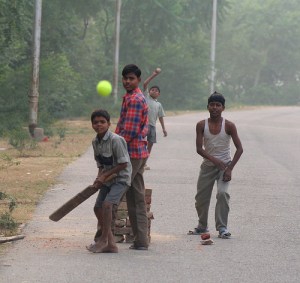
 More from my India trip –
– After just a week here, I have realized that it is virtually impossible to watch live TV in India. The greed with respect to ads is just unbelievable. Thanks to owning a DVR, my dad actually figured out the content/ad ratio. It is an incredible 8/22 for every 30minutes of viewing time. Isn’t there some kind of FCC-like organization in India that regulates that? Even live cricket isn’t spared; since the game can’t actually be interrupted, the ads frame the play, something akin to the old days of cable television where ads would bounce and ripple their way along the bottom, top, and occasionally the middle while movies were being screened.
– The corollary to that is that viewers in India (especially those not owning a DVR) have incredibly low levels of patience. After all, every TV watching experience is fraught with the desire to escape the ads, so you click, click, click the remote all the time, trying desperately to find a channel that has some actual programming. My sample is admittedly pretty low, statistically speaking, but across two cities and several relatives, I noticed that this lack of patience spread to other walks of life as well. Turns out this American citizen, used to things working when and how they are supposed to, actually could deal much better with drivers not showing up, traffic at a standstill, and the generally slower pace of life much better than the Indian residents. (To be fair, it could have been that my family was unhappy at the impression India was making on me and that translated to stress on their part.)
– Enough has been written about the chaos of Indian traffic and I won’t repeat it here, except to say that I have to believe a force field a few millimeters thick exists around all objects on the road. How else to explain the innumerable number of narrow misses? I saw helmet-less children riding pillion on scooters in a hyper aware state; their legs in a constant dance to keep out of harm’s way.
– Which leads to the conclusion that driving in India is not for the reflex-challenged. And sure enough, the average age of a motorist on Indian roads appears to be in the 30s. The few grey-haired uncles I saw were keeping cautiously to the edges of the road; not engaging in the typical competitive machismo that defines Indian traffic.
– That machismo is particularly visible in drivers of two-wheelers (gender be damned). Motorists in India have internalized the adage of being like sugar in milk; they will be rush to fill any empty spots between the larger molecules represented by cars and trucks. I found it particularly inexplicable. After all, the aggressiveness doesn’t mean more than a minute or two saved in the total travel time, but the risk of serious bodily injury (in Chennai the helmet rule is almost universally flouted) is disproportionately high. When I mentioned this to a friend who recently relocated to India, she had an interesting take on this. “Ask anyone of these crazy drivers what they do professionally and you will find that their career choices are almost comically risk-averse. Why don’t they channel their need for risk-taking into their careers instead?” There is a sociology thesis in here somewhere.
Picture courtesy foxypar4 via Creative Commons attribution license
 Hurray! A supermajority in the senate passes its version of the health care reform bill. The drama has been intense and there have been many moments when it seemed like talk of death panels and communism would defeat the process but, ultimately, with the help of giveaways to all the special interests and plenty of backroom wrangling, majority leader Harry Reid managed to thread the needle. Yes, this is a hugely imperfect bill. But it is also a tacit acceptance of the responsibility of the government to ensure affordable health care for its citizens. For that alone, it is a remarkable accomplishment. In the years to come, it will be hard to reverse any of the benefits and easier to keep improving upon the foundation that was laid today.
 You know you’re in Chennai when the pocket of the passenger in front of you starts blaring “Palaniappa, Swami Palaniappa.” The heavy set gentleman on the seat in front of me could have been straight out of central casting for the role of the villain in a Tamil movie (or hero, in Tollywood you can’t often tell the difference). His wards were a gaggle of elderly ladies, diamonds dripping from noses and ears, though if you had met the bunch on a Chennai street sans their jewelry, you might have compassionately pressed 20-rupee notes into their palms. Hey, I was pretty scruffy too, after 20-odd hours on the plane!
 Water, No Ice