If you are in India and spend your retiree hours watching day&night TV news channels, chances are you have stopped watching feature films. In the last year alone, the skeletons that the channels have discovered in government and private cupboards and have instantly sensationalised on air are meat enough for a dozen thrillers in Anywood.
It is not that we haven’t had scams – public and private – in the past 60 years. You may be unaware of the Mundra affair that cost Finance Minister TT Krishnamachari his position in the cabinet in the early years after Independence, but you couldn’t have forgotten the Tehelka expose of bribing in a national party. Then there was the Bhopal gas tragedy soon after which Union Carbide’s Warren Anderson was carefully put on a plane under government escort and sent home. Union Minister Sukhram was caught surrounded by sacks of home-stashed cash. The Bofors scam followed. Rajiv Gandhi and the Congress pleaded innocence, but were voted out of power. After Telgi’s stamp scam, Kargil coffin scam, and Lalu Prasad’s fodder scam, we were getting immune to scam news.
That is because we had underestimated the political classes’ capacity to plunder. In the last year and a half we saw an unprecedented burst of scams – each larger than the previous one in scale, scope and brazen-ness. The “mother of all scams” the 2G Spectrum allocation fiasco, no doubt, was unearthed by a journalist using the old investigate-chase-talk-corroborate method, but it could not have reached such a wide audience in India and abroad without the “breaking-news” journalism of the TV and the Internet.
In what looked like a domino effect, we saw the CWG tamasha, the Adarsh housing tragedy and the Antrix-sponsored S-Spectrum deal that got stopped at the last moment. It was a one-a-week expose by the print and e-media – quick, graphic, and relentless. A few weeks ago, The Hindu published excerpts from the Wikileaks cables dealing with the cash-for-votes scam connected to the Nuclear Liability Bill. Within hours the news was splashed on at least a five major English TV news channels. Scenes of chaos in the parliament during the vote got glorious re-runs all day, participants in the sting operation were called for a panel discussion, anchors waved papers pertaining to them at our noses, and every channel called it “Breaking News”. Hasan Ali and his $9 bn wealth in foreign banks is the latest in the series.
Ironically, the Tamil Nadu CM’s free colour-TV sets scheme brought a lot of these stories into the viewers’ living room without their asking for it.
Twenty-four-hour news channels foraging for news-bites in every government file is only a part of the story. A lot of the credit for our saturation scam-news must be placed at the door of personal technology. Inboxes once filled with sob stories, you-have-won-a-prize con stories and chain mails with god stories – promising a place in hell if you didn’t pass them on to five people – have been upgraded. The sagas that spring from your mail-box are about politicians of all hues, bureaucrats of all shades of loyalty and corporates neck-deep in crony capitalism. The stories are real and can be verified. With each of us belonging to several interest groups, how long before they are forwarded to a million e-addresses? That each one of us is an armchair pol-analyst only helps in the punch-key dissemination of news.
And ah, the power of social net-working. Internet news is participative. Within an hour of the latest political shenanigan breaking out, you could write a blog, leave comments on a news website, write on a Facebook wall and join tweeple airing views on the subject. It is impossible not to know the “latest” one way or the other. It is your response time that is in question.
All these trends came to a head making a huge success of Anna Hazare’s fast for a Joint Committee to discuss the Jan Lokpal Bill. A little known senior came out of an even lesser known hamlet called Ralegaon Siddhi in Maharashtra, landed at Jantar Mantar, spread his gaddi and declared a fast unto death. He was flanked by a Magsaysay Award winner credited with the RTI Bill and an extremely popular ex-supercop. The timing was strategically perfect – between World Cup cricket and the IPL, when eyeball score was low. TV channels had a newsbite and they made a major event of it. The story ran 24×7 for the four days the fast lasted. Anna and his mission got written about, SMS-ed on, Facebooked and tweeted around endlessly. The usually apathetic middle class, hit by corruption, and the young population hit by idealism (both users of technology) saw a messiah in the elderly man who wore a Gandhi cap. They called friends and congregated in many towns to show solidarity to the cause.
Finding the pertinent rules and making copies of laws, court cases and judgements is done in a jiffy, and sent off in even less time. We are better informed, better prepared to take sides.
Another trend in the success of such campaigns is the slow shedding of inhibition of the tweeting class. People generally of a “withdrawing” temperament, now face the TV and other handicams readily, publicly, repeatedly. “Public Opinion” is now voiced by well-dressed, well-informed, articulate men and women. Movie and sports stars lend their faces and voices to the programs getting publicity for themselves and their current productions.
“Technology to fight crime” can no longer be taken in the narrow sense of cops fighting with computer-aided armoury. Technology today informs people like you and me of criminal acts, supplementing it with laws, arguments and plans of action. You need not jump into street-action to fight it. Forwarding it with a few clicks on your Blackberry makes you an indispensable participant, a finger-and-thumb activist!
Just got mail that sand is being mined at the Adyar river estuary in my city. Off to the police station to join other campaigners to register a complaint. Wish us luck!
By Geeta Padmanabhan
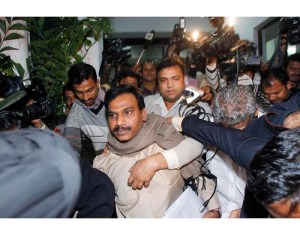
Telecom Minister Raja
If you are a retiree in India and spend your hours watching day&night TV news channels, chances are you have stopped watching feature films. In the last year alone, the skeletons that the channels have discovered in government and private cupboards and have instantly sensationalised on air are meat enough for a dozen thrillers in Anywood.
It is not that we haven’t had scams – public and private – in the past 60 years. You may be unaware of the Mundra affair that cost Finance Minister TT Krishnamachari his position in the cabinet in the early years after Independence, but you couldn’t have forgotten the Tehelka expose of bribing in a national party. Then there was the Bhopal gas tragedy soon after which Union Carbide’s Warren Anderson was carefully put on a plane under government escort and sent home. Union Minister Sukhram was caught surrounded by sacks of home-stashed cash. The Bofors scam followed. Rajiv Gandhi and the Congress pleaded innocence, but were voted out of power. After Telgi’s stamp scam, Kargil coffin scam, and Lalu Prasad’s fodder scam, we were getting immune to scam news.
That is because we had underestimated the political classes’ capacity to plunder. In the last year and a half we saw an unprecedented burst of scams – each larger than the previous one in scale, scope and brazen-ness. The “mother of all scams” the 2G Spectrum allocation fiasco, no doubt, was unearthed by a journalist using the old investigate-chase-talk-corroborate method, but it could not have reached such a wide audience in India and abroad without the “breaking-news” journalism of the TV and the Internet.
In what looked like a domino effect, we saw the CWG tamasha, the Adarsh housing tragedy and the Antrix-sponsored S-Spectrum deal that got stopped at the last moment. It was a one-a-week expose by the print and e-media – quick, graphic, and relentless. A few weeks ago, The Hindu published excerpts from the Wikileaks cables dealing with the cash-for-votes scam connected to the Nuclear Liability Bill. Within hours the news was splashed on at least a five major English TV news channels. Scenes of chaos in the parliament during the vote got glorious re-runs all day, participants in the sting operation were called for a panel discussion, anchors waved papers pertaining to them at our noses, and every channel called it “Breaking News”. Hasan Ali and his $9 bn wealth in foreign banks is the latest in the series.
Ironically, the Tamil Nadu CM’s free colour-TV sets scheme brought a lot of these stories into the viewers’ living room without their asking for it.
Twenty-four-hour news channels foraging for news-bites in every government file is only a part of the story. A lot of the credit for our saturation scam-news must be placed at the door of personal technology. Inboxes once filled with sob stories, you-have-won-a-prize con stories and chain mails with god stories – promising a place in hell if you didn’t pass them on to five people – have been upgraded. The sagas that spring from your mail-box are about politicians of all hues, bureaucrats of all shades of loyalty and corporates neck-deep in crony capitalism. The stories are real and can be verified. With each of us belonging to several interest groups, how long before they are forwarded to a million e-addresses? That each one of us is an armchair pol-analyst only helps in the punch-key dissemination of news.
And ah, the power of social net-working. Internet news is participative. Within an hour of the latest political shenanigan breaking out, you could write a blog, leave comments on a news website, write on a Facebook wall and join tweeple airing views on the subject. It is impossible not to know the “latest” one way or the other. It is your response time that is in question.
All these trends came to a head making a huge success of Anna Hazare’s fast for a Joint Committee to discuss the Jan Lokpal Bill. A little known senior came out of an even lesser known hamlet called Ralegaon Siddhi in Maharashtra, landed at Jantar Mantar, spread his gaddi and declared a fast unto death. He was flanked by a Magsaysay Award winner credited with the RTI Bill and an extremely popular ex-supercop. The timing was strategically perfect – between World Cup cricket and the IPL, when eyeball score was low. TV channels had a newsbite and they made a major event of it. The story ran 24×7 for the four days the fast lasted. Anna and his mission got written about, SMS-ed on, Facebooked and tweeted around endlessly. The usually apathetic middle class, hit by corruption, and the young population hit by idealism (both users of technology) saw a messiah in the elderly man who wore a Gandhi cap. They called friends and congregated in many towns to show solidarity to the cause.
Finding the pertinent rules and making copies of laws, court cases and judgements is done in a jiffy, and sent off in even less time. We are better informed, better prepared to take sides.
Another trend in the success of such campaigns is the slow shedding of inhibition of the tweeting class. People generally of a “withdrawing” temperament, now face the TV and other handicams readily, publicly, repeatedly. “Public Opinion” is now voiced by well-dressed, well-informed, articulate men and women. Movie and sports stars lend their faces and voices to the programs getting publicity for themselves and their current productions.
“Technology to fight crime” can no longer be taken in the narrow sense of cops fighting with computer-aided armoury. Technology today informs people like you and me of criminal acts, supplementing it with laws, arguments and plans of action. You need not jump into street-action to fight it. Forwarding it with a few clicks on your Blackberry makes you an indispensable participant, a finger-and-thumb activist!
Just got mail that sand is being mined at the Adyar river estuary in my city. Off to the police station to join other campaigners to register a complaint. Wish us luck!
Picture by spectrumscandal courtesy Creative Commons.
 When local student Lorry (Babbar) receives admission into a U.S. college but without financial aid, the Goan drug cartel sees an opportunity for a mule. After much persuasion Lorry consents, and lands at the international airport with his cocaine-laden bags. The next sequence introduces us to the “heroes” of the movie, and is worth the price of admission. Each character is battling demons, from newly- reformed ACP Vishnu Kamath (Bachchan) to the susegaad Joki (Daggubati), the networked but powerless singer.
 Water, No Ice