Yearly Archives: 2008

Goodbye 2008, it's been bittersweet knowing you

There are still a few days left, but since I will be off on vacation till the end of the year, I thought I’d take stock of what has been a tumultuous year to anyone who has been living in the US.

First there was the Presidential election. Had someone predicted even a couple of years ago that a man proudly bearing the middle name of Hussein would be even remotely electable, they would have been dismissed as kooky optimists . But a perfect storm – guilt over Iraq, disillusionment over the Republican brand of conservatism, dismay over Katrina, a collapsing economy and a candidate with a Machiavellian understanding of grassroots organization – made it possible to Americans to elect a scrawny African American with a funny name their President. The vote of 70 million people made it possible for 300 million to hold their heads up again in the international arena, though carrying a US passport is still fraught with danger in parts of the world.

The US economy groaned under the weight of war spending and leveraged risk and gave way as 3 quarters of negative growth announced a recession. Gas prices, touching $5 a gallon in the summer, dropped precipitously as demand crashed and domestic industry slowed to a crawl. While foreign policy mavens looked at the silver lining of declining Middle-East influence, environmentalists worried that the enthusiasm for green initiatives and gasoline alternatives could recede just as it did during the Reagan era.

US Auto companies clamored for a bailout of their own, reasoning that with $700 billion floating around, $15 billion would seem like spare change. But Congress proved surprisingly hostile to the idea, enraging workers already outraged by the protection of absurdly high executive compensation in defaulting financial institutions. It feels like only a honeymoon period for the President-elect is keeping a full-fledged class war from erupting.

Terrorism got the global visibility it craved as attacks on high-end hotels in Mumbai brought the reality of it all to the rich, aka “people who matter”. Unprecedented 24-hour coverage via CNN  created universal outrage and gave the President-elect of the US leverage in his hard-line stance on Pakistan – maybe we will finally see some pressure being brought on the beleagured civilian government in Pakistan. Meanwhile, there has been a sort of awakening among the politically-apathetic intelligentsia – if the carnage in Mumbai leads to even the beginnings of political reform in India, those deaths would mean something.

We enter 2009 battered and bruised. Some lessons are there for the learning – for a free market to function, tight regulatory oversight is necessary; greed is good, but not when you earn 300 times the salary of the average worker; spending is necessary, but not when you max out your credit cards and leverage your home; one vote, one voice and one dollar at a time can dramatically change the face a country presents to the world; terrorism cannot be fought like a  war, rather, it can be combated by cooperation between enemies, by painstaking police work, by working towards the social inequality that breeds resentment and disengagement.

Is this the lowest we can go? Is the only way up? I hope so.

Who says today's kids don't read?

Lately it’s been a lament among my friends that our kids don’t read. For pleasure, that is; there’s plenty of assigned reading from school to go around – forced reading, that pretty quickly takes the joy out of the exercise. Imagine reading “Lord of the flies” with a mandate to find a useful quote from each section read and apply it to your own life. It’s not surprising that my 12-year old rebels when he is offered a book.

There’s also the irresistible lure of the video game, the computer and the hand-held electronic device – with so much instant visual and auditory gratification, why on earth would a child spend time on something that takes much longer to scan and which doesn’t have images or sound to supplement the experience? I was very afraid that a whole generation was growing up that did not enjoy the simple pleasure of reading a book.

Till I read this interesting article in the New Yorker titled “I ? novels”. In Japan, a new genre of books has emerged – the cell-phone novel.

Mone was depressed. It was the winter of 2006, and she was twenty-one, a onetime beauty-school student and a college dropout…. she went to stay with her mother, in the country town where she had grown up. Back in her old bedroom, she nursed her malaise, and for weeks she barely left the house…One day, at the end of March, she pulled out all her old photo albums and diaries, and decided to write a novel about her life. She curled up on her side in bed and began typing on her mobile phone. Mone started posting her novel straight from her phone to a media-sharing site called Maho i-Land.

By the third day of posting, she started receiving reader comments and responses. She typed out thousands of words a day on that tiny screen and eventually, bolstered by positive comments, finished her novel in nineteen days. The book was picked up by a publisher and converted into a hardback version. Inspired by Mone, other writers started writing on their cell phones and at the end of 2007, four out of the five top selling hardcover titles in Japan were “cell-phone” novels.

I guess there will always be a demand for stories – it is just the medium that has changed. Just as we could not read Dickens without grimacing, kids today cannot cope with our way of reading. They will figure out their own medium and their own language and hopefully the love of reading will simply find a generationally appropriate outlet. Life lessons may be learnt from comic books and who knows, the classic of this century may be penned all in SMS!

Community Bulletin

Home of Hope is being featured on NBC’s Bay Area Proud segment on December 24th and December 25th at 11:19 p.m. This a proud moment for the organization, which devotes itself to specific, project related non-profit work in India.

– The India Community Center at Milpitas is reducing its general membership fees by 30-40%. Lots of other changes are being implemented to make the center more of a community watering hole. Other changes include –

  • The ‘ICC State Month Days’ are back! Due to incredibly popular demand by the community we are restarting these highly popular events with a celebration of Tamilian culture on 11th January 2009, Goan in February, and Karnataka in March.
  • Access and use of our brand new computer and internet center
  • 5 -10% discount on kids camps and classes
  • 10% discount at the ICC café
  • Free membership of the ICC Table Tennis Club
  • Discount on ICC services such as spa, room rentals etc.

Top 5 Bollywood movies of 2008

Picture by Meanest Indian

Picture by Meanest Indian

2008 was a year of exploration for Bollywood. Very few movies hewed to the cliched formula of rich boy/poor girl/disapproving parents that the industry has been mercilessly lampooned for over the years. The introduction of corporate entities in funding and the economics of the multiplex made it possible for young filmmakers to make smaller, more experimental movies and be assured of a reasonable amount of success. Stars like Shahrukh Khan and Aamir Khan sat on the bench this year, allowing younger talent to emerge.

It feels like the era of the superstar may be over, which is probably not a bad thing for the future of the Hindi movie industry. it also feels like the hegemony of big studios has been disrupted , with big showy films with known leads tanking at the box office. Bollywood went back to the drawing board this year, looking for good scripts and low-key, non-intrusive direction. Directors un-apologetically made urban movies, (which may explain the unexpected success of the lone rural movie – Welcome to Sajjanpur.)

Not all the experiments were successes. Many low-budget movies, made with the best of intentions, tanked at the box-office. There was Dasvidaniya, the Vinay Pathak starrer and The Last Lear, a self-indulgent movie that did not succeed despite the presence of Amitabh, who also starred in another low-key dud, Bhootnath. Still, the industry deserves an E for effort. If the trend is towards strong scripts filmed on lesser-known actors, I am all for it. It is about time we created our Pacinos, Hoffmans and De Niros.

Here are the top 5 movies of 2008 in ascending order –

5. Jodha Akbar – Ashutosh Gowarikar’s paean to the best loved Mughal emperor, Jodha Akbar stands out as a lavish historical that worked, mostly due to the gorgeous Hrithik Roshan, who transformed people’s idea of Akbar from a podgy, stodgy medieval ruler to a character straight from the cover of a romantic fantasy. The battle scenes were beautifully shot and the chemistry between Hrithik and Aishwarya as Jodha kept the long movie from getting tedious. Even though the existence of Jodha is historically suspect, audiences took their kids along to give them a history lesson come to life.

4. Jaane Tu…ya jaane na – Talented scriptwriter Abbas Tyrewalla made his directing debut with this movie, a sweet college+ romance that introduced us to another talented member of Aamir Khan’s family, the innocent looking Imran Khan. With a perfect musical score by Rahman and a wholesome script, the movie got great word-of-mouth and did very well at the box office. Imran later attempted to play against his chocolatey looks in Kidnap, but that movie sank without a trace.

3. Rock On – Bollywood’s first movie about a rock band which did not devolve into a Mithun Chakraborty parody, Rock On was a surprisingly intelligent movie made by Abhishek Kapoor, with director Farhan Akhtar( Dil Chahta Hai, Don) in front of the camera as the lead. The excellent script and subdued direction made me go back and check out the director’s previous movie, Aryan, which turned out to be tolerable and could have made waves if cast better. Shankar, Ehsaan and Loy’s authentic rock music gave the movie a lot of credibility, though I could have done without the actors singing their own songs. Remember how you always felt you could do a good job singing Hindi songs in a Karaoke bar? In this case, you really can do better than the actual singers!

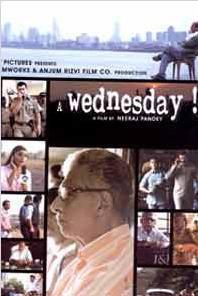
2. A Wednesday – A bona-fide thriller in the mould of The Negotiator, a Samuel Jackson/Kevin Spacey movie, A Wednesday was remarkable because it cast Anupam Kher and Naseeruddin Shah as the leads, a risky proposition at the box office. A gripping plot and terrific ensemble acting elevated this low-budget production to one of the best movies to emerge out of Bollywood this year . With a terrorism infused plot that is enormously relevant in the current environment, it would be great if A Wednesday made the shortlist for Oscar entries from India.

1. Slumdog Milionaire – Though this movie was directed by an Englishman, Slumdog Millionaire is pure Bollywood. Danny Boyle perfectly captures the masala-infused atmosphere of Mumbai, where slums and high-rises coexist uneasily, where a chaiwalla can dream of being a millionaire. A.R. Rahman once again demonstrates his brilliance with a score that is jangly and discordant at times, electric at others, making it an integral part of the fast-paced action adventure. The high-octane drama also captured the imagination of the venerable folks over at the Academy of Motion Picture Arts and Sciences in Hollywood and it is generating Oscar buzz.

UPDATE: I see from the comments that lots of viewers want to nominate Ghajini for the best movie of 2008. To my mind, a frame-by-frame remake of a Tamil movie does not qualify for contention in best movie..if anything, it should have been up for judging in 2005, when the Tamil movie was released. Also read my review of Ghajini where I attempt to explain my problems with the movie and why it did not make it to the top spot.

Digital books for the visually impaired – Bookshare

For readers with print disabilities, books are available through the National Library Service and Recordings for the Blind and Dyslexic. While providing an excellent source for audio books, these services fall short when it comes to manipulation of the books, such as search and skip functions. Bookshare, an online digital library, aims to fill that gap with books scanned and available in digital text formats, which allow for a broad range of functionality.
Started in 2000, Bookshare took the help of volunteers, some of who were visually impaired, to scan books into a digital format which can be read in different ways by people with special needs. The books can be read aloud, print-enlarged or a combination of both for the dyslexic. Though Bookshare operates like a library, books can also be downloaded to the computer or mp3 players for indefinite personal use.

The library provides people with print disabilities in the United States legal access to over 43,000 books and 150 periodicals that can be converted to Braille, large print or synthetic speech.

“We restrict downloads to 100 books a month,” says Viji Dilip, the international program manager for Bookshare. An annual subscription fee is needed for access to the library. Because of copyright issues, proof of disability is crucial. (The Chafee Amendment to the Copyright law allows reproduction and distribution of books specifically in formats for the print-disabled.) “We do not allow anyone who is not print-disabled to become members.” Because the audio is digitally created in the Daisy format( a digitally synthesized voice system), she thinks it is unlikely the service will be misused.
The library built up its collection initially with the help of volunteers who would scan the books to be proofread by other volunteers. Recently it received a grant from the Department of Education which makes it easier for the library to subcontract the work as paid employment. Here too, the organization has chosen to benefit the disabled. “We are very proud of the fact that we employ 15-20 physically disabled people in Chennai to scan and proofread the books that will be read by visually impaired people in the United States,” says Viji. Outsourcing at work!

Another outreach has been to make Bookshare available in India and other English speaking countries as well. “We have tied up with a few NGOs in India to help with confirming proof of disability and customer support,” adds Viji. The annual subscription fee is much lower in India, just $10 as compared to the first year fees of $75 in the US.

Bookshare is the largest online digital library in the world focusing on the visually impaired. Thanks to the grant from the Department of Education, they are also in the process of making textbooks and literature available to kids in grades K-12. “What we would like is to make this service as widely known as possible so more people can make use of this service.” According to teachers, the textbooks offered by Bookshare.org help students with print disabilities keep up with their classmates. High-quality digital books in accessible formats also encourage students to study independently and develop their tastes in recreational reading outside the classroom.

If you have a friend or a family member who could use this service, refer them to Bookshare with its library of over 43,000 books. You or they can also volunteer to be a part of the proof reading team.

Online gamers beware!

An interesting piece in boingboing about recruiters discriminating against World of Warcraft players –

….employers specifically instruct him not to send them World of Warcraft players. He said there is a belief that WoW players cannot give 100% because their focus is elsewhere, their sleeping patterns are often not great, etc. I mentioned that some people have written about MMOG leadership experience as a career positive or a way to learn project management skills, and he shook his head. He has been specifically asked to avoid WoW players.

Is it reasonable? Maybe not. Plenty of employees are addicted to sporting events and will follow them obsessively during the season. I remember in India how the serial Mahabharat brought the entire nation to a halt when it was being aired. I bet American ( and even global) productivity was seriously affected by the recent presidential elections. So why single out online gamers?

Well, from personal experience I can vouch for the fact that WoW and other MMOGs( Massively Multi-player Online Games) are unbelievable addictive. My 12-year old played WoW for a couple of years. We didn’t allow him to play online so it was restricted to our PC but even so it was a battle to pry him loose from the terminal. It is easy to see why. Online games like WoW are complex, so they appeal to intelligent kids. For a young person who chafes at the constraints imposed by parents, school-teachers and peers, this is an environment where he/she is in control – solely responsible for his or her successes and failures.

(My theory is that in earlier generations, teenagers were often put to work, apprenticing to adults in the professions they showed an interest in. Today’s emphasis on academics means that our children are babied for much longer, having no real responsibility till they are almost in their 20s. That energy and capability has to find an outlet somewhere and for most parents, a computer is the least dangerous of the alternatives.)

Still, I get why employers would be leery of hiring serious gaming enthusiasts. Since an online game is always going to be more attractive(instant gratification!) than the tedium of a conventional job, who would want a disinterested employee? The defense to that is absence of online gaming is not going to make people love their job any more, though it might just make it easier for them to tolerate it. I suspect as more and more bright young people get drawn into the world of gaming, employers will have to figure out ways of making jobs less monotonous and harness the creativity and problem solving skills their future employees so obviously have.

In the meantime, keep mum about what you do in your spare time and for heavens sake, get some sleep!

Neither/Nor

By Isheeta Sanghi

What is it that makes us who we are? Is it our parents? Is it where we grew up? Or is it our friends? I have struggled a lot with figuring out the answer to this question. For the longest time it was easy, I was simply an American. No two ways about it. Then somewhere along the way I realized that I wasn’t .

I realized that my non Indian friends did not tie a band around their brother’s hand once a year symbolizing that there will always be togetherness, a bond of love, a bond of protection. I realized that my non Indian friends’ mothers did not fast once a year to bless their husbands with long, prosperous lives. I know that these traditions are just that- traditions, and there’s no scientific proof that by tying a Rakhi or by participating in Karva Chauth that anything happens- but that’s precisely the point. We have these traditions that give us hope, they keep us going.
Growing up with two cultures puts you in limbo- because it’s not that you have a choice, you really are neither/nor. You can’t be totally American because the festivals will pull you back- the color, the music, the excitement and anticipation of festivals like Rakhi and Karva Chauth will rope you back to your roots. The haunting voice of Lata Mangeshkar singing ‘Aye Mere Vatan Ki Logo’ brings you to tears, because you think of what the country has gone through, what all the people of the country have gone through, and you are instantaneously overwhelmed with a sense of pride.
Simultaneously, you’re not all Indian – you articulate a certain way, have certain mannerisms, and of course have cleaning methods that overwhelm the house help; Manju looks at my Mom in complete and utter bewilderment when she tells her to wash and dry the bananas before putting them on the table.
You also remain incredibly involved in US Affairs including the victory of President-elect Barack Obama. I actually was airborne on my way to India when the captain announced that the new president of the United States of America was Barack Obama. I was overwhelmed with excitement.
So is it my passport that defines me, or is it my last name? I don’t really know, because I don’t feel completely one or the other is what defines me. On the inside I feel that both cultures are part of me, they’re interwoven into the person I am and I can’t choose just one to define me. Traditional values that pull me back to my Indian roots are at the same time balanced out by my American independence.

The American in me realizes that there are things that I have to do- for myself and for my life, and the Indian in me recognizes that though I should set out into this world and do all the things that I want to do, I should never forget that a lot of who I am is because of my family- and their due importance should always be appreciated and noted.

Isheeta Sanghi grew up in San Diego and recently relocated to India.

Bush ko joote pade

“I’m ambivalent about this,” said a friend. “After all, he is the President, yaar.” She was, of course, referring to the chappal heard around the world. Yesterday Iraqi journalist Muntader al-Zaidi threw his shoe at still-President Bush saying “This is a farewell kiss, you dog. This is from the widows, the orphans and those who were killed in Iraq.”

I’m sure some journalistic code of conduct has been violated – isn’t the pen supposed to be mightier than the shoe? – but I can’t help feeling a sneaking sense of sympathy for the poor man. Here you have a country reeling under a civil war and a prolonged, mismanaged occupation and you have to sit and listen to the chief architect of that destruction blithely state that “things are going well”. That’s enough to make anyone snap. Zaidi’s action is like that little kid in the fable saying, “The emperor has no clothes.”

That’s the irony of crime in the 21st century. Default on your taxes and get summoned to court. Bankrupt the economy and you’ll still preserve your obscene compensation packages. Get into an argument with your neighbor and get hauled off to the hoosegow. Give orders to kill tens of thousands of people and displace millions and you get to build a presidential library. And stock it with what? Copies of “The pet goat?”

Zaidi’s ultimate insult comes from the frustration of knowing that the people responsible for one of the biggest military and strategic blunders in modern times will not only get away scot-free but are busy rewriting history to bolster their legacies. Impeachment is off the table, as the Democrats have been at pains to emphasize and it appears that even the egregious crime of torture will be swept away under the carpet of a new administration. What more can a hapless patriot do than make a symbolic gesture of “@#$% you”?

Zaidi’s arrest has, predictably enough, sparked protests in Iraq. Let’s hope the Iraqi governement has the sense not to make a martyr out of him and lets him off with a slap on the wrist. Meanwhile, here is an alternate theory of the incident –

With Love, from Milpitas to Mumbai

By Purvi Gajjar

On December 5th, a run-of-the-mill Friday evening, at a run-of-the-mill Indian Restaurant, a very special event took place as 50 community members gathered for a Peace Vigil in memory of the recent attacks in Mumbai. The vigil was held at Swagat Restaurant in Milpitas and was hosted by the Art of Living Foundation, a non-profit, humanitarian organization, in association with its sister concern, the International Association of Human Values (IAHV).

In the light of India’s 26/11, the foundation has resolved to strengthen the spirit of Mumbai, not just within the city, but also across the globe. In one such effort, Art of Living’s Milpitas chapter dedicated the evening for peace and prayer in honor of the brave souls who lost their lives, as much as for the heroic survivors of the gruesome 60 hours of terror in the life of Mumbai.

“When nothing works, prayer works,” said Sri Sri Ravi Shankar, the founder of the Art of Living Foundation, upon hearing of the recent Mumbai terror attacks.  In a statement, Sri Sri called for solidarity among people and said, “In this situation, religious and political leaders need to show the country that we stand together against terrorism.”

At Swagat, the banquet room’s entrance was adorned with smiling volunteers, and beautifully decorated with tea-light candles in the shape of ‘PEACE’. Symbols of peace were made on either side, followed by a petition on the wall calling out to world leaders to end global terrorism. Each one, as they entered, lighted a candle to bring the word PEACE to life, and gradually it shone brighter and fuller, denoting the strength of unison.

Rekha Kodialbail, Art of Living instructor and volunteer in the Milpitas area, who organized the Vigil, said, “This evening stands as a reminder that we are not just a man or a woman, an Indian, American or a Chinese, rich or poor, engineer or doctor, mothers or fathers, daughters or sons, sisters or brothers; these are simply the roles we play. First, we are human beings and our innate quality is humanness.” Her voice resonated for several minutes, like an echo, and radiated the warmth and sense of belonging that connected with every person in that room.

Among others who joined to pledge their support was Easan Katir, representative of Hinduism Today, a publication of the Kauai Hindu Monastery. He shared the importance of spirituality in today’s world, and said that just like one has set rules for one’s life, the community should also have a set of rules to maintain discipline and peace among all. Manisha Verma, another member from the community said that ever since she heard about the massacre, she has been feeling sad and angry. The Peace Vigil lifted her spirits and she said that she was happy to be a part of the solution, rather than grumble about the problem.

The Peace Vigil was about collectively putting attention and intention to the human values of love, compassion, trust, enthusiasm, responsibility, and commitment. “The time has come for us to experience these qualities in our lives on a day-to-day basis and reach out to fellow members of the community,” Rekha said. Supporting her and the Art of Living was Milpitas’ Mayor Bob Livengood, who said that India and America are the greatest democracies of the world and they stand for freedom, wisdom, and peace. “We cannot let anyone take that away from us,” he added.

Many people shared stories of losing their friends and family that dreadful night in Mumbai. Most of them had tears rolling down their face, as they narrated the incidents. Aparna Atmaram, an engineer by profession, who attended the Vigil, said, “I cannot empathize, I cannot understand; is shedding a few tears all that I am capable of?” She was deeply thankful to the Art of Living Foundation and IAHV for hosting the vigil, as “it exemplifies that peace has a voice and it will be heard loud and clear,” she stated.

The foundation has already initiated free trauma relief workshops all over Mumbai. These sessions are being offered on a continuous basis, and are open to all. For more information, please visit www.traumacareformumbai.com.

Purvi Gajjar has been a freelance journalist and writer from Bombay for the last 5 years. Her work has been published in prestigious publications, including Femina and Marwar magazines.She has extensively written about the Art of Living Foundation, their service projects and numerous programs and workshops across the globe.

A version of this article was also published in “What’s Happening, the TriCity Newspaper.

Movie Review – Slumdog Millionaire

One is used to watching execrable movies made out of beloved books. Rarely is the converse true. Slumdog Millionaire, adapted from the mediocre Q & A, is a jolt to the senses.

I remember picking up Q & A a few years ago at an airport bookstore. Written by Vikas Swarup, it has an intriguing concept; a young man from the slums improbably answers all the questions on a game show modeled after “Who wants to be a millionaire”. He is hauled up by the police to investigate if he had any outside help. His explanations about his knowledge of each question form the chapters of the book.

Unfortunately, as it happens with many English books written in India, the style is pedestrian. Like Chetan Bhagat’s recent books, Q & A reads more like a script than a novel, which might have been its attraction.

Danny Boyle, who directs Slumdog Millionaire, ruthlessly pares the book of all its fluff. Instead of an improbably and ambiguously named Ram Mohammad Thomas, we now have Jamal Malik, Muslim resident of Dharavi. When the movie begins, we see Jamal being tortured at a police station. The disbelieving cops prod him (literally and metaphorically) to explain how he, a humble chaiwalla in a call center, could know the answers to questions in categories that have left many learned contestants in the dust.

As the film progresses, we are taken on an exhilarating tour of the grimy underbelly of Bombay, as Jamal explains how the journey of his life has made him peculiarly suited to that particular set of questions. From a childhood memory of religious riots to a stint in a scary orphanage to an encounter with the Mumbai mafia as an adult, Slumdog Millionaire is a pulsating look at a city whose predominant scent is not that of feces (though that plays a memorable role in the movie) but that of survival.

A few quibbles – Dev Patel as Jamal Malik has a cultured accent completely out of place for a man out of a slum; The language keeps switching between Hindi and English, not always appropriately – I think the movie would have been great in the Hinglish patois that is spoken in Mumbai. Still, the acting is great overall. The child actors are remarkable, often better than their adult counterparts. Irfan Khan as the callous inspector who slowly comes to believe Jamal’s bizarre explanation is good as usual. Anil Kapoor as the pompous, patronizing game show host is perfectly cast- he delivers the performance of a lifetime.

There are some unpleasant bits – anybody who is familiar with Trainspotting, Danny Boyle’s claim to fame, knows that the director does not shy away from gore. Despite some horrifying scenes( one prolonged one dealing with blinding children to make them beggars was so awful I squeezed my eyes shut and jammed my hands over my ears and was thankful that I had helped out ADAA this year) Slumdog is not a depressing movie. Aided by Rahman’s pounding and sometimes discordant background score, it is a throbbing, electrifying look at Mumbai that entertains every second. It is a pity that the best masala film out of Bollywood this year had to be directed by a man from Manchester, England.

Slumdog Millionaire
Directed by Danny Boyle
*ring Dev Patel, Frieda Pinto, Irfan Khan
My rating 4.5 out of 5 stars.