Author Archives: vpdot

Dr. Sanjay Gupta the new Surgeon General?

Per Huffington Post, a possibility that Dr. Sanjay Gupta may be being considered for the post of the Surgeon General in the Obama administration.

At first glance, Indian-American or not, this is not particularly exciting news. Dr.Gupta has a prominent and popular media presence on CNN, but he is hardly path-breaking in his pronouncements. I have heard him discuss subjects like autism, obesity and stress and his opinions are safely within the mainstream, nothing different from a visit to my regular doctor. I have never heard him voice a dissenting point of view to prevailing wisdom and given the astuteness of the President-elect’s recent cabinet picks, I have to confess I found this a little disappointing.(Dr. Gupta’s spat with activist filmmaker Michael Moore is well known. Check out this 17 minute clip from Larry King Live. It betrays a real lack of understanding on Dr. Gupta’s part on the state of health care in the US today.)

But I then looked up what exactly a Surgeon General of the United States is expected to do. At most he is the public face of the policies of the administration, not necessarily a policy creator or driver. He reports to the Assistant Secretary of Health , who in turn is the principal adviser to the Secretary for Health and Human Services( who would be Tom Daschle, once confirmed under the Obama administration.) Previous Surgeon Generals have left their mark by working on important but non-crucial subjects like passive smoking and childhood obesity, not on health care policy.

Should the appointment happen, we would have a highly visible Indian American who would be responsible for being the front man for health initiatives. My expectation is that there will a renewed emphasis on personal responsibility for health care, like eating right, getting off the couch and limiting video games for children. And it will be delivered in the most pleasant manner possible. Hmmm…..I suppose I could live with that.

Movie review – Ghajini

We’ve had more than one comment to my article on the top 5 Bollywood movies of last year that suggest Ghajini should have been given the top spot. Well, first of all, Ghajini was released after my vacation deadline and secondly, having seen the original in Tamil a few years ago, I was pretty sure there would be no error of omission on my part.

The Tamil/Telegu version of Ghajini, directed by A. Murugadoss, was released in 2005. Loosely inspired by the convoluted Christopher Nolan film Memento, it deals with a man suffering from anterograde amnesia who is searching for the killer of his wife. His only clue is a dying whisper from her -“Ghajini”. Since a blow to his head prevents him from remembering anything that happened more than 15 minutes ago, the protagonist tattoos the most important information on his body and uses pictures and notes to help him stay on track. Some visceral memories of her death keep the flame of revenge alive even though every day is literally a blank slate for him.

Unlike the complex and layered plot of Memento, Ghajini‘s plot is pretty straight forward. Girl meets boy, love happens after many cute misunderstandings, girl gets killed by gangster, boy takes revenge. This being an Indian movie, the romantic angle takes up a big chunk of time. What is different is the treatment, which involves chronological leaps back and forth and jump cuts to give some of the violent scenes an edgy, MTV feel.

Tamil movies can be inventive but loud and crude ( watch Anniyan if you doubt that statement) and I was hopeful that Aamir Khan’s steadying hand and fine directorial instincts would smooth out the rough edges in the Hindi version. Unfortunately, the Hindi Ghajini appears to be a frame-by-frame remake of the original. This leads to some temporal problems such as the use of a Polaroid camera which I believe is no longer in use. It seems strange that the owner of a cutting- edge cell phone company would not go digital. Ghajini is also technically a bit crude and leaves something to be desired stylistically, problems that are carried over intact from the Tamil version.

Aamir bulks up for the movie and while the boffo physique is impressive in the scenes where the revenge-crazed amnesiac takes on the bad guys, the man-boobs are a distraction in the romantic song sequences. Seriously man, cover up. He looks as uncomfortable as ever romancing the heroine Asin( carried over from the Tamil movie) but lets loose impressively as the memory-disabled Sanjay Singhania.

Asin, who looks sweet and chulbuli, plays her role exactly the same as in the Tamil movie. This means that her performance is slightly over the top as Hindi movies ( amazingly enough) are just a little more restrained than Tamil ones. As hubby astutely pointed out, Sridevi would have been great in that role.

Jiah Khan is the catalyst for the events of the plot to unfold and she is just plain bad. Rahman’s songs are pleasant and hummable.

I can see the fascination with Ghajini for viewers who have never seen Memento or the earlier version. It is an unusual plot, very different from the standard Bollywood fare and Aamir’s terrific instincts about what will work at the box office pay off once again. Still, there is no way the movie meets the film-making standards set by A Wednesday or Rock On, where the excellent scripts were embellished by subtle and sensitive direction and superb acting by the leads. I stand by my original recommendations.

As for those of you who thought Rab Ne Bana Di Jodi should have been a contender, what does that say about your taste ?

The Story of India

PBS and the BBC team up for a landmark series on India. The six-part series, in which historian Michael Wood explores the history and achievements of the world’s oldest civilization while journeying across the Indian subcontinent, begins with the migration of people out of Africa; visits ancient Indian cities.

Broadcast Schedules can be found here. Comcast viewers can see it on Channel 9(KQED)starting today, January 5th,2008 .

Record it and see it with your kids.

A tale of two cities: Singapore/Bangkok

Singapore: “Even the trees know to behave here,” said a friend only half-jokingly as she drove us to her apartment from the airport. Indeed, the pristine sidewalks and the immaculate topiary lining the road speak of a force of will that transformed a Malay fishing village into a model city-state that sets an example of modern urban planning.

We spent touristy time at the Jurong Bird Park, Sentosa Island and the Night Safari, but the highlight of our trip was a conversation we had with several expat Indian friends one evening. After 8 years of the Bush administration in the US, we really didn’t have much of a leg to stand on, but we still vigorously defended the institution of democracy, messy though it is in practice. Yes, Singapore is a democracy, with regular elections where the ruling party wins overwhelming support cycle after election cycle, but there’s more than meets the eye. Dissent is ruthlessly crushed by the simple expedient of bankrupting the odd brave soul who dares to stand in opposition. This is done (according to friends who whispered to us sotto voce) by analyzing every single pronouncement and speech made by the candidate during campaign season, finding the odd discrepancy or inaccuracy in their statements and then suing their pants off. The logic (and this applies to any criticism leveled against the State) is that since the State is doing such a great job for its citizenry (an unarguable point) any criticism must be false. The Supreme Court, of course, heartily concurs.

Our friends were completely on board with such actions, even though to us they smacked of dictatorship, benevolent though it may be. “Democracy is just oppression of the minority by the majority or of the majority by a minority,” said one. “The man on the street is just not capable of making an informed decision,” said another. To us, freshly emergent from an election where we saw the likes of Sarah Palin almost make it to commander-in-chief, that hit uncomfortably close to the bone.

It’s not hard to see their point of view, especially when things work so well in Singapore. The government of Lee Kuan Yew has made few missteps since it came to power over 4 decades ago. English has been adopted as one of the official languages and nearly every Singaporean is a polyglot as a result, well equipped to respond to international opportunities. When there was some clash between the various races that inhabited the island (Chinese, Malay, Tamil) public housing was structured with quotas for each race, so people wouldn’t ghettoize and would learn to get along with their neighbors. The education system, considered to be among the finest in the world, separates achievers from drones( my word) very early and fast tracks the former. Average students still have the potential to earn a decent living in jobs that are more suited to their capabilities (late bloomers – too bad!)

To an outsider, there is something awfully Big Brother about it all, but Singaporeans appear to revel in the safety and prosperity of their city. When I questioned whether such authoritarianism stifled creativity, it seems the government has realized that eventuality too, and encourages immigration as a way to get fresh blood and fresh ideas from the outside. Yes, free speech of the American sort is a casualty – friends would only hesitatingly mention the strictures and constraints they operated under, as if they were afraid it was being recorded somewhere. But if greatest good of the greatest number is the objective of any establishment, then one can unequivocally say that Singapore is a terrific example of governance.

Is it replicable? I doubt it. Experience has shown that dictatorships and authoritarian regimes are more likely to misuse their power than genuinely work for the public good. Witness Mugabe, Kim Jong Il..the list goes on.(Even China, which is often cited as an example of how a centralized, opposition-free government can make quick decisions, has shown a disturbing tendency towards disregard for human capital, corruption and environmental degredation). The rest of us will just have to muddle along in our flawed democracies. As Winston Churchill said, “… it has been said that democracy is the worst form of government except all those other forms that have been tried from time to time.”

Bangkok: Krung Thep or City of Angels is its Thai name, but Bangkok lives up much more to the seedy connotations of its farang moniker. Steamy in every way, Bangkok is the yin to Singapore’s yang. It is colorful and gaudy, with streets full of cars in shades of neon pink, green, yellow and orange. All the wats( temples) are generously plastered with gilt and the many Buddha statues in a multitude of poses all gleam with gold and scraps of gold flakes pressed on them by devotees. The sidewalks are crowded with hawkers selling everything from fried meat( of nameless animals) to pirated DVDs( really high quality!) to cheap clothes and brand knockoffs.

We reached Bangkok a few weeks after the protests that had shut down the airport. Apparently this is one of the worst years for Thai tourism, but we were still cheek to jowl with other tourists in every excursion we took to explore the city and its environs. Buddhism with its message of stoicism is a perfect fit for these laid back, indolence-loving people who shrug off any disruption to their lives with admirable insouciance. (Also, you would need to be a Buddhist to put up with the traffic on Sukhumvit, an arterial road that cuts through the entire city and can jam up even during off-peak hours.)

Bangkok is also a city of hustlers with approximately 50 percent of the people out to cheat you and the other 50 percent warning you against those very same cheats. “Don’t let the taxi driver charge you more than 150 bahts from the palace to the hotel,” said our kind concierge and sure enough, on the way back a taxi driver nonchalantly asked for 500. When we asked for directions from the Grand Palace to Wat Po( the temple of the giant reclining Buddha) a helpful guide warned us, “No matter what anyone tells you, the temple is open.” Predictably, on our walk we were stopped and assured that the temple was closed for an afternoon siesta and we could see a “lucky Buddha” instead!

John Burdett’s thriller series is an invaluable read for tourists planning a visit to this garden of earthly delights. I read Bangkok 8 and gained a much better understanding of all the middle-aged white men with their nubile Thai companions, all of whom appear perfectly content with their respective bargains. I learn that somtam is a spicy papaya salad that has 12 varieties of chilies ground into it and can consequently blow the roof of your mouth. And most importantly, I had an insight into these beautiful people who have never been colonized and are so fiercely patriotic that not understanding English is almost a badge of honor.

Yes, it is an inexplicable fact, but very few Thais have even a working knowledge of English. Considering how much of the economy is dependent on tourism, they somehow get by with hand gestures and lovely smiles. Forget about making special arrangements or accommodating special needs in Thailand( unless they are needs of a certain kind, in which case nothing is impossible) and live as they do, enjoying life one day at a time, making up for their sins with acts of generosity and compassion( the karma all balances out) and philosophically accepting (what in the Western world would be termed apathy) of whatever life has to offer them.

Bangkok is not the first destination that comes to mind if you are family with little children, but there’s plenty of fun for them for a couple of days. I would recommend the canal tour to see the houses built on stilts( surprisingly unsmelly), a visit to the Tiger temple outside the city( a full day tour) and a tour of the Grand Palace and some of the more important wats. Of course there are the many gorgeous beaches which can be reached within a few hours from the capital where the kids can have a glorious time in the warm water while you get every part of your body massaged for incredibly low prices in USD.

The city is a complete contrast to the staid and successful Singapore. The government is constantly in a state of instability (though the king and queen are universally beloved), the police are famed for their corruption and the traffic is permanently snarled. People in the rural areas live in abject poverty, which is why so many young people show up in the city to participate in the flesh trade. It is still a joyous and vibrant place that welcomes the visitor with open arms. It is exciting, amoral, colorful and unpredictable.

Which city would you prefer to live in?

Movie review – Rab Ne Bana Di Jodi

Hai Kajol! When the dusky actress appears in a cameo in one of the songs in Rab Ne Bana Di Jodi( RNBDJ) you feel the sharp ache of longing that she were the lead in Yash Raj Films’ latest romantic fairy tale.

Like other Yash Raj films, RNBDJ also seems to exist outside normal space/time and the reality of life in India( the sets intensify this feeling). Shahrukh Khan plays Surinder Sahni, a Walter Mitty-like meek everyman who works for Punjab Light and Power in Amritsar. When circumstances( that only happen in the movies) force him to get married to the pretty Taani( newcomer Anushka Sharma), who he has secretly fallen in love with, he creates a dashing alter ego to woo his reluctant wife. Complications ensue when Taani falls in love with the “other” guy.

There is more than a hint of self-mockery in Aditya Chopra’s latest. The dashing Shahrukh is named Raj, in an obvious nod to the many Raj Malhotras inhabiting Bollywood productions; “Dhoom machale” plays in the background during a scooter chase. But RNBDJ still falls prey to the cliches of mainstream masala movies. God( or Rab, in this case) is invoked at crucial times and many soppy dialogues extol the virtues of matches made in heaven. Despite the hackneyed treatment, the film is a hit and sole credit must go to its lead actor.

The casting for RNBDJ both makes and unmakes the film. Without SRK, the movie would have been a dud- just try and imagine Raghubir Yadav or Manoj Bajpai( both of whom are surely better fits as the self-effacing Suri) in the movie and its many flaws become glaring apparent. SRK’s charisma overshadows his attempts to play the self-effacing Suri, but he gives it the best he possibly can. Seeing him in coke-bottle glasses and a mustache makes you realize how unprepossessing his looks are and how much of his success is due to the force of his personality and those burning eyes!

Anushka Sharma, on the other hand, almost drags the movie down. Unemotive, unremarkable and just averagely pretty, she acts as a passive foil to the ebullient Khan. When her fiance( a love match) dies on her wedding day and she is forced to marry Surinder, there’s hardly a trace of shock or grief on her face – she just endures. When she realizes that she is falling for Raj, there is no sign of the internal conflict she must be going through as she debates whether to leave her husband for him. Another tragedy of casting is the talented Vinay Pathak as Bobby, the crudely dressed hairstylist who effects Suri’s transformation into Raj. He looks ill-suited, uncomfortable and too old for the role though he turns in a competent performance as usual.

Salim-Suleiman’s music is derivative and predictable, following the template of Yash Raj movies though I did learn some Bollywood dance moves with the peppy “Dance pe chance mar le” .

RNBDJ is harmless, mildly entertaining movie that is family friendly. I enjoyed it because a) I happen to be an SRK fan and b) I watched it in a theater with friends and we had a great time commenting on the inadvertantly funny moments. See it under those caveats.

Rab Ne Bana Di Jodi

*ring – Shahrukh Khan, Anushka Sharma

Directed by Aditya Chopra

My rating -3 out of 5 stars.

Happy New Year 2009 – a return to basics

2008, which has to be the most memorably bad year in recent memory, went out with with a sting in the tail. We were vacationing the last couple of weeks, offline and off-media most of the time, but caught snippets of the Israel/Hamas conflict in bits and pieces on airport cameras and hotel newspapers. (As I write this, Yahoo news reports yet another “blistering offensive” on Gaza and public opinion towards Israel’s actions, normally inclined to be favorable, is teetering towards denunciation of the Jewish state for the civilian Palestinian casualties inflicted by the sustained attack.)

All through the East on our two weeks in the region, people we met presented a gloomy  outlook for 2009. “Put your money in gold,” observed a friend in banking morosely, utterly pessimistic about the state of his own industry. The financial market in Asia has held up so far, mainly because of the healthier balance sheets of companies in the region, but the ripple effect from the US economic collapse is expected to extract its toll this year as the biggest global consumer puts its wallet away. The one bright spot seems to be the sensible, no-drama transition of President-elect Obama. A mortgage broker friend confided that home equity and refinance had picked up shortly after the elections as buyers and home-owners felt a little reassured by the competent political appointments and calming weekly addresses of the President-elect.

Still, by all accounts, 2009 is poised to be a tough year, as the implications of the US recession begin to sink in. As portfolios shrink and home values dwindle, it’s a time to take stock of what’s really important and I am making my New Year’s resolutions in that spirit –

1. Loving – Extra hugs for my family and more calls to parents back home. In these gloomy times, we have to hold on to the people who have always been and always will be there for us.

2. Living – “I am thankful I have my health, my kids are growing up fine and my brain is still functioning,” said a friend. Amen to that. When you get down to it, what more do you need?

3. Giving – If there’s one thing that the US presidential elections have taught me, it is that a small effort by a large number of people can make a big difference. If each of us spares a buck or two for those less fortunate, charities can continue doing their good work even in these tough economic times. When things get rough it is our instinct to hunker down and get tight-fisted, but I plan to put away a dollar a day to be given to a worthy organization. Don’t forget a charity you’ve been supporting – even if you can’t match the contributions of previous years, every little bit helps.

4. Reaching out – I am truly grateful to Water, No Ice readers for keeping me going. As an Indian American who loves both countries equally, it has been a privilege to write about life and people in the Bay Area and the US for the last couple of years. A big thanks to guest writers who have shared their opinions and advice on this forum – I hope to see more of you this year as we navigate these troubled times.

Happy 2009 to all ! Do share your New Year’s resolutions.

Goodbye 2008, it's been bittersweet knowing you

There are still a few days left, but since I will be off on vacation till the end of the year, I thought I’d take stock of what has been a tumultuous year to anyone who has been living in the US.

First there was the Presidential election. Had someone predicted even a couple of years ago that a man proudly bearing the middle name of Hussein would be even remotely electable, they would have been dismissed as kooky optimists . But a perfect storm – guilt over Iraq, disillusionment over the Republican brand of conservatism, dismay over Katrina, a collapsing economy and a candidate with a Machiavellian understanding of grassroots organization – made it possible to Americans to elect a scrawny African American with a funny name their President. The vote of 70 million people made it possible for 300 million to hold their heads up again in the international arena, though carrying a US passport is still fraught with danger in parts of the world.

The US economy groaned under the weight of war spending and leveraged risk and gave way as 3 quarters of negative growth announced a recession. Gas prices, touching $5 a gallon in the summer, dropped precipitously as demand crashed and domestic industry slowed to a crawl. While foreign policy mavens looked at the silver lining of declining Middle-East influence, environmentalists worried that the enthusiasm for green initiatives and gasoline alternatives could recede just as it did during the Reagan era.

US Auto companies clamored for a bailout of their own, reasoning that with $700 billion floating around, $15 billion would seem like spare change. But Congress proved surprisingly hostile to the idea, enraging workers already outraged by the protection of absurdly high executive compensation in defaulting financial institutions. It feels like only a honeymoon period for the President-elect is keeping a full-fledged class war from erupting.

Terrorism got the global visibility it craved as attacks on high-end hotels in Mumbai brought the reality of it all to the rich, aka “people who matter”. Unprecedented 24-hour coverage via CNN  created universal outrage and gave the President-elect of the US leverage in his hard-line stance on Pakistan – maybe we will finally see some pressure being brought on the beleagured civilian government in Pakistan. Meanwhile, there has been a sort of awakening among the politically-apathetic intelligentsia – if the carnage in Mumbai leads to even the beginnings of political reform in India, those deaths would mean something.

We enter 2009 battered and bruised. Some lessons are there for the learning – for a free market to function, tight regulatory oversight is necessary; greed is good, but not when you earn 300 times the salary of the average worker; spending is necessary, but not when you max out your credit cards and leverage your home; one vote, one voice and one dollar at a time can dramatically change the face a country presents to the world; terrorism cannot be fought like a  war, rather, it can be combated by cooperation between enemies, by painstaking police work, by working towards the social inequality that breeds resentment and disengagement.

Is this the lowest we can go? Is the only way up? I hope so.

Who says today's kids don't read?

Lately it’s been a lament among my friends that our kids don’t read. For pleasure, that is; there’s plenty of assigned reading from school to go around – forced reading, that pretty quickly takes the joy out of the exercise. Imagine reading “Lord of the flies” with a mandate to find a useful quote from each section read and apply it to your own life. It’s not surprising that my 12-year old rebels when he is offered a book.

There’s also the irresistible lure of the video game, the computer and the hand-held electronic device – with so much instant visual and auditory gratification, why on earth would a child spend time on something that takes much longer to scan and which doesn’t have images or sound to supplement the experience? I was very afraid that a whole generation was growing up that did not enjoy the simple pleasure of reading a book.

Till I read this interesting article in the New Yorker titled “I ? novels”. In Japan, a new genre of books has emerged – the cell-phone novel.

Mone was depressed. It was the winter of 2006, and she was twenty-one, a onetime beauty-school student and a college dropout…. she went to stay with her mother, in the country town where she had grown up. Back in her old bedroom, she nursed her malaise, and for weeks she barely left the house…One day, at the end of March, she pulled out all her old photo albums and diaries, and decided to write a novel about her life. She curled up on her side in bed and began typing on her mobile phone. Mone started posting her novel straight from her phone to a media-sharing site called Maho i-Land.

By the third day of posting, she started receiving reader comments and responses. She typed out thousands of words a day on that tiny screen and eventually, bolstered by positive comments, finished her novel in nineteen days. The book was picked up by a publisher and converted into a hardback version. Inspired by Mone, other writers started writing on their cell phones and at the end of 2007, four out of the five top selling hardcover titles in Japan were “cell-phone” novels.

I guess there will always be a demand for stories – it is just the medium that has changed. Just as we could not read Dickens without grimacing, kids today cannot cope with our way of reading. They will figure out their own medium and their own language and hopefully the love of reading will simply find a generationally appropriate outlet. Life lessons may be learnt from comic books and who knows, the classic of this century may be penned all in SMS!

Community Bulletin

Home of Hope is being featured on NBC’s Bay Area Proud segment on December 24th and December 25th at 11:19 p.m. This a proud moment for the organization, which devotes itself to specific, project related non-profit work in India.

– The India Community Center at Milpitas is reducing its general membership fees by 30-40%. Lots of other changes are being implemented to make the center more of a community watering hole. Other changes include –

  • The ‘ICC State Month Days’ are back! Due to incredibly popular demand by the community we are restarting these highly popular events with a celebration of Tamilian culture on 11th January 2009, Goan in February, and Karnataka in March.
  • Access and use of our brand new computer and internet center
  • 5 -10% discount on kids camps and classes
  • 10% discount at the ICC café
  • Free membership of the ICC Table Tennis Club
  • Discount on ICC services such as spa, room rentals etc.

Top 5 Bollywood movies of 2008

Picture by Meanest Indian

Picture by Meanest Indian

2008 was a year of exploration for Bollywood. Very few movies hewed to the cliched formula of rich boy/poor girl/disapproving parents that the industry has been mercilessly lampooned for over the years. The introduction of corporate entities in funding and the economics of the multiplex made it possible for young filmmakers to make smaller, more experimental movies and be assured of a reasonable amount of success. Stars like Shahrukh Khan and Aamir Khan sat on the bench this year, allowing younger talent to emerge.

It feels like the era of the superstar may be over, which is probably not a bad thing for the future of the Hindi movie industry. it also feels like the hegemony of big studios has been disrupted , with big showy films with known leads tanking at the box office. Bollywood went back to the drawing board this year, looking for good scripts and low-key, non-intrusive direction. Directors un-apologetically made urban movies, (which may explain the unexpected success of the lone rural movie – Welcome to Sajjanpur.)

Not all the experiments were successes. Many low-budget movies, made with the best of intentions, tanked at the box-office. There was Dasvidaniya, the Vinay Pathak starrer and The Last Lear, a self-indulgent movie that did not succeed despite the presence of Amitabh, who also starred in another low-key dud, Bhootnath. Still, the industry deserves an E for effort. If the trend is towards strong scripts filmed on lesser-known actors, I am all for it. It is about time we created our Pacinos, Hoffmans and De Niros.

Here are the top 5 movies of 2008 in ascending order –

5. Jodha Akbar – Ashutosh Gowarikar’s paean to the best loved Mughal emperor, Jodha Akbar stands out as a lavish historical that worked, mostly due to the gorgeous Hrithik Roshan, who transformed people’s idea of Akbar from a podgy, stodgy medieval ruler to a character straight from the cover of a romantic fantasy. The battle scenes were beautifully shot and the chemistry between Hrithik and Aishwarya as Jodha kept the long movie from getting tedious. Even though the existence of Jodha is historically suspect, audiences took their kids along to give them a history lesson come to life.

4. Jaane Tu…ya jaane na – Talented scriptwriter Abbas Tyrewalla made his directing debut with this movie, a sweet college+ romance that introduced us to another talented member of Aamir Khan’s family, the innocent looking Imran Khan. With a perfect musical score by Rahman and a wholesome script, the movie got great word-of-mouth and did very well at the box office. Imran later attempted to play against his chocolatey looks in Kidnap, but that movie sank without a trace.

3. Rock On – Bollywood’s first movie about a rock band which did not devolve into a Mithun Chakraborty parody, Rock On was a surprisingly intelligent movie made by Abhishek Kapoor, with director Farhan Akhtar( Dil Chahta Hai, Don) in front of the camera as the lead. The excellent script and subdued direction made me go back and check out the director’s previous movie, Aryan, which turned out to be tolerable and could have made waves if cast better. Shankar, Ehsaan and Loy’s authentic rock music gave the movie a lot of credibility, though I could have done without the actors singing their own songs. Remember how you always felt you could do a good job singing Hindi songs in a Karaoke bar? In this case, you really can do better than the actual singers!

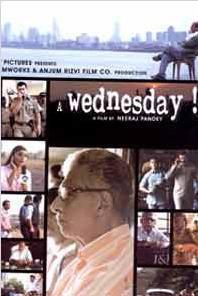
2. A Wednesday – A bona-fide thriller in the mould of The Negotiator, a Samuel Jackson/Kevin Spacey movie, A Wednesday was remarkable because it cast Anupam Kher and Naseeruddin Shah as the leads, a risky proposition at the box office. A gripping plot and terrific ensemble acting elevated this low-budget production to one of the best movies to emerge out of Bollywood this year . With a terrorism infused plot that is enormously relevant in the current environment, it would be great if A Wednesday made the shortlist for Oscar entries from India.

1. Slumdog Milionaire – Though this movie was directed by an Englishman, Slumdog Millionaire is pure Bollywood. Danny Boyle perfectly captures the masala-infused atmosphere of Mumbai, where slums and high-rises coexist uneasily, where a chaiwalla can dream of being a millionaire. A.R. Rahman once again demonstrates his brilliance with a score that is jangly and discordant at times, electric at others, making it an integral part of the fast-paced action adventure. The high-octane drama also captured the imagination of the venerable folks over at the Academy of Motion Picture Arts and Sciences in Hollywood and it is generating Oscar buzz.

UPDATE: I see from the comments that lots of viewers want to nominate Ghajini for the best movie of 2008. To my mind, a frame-by-frame remake of a Tamil movie does not qualify for contention in best movie..if anything, it should have been up for judging in 2005, when the Tamil movie was released. Also read my review of Ghajini where I attempt to explain my problems with the movie and why it did not make it to the top spot.