Author Archives: vpdot

What about the 177 people who died in Tamil Nadu?

The Press Trust of India reports that 177 people have died so far in the aftermath of cyclone Nisha’s torrential rains that hit Tamil Nadu. The news did not come as a complete surprise to me because I have family in Chennai who reported of flooded roads and downed power lines. If people living in one of the better areas of the capital city were without water and power for 5 days, it stands to reason that people in the outlying rural areas were worse off – sure enough, casualty reports are coming in now.

Why are we not outraged about this? For the last week, the media have been dominated by the events in Mumbai and understandably so, but the situation in Tamil Nadu is as much a failure of governance as the carnage in Mumbai.

We seem to have given up on expecting anything from our government, whether it be basic amenities, infrastructure or protection. If our governments cannot fulfill their core obligation to look after their constituents, why are we tolerating them like parasitic beings who feed off of our efforts and give nothing in return? It is a common saw that “India thrives inspite of its government.”

I see that there is a tremendous movement in Mumbai in the wake of the terrorist attacks to hold the government accountable for its ineptitude and force them to be proactive about these kind of situations in the future. There is talk of a federal intelligence agency and enhanced attention to the needs of our police and armed forces. My hope is that a similar movement demands that the government be as proactive when it comes to natural disasters, urban planning and basic infrastructure.

My expectation though? Unlike Mumbai. the deaths in Tamil Nadu were of poor farmers and villagers who have never had a voice – I don’t believe they ever will.

Mumbai

By Isheeta Sanghi

There isn’t one emotion that I am feeling that’s significantly more overbearing the others. I feel hurt, angered, sad, disappointed, and awestruck. What happened last week in the financial capital of India was horrific.

As the events unfolded all the news channels sparked debates, calling in significant Mumbaikers to come and speak on behalf of the city. Everyone was outraged. And why shouldn’t they be? These attacks took place in such significant places; such prominent symbols of Mumbai were attacked.

Of course the finger is always pointed to a particular sect and a particular country even before hard evidence is available. Then the finger pointed towards certain members of the government. The inexcusable remark made by Maharashtra’s RR Patil ‘Such things happen in big cities like Mumbai’ only made people’s anger and resentment grow deeper for the ever corrupting government.

Then you have Vilasrao Deshmukh bringing his Bollywood star son and notorious filmmaker Ram Gopal Varma to the scene of the siege- and people’s anger grew even more. His defense is that Ritesh is his son- it’s the famous line that all politicians use and why the Indian government is so corrupt. Civilians were not allowed in the hotel and Ritesh and RGV are civilians- they are not above the law of the land.

The home minister very conveniently retired upon the news of this attack- he enjoyed the benefits of being a Minister, of having high security and all. When it came down to doing his job which is ensuring the safety of a population of over 1.5 billion people, he failed, he failed miserably. This is not the first attack to happen in India. We’ve been targeted many times before, 1993 the Mumbai blasts that claimed the lives of so many. In 2008 itself we had blasts in Bangalore, Delhi, Ahmedabad and Malegaon. It’s no secret that these were all overlooked- probably because they happened in ‘less significant’ areas. The burning of the hotel by the bay, where the most prominent dignitaries, politicians, actors and socialites all convene hits closer to home for most.

How was it that these terrorists came in on little boats? How could the Indian coast guard not have seen these men carrying so much ammunition, grenades, RDX and guns on a small little boat? Needless to say it’s time for change. It’s time to clean up the political structure that has for too long now reeked of corruption- all the way from the top down. Prominent players must step down in order for a more useful system to be put in place. It is not only Mumbai that has been attacked- it is India. It is not only Mumbai that is bleeding- it is India that has those very same wounds.

It’s very easy to say change, change, change but in the end action must take place. I think it’s a very good sign that certain politicians have stepped down, I think it’s a very good sign that we’re still talking about this days after the attack, I think it’s (sadly) a very good sign that celebrities are taking part in discussions. This is the world we live in- where if Amitabh Bachchan has a gun, everyone will want a gun. If John Abraham says smoking is bad, people might just stop smoking. Sadly, this is what it takes for us to get the message. And if in the end this is what it takes to secure the nation’s boarders- air, land- and sea, then so be it.

Isheeta Sanghi moved back from San Diego to New Delhi recently.

Home Street Home

10-year old Nikita Shetty of San Jose wrote the following short poem on a visit to India. A small reminder of the forgotten people of Mumbai.

Home … to you and me, a home means a house, and that’s all it could
mean
A dusty old road, thats all it would be
Well we’re wrong
A dusty old road , is a home, to so many
A dusty old road, is all they ever seen,
And for some..
Its Home Street Home.

NIkita lives with her parents in San Jose, California. She attends fifth grade at Simonds Elementary School.Nikita enjoys writing, sketching, and playing soccer.
When Nikita grows up she wants to become a Sketch Artist and an Author.

Egypt – a clash of civilizations

Enakshi Choudhuri

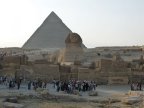
Sphinx and the Great Pyramid

“Ahlan wa sahlan! Welcome to Cairo,” intoned the flight steward as our Egypt Air flight touched down at Cairo International Airport. It was late evening and light smog shrouded the airport buildings.  We climbed down the unsteady staircase onto the hot tarmac and threaded our way to the waiting buses. Our representative from the travel agency, Mustafa, met us once we alighted at the terminal building. As we would find out during the course of the week, Mustafa was our main link to the agency; he practically worked 24 hours a day and would often catnap in the car or in various hotel lobbies to catch up on much needed sleep. His dedication to his job was commendable.

We moved through immigration and customs very smoothly, thanks to Mustafa, and were soon outside waiting for the agency van to come pick us up. Cairo, a sprawling metropolis of over 15 million people, is a city that never sleeps. The traffic and smog hit you right away and immediately transport you to India. For many Western travelers the chaotic traffic and beeping horns, patched up cars filled to capacity, buses that stop anywhere and everywhere and the run down buildings with large colorful billboards represent a strange, exotic and potentially alarming spectacle. But to travelers with roots in South Asia, Cairo is like home. Everything is familiar and yet strangely unfamiliar in an indescribable way.

Cairo Marriott

Cairo Marriott

We spent 7 incredible days in Egypt which, in retrospect, seemed too short. Egypt’s magnificent history and culture overwhelms the senses and yet leaves one begging for more. Since we were traveling with a child (our daughter is seven), we were notably concerned about how much she would be able to do on any given day. One of the best decisions we made, as first time visitors to Egypt, was to have one travel agency organize all our tours, hotel accommodations and travel arrangements within the country so we only had to contact one person in case of any problems.

The other decision we patted ourselves on the back for was our request for private tours. These are a little more expensive than group tours, but doing so helped us set up our own itinerary and allowed us the luxury of a having a private air-conditioned minivan with unlimited stops along our way to various tourist sites. A guided tour is very valuable as many of the guides have degrees in history and archeology, have actually been on digs and are a fount of knowledge you can depend upon.

Avenue of the Rams

Avenue of the Rams

Egypt recognizes that tourism is its biggest industry and most tourist sites and cities are very well prepared for tourists. There is a special Tourism and Antiquities police force who only deal with tourist concerns. Arabic is the main language, although most people have a working knowledge of English and French, a throwback to Egypt’s European colonial past.  ATM’s are plentiful and most good hotels will exchange dollars for Egyptian pounds (1 US dollar = approximately 5 Egyptian LE). What’s even more convenient is that at the end of your stay your hotel will exchange any left over pounds for dollars at a very reasonable rate. Credit cards, dollars and euros are acceptable at all tourist sites so one does not need to carry large quantities of local currency.

Most areas in and around Cairo seem to be quite safe at all times. We noticed women and children walking on the streets of Cairo at 2 a.m. in the morning and families socializing in the wee hours of the morning by the Nile.  As far as getting to bed at a reasonable hour, anarchy appeared to prevail for both kids and adults, and nobody appeared too worse for the wear in the morning.
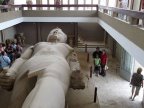
Statue of Ramses at Memphis

Statue of Ramses at Memphis

Egypt is an amalgamation of old traditions and conservative values and modern westernized beliefs. Women wearing the traditional hijab or in some cases, the full length burkha, mingle freely with others in western attire.  Many Egyptian guidebooks and internet travel sites caution women travelers to cover up fully and be modest in their attire. Although I went fully prepared I found that I need not have adhered to such strict guidelines. Our guide, a modern Muslim woman, did not cover her hair, wore short-sleeved shirts and calf length pants and definitely believed I was ‘over dressed’ for many of our tours. At one point, she asked me incredulously, “Didn’t you bring any shorts?”  I shook my head, wishing for the umpteenth time that I had packed a pair of bermudas or even capri pants instead of baggy trousers or long ankle length skirts.
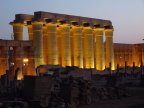
Luxor

Luxor

My wardrobe deficiencies notwithstanding, we did manage to see quite a bit of Cairo and its surrounding areas and make quick trips to Luxor and Alexandria. To give you a quick snapshot of our itinerary – we started with a trip to the Egyptian Museum in Cairo and a dinner cruise on the Nile on Day 1 and followed that by a tour of the pyramids and ruins of Saqqara, Dahshur, Memphis and Giza on Day 2. On Day 3, we toured historic Jewish, Coptic Christian and Islamic sites in Cairo and on Day 4 we winged our way to Luxor, about 600 km south of Cairo and explored the temples on the east bank (Karnak and Luxor). The next day (Day 5), we visited the magnificent necropolis at the Valley of the Kings, Queen Hatshepsut’s temple and the Colossi of Memnon. We flew back to Cairo that night and spent the next day, Day 6, in Alexandria exploring Greco-Roman catacombs, a Roman amphitheater and a fort built on the site of the original Lighthouse of Alexandria. On Day 7 we relaxed, did some shopping and closed out our trip by heading to Cairo airport late in the night for our flight back to the US.

Egyptian Museum

Egyptian Museum

The Egyptian museum is definitely worth visiting early on in your trip as it gives you an excellent overview of the history and culture that you will encounter on your tours to actual sites. The Tutankhamen exhibit halls are magnificent as well as the Amarna collection of Akhenaten. My daughter found the animal mummies fascinating, although she was quickly restless with the endless statuary and displays that we found so interesting. The Mummy room, for which you pay extra, contains about 21 mummies of ancient royals including that of Ramses II.

Step Pyramid at Zosur

Step Pyramid at Zosur

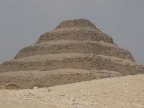
The Saqqara pyramids are among the first pyramids in Egypt. The Step pyramid of Zoser at Saqqara and the Bent pyramid at Dahshur are the forerunners of the later pyramids of Giza. There is no shortage of pyramids in this area, discovered or undiscovered; in fact, during our meanderings, we wandered onto an archeological dig which, after we returned to the US, was announced to be the site of the latest pyramid discovery in Saqqara. Our 15 seconds of proximity to fame and we didn’t even know it!

Red Pyramid of Sonfru

Red Pyramid of Sonfru

If you want to go inside a pyramid, it may be better to see the Red pyramid at Dahshur rather than the Giza pyramid where the challenge of having to deal with hordes of fellow tourists is compounded by the chagrin of having to buy a separate ticket for entrance. To get inside most pyramids you climb half way up one of the faces (about a 100 feet up) and then climb down a steep narrow shaft (about a 150 feet down), hunched over almost double at some points, leading to one or more burial chambers. The pyramids themselves are empty and most are quite musty as there are very few air shafts. If you are unused to much climbing or generally out of shape, it is probably best to avoid the cardiovascular and musculoskeletal distress associated with entering a pyramid.

Hanging Church

Hanging Church

Coptic Cairo is a pilgrimage for many tourists as it contains not only the legendary site where Moses was found in the rushes but also some of the places that Joseph, Mary and Jesus visited in Egypt while in exile. The Hanging Church, so called because it has no real foundation and built over one of the towers of the Babylon fortress, is worth visiting. We were mesmerized by the carved wooden ceilings at the Coptic Museum, ceilings that had been salvaged from various crumbling monasteries around the country. In Islamic Cairo the Alabaster Mosque built inside the 12th century Citadel of Saladin is a landmark destination. Even those unfamiliar with early Christian or Islamic history will appreciate the significance of these sites. A unique area that we passed on our way to Islamic Cairo was the City of the Dead, an erstwhile cemetery that, untransformed, has been home to the poorest citizens of Cairo for countless decades. The Egyptian government is now trying to relocate these families living among the graves and inside the mausoleums, many of whom have been living there for generations and refuse to move.

Queen Hatshepsut's Temple

Queen Hatshepsut

In ancient Egypt, the domain of the living was on the east side of the Nile and the domain of the dead on the west. The temples at Karnak and Luxor on the East Bank were storehouses of wealth during the time of Ramses II. The six soaring statues of Ramses II guarding the temple of Luxor are a sight to behold.  The Valley of the Kings on the West Bank houses the tombs of over 65 pharaohs in deep caves carved into soft limestone rock, many of which still haven’t been found. The tombs here date back to the New Kingdom (1570-1070 BC) when the pharaohs realized that the pyramids were beacons to grave robbers. The tourist sites around Luxor entail a fair amount of walking and the ground is quite uneven. Sturdy shoes and lots of drinking water are a good idea as the actual tombs are quite far away from the main ticket offices. No photography is allowed inside the caves which is a pity as the frescoes are amazing. This was one of the few places where our daughter decided to sit with the guide in the shade while we braved the scorching hot sun and armies of tourists to explore some the tombs. The heat and the crowds make it impossible to see more than four or five tombs in a morning but whatever you can see is highly worth it.

Mediterranean Sea

Mediterranean Sea

We found Alexandria to be a pleasant seaside town with a few Roman and Greek sites. The catacombs were worth visiting but paled in comparison to the other tombs that we had seen before we got to this city, Egypt’s second largest. The Mediterranean Sea was a breathtaking azure blue and the sail boats bobbing in the breeze were picturesque. For history buffs, Alexandria may be a bit of a letdown, given that much of the original wonders of the ancient world no longer remain and have been replaced with fairly recent structures as markers where these monuments once stood. In retrospect, we feel that we could have easily skipped this tour and chosen to go either to the temple of Abu Simbel or to one of the historic sites in the Sinai Peninsula.

Now no traveler’s tale is complete without a mention of the local cuisine and this is no exception. We enjoyed typical Egyptian dishes like kushari (a lentil, pasta and rice dish with red sauce), fuul (mashed refried beans), kebabs, hummus, grilled pigeon, chicken and fish tagines or stews, fetir (sweet or savory stuffed pancakes) and a delicious baladi bread similar to a tandoor roti. Being vegetarian would be very hard in Egypt if you had to subsist on traditional food but in most places American or European food is readily available.  Be careful of fresh cut vegetables and fruits unless you want to spend most of your time “resting”; although we were not affected, we found that it was a constant topic of discussion wherever there were tourists. Fresh fruit juices such as lime, mango, guava or strawberry were surprisingly good and very refreshing. Alcohol is served primarily in big touristy restaurants or hotels. Egypt Air, the national airline is totally ‘dry’ and no alcoholic beverages are sold even on trans-Atlantic journeys.

We found that many tourist sites do not allow photography inside the monuments or buildings and would recommend buying the postcards being sold by vendors so you can hold on to some memories. Tour guides will also stop for ‘refreshments’ at carpet factories, perfume factories, papyrus institutes and other handicraft industries. In a private tour it is much easier to avoid such places than on a large guided tour. Bargaining is a must if you plan to buy. We started with one third the quoted price and worked our way up to what we thought was an acceptable upper limit for us.

Bottled water is essential as is sunscreen for the sun can be brutal at midday. Weather- wise the best time to visit is probably October to March, when temperatures are manageable. Also, tipping or giving baksheesh is a way of life in Egypt. Keep plenty of one pound notes (notes are more acceptable than coins) as even when you go to a public restroom you need to tip the attendant before you can get a small strip of toilet paper to use. People will ask for tips to take photographs of you at most tourist sites.

If you are traveling with kids, the additional expenditure of staying in four or five star hotels is worth considering. Smoking is very common in all public places including hotel lobbies. A non-smoking room in a 5 star hotel is like paradise if you are not used to cigarette smoke.  When traveling with children take the usual precautions you would take when traveling to India or other countries in the subcontinent with respect to food, restrooms, over the counter medicines etc. Egyptians love children and will often take the time to interact with them or bring special treats.

As we boarded our flight back to the US, the words of P.B Shelley came to mind:

“I met a traveller from an antique land
Who said: “Two vast and trunkless legs of stone
Stand in the desert. Near them on the sand,
Half sunk, a shattered visage lies, whose frown
And wrinkled lip and sneer of cold command
Tell that its sculptor well those passions read
Which yet survive, stamped on these lifeless things…
…Of that colossal wreck, boundless and bare,
The lone and level sands stretch far away.”

For us, Egypt is now a collage of pillars and pyramids, monasteries, churches, mosques and temples, some shattered by the march of Time and History, as Shelley describes, yet others still standing, proud and desolate and endlessly fascinating. It is a canvas of the clash of civilizations, the ancient and modern saga of humankind in all its grandeur, its hubris, its compassion and its frailty, and the enduring bonds that tie us all together. We can’t wait to find our way back.

Mumbai terror attacks – what needs to be done

From a friend in the IPS who asks that his name be withheld, a list of suggestions in the wake of the terror attacks in Mumbai –

The general idea –
1. Terrorism, an organized case of mass murder, requires much higher grades of police/intelligence infrastructure.
2. Police to population ratio is less than 200 per lakh in India compared to more than 500 in most countries.
3. Intelligence operatives to population ratio in India is less than 5 per lakh in India compared to above 40 in many countries.
4. This, despite India being beset with 6 types of terror – Islamic, Kashmiri, Hindu, Sikh, north-east and Naxals – much more than only Islamic terror threat for the west, Russia, China etc.
5. We kept Maulana Masood Azhar in our jails as an under-trial for 6 yrs and released him to the Kandahar hijackers – he is the current big boss of the LeT( Lashkar-e-Toiba) in Pakistan. Why did the judiciary take so much time? At that time we had the strictest of laws – TADA, in currency.
6. In 2000, post-Kargill a Group of Ministers made a report to realign and resolve India’s security infrastructure – red tape has killed it
7. To get over the red tape, the PM in 2005 announced the Police Mission to reform the police system – red tape killed that too.
8. IB and R&AW have suffered 40% vacancies in top level supervisors (IPS officers) for more than a decade now and 50% vacancies in levels of SI and Inspector!
9. Post-9/11 the US and UK networked their communication and financial data so that security agencies could check on their computer screens on any terror suspect – India is nowhere near that nor are we even thinking of it.
10. When the terrorist started hijacking planes and entering through the Indo-Pak border, post facto we enhanced checking at airports and fenced the border. So he shifted to hotels and the sea route; post facto we shall make all our hotels and sea ports and coastlines secure. When he shifts to malls and microlight aircraft, post facto we shall make malls and the air space more secure and so on……….
11. Why was Karkare’s BP jacket inferior to the NSG BP jacket in this age and time when India pays Rs 5 trillion in taxes?

You can see how his frustration has leaked through. He hopes that if the word spreads, there may be a grassroots-driven effort ( with some corporate outrage) to fix at least points 1, 2 and 3. If you have a voice in the media, do your bit and let it be heard on behalf of the hard-working Indians in uniform who have been constrained for so long by the ineptness of their political masters.

Somber reflections at a shocking time – the Mumbai terrorist attacks

Thanks to the Blackberry, reality intrudes even when you’re in the middle of San Diego Zoo with your kids, watching the pandas be cute. It is a testimony to the desensitization on (ex)Mumbaikars that my first reaction was “Oh, another bomb blast?” I had been in the thick of things in 1993, racing home in a taxi after the stock exchange explosion, unaware that many other bombs had gone off in various parts of the city. It was a time before the 24-hour news cycle.

15 years later we returned to the hotel to find non-stop coverage from CNN and the laptop spewing out news from NDTV, but there were still more questions than answers. It has been almost 48 hours since the first attack and I suspect that Indians the world over have become forensic scientists for the last two days, poring over the bits of information and piecing together what really happened from blogs, eyewitness accounts and pure conjecture, while the networks stay mesmerized by the “movie-like” picture of commandos descending on Mumbai rooftops.

It is a failure of information at a vulnerable time for the country, and it is failure of information of another sort that brought India to its knees on Wednesday night. For all that criticism that has been levelled at the Indian police and armed forces for their delayed response, getting their top commanders killed and the long drawn out sieges at Mumbai landmarks, there is not much any defenders can do against an attack with AK-47s and grenades without incurring loss of life and limb.

The best defense against attacks like this is preventing them before they happen and it is surprising and dismaying that such a large body of terrorists were able to plan a meticulous plan with redundancies built into it without so much as a whisper of it being known to Indian intelligence. One report I heard out of the many disjointed ones suggested that security had actually been downgraded at the Taj a couple of weeks ago. Take it with a pinch of salt, but it certainly seems like nobody had a clue.

Unfortunately, this sad episode will only renew demands for reinstallation of POTA and crackdown on certain communities. An angry Indian even said, “George Bush may have been a rotten President but at least you didn’t have another terrorist attack since 9/11.” I put it down to shock, since I hope nobody would like to create an Abu Ghraib or Guantanamo in India, but it is a sentiment I suspect many Indians have thought or voiced in the last two days. It seems almost inevitable that the Congress will lose the upcoming elections and the forces of Hindu fundamentalism will be resurgent. Xenophobic goons like Raj Thackeray will be emboldened to single out foreigners( I cut a broad swathe with that term) without fear of punishment.I shudder to think of the long term implications of these events.

What is really needed, IMHO, is not a emotion-driven vendetta ( though with Narendra Modi prowling around Mumbai, I have my fears) but a cleansing of the police and counter-terrorism organisations. Hire the best people and give them a great deal of autonomy. Our space program has been successful because of those reasons and there is no reason why our intelligence and counterterrorism departments couldn’t be as well once the pernicious influence of politics is removed. I know from firsthand knowledge that there are some really talented people in the IPS – they work under tremendous constraints and would be much more effective if given the freedom to use thir talents without interference.

“This is not a time for appeasement,” you say. Certainly in the wake of these attacks there are questions about why the convicted criminals of previous attacks are still in jail despite their death sentence – there is a thirst for blood in the Indian populace that has not been allowed to die down because of lack of closure. But there is also a  danger of overreaction. Economic prosperity in India has not been well distributed and race relations have always been a tinderbox, only waiting for an excuse to set them off. I do  not mean in any way to minimize the horror and suffering of Mumbai, but the answer is not a witch hunt. Terrorism is less a war than a crime and sovereign nations like Pakistan that breed terrorism without sanctioning it have to be coopted to defeat this Hydra.

Meanwhile here are my questions and observations about the unfolding events –

– It is commendable that the Indian authorities have decided that they will not negotiate with terrorists; I wonder if the people held as hostages feel the same way. The numbers seems to be confusing – one report put the number of hostages at 200 yet only 30-35 had been rescued. The mind keeps skittering away from the conclusion that those numbers draw.

– Why were senior members of the Mumbai anti-terrorism units in the line of fire? One theory suggests that they were specifically targeted but it has not been supported by any real news. Yet.

– News networks have been pathetic at bringing the big picture. Tabloidism has pervaded every piece of visual journalism. For several minutes last night, I watched the drama unfold at Nariman House but not one time did any of the channels give us an update of what was happening elsewhere. There were also reports on a gun battle at the Ramada – completely ignored by the networks. Every channel keeps reporting 10 places targeted but none gives a list.  I expect eventually print media will put together a comprehensive report with time lines. The shallowness of broadcast media has been blindingly exposed.

– Expect a much more furious response to these attacks as opposed to previous bomb blasts. For one, it has exposed how vulnerable our cities are to armed conflicts. For another, this time the terrorists targeted rich people.

– I think the term “Deccan Mujahiddeen” was made up 5 minutes before the terrorists landed. This well planned attack cannot be the work of a fledgling organization – or this says something dreadful about the competence of Indian counter-terrorism.

– Expect life to get a whole lot more complicated and uncomfortable if you live in , work in or visit Mumbai. What needs to be done is to institute a system of identification for Indians to allow easy travel across the country. But this is such a daunting task and so prone to corruption and hacking that the political will will quickly evaporate. Instead, the knee-jerk response will be to install metal detectors everywhere. Airport security will increase exponentially. The stable door will be triple-bolted and locked.

My thoughts and prayers are with Mumbai at this dreadful time. It has risen like a phoenix from the ashes several times and I have no doubt it will do so again. I just hope the collateral damage is minimal.

Basab has his take on the attacks here.

36 hours in Bengaluru

By Geeta Padmanabhan

New Bangalore Airport

New Bangalore Airport

My office in Chennai said, “No one will meet you at the Bengaluru airport.” I protested. My conference venue was far away from the new airport and I was scheduled to land at 6:30 am.

“Not to worry,” said the boss. “Bengaluru cabbies are honest, highly professional. Their meters work. You just pay the amount.” I checked with the Conference Secretary. “If we send a cab, we pay up and down. Just hop into one at the airport, please!” She was going to sign the bill, so…

The new Bengaluru airport is impressively large, with a glass-house terminal, neat and spacious. I stepped out and sat down on a square stone (meant for sitting?). The air was cool and bracing. As far as the eye could see, there were neatly laid flower beds dotted with saplings. When they mature, the terminal will have a wooded look. Nice.

That pleasant feeling was soon replaced by confusion. Where was I supposed to get a cab? The boards outside had no information. There is a coffee shop, airlines booths, but no info on cabs. Does one walk up and down to find one? There were a couple of parked cabs, but they had no drivers. I then noticed a few men across the street in front. I crossed, one came up. “Taxi, madam?”  He pointed at some distance. “The car is there.” I carried my bag a half kilometre to the car park, stopped and asked, “Gadi kahan hai?” He said, “Bhool gaya.” I asked him what people who couldn’t walk this far did. “You would be standing at the spot where you saw me. I would bring the car.” Where I stood was a narrow pathway. What if there was a crowd?

I gave the cabbie the address. “I know Nagarbhavi,” he said. I sat back. At the exit point he said, “Please pay Rs. 100/- for parking.” I did.

For about 30 kms it was riding bliss – wooded areas, smooth roads, one-way traffic. Then the car got into the semi-urban area. Slowly, the road turned bad, the air got foul and we met heavy oncoming traffic. It was nearly 8 m. I tried to read the shop boards to know where I was. Nothing was in English. The cabbie asked, “Have you been here?” I said the place looked familiar. “The route to Nagarbhavi is always choked with lorry traffic.” We stopped, we moved, stopped and asked for directions. We reached the Mysore road, got into the University campus. Another two kilometers on a lonely road inside the campus, and we were in front of the NLS training centre. It was 9 am.

I asked for the bill. The cabbie fiddled a bit, and gave me the paper. It said, “Rs. 950/- That’s right.  “It’s 60 kms, madam.” A man from the Centre came down. Should I pay? “Yes,” he said. They always charge for both ways. He has to go back to the airport.”

I talked to several people at the meetings. An Asst. Commissioner from Delhi said, “I landed at midnight, flagged a passing taxi, bargained and got here for Rs. 600/-!” A rehab officer from Andhra Pradesh paid Rs. 713/-. Giving me this information, a Commissioner from AP complained, “How can we pay different charges? My meter showed Rs. 735/-!” I tried not to laugh.

I left the campus the next day at 2 pm to catch my flight back. It was a working day. But then this was a different car, a different driver. He left through another gate which faced the main road. He took city roads I had not seen on the way down.  He quickly hit the highway to the airport and whizzed through. I asked him to note the distance. I said I was writing about the journey.

I reached the airport in one and a half hours. The meter showed Rs. 700/- and the distance was 50 kms. I narrated this to the guard checking the ID at the arrival gate. He said, “If you had asked me I would have arranged a pre-paid taxi at reasonable rates.” When was this system installed?

I had a long wait. I had my overnight bag, my laptop and a bag stuffed with Conference material. I put them in a cart and looked for a telephone. I couldn’t find one. I scrutinized all the boards in the main baggage checking area. The two huge ones had no picture of a telephone. In fact, there was no indication of a telephone anywhere.

In the old airport the telephone booth is in the sitting area. In this vast modern sea of tiles, glass and high ceiling, the telephone is an obsolete device. I could have sworn there were fewer seats too.

I stopped an airport guy. He said, “I don’t know, madam. But please use my mobile. What is your number?” That is India, I guess. Ill-informed, but helpful. He offered to go with me looking for a telephone. We found a couple near the packing material vending stand. He didn’t know which one would take STD calls. He walked down to the far end, found one and called me. I wheeled the cart down and made the call. I thanked him.

I walked back all the way to the other side and had tea at the only café. It was half a regular paper cup of bad tea. I paid Rs. 65/- for it. That over, I wanted to browse at the shops. Only there were none. You take a seat and all you can see are rows and rows of airlines booths that open both on the outside and inside. The shopping area is on the first floor, up an escalator. With my three pieces of luggage I wasn’t going up. If I took the elevator (I didn’t know where that was) I would still need a cart. People I spoke to felt the same way.

This is my take on this swanky airport: it is meant for airlines that’ll soon choke the Indian sky. It is for state-of-the-art gadget users, fit Olympians. It is not for elderly and disabled passengers like me. In a melting economy it is people like me who have the wherewithal to travel. All the delegates – about 200 – flew down. They must fly. They are in wheelchairs, they are blind.  They are elderly. They have money, will travel, will buy. Why doesn’t the industry welcome us, fill the seats and run profits, instead of sacking employees?

This was one side of India. During the one and half days of deliberations at the famous Law School I met a very endearing face of India in the Conference room and outside at night when I walked around the campus meeting the students. That is masala for another story.

Picture by vermin-jr, Creative Commons use.

Movie review – Dostana

Heavily inspired by I Now Pronounce You Chuck & Larry, Dostana is a product of Karan Johar’s Dharma Productions, directed by debutant director Tarun Mansukhani. I suppose the best way to describe it is a gay-medy.

Handsome horny hunks Kunal and Sam(eer) find themselves pretending to be a gay couple so they can get through immigration quickly(?) and also become acceptable roommates to gorgeous Neha in swinging Miami. When Neha gets interested in another guy, the duo try to sabotage the relationship so each can woo her for himself.

Since Kunal( John Abraham) and Sam( Abhishek) play gay through most of their screen time, the movie opens with a strong bid to establish their hetero credentials, in case any of the audience gets convinced otherwise by their acting talents(!) There is an abundance of female flesh but the most lascivious camera work is devoted to John’s rippling muscles as he does a Daniel Craig doing a Halle Berry and emerges from the waves. I thought Dhoom 2 was pretty risque, but Dostana flings around skimpily clad bodies with gay( no pun intended) abandon. Even Priyanka’s haute couture looks like draped towels most of the time – mercifully she has the figure to carry off the tiny pieces of cloth that pass for dresses.

As for the plot and the treatment, one reviewer at rediff called the movie “injuriously entertaining”, lamenting the setback the movie may be doing to the gay rights movement in India. I would shorten that assessment by one more word – Dostana is infuriating and disrespectful and not entertaining at all, unless your idea of entertainment is to poke fun at people by using the worst stereotypes associated with them. It is like the “Madrasi” Mehmood in Padosan – it was funny when I first saw it but it left me with a feeling of discomfort at the end because it was so campy and outrageous. The movie is also very derivative, borrowing funny bits from successful Hollywood comedies. There is a body wax scene that is ripped (again, no pun intended) straight from The Forty-year Old Virgin.

Dostana tries to do the right thing but it ends up portraying the ambivalent feelings Indians have towards homosexuality. When Sam asks Neha if she’s ok with him being gay, she replies, “Oh sure, whatever, it’s your choice.” Uh, no, it isn’t. When Sam’s mother learns that he is gay, we have a song sequence that is positively cartoonish in its lament, with an exorcism thrown in for good measure. I suppose the point was to make these reactions look ridiculous and regressive but when the mother changes her mind and accepts her son’s partner, she makes him overturn a bowl of rice at the door and gives her “bahu” kangans. So what is it exactly? A movie about accepting gays for who they are or a comedy with buffoonish characters who overreact at every twist and turn?

The only redeeming factor could be that Dostana is an equal opportunity insulter, taking on Sindhis, women, and the nursing profession with rude gusto. Sushmita Bannerjee as the Sindhi landlady hams away under the burden of terrible lines and Kirron Kher plays the Punjabi mom character she can probably pull off in her sleep.

It takes a talented director to make a movie that deals with a sensitive subject funny without being offensive and Tarun Mansukhani, while indulging in the trademark Karan Johar gloss, does not have KJ’s masterful touch behind the camera. John and Abhishek act well, and Abhishek in particular shows his playful side. This is what gives the movie its two stars of watchability. I found the script dreadful, the song sequences over-the-top and the comedy jarring. I would be surprised if the movie has legs beyond its initial boost from the Karan Johar name and the star cast – this is one movie I think even permissive Indian parents will not take their kids along to. Avoid it and rent one of Karan Johar’s well-made melodramas instead.

Dostana

*ring John Abraham, Abhishek Bachchan, Priyanka Chopra

My rating – 2 stars out of 5.

California Cricket Academy celebrates its fifth anniversary

The California Cricket Academy may have had its share of drama and controversy over the years but there is no denying that it is the premier training academy for kids interested in cricket in the Bay Area. The disciplined and dedicated approach to the game has brought the organization a tremendous amount of success and I am passing on Kinjal Buch’s report on their fifth anniversary celebrations held recently.

Cupertino Mayor Dolly Sandoval with CCA volunteers

Cupertino Mayor Dolly Sandoval with CCA volunteers

The California Cricket Academy (CCA) for youth is celebrating its fifth year anniversary this year by hosting the first international U-15 championship between USA and Canada U-15 team during the Thanksgiving weekend.

Since its inception in 2003, the academy has grown from 23 players to over 150 players. In October 2008, academy completed its fifth annual KeyPoint Cup tournament ( sponsored by the KeyPoint Credit Union) and organized the award function at Quinland community center in Cupertino. Mayor Ms. Dolly Sandoval gave a proclamation acknowledging the Academy’s achievements and assured the city’s commitment to supporting cricket as an alternative sport.

During the ceremony, the academy recognized players with outstanding performances as well as several sponsors and volunteers; program coordinator Ms. Priya Pradhan, Mr. Zain Jeewanji of G1G insurance, Mr. Mahesh Nihalani of Cupertino, Mr. Prashant Mehta of Brookside Inn in Milpitas and Mr. Himasnhu Vajir of Days Inn, Sunnyvale.

“We are proud to support California cricket academy for youth and looking forward to a stronger relationship for years to come”, says Helen Grays of KeyPoint Credit union.

Details of the Thanksgiving weekend tournament details between Canada and US  can be found on the academy’s website www.calcricket.org.  A live webcast of the event is planned on 27th of November. We expect over 10,000 cricket fans to watch the event in different parts of the country and world. Games will be played at the W.A. Wilson adult education center ground in Santa Clara on Benton Street and Dilworth Elementary of Cupertino school district on November 27th, 28th and 29th.  The academy will provide hotel rooms, lunch, dinner for the visiting teams thanks to kind support from its sponsors.

“Five years ago, my wife Kinjal and I established the academy with the goal of taking cricket to schools in Bay area and start first youth league in the country. We studied how AYSO and other youth sports league operate. We are proud that we have achieved amazing results,” says academy founder and Chairman of the USA Cricket Association western region chairman Hemant Buch. Now after five years, the academy has won national championships for last 3 years. 8 academy players have represented USA in international competitions and the academy has conducted tours of India and England, has organized the first ever interschool championship for middle schools in Cupertino and trained over 250 players. The U-13 team from the academy is all set to go to India in December of 2008 and will play 9 games in 12 days in different part of the country.

Airport Rage

By P.R. Ganapathy

Bangalore Airport

Bangalore Airport

When I last counted, I estimated that you have to stand in line 7 different times before you board a plane in India. At the entrance to the airport, baggage scanning line, check-in line, security line,
check-your-boarding-pass line, to get on the bus, and finally, to get on the plane.

Over the last few trips, I’ve noticed a certain hyperaggressiveness among passengers in India.

One of the most egregious experiences I had was on the last trip to India. Very often, when a flight is called, a long line forms in front of the counters to check your boarding pass. And you’ll often notice someone sidle up to some meek-looking soul in the line, hoping to be
able to slide in, and avoid having to go to the back of the line. Very little makes me see red, but this is unfortunately one of them. And so, I make it a point to call them, and ask them to go to the back of the line, even if they’re not trying to slide in in front of me.

So on this particular instance, I was boarding a flight to Mangalore, and a tall young man stands beside and slightly ahead of me. The line is already 5 or 6 people deep behind me. So I look him in the eye and say “Excuse me, I think the end of the line’s back there”, pointing
behind me with my thumb.

Whoa, did that set off a nerve somewhere. He started shouting at me for “acting smart” and being a “villager who seemed to be traveling for the first time”, etc., ad nauseaum. So I told him I was surprised that he was being so aggressive about such a small issue. That really set him off – he took a few menacing steps towards me, and I almost reached up and took my glasses off so that they wouldn’t shatter when he hit me. Thankfully, it didn’t come to that. He then proceeded to
bully a smaller guy right behind me to let him stand in line, and shadowed me all the way through the bus ride to the aircraft, glaring at me at every concievable opportunity.

What’s driving this? Some of you may say that this is because airline travel in India has become progressively less expensive, and that’s brought a whole new stratum of travelers into airports. People who may be traveling for the first time, in some cases, or less familiar with airport procedure. That could be true, but I don’t think it adds up.

Have you had such experiences when you travel in India? Why do you think it’s on the rise? Can something be done about it? If so, what? I’d love to hear your thoughts.

Picture by Soumik Kar