Category Archives: Features

1 Cathartic Journey, 2 Circumstantial Victims, 4 Chakravarti Rajas: "Madhavi" Promises Drama Alright!

By Priya Das

“What is freedom? That I am finally freed of my intense love for you, or that I cannot hold my child even when my bosom yearns for him?” asks Madhavi, of her young and idealistic beau. Naatak’s 29th production, ‘Madhavi’ is as much a story of duty and debt as it is of the ‘business’ of love. It is a saga of two souls finding themselves in deal-striking circumstances that don’t always go their way. It is a riveting glimpse on what power struggles can be all about. Like the shocking few moments after you realize the water’s colder than you thought it would be before you jumped in, ‘Madhavi’ will stun first, and get you thinking and reacting furiously later.

That’s the thing with all aces: a script painted on the canvas of the Mahabharata, dialog by Bhisham Sahni (simplified by Naatak), deft directing, and acting. Each backs the other’s intrigue. The 45 minutes that I spent watching the rehearsal left me hanging on to every word that couldn’t be emoted fast enough by the characters.
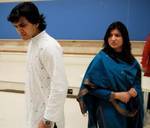
In this play, Bhisham Sahni uses a little known story from the Mahabharata to comment on the subjugation and manipulation of women that has gone on through the ages. Galaav, arrogant disciple of sage Vishwamitra, insists on giving him gurudakshina, even though the sage wants nothing. Vishwamitra’s demands cannot be met by the impoverished Galaav who goes to King Yayati, who has a prodigious reputation for generosity. Yayati gives him his daughter Madhavi who is blessed with two boons: she can renew her virginity and youth whenever she wants and each son she bears will be a chakravarti. So Galav gives her away to one horse-owning king after another for just one year in return for a reward. She in turn gives them each a son.
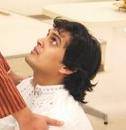
Gaalav, Madhavi’s beau is fittingly played by Ratnesh Rai, down to the long hair and idealistic fire in his eye. In Rai’s view, “Gaalav is mahatvakangshi( supremely ambitious). He is proud and selfish, and thinks nothing of scheming to get his needs met.” A professional theater person from Jabalpur, Rai would like to be famous one day. He admits that he identifies with Gaalav’s ambition to an extent. “Gaalav is like a flowchart, he knows what combination of boxes to push to get the right result. Who wouldn’t want to be an emperor, especially if it is offered on a platter at no cost to him?”

And that is what Madhavi offers him. She willingly agrees to the liaisons so Gaalav can pay his guru-dakshina. A case of duty gone awry, or selfless commitment to a cause?

I asked Sareeka Malhotra-Pancholi who plays Madhavi, whether she could identify with her character at all – “I definitely wouldn’t go the length as Madhavi did for love. Apart from that, there are shades in Madhavi that any woman would recognize.” Malhotra-Pancholi is a veteran Naatak’er. She’s played the lead, and smaller roles in Naatak’s productions, such as Phool Kanwar in the recent Sultana Daku. She has also produced plays and participates in American theatricals, in addition to being a researcher in her non-stage life.

As the audience, you will wonder whether Madhavi is an innocent, a martyr or simply a fool. At times, the play feels like the Hitchcockian Rebecca, the lead is felt rather than actually there. The other characters take over the story and her life. Gaalav, Yayati-her father, the various Rajas salivating for her beauty, even Marich, a non-royalty; have an opinion on what is right for her.

This kind of script makes it ideal for actors to show off their talent. Asheesh Divetia plays 2 roles, one of which is Raja Haryasch, a good man whose head is turned when he hears about Madhavi’s irresistible appeal- that she can bear him a Chakravarti son.  Divetia opines, “Haryasch is a deal-maker. He is a chauvinist, and alleviates any sense of guilt by a perception of duty, that of being a provider to his praja.” Divetia is a force on stage, as he plays King, his piercing glance challenges your perception of what is real and what is staged.

Speaking of what feels real, ladies, you may want to hang on to your stoles a little tighter- brilliantly played by Harish Sundaram-Agastya, Raja Divodas’ lecherous eyes will penetrate the darkness that envelopes the audience. “So are you proficient in Kama? Do you know what makes a man happy?” the raja lasciviously asks of Madhavi. The stage is where Sundaram-Agastya was born to be, he is a character actor par excellence, and plays two other roles in Madhavi, roles that need to be watched rather than written about! He also wears many hats, he directed ‘Final Solutions’ most recently for Naatak.

So who handles all these various shades to every character, who keeps the passion on the straight and narrow? As director, Abhishek Das has his work cut out for him. What makes it easier in some sense, is that Madhavi is his pet project. “I lived with ‘Madhavi’ for a year before deciding to do it. I wanted to bring alive the beauty of language, create the golden-era, 70s feel.”

Das started as a creative personality even in his student days at IIT Kharagpur. Interestingly, when he auditioned with Naatak after he got to the Bay Area he got turned down a few times for looking too young. He did drama classes and participated in Stanford theater productions. Next, he directed a quasi musical for Project Pulse, followed it up by making a movie, ‘8000 miles away’, which was screened in August 2008. Madhavi is his directorial debut with Naatak. The complex weave between the characters is what caught his imagination. And also what Madhavi’s motivations could be- they seem out of place in our times.

So, “Madhavi ka kya hoga?” Will Gaalav and Madhavi find their way to each other amidst the ambition and deal ridden path? Will Madhavi reclaim herself through her catharsis? Find out for yourself! The play promises masala and suspense, an evening well spent.

Pictures of rehearsal shot by Nikhil.

Madhavi
A play by Bhishma Sahni
Adapted by Naatak.

SHOW TIMES: 13th February, Friday 8 pm, 14th February, Saturday 6 pm, 15th February, Sunday 3 pm.

Where: Cubberley Theater, 4000 Middlefield Rd, Palo Alto, CA 94303. More info at www.naatak.com

Tickets: Online tickets can be purchased here.
Tales from New York City

P.R. Ganapathy lived in the San Francisco Bay Area from 1999-2009, when he was assigned to a posting in New York City for a year. This series is about his experiences moving from suburban California to urban Manhattan.

It pays to think ahead

I spent the week tying up other loose ends. We finally decided to rent most of the furniture for the apartment, from CORT furniture rental. We picked out a “1-bedroom package” which contains everything one needs, and will furnish (my son) Dhruv’s room with IKEA furniture later. The rest of our worldly possessions were scheduled to reach New York via Fedex.

Aisle-seat fracas

Thursday night rolled around, and we boarded our JetBlue red-eye flight. It was a “full-flight” (what are the airlines complaining about? Every flight seems to be “full”) and we didn’t all get seats together – my son Dhruv and I were in 5D and E, my wife Sandhya was in 4C . There was a single woman in 5C, so I asked her whether she’d be willing to swap seats with Sandhya. She stood up and was on the verge of agreeing, when she saw that the folks sitting next to Sandhya had a baby with them. I guess she had made up her mind not to move, and this gave her an excuse — so she said “Oh, I don’t want to sit next to a baby. I’m sorry.” At this point, I gave up. New York attitude? I hope not…!

First impressions

We arrived a bit early, to crystal clear weather in New York City. It was cold, but bright and sunny. Despite being a bit bleary-eyed after the red-eye, approaching the Midtown tunnel on the Long Island Expressway, we had a spectacular view of Manhattan in the rising morning sun. The Empire State Building towering over all the others, and the Citigroup Tower, reflecting the sun brightly off its steel and glass facade… Waterside Plaza (the place where we’re going to stay, on the East River) itself was also clearly visible, making the sight memorable in a personal way. Our home for the next one year! All the doubts and lethargy seemed to blow away with that one breathtaking view.

Supervising delivery

CORT furniture showed up a bit late, but still within their promised delivery window. They quickly installed everything, cleared out their stuff, and left.

The Cable guy showed up first the next morning, and he too quickly installed his equipment, had me test the Internet connection using my laptop (no TV) and then he left.

TV-purchase outing

I left the family in the apartment and headed out to get a TV. I had emailed several people using Craigslist, and there seemed to be a promising prospect in the East Village, a short distance away.

The address I was looking for turned out to be in the heart of the East Village. While driving by I noticed all sorts of interesting dining options in that area and marked them for the future. The building itself was a small and narrow “pre-war walk-up”, and the person I was buying the TV from lived in Apartment 17, which turned out to be on the top (fourth)  floor – so after trekking up four stories on a narrow stairway, I finally reached the small studio apartment. The TV was huge (27″) and it was a regular old tube TV, so you can imagine it was really heavy. They had apparently received a new flat-screen TV for Christmas, which is why they were selling this one. But their cable was plugged into the flat-screen, and so I couldn’t test to make sure the monster she was selling me actually worked. I guess I’m the trusting type, and so I believed her when she said “It works perfectly. If you have any problem at all, you can have your money back.”

The lady staying there was really kind to offer to help me carry it (I had been speaking to her boyfriend until then, but he decided to “step out” at that moment, so wasn’t there to help) and we both lugged it carefully down the narrow and well-worn stairs. After carrying it down, I figured that if it didn’t work, there was no way I was going to bring that TV back, lug it up 4 floors, to get my money back!

Thankfully, there were no mishaps, and 20 minutes later, I had it back at our apartment, where to Dhruv’s delight, the TV worked perfectly.

Craigslist to the rescue again! I received several calls that day, from other folks whom I had emailed, and I continue to be amazed at what a vibrant “market-place” that simple site has created.

Unpacking with our hearts in our mouths

I returned to find that the Fedex guys had taken about half the boxes upstairs and were continuing to work their way up. Sandhya saw stains on some boxes – it was obvious that something had broken inside and leaked out. We nervously watched as more boxes came and were stacked randomly all over our living room. And then the moment we’d both been dreading arrived — one of the Fedex guys casually started unloading one largish box, and it slipped from his hands, to fall to the floor with a sickening “crunch”. We quickly read the sign on the side of the box: “Glassware, Dishes” – we both knew what was in it – our wine glasses, China dinner plates, and other breakable stuff.

We began unpacking soon after they left, and for some reason, we both kept avoiding unpacking that one box – till late in the evening, when we had no other boxes to unpack. The wine glasses were closer to the top, and we were pleasantly surprised to find that all of them had made it unscathed. The dinner plates were at the bottom (the part that hit the floor) and as Sandhya unpacked, we kept counting – 3 safe, 6 safe, 9 safe, but unfortunately the last batch of 3 had broken.

41 boxes, two moving companies (Nor-Cal and Fedex) and the final tally – a few Corning bake-and-serve dishes, a couple of Sugar / Coffee canisters, three China plates, and few plastic containers. Not bad at all. Whew.

Home delivery heaven

On Friday night, Sandhya had ordered a whole lot of groceries using Fresh Direct and that arrived on Saturday afternoon. From apples to eggs, Oil and Toilet Paper, it all came in neat little boxes. That’s one big difference we’re going to have to get used to – of having things delivered. We’ve always picked up and lugged stuff home in California but without a car, with all the parking hassles, and given the easy availability and relatively low cost of home delivery, we are sure to use it a lot. Almost a bit like India, where your friendly neighborhood grocer would be only too happy to have a “boy” bring you your stuff at home.

Dinner in Little India

We walked into Little India for a nice dinner of Kathi Rolls at a small hole-in-the-wall called Rumali. It turned out really nice – the Kathi Rolls were close to the best we’ve had in Calcutta. Little India itself was really impressive – tons of Indian Restaurants – some quite posh, some a little more “value-for-money” and even one that advertised itself as “Kosher”!! And it’s just four blocks away!

Looking forward to next week

We have a tour of Dhruv’s school scheduled for Monday, and he’ll start on Tuesday. I also begin my new work-related assignment next week, with a few meetings already set up. The weather has been great – Bright, Sunny, albeit rather cold. As I sit here, looking out over FDR and at the brightly lit Chrysler Building, we’re both filled with excitement and anticipation at the coming weeks and months. The move has been quite smooth, and roadbumps, if any, have been very minor. Touch wood, and fingers crossed!!

More on the New York move can be found on P.R. Ganapathy’s blog  talesofnyc.blogspot.com

Picture of Manhattan by randubnick under Creative Commons license.

Picture of Little India by randubnick jodi*mckee under Creative Commons license.

Show Me The Curry!

As any cook worth her/his salt will tell you, the best way to learn a new dish is to watch someone else make it in front of you. That is the simple idea that is the basis of Show Me the Curry, a cooking blog that is rich with videos of recipes both simple and exotic, with a bent towards Indian cuisine.

Show Me the Curry is the brainchild of Hetal Jannu and Anuja Balasubramanian, neighbors in the suburban Dallas town of Frisco,TX. As kids grew up and out into school, the friends decided to embark on a venture that allowed them to use their time productively while not missing out on a single moment of “mommy time.” Both loved to cook and a cooking video blog seemed like a perfect fit. Keenly desirous of keeping what is (literally) a home-grown business professional, the friends decided to post two videos a week faithfully, with a few extra ones during festivals and special occasions.

“Even I’m embarrassed to watch our early videos,” says Anuja with a laugh. The two taught themselves the basics of video production and editing and kept improving on the bi-weekly videos, while the website was designed with a lot of help from Hetal’s techie husband.

In an industry with very few entry barriers, Show Me the Curry distinguishes itself by the professionalism of its videos and the foolproof nature of its recipes. One friend gushed, “I made Gobhi Manchurian for the first time with the help of their video and it turned out perfectly.” Their recipes also have tips for the inexperienced cook. “I learnt all my cooking through trial and error,” says Anuja , “so I figured out cooking secrets and  shortcuts the hard way. Why should anybody have to reinvent the wheel?” For instance, the website features a perfect way to make chapatti dough ahead of time and freeze. Anuja is a self-taught cook and Hetal, who grew in the US, brings a unique perspective to Indian cuisine.

Not all recipes are Indian, though the bulk of them are make to suit the Indian palate. “As cooks, we tend to get stuck on our comfort zone,” says Anuja. “Hopefully these videos will encourage people to experiment with at least cuisines outside their region in India, if not western ones.”

SMTC also has a DVD out that helps cooks to put together a party menu stress-free. In addition, an affiliate program with Amazon allows novice cooks to get some of the hardware associated with cooking.

Show Me the Curry has been around for less than two years but it is already putting the two friends on the path to financial freedom. It is a free site but its popularity makes it an attractive proposition for advertisers. “We have close to 5000 subscribers between YouTube, SMTC and the community,” says Hetal. SMTC gets about 10,000 video views per day on YouTube and 20,000 on the website. It is a great example of a successful blog that is neither technology-related nor politically inspired.

Credit for the success must also go to SMTC’s marketing efforts. The videos are available of YouTube and SMTC is up on Twitter, FaceBook, Orkut and other social networking sites as well on mobile phones. The friends also decided to start a SMTC community where viewers could put up their own recipes. “And if one of them is really good, we make a video of it ourselves, with credit to the original poster,” says Anuja.

The website has been featured in many of the local media affiliates and on USA Today. “We want to become a household name one day,” says Hetal.

Here is a video on how to make perfect Ras Malai, one that is the favorite of the founders:

H/T to Madhavi Cheruvu for the article idea.

Rang De – Share the colors of joy!

It was five years ago that Dhanalakshmi decided to set up a small general store in her area. Her thrifty ways soon fetched her enough profits to acquire a milk agency. Her life partner is also her business partner, and operates from the same location, helping her to deliver the milk.

Dhanalakshmi is now striving to do better still. She observes that there is a crying need for school stationery to be made available easily. She has also set her sights on buying a refrigerator to store milk and other perishable goods.

Dhanalakshmi is a perfect example of how an ordinary woman can turn into a smart businesswoman. The loan of Rs.10000/-   that she received for the development of her store has gone into buying a refrigerator, a coin pay phone, storage containers and a variety of stocks that includes milk. She has effectively multiplied her sources of income and her original plan of stocking school stationery? Well- “That will also be bought with the profits from the store.” says a determined Dhanalakshmi.

Dhanalakshmi’s story was made possible by Rang De, a non-profit organization that facilitates micro-credit in India. Rang De offers a platform for individuals to become Social Investors for as low as Rs.500 and connect with borrowers. Smita Ramakrishna, co-founder and CEO of Rang De writes about the decision behind the organization.

RangDe.Org began with a simple question – Why charity? If you and I want money for business, education or health, we walk up to the bank for credit. We do not ask for a donation. Have you ever wondered what happens if your corner tea stall vendor or your vegetable shop vendor needs a loan to expand his/her business?

When Ram and I decided to relocate to India and get into the development sector, one of the obvious ways would have been to set up an NGO in India and work for a cause. When we thought a little deeper about some of the issues, we began to realize that all these causes are manifestations of poverty and unless we address poverty we will not make much headway. There was a need to address poverty in a sustainable manner by involving individuals through a platform where barriers of distance or economics would not become a hindrance.

And thus RangDe.Org was born as a platform through which, any individual can connect with a person who lives in poverty and needs financial support. This connection between people of different economic backgrounds, we feel, is very important if we want to see a change in India.

Through RangDe.Org you can connect with a borrower of micro-credit by lending small sums of money small sums of money to an individual of a low income household. The money that you lend serves as the working capital for a micro-enterprise in a village or in urban slums. The typical needs that we are talking about are petty shops, cattle rearing, telephone booths.

Take Zythoombi, for instance – This widow has been eking out a living for the last 25 years, rolling beedis. She is a daily wage earner. Recent interactions with a local support group lit a spark within her. She intends to source the raw materials herself, make the beedis and sell it directly to the agents. ‘All I need is the capital” says the confident Zythoombi. Zythoombi has received Rs.5000 from Rang De. But she is not satisfied.

The amount has fetched adequate beedi leaves and tobacco to keep her busy, but leaves her two accomplices sitting idle. “We could easily handle a Rs.10000 loan and get better returns.” says Zythoombi. Her goal now, is to pay back her loan quickly and start again, with a bigger capital.

So far Rang De has raised loans for 205 borrowers from Maharashtra, Tamil Nadu and Uttar Pradesh, and plan to reach out to about 1000 borrowers in the next 6-8 months.

Rang De believes that little deeds from individuals can create a positive impact. Not everyone needs charity. Give people an access to financial opportunity and see what difference you can make with small sums of money. Log on www.rangde.org to learn more.

Inauguration Concert at the Lincoln Memorial

By Rajul Awasthi

I attended the Inauguration Concert at the Lincoln Memorial yesterday. To be honest, I went to see, for free, the great names of music that I so love and admire – live! There were Bruce Springsteen, John Mellencamp, Stevie Wonder, U2, Shakira, Usher, Beyonce (who I didn’t actually see), and many others, as also actors like Samuel Jackson and Queen Latifah. It was a great opportunity. And it was truly wonderful to hear them sing and perform.

But I have come away with an experience very unlike – and much more profound – than witnessing a rock band perform. This was truly the spirit of America that I got to feel and see. There was such a mass of people, at least a couple of hundred thousand, people who had traveled many miles to be there, to celebrate and participate in a celebration that was theirs. Each one there, I could see, owned the moment. This was their country, their celebration, their victory, and Barack Obama, their leader, their hero. It was amazing to see, whenever the Jumbotron showed a close up of Obama – singing with the music or just nodding his head to the beat – the crowd cheered lustily. And the cheers were much louder than those even for their greatly loved and admired stars that performed on the stage.

Democracy is alive and well in America. There were whites and blacks and Latinos and Asians, and all united in their ownership of the great moment. Truly, they feel the ownership because they have helped create it – they have voted. And they know each vote counted, and they know that that was their vote that got Obama to the White House.

There was much talk of history during the concert – the music was interspersed with short speeches from celebrities (Tiger Woods was one such speaker). There were the usual references to Abraham Lincoln and Martin Luther King, Jr. and John F. Kennedy and Roosevelt and, of course, George Washington. But, today when I heard the speakers quote Abraham Lincoln or Martin Luther King I felt a jab in my heart, I felt a swelling in my throat, I felt a shiver down my spine. The words acquired a meaning for me today. These men were great, their ideas were great, and this country and its people that recognized their greatness and gave them such a hallowed place in its history are, therefore, great.

Sure, the world is going through real tough times: there are conflicts in every hotspot from the Middle East to India-Pakistan, the world economy is going through the worst downturn in decades, terrorism is rampant, religion is being abused; as Shakespeare wrote in Julius Caesar – “Oh judgment, thou art fled to brutish beasts and men have lost their reason”. Yet, seeing the spirit of freedom and celebration and democracy and victory that I got to see today, I have hope. The world shall yet be a better place. America has shown how and where it can begin.

Rajul Awasthi is an IAS officer who is in the US on a one year deputation with the World Bank.

Pic courtesy the Presidential Inauguration Committee under Creative Commons License.

Frisbee on the beach

By Geeta Padmanabhan

“Frisbee should be in the Olympics,” said the guy, between swigs of Red Bull and shouts of “Come on DOD, come on LTF, SDS, CU, MU…” Which team was he rooting for? “All,” he said in ad copy lingo, “I’m for the disc game, are you?”

It’s amazing how Frisbee has caught on in Chennai. Seven teams (one of them Sri Lankan) with players from scattered geographies (Indians, Americans, Canadians, Spaniards, Brits, Germans and Australians) chased the disc under floodlights at the International Beach Ultimate Frisbee tournament at the Besant Nagar beach. “Beach Ultimate tournaments happen in only two other places – Bali and Thailand. Ours will be an annual event like those,” said Manu Karan, project head.

Informality must be Frisbee’s greatest charm. The Mumbai Storm Chasers(MSC) became a combo of disc buddies only in September 2008. “We play for 45 minutes each week-end,” said a Hrithik Roshan look-alike. “For losing weight, you can’t beat it.” This young team took a train at Dadar on 26/11 just after they heard of the CST attack. “We had to show we wouldn’t be defeated by violence,” said team captain Sunal.

The friendship here is unbelievable, said the MSC. “Balaji from a rival team gave us tips on using the wrist for better throws.” Pritham flew down from the US to join Learning to Fly(LTF), another team. “Word usually spreads though e-mail, facebook and blogs,” said Pattu Subramaniam, BMW specialist. “They would’ve played in the rain.”

It’s fine recreation, said Venky of Disc O’ Diwane, a group of tall (ave. 5’10) rock climbers in Bangalore who throw around the Leo disc after climbing sessions. They Googled for info, found LTF, formed the all-Bangalore cell. “At the Kodai tournament in July we were babes in the game, now we are in the semis.” The game is dynamic, but “we are adventure sport faddists.”

Pure enthusiasm drives the Sri Lankan Serendiscity, who practice at Colombo’s Victoria Park on Sunday afternoons. The group is truly diverse – young, old, men, women, novices and veterans. The playing crowd is transient, as expats are on short term contracts, making it a different game every week-end. Possible only in this disc game.

“We have been frissing around since November 2006,” said Chenoa, one of the three women in the eight-member squad. Said team-mate Jesse, “Colombo is choked up  with international NGOs.  It has an equal number of Sri Lankans and expats. Frisbee affords us a great op to know people.” Work in Sri Lanka is intense; they don’t have an easy time. “Back there everyone talks about Chennai,” said Chenoa. “We’re glad to be away from the sound of guns. Fun to be here.”

For Delhi’s Stray Dogs in Sweaters, the appeal is undoubtedly gender equality. “It’s a beautiful game, men and women can play together without making contact,” said Troy Duffield, a globe-trotting teacher, here with colleagues from the Embassy School. SDS is an all-expat team except for Mahesh. He picked it up easily, he said. “You could join at any level. Frisbee eliminates the gender imbalance in sports like basket/volleyball.”

“In spite of gender or athletic ability you can be competitive,” added Troy. “There is beauty in the co-ordination not found in games like soccer and football. There’s so much you can do with a Frisbee – hammer throw, scoober, fore and back hand, pizza pie. When a ball has a dream, it dreams of being a Frisbee.” It’s convenient as well. Troy packs this light equipment and flings it anywhere he finds an open space and a group of kids. “I’ve done it in Peru,” he said.

Frisbee is a generous, non-referee game. The penalty is to go back and start. Its greatest draw is the friendly culture it creates and supports. Chennai Ultimate is grooming a team at the Olcott Memorial School. You’ll find teams in Gandhi Ashram on the Sabarmati, and KFI, Adyar, said Srivatsan Murali.

Bryan Plymale, teacher and coach at Kodaikanal International School says: “The flying disc symbolises the spacecraft we travelled in to reach planet earth, represents Vishnu’s disc destroying ignorance and darkness. Ultimate is a sport that combines the best of sports like hand ball, water polo, futbol (soccer), basketball, lacrosse, kabaddi, rugy, Ultimate is a metaphor for community cooperation, excellence, integrity, honour, joy and play. In the end it’s just a silly game played by brainiacs with a plastic pie plate!”

Gana Bajana – a piano book with Hindi songs

If you’re a Silicon Valley parent, chances are your child or a child you know is learning the piano. Evenings are spent listening to broken versions of Row, row, row your boat or, if it’s been a few years, Fur Elise and the Star Wars Theme. Suddenly you’re wondering if the only musical connection you’re going to have with your children is Bollywood.

Not to worry; mother–daughter team of Nikita and Natasha Parikh have figured out a unique way for your child to straddle two musical cultures. They have collaborated on a book of Hindi songs for the piano called Gana Bajana, childhood rhymes that should easily sweep you right back into nostalgic memories of your childhood.

The idea came about because Natasha, now 16, started learning Indian classical music when she was around 6 years old and later developed an interest in Western classical( she sings in the choir at Mission San Jose High School in Fremont.) Having the opportunity to experience both strands of music, she looked for similarities and fusion possibilities. Nikita, her mom, had also enrolled in the Music for Minors program, which brings music to public schools. “I was trained on Indian classical music,” says Nikita, “and never learnt to read sheet music.” She had run several music classes for the India Community center in Milpitas but the skills were all imparted by memory. “I started researching for ways to bridge the gap between Indian and Western music,” she says.

In her music classes at ICC, Nikita used bags of puppets, different instruments and Natasha accompanied her sometimes on the piano. When parents came to her asking for the notation to the songs so they could help their kids with the lessons at home, Nikita and Natasha decided to work on a book of popular Indian children’s songs with notations for the piano. They worked for 2 years, finding artists who would understand their concept and a format that would be accessible to both parents and kids.

The result is ‘Gana Bajana’ a book of songs like Jala Ki Pari and Chanda Mama, popular tunes you might remember from your younger days.

Or not. One problem Gana Bajana’s earlier readers faced was that they were not very familiar with all the songs. And as any parent who has helped out his/her child with piano lessons knows, it helps to know the tune. Nikita and Natasha have figured that problem out now by providing mp3 versions of the song on their website so you and your child can familiarize yourself with the song.  I tried out Jala Ki Pari with my kids and they were quite intrigued and interested that you could play a Hindi tune on the piano. The songs are simple and easy to follow though they follow a G-Major key and the Hindustani notations are provided on the facing page using ‘Sa, re, ga, ma pa,’. The songs are all written in English.

Sudipa, whose daughter Madhulika learns music from Nikita, had this to say: “Madhulika loves the book and in her free time she picks the songs out on her keyboard. She is familiar with the songs already.  I also think the book is very good. The cover reminds me of my childhood books.”

Says Nikita, “Indian music is open to interpretation and cannot be learnt without a guru. Through our book and future projects, we want to try to bring the essence of Indian classical music in a simple and easy way to second and third generation Indian Americans.”  Check out the songs and buy the book here. It makes for a great introduction to Indian music for young piano enthusiasts.

A tale of two cities: Singapore/Bangkok

Singapore: “Even the trees know to behave here,” said a friend only half-jokingly as she drove us to her apartment from the airport. Indeed, the pristine sidewalks and the immaculate topiary lining the road speak of a force of will that transformed a Malay fishing village into a model city-state that sets an example of modern urban planning.

We spent touristy time at the Jurong Bird Park, Sentosa Island and the Night Safari, but the highlight of our trip was a conversation we had with several expat Indian friends one evening. After 8 years of the Bush administration in the US, we really didn’t have much of a leg to stand on, but we still vigorously defended the institution of democracy, messy though it is in practice. Yes, Singapore is a democracy, with regular elections where the ruling party wins overwhelming support cycle after election cycle, but there’s more than meets the eye. Dissent is ruthlessly crushed by the simple expedient of bankrupting the odd brave soul who dares to stand in opposition. This is done (according to friends who whispered to us sotto voce) by analyzing every single pronouncement and speech made by the candidate during campaign season, finding the odd discrepancy or inaccuracy in their statements and then suing their pants off. The logic (and this applies to any criticism leveled against the State) is that since the State is doing such a great job for its citizenry (an unarguable point) any criticism must be false. The Supreme Court, of course, heartily concurs.

Our friends were completely on board with such actions, even though to us they smacked of dictatorship, benevolent though it may be. “Democracy is just oppression of the minority by the majority or of the majority by a minority,” said one. “The man on the street is just not capable of making an informed decision,” said another. To us, freshly emergent from an election where we saw the likes of Sarah Palin almost make it to commander-in-chief, that hit uncomfortably close to the bone.

It’s not hard to see their point of view, especially when things work so well in Singapore. The government of Lee Kuan Yew has made few missteps since it came to power over 4 decades ago. English has been adopted as one of the official languages and nearly every Singaporean is a polyglot as a result, well equipped to respond to international opportunities. When there was some clash between the various races that inhabited the island (Chinese, Malay, Tamil) public housing was structured with quotas for each race, so people wouldn’t ghettoize and would learn to get along with their neighbors. The education system, considered to be among the finest in the world, separates achievers from drones( my word) very early and fast tracks the former. Average students still have the potential to earn a decent living in jobs that are more suited to their capabilities (late bloomers – too bad!)

To an outsider, there is something awfully Big Brother about it all, but Singaporeans appear to revel in the safety and prosperity of their city. When I questioned whether such authoritarianism stifled creativity, it seems the government has realized that eventuality too, and encourages immigration as a way to get fresh blood and fresh ideas from the outside. Yes, free speech of the American sort is a casualty – friends would only hesitatingly mention the strictures and constraints they operated under, as if they were afraid it was being recorded somewhere. But if greatest good of the greatest number is the objective of any establishment, then one can unequivocally say that Singapore is a terrific example of governance.

Is it replicable? I doubt it. Experience has shown that dictatorships and authoritarian regimes are more likely to misuse their power than genuinely work for the public good. Witness Mugabe, Kim Jong Il..the list goes on.(Even China, which is often cited as an example of how a centralized, opposition-free government can make quick decisions, has shown a disturbing tendency towards disregard for human capital, corruption and environmental degredation). The rest of us will just have to muddle along in our flawed democracies. As Winston Churchill said, “… it has been said that democracy is the worst form of government except all those other forms that have been tried from time to time.”

Bangkok: Krung Thep or City of Angels is its Thai name, but Bangkok lives up much more to the seedy connotations of its farang moniker. Steamy in every way, Bangkok is the yin to Singapore’s yang. It is colorful and gaudy, with streets full of cars in shades of neon pink, green, yellow and orange. All the wats( temples) are generously plastered with gilt and the many Buddha statues in a multitude of poses all gleam with gold and scraps of gold flakes pressed on them by devotees. The sidewalks are crowded with hawkers selling everything from fried meat( of nameless animals) to pirated DVDs( really high quality!) to cheap clothes and brand knockoffs.

We reached Bangkok a few weeks after the protests that had shut down the airport. Apparently this is one of the worst years for Thai tourism, but we were still cheek to jowl with other tourists in every excursion we took to explore the city and its environs. Buddhism with its message of stoicism is a perfect fit for these laid back, indolence-loving people who shrug off any disruption to their lives with admirable insouciance. (Also, you would need to be a Buddhist to put up with the traffic on Sukhumvit, an arterial road that cuts through the entire city and can jam up even during off-peak hours.)

Bangkok is also a city of hustlers with approximately 50 percent of the people out to cheat you and the other 50 percent warning you against those very same cheats. “Don’t let the taxi driver charge you more than 150 bahts from the palace to the hotel,” said our kind concierge and sure enough, on the way back a taxi driver nonchalantly asked for 500. When we asked for directions from the Grand Palace to Wat Po( the temple of the giant reclining Buddha) a helpful guide warned us, “No matter what anyone tells you, the temple is open.” Predictably, on our walk we were stopped and assured that the temple was closed for an afternoon siesta and we could see a “lucky Buddha” instead!

John Burdett’s thriller series is an invaluable read for tourists planning a visit to this garden of earthly delights. I read Bangkok 8 and gained a much better understanding of all the middle-aged white men with their nubile Thai companions, all of whom appear perfectly content with their respective bargains. I learn that somtam is a spicy papaya salad that has 12 varieties of chilies ground into it and can consequently blow the roof of your mouth. And most importantly, I had an insight into these beautiful people who have never been colonized and are so fiercely patriotic that not understanding English is almost a badge of honor.

Yes, it is an inexplicable fact, but very few Thais have even a working knowledge of English. Considering how much of the economy is dependent on tourism, they somehow get by with hand gestures and lovely smiles. Forget about making special arrangements or accommodating special needs in Thailand( unless they are needs of a certain kind, in which case nothing is impossible) and live as they do, enjoying life one day at a time, making up for their sins with acts of generosity and compassion( the karma all balances out) and philosophically accepting (what in the Western world would be termed apathy) of whatever life has to offer them.

Bangkok is not the first destination that comes to mind if you are family with little children, but there’s plenty of fun for them for a couple of days. I would recommend the canal tour to see the houses built on stilts( surprisingly unsmelly), a visit to the Tiger temple outside the city( a full day tour) and a tour of the Grand Palace and some of the more important wats. Of course there are the many gorgeous beaches which can be reached within a few hours from the capital where the kids can have a glorious time in the warm water while you get every part of your body massaged for incredibly low prices in USD.

The city is a complete contrast to the staid and successful Singapore. The government is constantly in a state of instability (though the king and queen are universally beloved), the police are famed for their corruption and the traffic is permanently snarled. People in the rural areas live in abject poverty, which is why so many young people show up in the city to participate in the flesh trade. It is still a joyous and vibrant place that welcomes the visitor with open arms. It is exciting, amoral, colorful and unpredictable.

Which city would you prefer to live in?

Digital books for the visually impaired – Bookshare

For readers with print disabilities, books are available through the National Library Service and Recordings for the Blind and Dyslexic. While providing an excellent source for audio books, these services fall short when it comes to manipulation of the books, such as search and skip functions. Bookshare, an online digital library, aims to fill that gap with books scanned and available in digital text formats, which allow for a broad range of functionality.
Started in 2000, Bookshare took the help of volunteers, some of who were visually impaired, to scan books into a digital format which can be read in different ways by people with special needs. The books can be read aloud, print-enlarged or a combination of both for the dyslexic. Though Bookshare operates like a library, books can also be downloaded to the computer or mp3 players for indefinite personal use.

The library provides people with print disabilities in the United States legal access to over 43,000 books and 150 periodicals that can be converted to Braille, large print or synthetic speech.

“We restrict downloads to 100 books a month,” says Viji Dilip, the international program manager for Bookshare. An annual subscription fee is needed for access to the library. Because of copyright issues, proof of disability is crucial. (The Chafee Amendment to the Copyright law allows reproduction and distribution of books specifically in formats for the print-disabled.) “We do not allow anyone who is not print-disabled to become members.” Because the audio is digitally created in the Daisy format( a digitally synthesized voice system), she thinks it is unlikely the service will be misused.
The library built up its collection initially with the help of volunteers who would scan the books to be proofread by other volunteers. Recently it received a grant from the Department of Education which makes it easier for the library to subcontract the work as paid employment. Here too, the organization has chosen to benefit the disabled. “We are very proud of the fact that we employ 15-20 physically disabled people in Chennai to scan and proofread the books that will be read by visually impaired people in the United States,” says Viji. Outsourcing at work!

Another outreach has been to make Bookshare available in India and other English speaking countries as well. “We have tied up with a few NGOs in India to help with confirming proof of disability and customer support,” adds Viji. The annual subscription fee is much lower in India, just $10 as compared to the first year fees of $75 in the US.

Bookshare is the largest online digital library in the world focusing on the visually impaired. Thanks to the grant from the Department of Education, they are also in the process of making textbooks and literature available to kids in grades K-12. “What we would like is to make this service as widely known as possible so more people can make use of this service.” According to teachers, the textbooks offered by Bookshare.org help students with print disabilities keep up with their classmates. High-quality digital books in accessible formats also encourage students to study independently and develop their tastes in recreational reading outside the classroom.

If you have a friend or a family member who could use this service, refer them to Bookshare with its library of over 43,000 books. You or they can also volunteer to be a part of the proof reading team.

Neither/Nor

By Isheeta Sanghi

What is it that makes us who we are? Is it our parents? Is it where we grew up? Or is it our friends? I have struggled a lot with figuring out the answer to this question. For the longest time it was easy, I was simply an American. No two ways about it. Then somewhere along the way I realized that I wasn’t .

I realized that my non Indian friends did not tie a band around their brother’s hand once a year symbolizing that there will always be togetherness, a bond of love, a bond of protection. I realized that my non Indian friends’ mothers did not fast once a year to bless their husbands with long, prosperous lives. I know that these traditions are just that- traditions, and there’s no scientific proof that by tying a Rakhi or by participating in Karva Chauth that anything happens- but that’s precisely the point. We have these traditions that give us hope, they keep us going.
Growing up with two cultures puts you in limbo- because it’s not that you have a choice, you really are neither/nor. You can’t be totally American because the festivals will pull you back- the color, the music, the excitement and anticipation of festivals like Rakhi and Karva Chauth will rope you back to your roots. The haunting voice of Lata Mangeshkar singing ‘Aye Mere Vatan Ki Logo’ brings you to tears, because you think of what the country has gone through, what all the people of the country have gone through, and you are instantaneously overwhelmed with a sense of pride.
Simultaneously, you’re not all Indian – you articulate a certain way, have certain mannerisms, and of course have cleaning methods that overwhelm the house help; Manju looks at my Mom in complete and utter bewilderment when she tells her to wash and dry the bananas before putting them on the table.
You also remain incredibly involved in US Affairs including the victory of President-elect Barack Obama. I actually was airborne on my way to India when the captain announced that the new president of the United States of America was Barack Obama. I was overwhelmed with excitement.
So is it my passport that defines me, or is it my last name? I don’t really know, because I don’t feel completely one or the other is what defines me. On the inside I feel that both cultures are part of me, they’re interwoven into the person I am and I can’t choose just one to define me. Traditional values that pull me back to my Indian roots are at the same time balanced out by my American independence.

The American in me realizes that there are things that I have to do- for myself and for my life, and the Indian in me recognizes that though I should set out into this world and do all the things that I want to do, I should never forget that a lot of who I am is because of my family- and their due importance should always be appreciated and noted.

Isheeta Sanghi grew up in San Diego and recently relocated to India.