Category Archives: Features

It's not easy being green

bartLast week the family visited the California Academy of Sciences. Charged with a pious sense of environmentalism, we decided to take public transit. We drove to the nearest train station at Union City and purchased tickets to the city. It being Sunday, trains were not frequent and there were no direct trains to our destination, so we hung around on the platform for a while before the BART train rolled in. We changed trains at Bayfair and eventually reached Glenn Park station. At Glenn Park, we waited a while for the bus to the Golden Gate Park and reached our destination 2 hours and 15 minutes from the time we started from home. A few hours later, we did the journey in reverse. Total travel time: 4 hours, 30 minutes. Total cost: $50( train and bus tickets).

Yesterday, we visited the city again, opting for the King Tut exhibit at the De Young Museum, which is located right across the Cal. Academy of Sciences. This time we took the car, printing out directions to the complex maze that is the Golden Gate Park. We left at almost exactly the same time as last week and arrived at our destination in 45 minutes, despite one wrong turn inside the park. It was early enough to find parking right  below the museum. In the afternoon we drove back, losing our way one more time, and reached home in about an hour and 15 minutes. Total travel time: 2 hours. Total cost: $ 20 ( parking and gas).

You might argue that there is a hidden environmental cost in the second option, in terms of pollution and use of scarce resources, and not factoring that in is unfairly tilting the balance in its favor. But to the average user, the obvious advantages are what count. The impact on the pocketbook and one’s time is real and immediate, while the environmental damage is in the abstract, so it is not surprising when consumers make unfriendly choices. Even an informed consumer will hesitate to work against his immediate self-interest; I know taking the train will not be the first choice for me when I plan trips to the city during non-peak travel times.

In the Bay Area, public transit is simply not convenient enough. Even if we were willing to pay more so that we may preserve the environment, the cost in time is simply unacceptable. Our lives are busier and more scheduled than ever, and no parent will consciously choose to drag impatient kids around a  minute longer than he/she has to. So there are obvious improvements to be made here.

The other is to assign a cost of the environmental impact to the driving option. Low gas prices drive our choices in the wrong direction. They deter innovation and investment in mass transit and do not reflect the destructive consequences of fossil fuel use. Had gas been at 6 dollars a gallon, the cost of driving to the city would have jumped to 37 dollars, a bit closer to the cost of mass transit. Additionally, some of that gas revenue could have been used to make improvements in public transit, perhaps bringing costs and travel time down.

The point is that it is unreasonable to expect people to make good choices about the environment when it is so hard to be green. Make the decisions more realistic and practical and the message of conservation is more likely to get embedded in the public consciousness.

Picture by Saikofish.

Akshay Patra is recognized in Washington

By Kathleen Cosgrove

akhsay-patraThe Congressional Hunger Center (CHC), a nonprofit anti-hunger training organization located in Washington, D.C., launched an exhibit last week featuring photographs of the Akshaya Patra Foundation, as well as other midday meal programs in Mali and Chile.  The exhibit is designed to help inform members of Congress, policy makers and other key opinion leaders on the success, magnitude and worth of school feeding programs around the world.
The photographs were taken along with in-depth interviews and site visits to Akshaya Patra kitchens and schools. The exhibit is part of a larger initiative to increase support for school feeding. According to the CHC, school feeding programs have been proven to not only alleviate childhood hunger, but also to promote educational opportunities for children, especially young girls. This photography exhibit is part of an effort to bring the voices of people who implement or are impacted by school feeding programs to those who are making program and policy decisions. The exhibit will travel to different venues and events throughout the country over the next year.
“It is an honor to be recognized by the Congressional Hunger Center for Akshaya Patra’s innovative solution to eradicating hunger while promoting access to education,” said Madhu Sridhar, Akshaya Patra USA’s President and CEO. “Akshaya Patra is a great example of what can be accomplished when the public sector, private sector and civic society collaborate– a cost effective, scalable solution with high quality service delivery. The program is a true global model of efficiency and ingenuity, built and designed to be easily replicated in other parts of the world.”

“The photo exhibit was extraordinarily powerful,” said Rep. Jim McGovern, (D-MA), co-chair of the Congressional Hunger Center.  “I’m proud that the House Hunger Caucus continues to educate members and staff about not only the reality of childhood hunger in the world, but also the incredible people and programs that are tackling the problem.”

Bharatanatyam Underground

By Lehkikaa

bharatnatyam-undergroundSavitha Sastry, guru of Sadhana Dance Academy in San Jose, CA and Navia Natarajan, an independent luminary to watch out for; both students of A. Lakshman of Channai, sparked the beginnings of the underground movement in Bharatanatyam on Saturday June 13, 2009 at the Leigh High School in San Jose. I say “underground” as an achievement we all should laud. A debut underground performance is characterized by superlative talent, an experimental approach, limited audience due to lack of publicity, and lack of sponsors. This recital had all these.

It was a pleasure to see these sinewy, evenly matched dancers on stage; they seemed to calibrate the stage into ethereal latitudes and longitudes. The first two pieces were traditional, the Mallari and Shankara Sri Giri; superbly executed, some or all of it had to be original choreography. Such flawless dancing induces one to fully immerse oneself into the pieces, the very many nuances were brought to life. Savitha and Navia broke through the pressure of symmetry sometimes, (I’m hoping intentionally,)- they would juxtapose instead of mirror-imaging their poses, making for an interesting effect. The other neat thing they tried was staggering their nritta, like syncopation in music.

The music for the third piece was cleverly edited, the pieces themselves were intelligently chosen. It was a study in contrast, not just because of the subject matter; but also because Savitha and Navia have contrasting styles. Savitha is a minimalist, she likes to say as little as possible while using the bharatanatyam vocabulary in a frugal manner. She’s like the mystery woman and one would like to see a less austere/ reserved side of her. Navia, on the other hand, is an expressionist and ventures to the far-reaches of the same vocabulary. Savitha’s virahotkhandita nayika showed very little, but it brought out the other woman “tease” very well. Navia’s khandita nayika felt deeply, showed effusively and brought out the man’s “debauchery” well.

The performance unraveled in the first piece after the break–“Sanjana’s love for the Sun God” had a lot of potential, the piece though, was muddled by either bad story-boarding, or mis-paced voiceover. A strong beginning showing the lovers and subsequent separation was sorely missed. The timeline for Sanjana’s yearning, and dance with the Sun God was confusing–the dance in tandem between Savitha and Navia was interesting, but again seemed out of line with the voice-over; we were supposed to be seeing Chaya, Sanjana’s living shadow at some point. The tandem dancing would’ve made for great real vs. shadow depiction, but was it the lovers, after the supposed separation? Chinmayi, Savitha’s student formed an unexplained middle-woman at the start, and 5 minutes into the item made a strange run from stage left to right… was she the wind? What was her role? The bar was raised so high in the first half, one could almost hear it crashing down here. What happened in this piece will remain a mystery. And the whole thing with the white cloth needed more context, why was it shown in the beginning? (The voice-over explained after a time-lag that it was Sanjana, wandering about as a mythical beast.)

Next came Chinmayi, who held her own when dancing in the line-up as the other two accomplished dancers. Though, it seemed like her piece was a hasty addition to the program, especially since there was no mention of her on the flyer. Her “Glimpses of Krishna” needed some reigning in at points; like with Putana’s pain/confusion when she realizes Krishna’s latched on to kill–it was overdone. It was not also in keeping with the spirit of the program. The MC had explained that there was no requirement for us to be knowledgeable rasikas for the second half, but then there was this traditional piece!

The recital redeemed itself in the last piece; which was experimental, novel in its story, and arresting in its portrayal. The two ordinary women played by Savitha and Navia, discovering that they are not alone in their wish for deliverance albeit for a temporary period of time was portrayed well. The non bharatanatyam vocabulary suited the story well, the two lithe dancers executed the free-flow rhythms well. Watching this made the memory of Sanjana’s story even more of a mystery- The choreographers paid so much attention to detail for this piece and not the other one?

What they should’ve done was create the entire second half around the Sanjana story but with this stylistically different approach. The red salwar khameezes, free-format dancing, white cloth indicative of the lost love–all of it would’ve fit very well in the experimental format. They could’ve dispensed with the filler traditional piece, and the second half would’ve been as enrapturing as the first one.

All in all though, one wishes Chinmayi well, and to see Savitha and Navia, together and as soloists again and again. However, a note to any further attempts at experimentation–do do a private peer level/ ordinary folk comprising friends/ family preview first! The simple feedback one receives at such informal previews goes a long way in tightening any performance. Also, a printed program lineup at the door is a must; even in place of the refreshments (it was a nice touch, but unnecessary). Without a program in hand, the audience doesn’t know what to expect, the MC’s script was no help at times. There should also be an announcement before the last piece that it is the culminating item–the event ended quite abruptly on Saturday.

In any case, one hopes that this is a more affirmative start to BharataNatyam Underground–more mature dancers and gurus taking on more experimentation.

Lehkikaa is a Bay Area dance and drama critic.

The Dysfunctions of Angel Investing in India

By Kashyap Deorah

angel-sketchIndia has a long history of entrepreneurship. Traditionally, entrepreneurship in India has fallen under one of the following categories: (a) family-owned businesses who pass along established businesses to the next generation of entrepreneurs to grow and diversify (b) forced entrepreneurs who do not get as many lucrative job opportunities as they get opportunities to make a decent personal income without significant investment (c) self-made businessmen with the nose for big opportunities and the acumen to bring together the right stakeholders and provide them with good share of profits in return for their power, resources, expertise or moneys. These three set of entrepreneurs still contribute to a bulk of the innovation and new business in Indian markets.

The late 90s saw a new breed of entrepreneurs, for whom entrepreneurship is a calculated career choice. These entrepreneurs neither have family businesses, nor dearth of good job opportunities, nor the natural tendency or access to deal with government, media, corporations or investors to mobilize a mature market opportunity. These entrepreneurs are usually young graduates from top colleges, returning Indians with a taste of entrepreneurship in the US, or senior employees in multi-national tech companies. This new breed of entrepreneurship, or organized entrepreneurship, subscribes to the ‘American dream’ formula and relies on access to external investment at an early stage of the company. In college campuses and NRI circles, the word entrepreneurship almost exclusively refers to organized entrepreneurship. Unfortunately, organized entrepreneurship in India has not seen enough success in India and probably mis-represents the term. Instead of extending the incumbent models of entrepreneurship in India with the meritocracy and scalability of entrepreneurship in the US, it operates as an elite form and even dismisses the traditional Indian models as rustic and arcane.

Dysfunction breeds dysfunction. In the late 2000’s, foreign investment came looking for investment opportunities in India at all levels – venture capital, private equity, hedge funds, mutual funds, real estate funds, investment banks. Between 2006 and 2007, dozens of US VCs set up India offices and set aside first funds of $50M to $150M for Indian investments. The fund management naturally saw opportunities through the goggles of the funds’ successes in the US and saw market trends from a US frame of reference. A rush to allocate the funds was tempered by the lack of understanding of Indian markets, culture differences in Indian start-ups and lack of access to local deal flow.

People who understood the differences and could translate from one culture to the other were at a premium. Full-time hires moving back from the US were good translators but suffered from the same handicap in understanding. Only a few funds hired management with operational experience in India, though rarely could a fund hire management with early-stage operational experience in India. This gap gave birth to a new culture of angel investing that mis-represents the phrase angel investing, and for identical reasons as organized entrepreneurship, let us call them “organized angels.”

Angel investment usually comes from ex-entrepreneurs or wealthy individuals with a penchant for new ideas, and is invested in entrepreneurs they can trust. The criteria for such an investment is informal, and each angel has a unique way of evaluating the idea, size of opportunity and people. Just like entrepreneurship, there is a long tradition of angel investing in India. Self-made businessmen, individual investors, family businessmen and wealthy corporators have been promoting new ideas and entrepreneurs informally and every successful self-made businessman tells about those in the network who helped him in times of need when no one else gave them a chance. Although angel investing is always active within networks, in India, it could even be seen as an extension of friends & family.

As long as real angels and real entrepreneurs work together to build great companies, there is much room for innovation and development of new ideas in India. As long as organized angels and organized entrepreneurs indulge each other without affecting the outside world, they would not affect the market in a significant positive or negative way. The trouble begins when the two paths cross. Entrepreneurs should be wary of organized angels when seeking investments for their businesses. First time entrepreneurs who are inexperienced with corporate structures, equity structures, and investment structures should especially be wary about raising money from organized angels posing as angels. This would take away their chance of building a company even before they got started. Here are a few ways for real entrepreneurs to identify organized angels.

Angel writes the cheque.
If the individual evaluating the deal is different from the individual writing the cheque, he is no angel. Angels may operate through trusts or other entities, but they do not not invest someone else’s money nor do they need the approval of another individual (besides maybe their wife!). Organized angels insist on council meetings, board approvals, business plan submissions, and defering to someone else for decision making or writing the cheque. If angels are organized as a fund that believes in a process driven evaluation and council driven decision making, the entrepreneur is probably paying the price of an institutional investment while raising money that would only get them past seed stage. Organized angels demand multiple board seats, usually seeking majority control of the board, making them more like institutional investors than angels.

Convertible debt is not Preference equity.
If the investor offers you a convertible note allowing himself sole discretion to convert to equity or withdraw money with interest when an institutional investor participates in the future, it is not an investment, it’s a loan. Convertible notes show as liability in the balance sheet and are not equity. The entrepreneur and future investors must view it as debt since neither has control over their conversion to equity. Preference shares, on the other hand, give investors rights protecting their interests in case of below-par performance, while giving investors all rights and ownership of equity. Preference shares do not force a dividend or return of loan when the company raises more money or generates cash, although allowing for those provisions if all parties find it necessary. Don’t let organized angels tell you that Indian laws do not have the equivalent of US preferred stock or that preference shares in India involve more paperwork than convertible notes.

Planned flip to a VC is not in Company’s interest.
An investor who wants to sell off all or part of his shares in the next VC round to cover his initial investment (with committed IRR) is not betting on the long-term success of the company, only on its ability to raise a VC round in the near future. While a long-term investor bets on the company’s eventual success, an organized angel is focused on the immediate gains. The organized angel would set up the equity structure, board structure and controls that protect this short-term agenda, even if it is in conflict with the company’s long-term agenda. After flipping to a VC, organized angels usually leave the company reeling without enough insider control and handicap future strategic alternatives. Organized angels also maintain sufficient control over the terms of the VC round, the choice of VC and when/whether it is the right time to raise money. In some ways, organized angels are VC brokers who get them good deals in return for a small commission that keeps them motivated.

Tranches are not for start-ups.
Start-up stage is probably the fastest growing stage for the company’s value. Every milestone that the company hits in the first two years reduces investment risk and increases valuations. Just as the organized angel wants to retain the right to not invest a committed amount unless a milestone is hit, the entrepreneur should retain the right to not accept a committed amount if a milestone is hit. If this is not the case, an entrepreneur is probably doing a dis-service to the company by issuing shares on a 6-24 month old valuation after hitting a big milestone. Besides, setting milestones beyond 3-6 months unnecessarily ties the company to a direction which may not be right. At start-up stage, there is tremendous value in agility. One should expect major milestones to change every 3-6 months and structure the business to allow for that change. Tranches help organized angels manage exposure on their loan and manage cash-flow on behalf of their fund. However, this is unnecessary baggage for a seed-funded start up.

Kashyap Deorah is the founder and CEO of Chaupaati Bazaar, Mumbai’s phone classifieds. If you are looking for good deals on computers, electronics, mobiles, automobiles and rentals, call 922-222-1947 and talk to a friendly call center representative. These deals are advertised by thousands of households and local entrepreneurs. You can advertise on Chaupaati too. Just call 922-222-1947.

Kashyap also maintains a travel blog where he logs his travels and tribulations.

Shop for Father's Day and help a child

onecause_logoThe Akshaya Patra Foundation, the world’s largest NGO-run midday meal program, recently partnered with OneCause, an online community aimed at socially conscious shoppers.

This is how it works: OneCause ties up with various popular merchants on one hand and with non profits on the other. When you sign up at OneCause, you can specify the charity you wish to support. After that, a portion of the money you spend on purchases at OneCause’s various partners goes to your favorite charity. Now Akshay Patra is one of those organizations supported by OneCause.

OneCause is partnered with hundreds of well-known merchants, including Amazon, Apple, Macys, Nordstrom, Target  and offers buyers special coupons and savings opportunities. Up to 20 percent of the total cost of each purchase goes directly to Akshaya Patra, at no extra cost to the consumer.

“This partnership comes at the perfect time, as people are starting to shop for Father’s Day and graduation gifts,” said Seema Joshi, Akshaya Patra’s Grassroots Development Director. “This is an easy way for people to help raise much needed funds for Akshaya Patra children.”

To learn more about this opportunity to support Akshaya Patra visit www.foodforeducation.org and get started today.

Handmade books in a digital age

sushmita“You went to school too?” “You were little once?” “You told a lie?” When we become parents, we reflexively continue the grand oral tradition of storytelling, often dredging up memories of our own childhood to illustrate a point or demonstrate a moral.

Sushmita Mazumdar takes these nostalgic journeys one step further – by crafting tangible, physical reminders of our experiences in the form of lovely handcrafted books that are a throwback to a pre-industrial age, when words were painstakingly written and treasured all the more, before Gutenberg revolutionized the medium and made possible the mass market distribution of print.

When Sushmita arrived in the US several years ago, she found herself in the familiar dilemma of not having a visa to work. She enrolled as a docent at the Smithsonian and received training in Asian art history. “I became comfortable communicating stories from different cultures to an American audience,” she recalls.

Sushmita quit her job when she became a parent, and exercised her narrative skills in story-time sessions with her children. “I started writing stories about my childhood and with my background as a graphic designer it was a natural progression to turn them into little books,” says Sushmita.

Once Sushmita has come up with the story, she works on a format. Then she designs the pages, picks up paper and other materials, puts the words and artwork together and assembles the pages into a book.

kairis“I made my first few books and showed them to my friends, who loved the idea. At my children’s school, I started conducting workshops to help kids come up with their own creations,” says Sushmita. Children learn about the Chinese method of books on scrolls and the Arabic tradition of writing from left to right. She also conducts workshops in museums and libraries.

Her son Arijit, now 7, is often her muse. “How come you drink tea when all the other moms drink coffee?” he once asked her. From that query came “Cha o’clock”, one of Sushmita’s newest books.

Each book is a work of art and a labor of love. Sushmita now gets commissions from all over the country to make keepsake books, helping to keep memories intact. Each commission begins with a long consultation, as she and the client come to an agreement on the vision behind the book.

homeworkOne client suggested miniature books. The result was  “Homework” , a book in the form of tiny flashcards that fit into a matchbox! For the recent presidential inauguration, Sushmita designed books in the shape of amulets, based on the concept of prayer wheels from Ladakh. The owners of the amulet would put in their dreams and aspirations in the amulets, which are small enough to be worn.

“I encourage everyone to make a book, even if it is just one book for your child,” says the craftsman. “As immigrants we have such a diversity of stories to tell about our different cultures. I remember my child’ surprise when she asked, ‘You went out in a storm to get mangoes even though you were told not to?’”

Sushmita Mazumdar will be visiting the Bay Area in the last week of June to conduct a fund raising workshop for the India Literacy Project. Parent and child teams will design and create their own books, with proceeds going to mothers and children in India. Keep checking this site for details on the upcoming event.

To create your own keepsake go to www.handmadestorybooks.com

Prague FAQs – the city where beer is cheaper than water

Beautiful Prague

Beautiful Prague

What is the best time to visit Prague?

If you want to avoid the crowd of tourists and the cold, I recommend visiting Prague in May. The bonus is that the Prague Spring Music Festival starts on the 12th of May each year, though this makes accommodations slightly trickier and you might have to book well in advance. The imminence of the music festival gives an amazing ambience to the city, with makeshift stages being set up in the Old Town Marketplace and free concerts playing in the square, leading up to the days of the festival. Check out the dates of the Prague Marathon as well to make accommodations easier.

Where should I stay?

Prague is very neatly divided into the old town with its medieval buildings and the rich history and the modern downtown. When booking, make sure you are within walking distance of the Old Town Square. This should ensure that you are situated somewhere in the heart of the old city and can walk to all the attractions, including the castle on the hill.

How many days do I need?

cesky-krumlov

Cesky Krumlov

Ideally, you will need a minimum of 3 days; two to soak in the history of Prague’s old city and one to explore the countryside. We chose our out of town excursion to Castle Cesky Krumlov, where one of the families of Czech nobility had a winding castle and beautiful gardens. The trip was made special by an amazing tour guide, so if you plan on visiting this castle, make it in time for the English tour. If your tour guide’s name is Rose, trust me, you are in luck.
Plan to arrive on a Wednesday and leave on a Sunday, since the town’s nightlife is dead Sunday nights through Tuesday.

Are those historically dressed guys distributing concert pamphlets for real?

Church at Old Town Square

Church at Old Town Square

Prague is filled with churches (it is called the “City of a thousand spires) and the city has had the brilliant idea of turning each and every one of them into a concert venue. Each evening, the churches feature classical music concerts with pieces by the best known composers of the region. Walking about the old city, you are sure to end your day holding a fistful of pamphlets advertising concerts around the town. Be sure to attend one – the acoustics of a church make for a soaring musical experience.

Should I be concerned about a dress code?

Any American traveling to Europe will find that jeans and t-shirts will set them apart immediately. Even the city employees sweeping the street are dressed well, so pack some of your better things to blend in. Though the music festival attracts the young and hip crowd who a re a little more careless about what they wear, in general this is a sartorially
conscious town.

What should I shop for?

Prague is intensely touristy when it comes to shopping and the old city is dotted with shops selling the Czech specialties of garnet jewelry and handmade crystal. Beware, original and unique crystal ware can only be found at some ateliers..most of the stuff is for tourists. Check your guidebook for the couple of jewelry places certified by the government so you can be sure of the quality of the garnets. Don’t expect to bargain a lot; despite their recent freedom from communism, the Czech have not yet figured out the art of the deal.

What if I am a vegetarian?

Clock tower

Clock tower

Not to worry; every restaurant in Prague (even the holes in the wall) features some vegetarian food in addition to the local favorite, pork knees! Our party was mostly vegetarian and we never had a problem, dining on pasta, pizza and a variety of soups. Try really hard and you’ll even find the odd vegetarian restaurant, though the best known among them, an Indian restaurant named Govinda, is only open till 5 p.m.
We even found a pure vegetarian restaurant called Laibon in the small town of Cesky Krumlov, and dined on “Sabdzhi” and rice made by a Ukranian chef.

Should I take my kids along?

Not unless your kids have a real passion for history. Otherwise, I anticipate the young ones being heartily bored in half a day by the preponderance of churches and medieval relics and the necessity of walking everywhere. The presence of kids might also put a damper on your ability to enjoy the Prague nightlife, with its smoky restaurants featuring jazz bands and local singers.

And finally, is beer really cheaper than water?

Yes!

Psychedelic Pancham

sandeep-khuranaAt first it feels odd to listen to childhood favorites like Chura Liya Hai Tumne (Yaadon ki Baraat) and O Maajhi Re( Khushboo) set to meditative music. Then you think, “Pancham Da would have approved!”
This interpretation of R.D. Burman’s oeuvre is the work of Sandeep Khurana, a prolific Bay Area composer, who specializes in new age albums, from yoga music to Reiki albums, from Shiva Mantras to psychedelic versions of Hindi hits.

An IT professional (can there be any other kind in the Valley?) Sandeep took courses in music at the Ali Akbar Khan College of Music here in the Bay and classes in film production and the media arts before deciding to pursue his dreams of a career in music full time. 11 quick albums have been the result since Sandeep started composing in 2002, some in collaboration with local artists like Rita Sahai and Renoo Nathan.

Ethereal Chakra

“Record companies are always willing to listen to a new concept,” say Sandeep, whose music is currently available in digital formats. In the US, Sandeep tied up recently with Songcast, which distributes his music on various digital download sites like Amazon and Itunes. The downloads are picking up but Sandeeps’s aim is to get a record label interested in producing CDs and have it on store shelves.

It’s not easy being a professional musician in a world filled with wannabes but Sandeep’s music has slowly been finding a market. “I just want people to give me a chance,” says the musician, confident that his work will do the rest of the speaking for him.

Check out some of Sandeep’s wide range of music here. One album that might be of interest is R.D. Burman – The Digital Way, volume one. Another one called “Celebrating Pancham” featuring Bay Area singers is in the works.

The Last Word

A disgruntled voter

May 18th, 2009

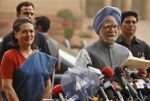
Sonia and Manamohan Singh - picture from NDTV.Com

Sonia and Manamohan Singh - picture from NDTV.Com

I’m writing this after a lot of soul searching. On a day when stock trading had to be suspended after it reached the upper circuit and was ballooning out of control, on a day when LTTE chief Prabhakaran, his son and aides were declared as “shot dead while trying to escape”, when TV channels are on overdrive “celebrating” Congress victory and Rahul Gandhi’s leadership, maybe my voice will sound churlish.

Today, I lost a whole lot of my faith in TV reporting. PTI said Prabhakaran was shot dead while trying to escape in a “jeep”. IBN Live said while trying to escape in an “ambulance”. Strangely, after 3 years of relentless war against the LTTE, President Rajapakshe was in Jordan when the final assault was mounted and the area left to capture kept shrinking. Why would he go away? Why did he say, “When I return, it will all be over?” It is too much of a coincidence that there was no progress in the war during the gap of three days between the last day of polling and the day of the results.

The new government doesn’t have to deal with a messy war. It just has to send supplies to the displaced Tamils. Busy with national elections, it could not have done anything to enforce a ceasefire. Did it really want to?

With Prabhakaran out of the picture (he became too ambitious), one can only hope that the Tamils are lucky enough to find an activist dedicated to their cause.

Back to the elections:  Tamil Nadu went through large scale rigging and tempering of electronic voting machines – a reason why the machines have been rejected by the US and Japan? What could not be fixed by EVMs was done by officers in the pay of the government. Everyone knows about it but they all feel powerless to interfere. The print media published a sanitized version of the story. TV channels were deafeningly silent on it, choosing rather to say that there was big support to a government that was responsible for power cuts, increase in all food prices, unprecedented violence, bandhs, land grabbing and sand theft and it won because of its populist policies is to mock at the people who are suffering.

And the news channels didn’t raise a whisper about the way P Chidambaram got elected.

At about 12 noon on May 16, the counting got over and the results were announced. AIDMK’s candidate was declared as winner at Sivaganga. For three hours after that, the certificate to that effect was not issued. There was no round by round declaration of results either. There was a flurry of phone calls, PC was taken to a backroom and issued the certificate. After more delay, paramilitary forces amounting to 5000 arrived and the announcement was made: PC had won by the same number of votes that his opponent had won earlier. The Chief Electoral Officer was consulted and he said that his hands were tied since the District Magistrate of the area had used his discretionary powers to “recount” and had made the correction. This man, who is now being described as “squeezed through the election” may soon be our finance/home minister.

Today, PC went on air thanking the CM of this state for his help in his election.

Yes, the Congress won a lot more seats this time and will provide a more stable government. Without having to depend on the Left (there’s international relief that the communists are out of the government) the party can speed up reforms and bring in more FIIs, more MNCs, more food imports and more cash to the party’s coffers. But behind that “stability” are candidates who muscled and moneyed their way in.

There are criminal charges against three Tamil Nadu ministers in the previous cabinet. They will get berths this time too. In addition there will be one more from Madurai who set a newspaper office ablaze over the family feud. It killed three workers inside.

Fifth and last phase of polling

By Geeta Padmanabhan

I cast my vote today

I went out and voted in the fifth and last phase of elections (2009) to the Lok Sabha. I thought I would be there before the 107*F summer heat kicked in and reached the polling booth at 7 am , the opening hour. Many, I found, had had the same idea. Each entrance had at least thirty voters. Only the election staff wasn’t ready. We had to wait at least a half hour before they opened the proceedings.

“Will they extend the timings?” asked the man behind me. “They weren’t expecting a crowd,” said a woman. “Anyway, they are adept at cramming the votes into the last hour (a reference to what happened in Thirumangalam).”

The large voter turn-out wasn’t really a surprise. In the last week, wherever I went, I had a flyer thrust into my hand. They all had this one message. “Go out and vote.” Each carried the name of an outfit – Liberal Association, Ekta, Election Watch – loosely constituted NGOs whose only aim seemed like they wanted to stir “public conscience.” Musical bands have been belting out similar messages on TV. There were celebrity endorsements for voting. The general slogan was “If you don’t vote you have no right to criticize”.

Mine is a very middle class constituency. So what does the higher voter turnout mean? A sense of despondency? Anger? (Plenty to be angry about, price-rise, power cuts, lack of a proper garbage removal system, construction of bad and unnecessary overhead roads, shrinking of walking spaces and sidewalks). They might be thinking: “If I don’t vote, I’m doomed. I’ll have no voice in what’s being done to my environment.” Voting out of anger is not a new phenomenon. If that brings them to the polling stations, it is very welcome.

Considering the magnitude (mind-boggling numbers) the Election Commission had done a decent job. There were ramps and voting papers in Braille. Policemen were helping voters find their way. Names and symbols of candidates were prominently displayed. Form 49-0 was easily available. The print media have been carrying regular reports on the “How to” of using the electronic voting machines.

But there are serious problems – systemic ones – in the voting process. To set them right, we need electoral reforms.

Voting is not compulsory and the day is a paid “holiday”. People just take off. Why should it be a holiday?

I have no say in who the political parties choose as their candidates. On what basis are they given “tickets”? Caste? Influence? Money power? Winnability? I am forced to vote for the party (and its supremo) and not for the candidate. This limits my choice.

I could vote for an independent candidate. My constituency has Sarat Babu, an IIM-A guy whose mom educated him on the earnings of her small roadside idli shop. Another independent is Venkatraman who has a long history of working for the disabled in these parts. But then, there are 35 others contesting for this south Chennai seat. Do they stand a chance at all? Do people even know about them?

My neighbour and his family were turned away because their names were missing from the voters’ list. They had voted in the last elections. If it is any consolation actor Kamalhasan wasn’t allowed to vote because his name went missing too. How did this happen?

A couple of days ago, my husband and I were given a “voting slip” by an anonymous caller. The slip carried our names, the name of the voting venue, and our voting register number. Those who did not carry this slip were barred from voting, even if they had voter IDs. No slip, no vote.

The shocking part is that the slip was not a plain innocuous one. It had, prominently printed on it, the election symbol of the ruling party. A pamphlet highlighting the “achievements’ of the party was attached to it. We almost looked for the pinned cash. Why is this piece of paper indispensable for voting?  Why would a political party spend on it and the election officials insist that we have it at the time of voting?

We also saw those infamous black-trousered-white-shirted guys around the polling station. They were constantly on their cellphones. We heard a guy say, “The bundles are with so-and-so.” We thought of the worst. Why can’t we cancel the candidatures of the contestants caught distributing cash or kind?

It will be good to have an age limit for the contestants. It will be good to make voting compulsory and open a “help booth” to sort out problems at the venue. It will be good to see 100% voting. Good to see proper vetting of “independent” candidates. Why would they contest, knowing well they would lose their deposits?

Each candidate is allowed to bring two observers. It is an open secret that many independents are dummy candidates to facilitate the presence of musclemen.

But I voted and I’m happy about it.