By Mahesh Padmanabhan
This summer, I had the opportunity to visit the Amar Seva Sangam. It is an institution that cares deeply about physically and mentally challenged people in India and has the organizational and operational skills to really make a difference to their plight.
My parents had been contributing regularly to this institution – making donations (on my birthday and my sister’s birthday) and getting it more exposure within the media.
I am usually very skeptical about the efficacy of an institution like this in India. With rampant corruption permeating almost every facet of Indian society and virtually no laws or programs in place to address the needs of disabled individuals, I was certain that it would be poorly run and its existence was merely a way to funnel money to its founders and investors.
I resolved to make a trip to Ayakudi, the headquarters of Amar Seva Sangam with a mixture of cynicism and curiosity. Ayakudi is a village beautifully nestled in the foothills of the Western Ghats. The Sangam itself is situated on the outskirts of this idylic village among the ubuiqutous wind farms strewn across the countryside.
I was pleasantly surprised by what I discovered.
Even though the Sangam has grown organically, the tour of the facility made me realize that they had given some thought to planning the growth, resulting in easy access to all buildings within the facility. Wheelchair access sometimes resulted in shorter distances to other buildings.
The Sangam started off as a shed but due to the diligent work of its founders, support staff, donations and sponsorship, has decent facilities now for early childhood intervention, rehabilitation, schooling and vocational training.
 I had the opportunity to talk to many teachers and administrative staff and I was impressed with their sense of purpose and their enthusiasm for their role and responsibilities. The entire network of people operating and participating in the Sangam felt like a well oiled machine. Many of the teachers and administrative staff come from nearby villages and more
importantly, are products of the Sangam.
The Sangam’s outreach program is equally impressive. Disability, especially in Indian villages, is akin to being a leper so village society shuns disabled individuals. A disabled family member is forced to stay away not just from society but from other family members. This isolation further exacerbates that individual’s psyche and does away with any notion of being a productive member of society.
The outreach program operates in over 600 surrounding villages and takes the hard road of door-to-door education and potentially getting disabled individuals back into the Sangam for rehabilitation and training so that they can make a positive impact to society. The program also has clear structure and guidance on establishing a self-sufficient group comprised of people from the village that can continue the process of education thereby allowing the outreach program to scale.
The Sangam was started as a rehabilitation and training center but has grown to include two things closer to my heart, integrated schooling and early childhood intervention.
Integrated schooling allows normal and disabled children to study and play together thereby increasing tolerance to and understanding of disability at an early age.
Early childhood intervention deals with getting disabled children into the Sangam at as early a stage as possible thereby mitigating the effects of age on self-sufficiency. This is especially true for mental retardation where detecting and starting the rehabilitation program as quickly as possible is critical to the well-being of the child and the child’s progression to
self-sufficiency.
I left Ayakudi uplifted, humbled and determined that I would try my best to keep the Sangam running for years to come. The Sangam relies heavily on donations and sponsorships especially as they are trying to make serious inroads into early childhood intervention, education, continued rehabilation and training.
It is absolutely essential that we do our part in helping this well run institution continue its noble mission. Please check out http://www.amarseva.org or better yet visit the Sangam as a volunteer. Please donate as much or little as you can or get your company to participate in corporate sponsorship of this excellent institution.
 The Akshaya Patra Foundation has launched Gifts For Moms, Smiles For Children, a Mother’s Day campaign that pays tribute to Mothers worldwide while helping to feed and educate children throughout India. Akshaya Patra is an organization with the vision that no child shall be deprived of education because of hunger. The campaign is a way for people to celebrate their Mother, Grandmother, Sister or Aunt by giving them a gift for Mother’s Day that actually gives back.
 This past week, torrential rains in Karnataka and Andhra Pradesh caused flooding, rendering hundreds of people homeless and thousands of others unable to travel or find food. The local governments approached Akshaya Patra and asked the organization to provide meals to displaced victims of the natural disaster.
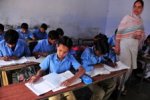 The Congressional Hunger Center (CHC), a nonprofit anti-hunger training organization located in Washington, D.C., launched an exhibit last week featuring photographs of the Akshaya Patra Foundation, as well as other midday meal programs in Mali and Chile. The exhibit is designed to help inform members of Congress, policy makers and other key opinion leaders on the success, magnitude and worth of school feeding programs around the world.
 The
The  The
The  Akshaya Patra
 The
The 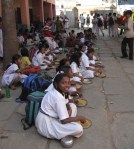 Through kitchens specially designed by engineers to leverage technology and sourcing its food stocks from local markets, Akshaya Patra is able to reduce costs associated with transportation and food spoilage while supporting the local economy. In a short time, the foundation has grown to become the largest, and certainly most innovative, school lunch program in the world. Akshaya Patra is a great example of what a non-profit organization can achieve– a cost effective, scalable solution with high quality service delivery.
 Bay Area non-profit
  Water, No Ice