Mexico's Hidden Gem – Queretaro

Rhishi Pethe

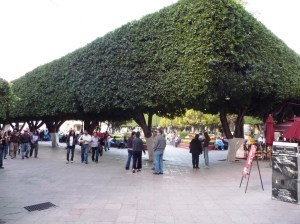
a-square-in-quretaro-mexicoFantastic ads by Corona, constant in-your-face late night infomercials for Girls Gone Wild videos and the rising toll due to drug violence on the border, fuel a common perception in the United States that Mexico is either too crazy or too unsafe to travel. If you follow a few basic rules and little bit of Spanish, Mexico is one of the most wonderful places to explore, enjoy and experience. Late last year, my wife and I decided to take a slightly less traveled road and took a trip to some historic and colonial towns north of Mexico City. Our destination was going to be the historic and beautiful city of Queretaro, a UNESCO heritage city about 160 miles north-west of Mexico City.

We took a hop at Dallas from Chicago on our way to Mexico City. (You can get to Queretaro from the Leon, Guanajuato Airport as well). Mexico City airport can be confusing for newcomers but things have improved significantly over the last 7-8 years. We took a luxury bus from the Mexico City Airport for Queretaro on the ETN line. The high end buses in Mexico are not very expensive, are very safe and provide top notch service. We paid just $ 23 per head for a 4 hour journey from Mexico City to Queretaro. A sandwich, a bottle of water and a fruit drink, along with extremely comfortable seats was included in the fare.

la Casa De La Marquesa

la Casa De La Marquesa

We had booked our stay at one of the best hotels in Mexico, La Casa de la Marquesa. La Casa was an 18th century gift from a Marquis to his wife Dona Josefa. The hotel is divided into two sections with exceptional rooms, a very nice restaurant serving local Mexican specialties and just a few minutes’ walk from the impressive Plaza de la Armas and other interesting squares and sites in the city.

Queretaro is one of the earlier cities established by the Conquistadores during the Spanish Conquest. The architecture is colonial, grand, beautiful and tends towards the religious. Queretaro is a city made for walking around. You go there to relax, spend a couple of hours in a square, eat some local food, have a beer and then move on to the next square. The people of the city take great pride in their heritage status and history and the city spends a lot of effort in keeping the city clean. The city is spotlessly clean with cleaning crews visible even at 11:00 PM in the night.

Queretaro was definitely the cleanest tourist destination I have seen anywhere in my life. The people in the city are extremely friendly and helpful. Very few people speak English, but a little bit of Spanish on your part will open up doors, bring out smiles and take you a long way. Most of the tourists are Mexicans and people from other Latin American countries as well. We spent a lot of time in the Plaza de la Armas, which is a beautiful square surrounded by restaurants, cafes and bars on three sides. We really enjoyed eating at El Meson de Chucho El Roto and the Restaurant 1810. (1810 is the year of the beginning of the Mexican war of Independence). Both restaurants serve a large selection of Mexican specialties including cactus (nopales), sea food, corn dishes and a very large variety of tequilas and margaritas. One should definitely try a dish served in a molcajete, which is a stone mortar.

If you are vegetarian, both these restaurants will accommodate you. The magic words to say are “sin carne, sin pescado (without meat, without fish or sea food).” Both restaurants have really good artists playing live music and if you are lucky to be there on the weekend, you can get to see and hear some Mariachi music as well. If you are slightly more adventurous, definitely try some Gorditas, made from corn flour in any of the squares. If you want a vegetarian option, the Gordita places are more than willing to do potato and cheese gorditas as well, which are to die for. We made it a point to spend at least half a day in each square, while doing lot of people-watching and engaging in some relaxed conversation. The leisurely hours spent can be great for couples to reconnect and bond and for friends to have a great time.

Queretaro is not just about great squares, good food and drink. There is lot of history to the city, with its museums and beautiful churches. It was also one of the early centers of the Mexican War of Independence and the treaty between Mexico and United States which gave California, New Mexico, Nevada and Utah to the United States was also signed in Queretaro.
Aqueduct - Queretaro

Aqueduct - Queretaro

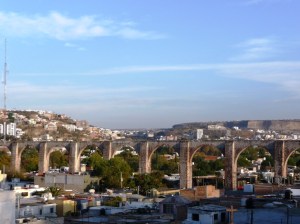
One of the landmarks towards the outskirts of the city is the magnificent Aqueduct with 74 gates. It was commissioned to bring fresh water to the city. The walk from the city to the Aqueduct is hardly 2 miles, but it took us almost half a day to get there. We started around 11:00 AM and kept stopping at different places to check out churches, do some shopping for silver trinkets, have lunch and some cerveza. The walk also takes you through the non-touristy residential part of town and it gives you an opportunity to watch the locals up close and personal. We finally reached the viewpoint for the aqueduct after a couple of hours and it is not only an engineering marvel but also a spectacular sight.

Another interesting site to visit is Cerras de la Campana. (Hill of Bells) This is the hill on which the death sentence on Archduke Maximillian was carried out and there is a very austere memorial to the Archduke still there. The hike up the hill is pretty easy and you can also marvel at the huge statue of President Benito Juarez towering over and keeping an eye on this beautiful city.

Queretaro also provides a great experience for shopping for silver. There are literally hundreds of stalls selling different silver items like beautiful earrings, rings, bangles, chains and what not. You could get a lot of good quality stuff without emptying your wallet, provided you do some tough bargaining.
El Teatro De La Republica

El Teatro De La Republica

The city is clean, safe and tourist friendly. They even hand out blue sweaters with the city logos to beggars during winter months to keep them warm and looking clean. Queretaro is a great place to learn about Latin and Mexican culture, which is in many ways similar to Indian culture in terms of family values, importance of traditions, spirituality, and extremely friendly people who are fond of music, food and festivals and like to have a good time. We have been traveling to Mexico for almost 7-8 years now, but this was definitely one of the best trips to the country.

Rhishi Pethe works in supply chain management consulting and is currently pursuing a part time MBA at the University of Chicago. His interests outside of work are spending time with his wife, travel, reading, economics, jazz, good food and blogging.

Welcome to Thekkady

By Naren Pradhan

thekkady

I was so excited when the train started to come to a halt. I looked out the window, and what I saw was a vast wonderland thick with trees, bushes, and other greenery. When I  caught a glimpse of the land, I immediately knew that I was going to love my 3-day stay in Thekkady, Kerala.

I was on a holiday in India with my grandparents for my summer vacation, and on August 13, we took a train to Kottayam in the district of Thekkady, arriving the next day. My grandparents told me to expect a beautiful mountainous region in the clouds up in the Western Ghats range, a land full of sparkling turquoise waters, gigantic tropical trees, and plants bearing all sorts of spices, medicines, and fruits. And when I got there, I was surprised to see how right they were.

thekkady-waterfalls

At the Waterfall with Grandma

After our train arrived, we took a long (114 kms) car ride through the hills. It was a majestic sight, trees and greenery blanketing the hills with snow-white waterfalls streaming out like precious liquid pouring out of a mystical fountain of nature. A few times, we got out of the car to see some of the sights up close. Once we came to a small rubber plantation, where we saw the sap of the rubber tree slowly pouring out of long cuts into coconut containers, which would later be taken to a factory, where it would be refined. I even got to pull out some of the hardened rubber and stretch it in my hands!

After that, we stopped at one of the many waterfalls of the range. Around here, waterfalls come in all shapes and sizes, from small streams flowing down a smooth stone wall to raging rivers tumbling down a carefully but naturally carved hillside. This one was one of the latter. It was a wonderful pathway of sparkling white water flowing out of the forest above into a serene pool, looking as if god himself had taken time to clear a path for these falls. This car trip took four whole hours, but it was definitely worth it.

thekkady-elephants

A Bumpy Ride

Finally, we made it to our destination, the Aranya Nivas, a small but luxurious forest hotel. The special thing about this particular hotel is that Jawaharlal Nehru himself stayed here, so we were eager to come here. After we settled in our room we went downstairs and had a meal fit for a king. We were ready to go to our first activity.

My grandparents and I took a short car trip to the Elephant Junction, a farm and nature preserve containing lots of trees, spices, and over a score of elephants. The great thing about this particular trip is that we got to see all of it from the back of a massive elephant! After we mounted the magnificent grey beast, a man on the ground started to lead the elephant, and the ride began. It was a bumpy ride, but we got to see the forest from a high point while the elephant walked. I loved it of course, but I don’t think my grandparents will ever want to repeat the experience! After that, we got to feed the elephant and watch as it crunched up a small pumpkin and a whole cucumber.

thekkady-spices

Checking Out the Spices!

The next day, after a hearty breakfast, we got into the car again. This time we were going on a tour of the farmland in the hills. As we drove, I noticed the many bushes covering the hills we passed. It turns out those bushes contained tea leaves, one of the most valuable plants in the world. And that was just the beginning. Soon, the three of us came to a spice garden, where we got a complete tour of  spice, medicine, and fruit-bearing plants. There was tea, pepper, cardamom, cinnamon, coffee, cacao, jackfruits, bananas, papayas and much more. There was even a plant that is made into a medicine that can improve memory. I bought that of course! The land is full of riches in the form of plants, and if it were up to me, I would call this range the Rupaiya (Money) Mountains.

That wasn’t the end of our tour. We headed over to a forest museum. There, we saw the preserved remains of all sorts of animals, including snakes, rats, flying squirrels, and deer, even an elephant!  But perhaps the best part of all was when we came to the border of Kerala and Tamil Nadu. The border was a small unpaved path on a cliff bordering the Tamil Nadu Valley. There, the three of us climbed a tall watchtower, where we could see the entire valley while feeling the wind in our hair. It was a magical experience, one that I will treasure for a long time.

We were to leave in the evening the next day, so all of us had to savor our last excursion the most. This time, we were going on a boat ride from our hotel through the Periyar River to the Lake Palace Hotel. We boarded our boat in the early morning before we could have any breakfast, but it was worth it. As we drifted along the river, we saw that it wasn’t just a body of water, but a submerged forest, with the tops of gigantic dead trees poking out. Who knows what was below those turquoise waters! Throughout the trip, we saw several jungle animals, including turtles, cormorants, bison, and more elephants.

Naren with grandparents

Naren With Thatha and Patti

Finally, we came to the Lake Palace Hotel. This was a fitting name, for this hotel was once a forest palace of an Indian king who used to keep an eye on the forest and prevent over-hunting. And what a palace it was! There were high ceilings, expertly painted walls, ivory ornaments, and a balcony from which you can see a large part of the lake surrounding the island, and the forest beyond. I actually got to eat breakfast at the king’s table and sit on his bed! Some people were even staying here as guests. We didn’t, as there were only six rooms, and it was too far above our price range.

As we drifted back to our own hotel, I knew this would be the last part of our short vacation, so I savored every moment and took in all the beautiful landscape around me. When our boat got back, we ate a light lunch, packed up and said goodbye to our wonderful hotel and its marvelous employees. We got into our car, and as we drove along the hills once again, I took one last good look at those beautiful green hills. Finally, my grandparents and I boarded the train and headed back to their home in Chennai. We all were extremely sad to leave this undisturbed paradise. In my heart, I know that someday I will return.

Naren Pradhan is an 8th grader at Thornton Jr. High. His interests include piano, soccer and Runescape.

People just don't read anymore

srkSo Shakrukh Khan got detained at Newark, New Jersey airport for the simple fact of having a Muslim surname. An uncomplicated case of profiling, I suppose, though it must have made King Khan realize his reign is limited to his diaspora pond, where he is a very big fish indeed.

But to be fair to New Jersey authorities, it’s not just international icons they don’t recognize. A rookie cop in the town of Long Branch picked up a scruffy, suspicious looking old man, not realizing it was – Bob Dylan!

Matt Yglesias has a paragraph in a post today which sort of offers an explanation for why stuff like this happens

..the change in the media is part of a much broader shift in American society. Technological and economic change has just made authority weaker and tended to fragment perspectives…. It’s extremely easy for people to bury themselves in a subculture of their liking and not worry too much about the mainstream.

( Emphasis mine)

I just think it comes from people just not doing a whole lot of casual reading anymore. I grew up in a small town in northern India with no exposure to literature, art or western culture, but I picked up a lot of stuff by reading newspapers, magazines and popular fiction, at least enough to recognize names and places in countries I (then) never thought I would ever be visiting.

Today it’s so easy to find a subset of like-minded thinkers and opinions on the internet and television, it is just not necessary or gratifying enough to be exposed to views that challenge your own. Don’t like the NY Times op-eds? Just switch to the Wall Street Journal. Don’t agree with CNN? Just keep the TV tuned to Fox News. And with a lot of the big-city, broad-spectrum newspapers folding, that trend is likely to accelerate.

I’m guilty of echo-chambering too. One glance at my bookmarks will reveal a definite left-of-center predilection. But I still subscribe to the big newspaper in the Bay Area and I will read op-eds by the likes of Pat Buchanan and Victor Davis Hanson, even though they make me gag over breakfast. The browsing that a newspaper encourages leads me to bits of trivia, Hollywood news, weird stories from around the world that I would never pick up over the internet by myself.

There’s a shitstorm brewing in India over the SRK brouhaha but I suggest everybody take a deep breath and calm down. Just advocate that the NJ cops read, read, read!

Kaminey – violent, vivid, rocking

kamineyThe ethos of the Mumbai underground is like compost – full of discarded peels and cracked eggshells, ripe-smelling and treacherous underfoot – but rich fodder for the imagination of talented directors. Vishal Bharadwaj is one such wunderkind, and he uses the steaming, stinking pile to fashion yet another cinematic gem.

Kaminey is the story of twin brothers Charlie and Guddu; the former lisps and the latter stammers. Charlie is a small time hoodlum who dreams of one big score which will fund his ambition to become a bookie in the crooked Mumbai race business. Guddu is a hapless NGO worker who gets involved with the sister of a thug-turned-politician. The two brothers loath each other and the busy metropolis gives them the space to avoid any interaction. One day however, Charlie’s greed sets up a train of events that lead to the intersection of their lives in a brutal and bloody finale.

Shot in large part with a hand-held camera in an in-your-face style, Kaminey is a frenetic, raw, and edgy piece of work. It’s not just Charlie’s dreams that are Dali-esque; the cocaine-hazed shootout at the end is equally surreal, as various characters blunder around madly discharging their weapons, not entirely sure whether they are hitting friend or foe.

Kaminey does not insult the viewer’s intelligence for one minute. Towards the beginning of the movie there is a scene in a hotel where multiple territorial interests collide, but the director does not lay out the characters neatly, preferring to let the audience figure it out as the movie evolves. The characters speak a melange of languages, from Marathi to Bengali to some kind of French-Angolan patois and I wonder how the audience in India would follow along without subtitles. This is a movie where you have to pay close attention to figure out all the wheels and angles, and you are richly rewarded for your interest.

The ensemble cast is terrific, as usual, and you figure out how many talented actors there are in Bollywood who never see the light of day except in these occasional gangster movies. Shahid Kapur does a great job as the twins and it is easy to believe that these are two completely different people. His efforts to create a ripped body (there is another surreal scene where the muscles are on display as Shahid races alongside horses) have made his face a little haggard, which feels completely appropriate for the movie.

Priyanka Chopra is a revelation as the fiercely protective Sweety, who will fight like a tigress to preserve her relationship with Guddu. Special mention must be made of Amole Gupte as her dada Bhope Bhau.

Vishal Bharadwaj writes the screenplay and scores the music as he usually does for his movies and it is unobtrusive, melodious and appropriate (the lyrics are opaque, which is a good bet that they are by Gulzar!). The background score is excellent too, as it builds up to a crescendo in key scenes (one, involving a game like Russian roulette is predicted by the music but still painful to watch).

Kaminey’s black comedy had me nervously chuckling throughout the movie, even as I stayed glued to the seat. It is not for viewers who want a feel-good Bollywood masala experience, but fans of Omkara will be delighted.

Kid advisory – Not suitable for kids under 13.

Kaminey

Directed by Vishal Bharadwaj

*ring Shahid Kapur, Priyanka Chopra

My rating : 4 out of 5 stars.

A Returning Indian Entrepreneur Reflects – Part 2

By Kashyap Deorah

Let’s just say that our move to India is done and we are now completely a part of the problem. It has been nearly 22 months since we moved back. Two Diwalis and two Holis later, Independence Day has now moved back from July 4 to August 15. The fascination of big weddings, auto-rickshaws, street food, fresh mithai, monsoon rains, cutting chai, tangdi kabab, patiala pegs, haggling street vendors, gymkhana memberships, high-school reunions, first-day first-shows, live cricket matches, festive crowds and high-honking lane cuts has now transformed to the little compulsions and compromises of life, sometimes trading off health with politeness, and sometimes freedom of choice with practicality.

After more than a year of parasitic living at our parents’ home, we are now on our own as a working couple managing a household with daily interactions with a maid, cook, driver, dhobi, nariyal-wala, milkman, newspaper boy, kachre-wala, watchman, car wash guy, and monthly interactions with the local cable goon, Internet provider, repair technician, plumber, carpenter, electrician, landlord, home delivery guys, and a barrage of brokers. I commute 10 minutes to work, while wife Shruti commutes 45-90 minutes depending on her traffic karma, to cover a distance similar to Mountain View to Palo Alto.

Besides moving from the US to India and from parents’ home to ours, some significant events in our life include a recession, starting up from scratch, Shruti’s career path change and seeing my sister’s daughter grow up. Actually, Zoya mirrors our life in India since our move happened during my sister’s third trimester. Our new life in India is as old as hers in this world. We have now started walking on our own and have started mumbling some sense, in between violent shrieks and tears when we are not well understood. Here is a sequel to part one written in March 2008.

Aspiration Vs Experience
A common theme across Indians, bar the extremely poor (about 35% of India) and the extremely rich (about 2% of India), is aspiration. Some aspire more than others, but we all aspire. Some aspirations are ambitions to jump many steps in the ladder at a time, but it remains perpetually apparent that we are all on a ladder. Each Indian seems to have a story of where they started in life, and where they are today. A story of struggle and a highly developed ego about how well-earned the cup of tea is this morning. Ironically, between steps in the ladder is a black-hole with infinite ability to suck energy. One can expend a lifetime without hopping a step, or one can swiftly curve right around and jump a few notches. On the other hand, the American’s story in the sports bar is about his experiences. The places he went, the women he was with, and the cigars he smoked. The American way of life focuses on being yourself and having unique experiences, no matter how much gas it guzzles. Of course, Indians keep finding their ways to be different while Americans participate in pissing contests to conform.

Survival Vs Progress
From the blue-collar working man to a small business to a corporation, the fair price of a product or service for the Indian market is based on the perceived cost and not the perceived value. Negotiations at all levels end up being cost justifications rather than value justifications. There are two reasons that together make this happen: competitive gaps are quickly filled by entrepreneurial energy in an over-competitive market, and the collective natural capacity of Indian customers to tolerate pain and out-wait you ensures that someone will blink on margins. The only way to de-couple pricing from cost seems to be exclusive rights to a scarce tangible resource. Think of all inorganic growth stories in India, and you would discover that it started with a certain license or right or exclusive ownership won early in the game, or persuasively prohibiting market entry for other players by force or tactic. For instance, real-estate in Mumbai is like stock options in the Bay Area. It is the most probable reason your high-school friend is driving a Porsche Cayenne. On the other hand, the American dream rewards the guy from the mid-West who sold the hot-dog machine that could produce thrice the number of hot-dogs a day and now has a star by his name while sipping Pina Colada in Lanai. The American market at large adopts small innovations at scale in the span of time before competition catches up, and original ideas can successfully be protected from being copied. Going back to the Sequoia and Banyan Tree comparison, the Indian ethos is optimized for continuous survival while the American ethos is optimized for continuous progress. India is growing, but only at a pace that is essential for survival of a billion people. Perhaps this is not an economically underdeveloped society, but an overdeveloped one.

Chaos Vs Order
Before moving to the US, my political views were right of centre. After coming back, they parked left. As an immigrant, your lifelong beliefs are questioned. The rules you were brought up with stop applying, and in order to build the next set of rules on your own, you must go back to first principles. Decisions based on first principles require more processing cycles per day compared to quick look-ups of a rules-based system. After moving back, you can live on first principles for a while and look beyond your preferences and embrace the environment with open arms.  Sooner or later you would start forming rules that help you live easier. In India, a better part of those rules would apply to people and would take the form of stereotypes – quickly judge people, then accept, reject or ignore. You would be one of a billion mutinies, with a certain set of impenetrable views, albeit unique and changing. In philosophical debates your conscious mind would argue on first principles, but in real life, your unconscious mind would be asserting these rigid rules. Indians end up with a fair degree of order in personal life, perhaps as a survival technique in a high chaos environment. Perhaps, this is not a socially underdeveloped society, but an overdeveloped one.

Man Vs Nature
Some of my most memorable experiences in the US were with nature. These were moments that made me feel closer to life than ever before, feeling every drop of blood in the body, aware of how insignificant we are in the face of nature, marvelling at how much the human race has achieved starting with a world of forests, mountains, deserts, oceans and volcanoes. Some of my most memorable experiences in India have been with humans. Moments that make you feel more alive than ever before, seeing the extremes of human resilience and adaptability, the fragility of human life, contrasts in the value of a human life, acts of selflessness and selfishness, kindness and cruelty, shallowness and depth, and the extremes of human ethics. You would be well advised to take a break from humans when in India and give yourself some mind space in what nature has to offer within Indian borders.

Immigrants are a cursed species. The merits of the place we live in are taken for granted, and the merits of the places we travel to or stay away from monopolize our thought. No matter where we live, the mind always wants the best of both worlds without accepting the merits and demerits of a place as two sides of the same coin. You cannot have one without the other. In general, those who move back to India after many years in the US choose to forego some obvious material comforts of life. There is a certain higher purpose that pulls one back home for fulfilling a human need closer to the soul. When moving back to India, I felt like the monk who sold his Ferrari (in this case, an Audi), only to realize that I am no monk. What seemed like a promotion to a higher plain of awareness is only the beginning of our pursuit of happiness. It would be a lie to say that we do not miss our life in the US. Life in India is much tougher, and as Calvin’s dad would say, it builds character.

At the same time, it is true that no matter what you choose to do here, you would be solving more fundamental problems and real needs compared to the US and making that much more impact on people’s lives; even if your expectations of being compensated or recognized commensurate with the impact might take a beating by US standards. Look at it as a journey towards self-realization and an opportunity to end up farther ahead as a world citizena after your life and experiences in India.

Art Excel Summer Camp

artexcelART Excel (All Round Training in Excellence) is a 5 days workshop for children (8-13yrs) starting Aug14th- 18th. The camp is conducted by the Art of Living organization.

When: August 14th-18th; Weekdays-5:00PM- 8:00PM; Weekends-  10:00 AM- 2:00 PM
Where: Sobrato Center,600 Valley Way,Milpitas, CA,95035
To Register for workshop:http://secure.artofliving.org/course_details.aspx?course_id=4817
RSVP: Reena @ 48.203.3576/408-518-2349 | reenasrisri@yahoo.com

Core Components:
Build 4 Cs in their life: Commitment, Concentration, Confidence, Clarity
Life Skills: Develop enthusiasm, leadership skills, group dynamics and Provide skills which enable kids to become positive role models for thier peers.
Enormous Fun: Games, Yoga and creative projects
Stress Management: Rhythmic breathing techniques that balance emotions, increases mental focus and facilitate the learning process.

Explosion 2009: really, really loud

explostion-2009Sonu Nigam, sorry, Sonu Niigam, is a consummate showman. His musical riffs, his banter with the audience, his creative mash-ups of old and new Bollywood numbers are part of a shtick he has perfected. Yesterday, at Explosion 2009 in Oracle Arena in Oakland, CA, that showmanship was our in full force, even if his voice sounded a little tired and stressed out.

Unfortunately, for people who had faithfully arrived at the listed opening time of 7:30 p.m., the wait was a looong 2 hours before the performer appeared.

When I had picked up the tickets from the local grocery store a few weeks ago, I was puzzled by a competing poster announcing a Global Bhangra competition on the same day, same time, same venue. Well, that mystery got solved when we arrived at the Arena and saw the competition announced on the screen. Whispers went around the audience as we asked our neighbors if we were at the right place; sure enough, everyone was here for Explosion 2009.

Nevertheless, the announcers began with the bhangra contest. At first the audience was quiet (which desi can pass up a freebie?) but after 45 minutes of the competition, the poor bhangra teams began to get booed. The announcer repeatedly assured us that the main act was just on its way, and then there would be yet another performance of bhangra. The crowd, by now, had started exhibiting some signs of turning into a mob, not a good omen for the headliners.

Finally the bhangra competition ended and the prizewinners exited the stage. The emcee for the bhangra competition had been irritating us with his spiel, but the emcee for Explosion was truly awful. After a few platitudes about the upcoming performances, the opening act came on, a truly awful singer named Ayub ( a payoff for some favors?). The crowd just listened in disbelief (at this point I was grateful the chairs were nailed to the ground).

Mercifully, after a couple of songs, the tone-deaf Ayub left and Sunidhi Chauhan took the stage. Her powerful vocals and peppy song selection calmed the restive crowd and eventually brought the house down with a fabulous rendering of “Desi Girl.” I could have listened to her for much longer, but the crowd clearly wanted Sonu and Sunidhi ceded the stage to him at around 9:45 p.m.

Sonu performed some of his own compositions before launching into a spirited version of a medley from Salaame Ishq, Rab Ne Bana Di Jodi and Om Shanti Om. Spirited competition in the Bollywood music industry has prevented domination by any one singer, unlike the days of Mohammad Rafi and Kishore Kumar, and the trend towards pop and rock numbers has sidelined soulful singers like Sonu in the last few years, but he still has sung the occassional chartbuster.

Sonu kept the tempo up for about half-an-hour, even with a audibly tired voice. We left when Hard Kaur came on, ears deafened by the decibel level, and wondering, as we always do after concerts in the Oracle Arena, if we wouldn’t have been better off listening to our CDs at home.

A few years ago we had attended a much more intimate performance by Sonu in a San Jose City Hall venue. There were only about 500-800 people in the audience and the acoustics were perfect. Sonu’s performance then was mind-blowing, and we often jumped up out of our folding chairs to applaud and sing and dance along. (It is ironic that he performed at a much smaller venue when his star was on the ascendant in Bollywood and at the much, much, larger Oracle Arena when his popularity is on the wane.)

I guess we expected the same experience as that memorable night from a few years ago, and we were disappointed. Though the sound guys were talented enough to provide echoes and tremolos and crescendos to enhance the singer’s voice, it seems to me that these guys always make the mistake of thinking the crowd wants it loud, and never get the balance between the treble and bass right. I would have been happy if Sonu and Sunidhi had just stood there and sung a capella. Unfortunately, what we mostly got was an assault of cacophony and I won’t be repeating the experience.

Our National Night Out

nationalnightoutIf you were to watch a time-elapse video of our neighborhood, you would see the bay waters gradually receding, then trees sprouting into orchards, then homes slowly appearing, getting denser and denser, till you reached 2009, and an orderly but small development of homes occupied the area, located on streets named after birds.

Then the camera would pause on Tuesday, August 4th, 2009, to observe the unusual phenomenon of home-owners slowly trickling out of their sanctuaries, wending their way to a blocked off part of the street, bearing pyrex dishes and foil covered plates, kids trailing behind them on their bikes. Some of the food-bearing adults would be long-time owners, having proudly moved into the neighborhood when the homes were brand new. Other families would have just moved in last week, glad to get the chance to get to know the neighbors.

Little would the latter group know that we were all in the same boat. Whether we moved in last week, last year or in the last decade, we have all been prisoners of our comfortable homes, too busy to make new friendships, and too scared to let our kids bike around the neigborhood alone. We are connected to the whole world, and clueless about our next door neighbors.

So when one enterprising homeowner in our little community decided to put together a flier inviting us to the National Night Out, we decided it was time to put aside our virtual friends for a couple of hours and make some real ones.

National Night Out was started in 1984, as a crime prevention initiative. the idea was that if people knew and were friends with their neighbors, they would look out for them and alert them to any suspicious activity. More active communities could also set up “neighborhood watches” where members would take turns patrolling the area at night to reduce crime. The first year about 2.5 million people participated. By last year, that number had grown to 34.5 million.

We discovered how popular the event had become when we went to request the Fremont Police to come to our event. About 120 events had been planned in the city and the officers were stretched thin. While in previous pre-recession years the police would come bearing gifts for the kids and sage advice for the adults, this year we had to make do with stickers and police volunteers, but we were lucky to be able to spend a little time with at least one officer, who patiently heard our grievances and scared the kids into safer biking habits.

But the best part of the event was getting to know the people who live around us and seeing the diversity that has crept into the neighborhood. Name-tags were necessary, much to our shame, but we exchanged emails and phone numbers, determined to meet more often that once a year. Kids were astonished to discover that they had potential friends living just a few doors away; imagine the number of missed opportunities for playdates. The men, as usual, gravitated to each other to discuss politics and crime. The women clucked over the recipes and planned for doggy bags.

When the event wound down by nightfall, we picked up our dishes and foldable chairs and reluctantly started back home. Even now I am not sure I can match the names to the faces or the faces to the the houses, but at least, when I see a friendly face on my evening walks or bike rides, I know I will wave and get a wave back. I know that in case of an emergency, I can knock on any door and be assured of help. That’s what National Night Out was created for and it meets its goal admirably.

A Royal Pain: Reshma Shetty breaks the stereotype of Indian actors on American TV

divya-and-hankRoyal Pains is a new summer series on USA Network. Despite having a medical theme, the show is more of a fairy tale, a light-hearted look at the life of the super-rich. Recently unemployed( and unemployable) Dr. Hank Lawson finds a gig ministering to poor little rich people and discovering that the very rich are also human, after all. In tone and treatment, Royal Pains is closer to USA’s other popular serials Psych and Monk rather than medical dramas like E.R. and House.

divya-and-hank2Reshma Shetty has a starring role on the show as Divya Katdare, who finagles a job as the reluctant Hank’s assistant in Episode 1. Not much is known about her character, except that she is well connected in the Hamptons and despite having some medical knowledge, does not fall into the typical Indian TV stereotypes of doctor/7-11 clerk.

So what is Divya’s back story?
RS: We’re going to learn her back story so I can’t give too much away. Around episodes 8 and 9 we should be getting more of the story. I hope a lot of people are curious. There are some things we do know. Divya has obviously grown up internationally. Her family moved around a lot. Her father is a businessman who works in Mumbai, London and New York. Her family is very well connected in the Hamptons. She is very much a girl who has a dream and you’ll find out more details later.

Did the writers take your own history into account while developing the character?
RS: The really great part about a new show is that the writers and the actors are always collaborating. They welcome my input. I suggest sometimes that “this is not how Indians would think, or how they would act or behave”; what are the expectations from an Indian character beauty wise and career wise.
The character was not specifically written for a British girl and I auditioned in an American accent. They enjoyed my natural speaking voice. So they changed the character so I could speak in my normal voice. Every new script you get to know her better.

Katdare is a hard name to pronounce.
RS: It is, it is. The original name of the character was Divya Sharma but I was not comfortable with it. I suggested but my boyfriend’s ( Deep Katdare, from American Desi) last name. His family had anglicized it to be pronounced as “cat dare”. (The irony is) that when we picked Katdare as my character’s last name, the pronunciation was changed to “Kuhdaaray” which is a lot closer to the original.

divyaHow did the role in Bombay Dreams happen?( Reshma played the role of Priya in the touring version of the play).

RS: I was in opera school in Cincinnati. I had heard about Bombay Dreams while I was still in school. When it went on Broadway, I sent in my materials to David Grindrod who was casting for the London replacements. His partner office in New York asked me to audition, just to be heard. I flew in from Cincinnati, saw the show and I auditioned for the ensemble track though I couldn’t dance, because (eventually) I wanted to try out for Priya. I didn’t make it then but once I graduated, I auditioned again and got it. It was one of those surreal things. Life is very funny … everything happens at the time it’s supposed to happen. I am a big believer in watching out for signs.

It seems like your perseverance made it happen, though.
RS: I believe that if you work hard at your craft and respect your craft, talent rises. Persistence is a big thing and as long as you try to be the best you can be, you’ll make things happen.

Has music taken a back seat?
RS: It has. People don’t get the fact that even in musical theater or in opera, you have to take acting classes. I always wanted to be an actress as an undergrad. It is not a big leap but a different asset being brought to the surface. I do miss singing on the stage. You have people’s reactions in a moment. But it wasn’t what I ultimately wanted to do.

Is it easier for an Indian actress to get a role in television these days?
RS: I played in Rafta Rafta off Broadway and Sarita Choudhury played my mother. Her  Mississippi Masala was the first time I had seen an Indian face in an American movie. We always work in the footsteps of our ancestors. What I’m doing will help an Indian actress 10 years form now. There are lots of Indian faces on television these days. There’s Parminder Nagra( E.R.), Sendhil Ramamurthy( Heroes). I have a good friend called Zahf Paroo, who’s in an upcoming show called  Defying Gravity on ABC. There seem to be more interesting character parts for men, though.

Why?
RS: Indian women easily fit into roles requiring ethnicity and exoticism. Men seem to find roles that are less ethnic and stereotypical. But Divya Katdare’s character is based on one of the writers’ best friends from college so the role was specifically written for a smart Indian woman. I think it’s getting better.
The role I have in Royal Pains is not very common. The family is (made up of) wealthy, attractive smart people. They don’t fall into the stereotypes of an Indian family. I hope that it continues and manifests in more roles and leads to better roles. I am proud of being Indian but I don’t want to get roles because of that.
Divya Katdare has gone to business school. She is a different kind of girl.  I think it is changing, slowly and we are the ones who are doing it.

How is the show doing?
RS: We are doing well. Our pilot was highly rated. Our ratings actually increased the second week and kept going up.

Has the show been picked up for next year?
RS: I don’t know. We are still filming. The cast and the crew are one of the best I’ve ever worked with. I loved every single person on the show. It is an absolute honor and delight to go to work every day.

Love Aaj Kal: surrender to the charm

love-aaj-kalI remember waiting to see Jab We Met on DVD, reasoning that a debut film with a hokey, polyglot title was not worth wasting $9.50 on. Boy, was I wrong. JWM was funny and charming, a crazy train ride through Indian suburbia (albeit a pretty glossy one), so watching Love Aaj Kal on the big screen was a foregone conclusion.

It is always a little nerve-wracking to see a successful debut director’s second movie; there’s all the hype, even when you try to discount it.. There’s the memory of previous let-downs(there was really no way Farhan Akhtar could top Dil Chahta Hai-Lakshya was oookay and Don was puzzling). In this case, though, while Love Aaj Kal is no Jab We Met, it doesn’t disappoint.

Director Imtiaz Ali doesn’t break any new ground in terms of plot. It’s a When Harry Met Sally storyline, already plumbed to some success by Kunal Kohli in Hum Tum, also starring Saif. What Ali brings to it is the refreshing treatment that made audiences gush over JWM. For instance, can you recall any recent Bollywood movie where the leads sat staring at each other for a few seconds, the silence speaking volumes for the two of them? Such poetic moments recur through the movie, with Deepika Padukone’s expressive eyes doing all the talking for her, while Saif(playing Jai Vardhan Singh)  babbles like the man-child character he’s perfected in mainstream Bollywood fare. Watch out for another such scene towards the end, at the wedding.

What is it with Saif and these roles anyway? I can count over half-a-dozen movies where he’s essentially playing the same character, a shallow, self-centered jerk who gets reformed at the last minute by the redeeming power of love. He performs his usual schtick without breaking a sweat and is mainly a foil to the lovely ladies on screen.

One of the lovely ladies is, of course, Deepika, whose leggy, coltish grace illuminates the screen. She is a very young actor, but improving with each movie. If she can survive the next five years in Bollywood, she is going to be a very fine performer..she has great potential. Here her eyes and smile cover for her  lack of experience, though she is miles ahead of other female actors her age in Bollywood. Deepika is like the chrysalis of a future Grace Kelly-like actor and I look forward to seeing her grow and develop into the fine thespian she can be.

The other lovely lady is Simran Giselle Monteiro. Jai’s misadventures in love are sympathetically observed by Veer(Rishi Kapoor), who  narrates the love story of his youth to teach the modern Jai a thing or two about what it means to love deeply. His story is told in flashback with Saif playing the younger Veer , and Simran Giselle, his love interest  Harleen.( updated, thanks to friends in India..her credits don’t appear in the film and imdb.com doesn’t mention her either. Giselle, apparently, is a Brazilian model who can’t speak a word of Hindi. Hmmm… that might explain why she has no dialogues in the film!)

Harleen has the simple girl-next-door beauty that makes Veer’s obsession with her completely understandable. Her sepia-toned story is where Imtiaz Ali’s talent truly shines; there are many touching scenes that play like a silent movie, where just the actors’ glances and small movements tell the story.

Pritam’s music, while foot tapping, is actually a bit of a distraction in this gentle movie. The songs break the narrative in a discordant fashion, though I suppose it’s not possible to completely omit them in a mainstream Bollywood movie. Pritam has become somewhat known for being “inspired” by previously composed music, and here the big number “Twist” lifts its base melody from the snake charmer’s theme in Nagin. The song sequences are where you really miss Shahid Kapoor( the hero of JWM) because Saif can’t dance, sala.

The heavily Punjabi Love Aaj Kal spans the NRI globe, staying the longest at Bollywood-friendly UK, with stops at San Francisco( go Bay Area!), Delhi, excuse me, Dilli and Kolkata. I guess we now know which community brings in the most ticket moolah . In a sense, Imtiaz Ali is the true inheritor of the Yash Raj brand of entertainer, though this movie was produced by Saif’s company. And like the better Yash Chopra movies, Love Aaj Kal leaves you in a good mood as you exit the theater. The song “Yeh Dooriyan” stays with you, and even its melancholy lyrics can’t stop you from feeling the satisfaction of being well entertained.