Entrepreneurship in times of Recession

By Kashyap Deorah

Recession is a great time to be an entrepreneur. Why, the only time to be a true entrepreneur. Some of the best businesses have been built during a slowdown. The last big slowdown after Bubble1.0 saw companies like Google and Facebook enter the mainstream. It is sometimes too easy to forget that while start-ups were folding and fair-weather entrepreneurs were moving on to risk-free green pastures, these companies were still figuring out their business model with not much money left in the bank to pay half-decent salaries. Here are the top 4 reasons why it is a great time for you to build a company.

Customers will fund you, not Investors

College graduates like to come up with ideas that are fund-able, not sell-able. Although it helps to have financial backing that lets you look a little farther ahead than paying for your meals this week; in 2007 & 2008, the pendulum swung a little too far in the other direction. Entrepreneurs spent more time trying to answer what idea an investor likes, rather than what a customer likes, or worse still, who is their customer?! Given the nascent state of “organized” angel investing and VC funding in India, it was a risky proposition to bet your business on the investors’ judgment. Now, with investors taking flight from early stage investments, entrepreneurs are forced to ask who the customer is and why the customer will pay them – the two most relevant questions you should ask yourself everyday you wake up in the morning as an entrepreneur.

You will get Pigs, not Chicken

In an American breakfast (eggs and bacon), the chicken is interested, but the pig is committed. In happy times, everyone wants to be an entrepreneur, for all the wrong reasons. Every entrepreneur has a story to tell about the resident consultant in her start-up who loves to talk the talk but never walks the walk. The chicken who puts her eggs in many baskets, but never puts her skin in the game. There used to be people who joined startups for, wait a minute, high salaries! Fortunately, those days are gone and so are those people. Your team would be committed and on deck for all the right reasons. A lot of good talent would be readily available, and with the right expectations. The hardest thing to do in any start up is to build a team. So do pick people carefully, even if it takes some more time. The recession will help you make careful and better decisions.

You will solve big Problems, not Trinkets

In a recession, the business world moves in slow motion. Use that to your advantage. Nice-to-have problems would vanish, and must-solve problems would be the only kind of problems worth solving. Problems that are critical to survival, critical to income, critical to cash-flow and critical to steady growth of your customers. If you can understand these problems and solve them during tough times, not only will you get a chance to do so for more and larger customers who would otherwise not care about a start-up; when things pick up, you will find yourself solving a basic problem that customers cannot live without solving. All of a sudden, you will find yourself in a spot where you are golden and people around you will wonder how they ever missed out on something so obvious. Some of the best ideas leave you with that feeling, don’t they? Truth is, it was always simple. You were the one who chose to stick it out and do it.

You will find it Cheap, not Pricey

Chances are that whatever it is you need to build your business would now be readily available for you and at affordable prices. Rents, media, service providers, travel, etc. etc. When liquidity is frozen for everyone, the appetite to offer capital expenditure things as operational expenditure becomes high. For example, a shutdown factory would let you use its machinery without any fixed cost if you generate enough cash to pay the bills. A distributor will let you earn commission on liquidating inventory without you taking the risk of holding any of it, as long as you help mobilize it. Your uncle would let you use his office space that he is not able to rent out, and is happy that you are using the place and keeping it bird-free. Service providers that wanted long term contracts and up-front payments would now chase you to try first and then pay after you use.

We live in a country of entrepreneurs. Look around you, and you will find an entrepreneur in every street corner, in every taxi and rickshaw, in every fish market, and in every technician who visits your home. In a country where the majority earners are entrepreneurs, albeit forced, stop looking for the safety and security of a cushy life in an air conditioned room overlooking water. Live a little. Solve a problem worth solving. Have lots of fun while you are at it. The good life is always one decision away.

Kashyap Deorah is the founder and CEO of Chaupaati Bazaar, Mumbai’s phone classifieds. If you are looking for good deals on computers, electronics, mobiles, automobiles and rentals, call 922-222-1947 and talk to a friendly call center representative. These deals are advertised by thousands of households and local entrepreneurs. You can advertise on Chaupaati too. Just call 922-222-1947.

Kashyap also maintains a travel blog where he logs his travels and tribulations.

It's Mother's Day – How about a home spa?

By Piya Mitra

mothers-day-home-spaMother’s Day is around the corner and I for one am certainly looking forward to celebrating it. I look forward to my two little girls giving me hugs and kisses throughout the day, telling me how much they love me. I am also looking forward to the little toy wrapped in paper from the printer with a flower stuck to it or the rocks wrapped in newspaper and my all time –  favorite ants from the garden offered as pets!!

Yes I do love those gifts because it’s the thought and effort put in by my five year old that matters. I would rather get a rock as a present than something picked out from the mall. I hope this recession teaches us that gifts don’t make us happy, it’s the person giving the gift and the thought behind it that we ultimately care  about.

Having said that I will add that all moms need to be pampered. Most of the days it’s the moms doing all the pampering and one day of R&R is certainly well deserved . A Spa Day is certainly a good gift for any mom but can be quite expensive and in these tough economic times may be hard to afford. So how about a Home Spa?

It can be easier on the pocket and if you make it a family affair it can be a fun way to spend quality time together. By using all natural ingredients you can keep it Earth friendly, so you end up pampering your mom and doing good for Mother Earth too!

The Home Spa

This will require some planning. You need to decide what services your spa offers Mom. Lets say a Manicure, Pedicure and a facial. You will need specific items for each treatment so make sure you have all of them.

The next step is to set up the spa area and give it a spa ambience and calming atmosphere.

spa-ambienceSetting the Spa atmosphere

Begin with cleaning up the area, dim the lights and set up scented candles, fresh flowers, calming music. You can also offer mom some cucumber water and chocolate dipped strawberries to snack on while she’s being pampered.

Pedicure/Manicure

For a simple home manicure you need

  • Warm water
  • Hand soap
  • Hydrogen peroxide
  • Hand cream
  • Hand towels
  • Nail polish remover
  • Nail polish

spa-ambience2Remove any old nail polish .Soak hand in warm water with few drops of hydrogen peroxide & soap. Soak each hand for few minutes. Dry hands with towel. Massage

each hand for five minutes. Dry hands with towel and apply fresh nail polish.

Some  tips for natural face masks and scrubs

Banana-Avacado Mask

Ingredients

  • 1/2 over-ripe banana
  • 1/2 over-ripe avacado
  • 2 Tbsp unflavored full-fat yogurt
  • 1 tsp olive oil

Instructions

Mash banana and avocado, combine with other ingredients, and mix well. Apply liberally to face and neck. Leave on for 20 to 30 minutes, then rinse with warm water.

Besan & Yogurt Mask

Ingredients

  • 2 tbsp besan (gram flour)
  • 1 tbsp plain yogurt
  • 1tsp honey
  • 1tsp rose water

Intstructions

Apply the batter to the face. With the tips of your fingers work the batter around and apply evenly to face. Leave on for 20 to 30 minutes, then rinse with warm water.

Oatmeal Exfoliating Scrub

Ingredients

  • 2 heaped tsp fine oatmeal
  • 1 tsp baking soda

Instructions

Mix oatmeal and baking soda, add enough water to make a thick paste. Rub over face, rinse, pat dry.

spa-ambience4If you are a Mom this is certainly a fun activity to do with your kid. Dads this will be a very nice way for your family to show your appreciation for mom



To all my fellow hard-working mothers out there – Happy Mothers Day!

Piya Mitra is a Bay Area event organizer. She can be reached at emailpiya@gmail.com or through her website Elegant Eventz . She also blogs her favorite recipes and party ideas at http://celebratingeveryday.blogspot.com/ Check out her blog for more massage tips.

Uniforms in public schools? One Fremont school tries the experiment

school-uniform

Picture by David Monniaux under Creative Commons license

To the first generation Indian American, wearing a uniform to school is so ingrained in the consciousness that it is actually a moment of dissonance when you realize you will have to figure out what your child is going to wear every day. When my older child moved from a uniform-requiring private school to the local elementary, clothes shopping for the school year was yet another chore that clogged up an already busy life.

Parents of school-going children in the US have always been resistant to uniforms. There is even an organization called Asserting Parental Rights — It’s Our Duty that actively opposes school uniforms, on the grounds that “the policies trample students’ right of expression and parents’ right to raise children without government interference.”

About one in four public elementary schools and one in eight public middle and high schools in the USA have policies dictating what a student wears to school – but school guidelines mostly restrict themselves to enforcing dress codes that emphasize neatness and adequate cover. Few mandate a specific kind of “common dress”, which is the euphemism that educators and uniform supporters use to make the idea more palatable.

In Fremont, two schools attempted to incorporate uniforms into school policy – one succeeded and one failed.

The first attempt was made at Forest Park Elementary, one of the higher performing schools in North Fremont. The effort was spearheaded by parents prominent among whom was Sridevi Ganti.

“I have old school views,” says Sridevi, trying to find words to explain her interest in promoting a uniform dress code. “When my older son went from Thornton Middle School to American High, I was shocked to see the way kids were dressed.”

“Kids should be focused on their education rather than the clothes they wear,” she adds. Her younger son was still in elementary school and she decided to focus her efforts on implementing uniforms there to begin with.

Sridevi was active as a volunteer at the school and on several committees and she approached the school administrators to get their opinion on the idea. There was institutional support, though Sridevi was warned that it would be a long process. One of the key requirements was a parent survey that required about 80% participation by all parents affected by the new policy and two-thirds assent from those polled.

Before putting out the survey, Sridevi decided to float the idea among parents through the local yahoogroups. Here the entire process broke down. Vociferous and militant opposition to the idea of uniforms from a small group of parents drowned out the low key support the idea had. “This is not India,” said one email, “here kids have a choice.”

The tone of the emails got so rancorous that the principal of Forest Park Elementary had to step in and walk back the school’s desire to move to uniforms. Parents who were generally supportive of the process decided to stay out of the discussion and did not turn in their surveys. Ultimately the plan fizzled due to lack of support.

This September, however, school children in another school in Fremont, Oliveira Elementary, will show up in common dress. This successful initiative is the result of the efforts of their dynamic Principal Roxanne J-Liu.

Roxanne worked as a teacher for several years in a school in Fresno where the students wore uniforms. “My experience there was fabulous,” she says. “Kids came to school focused on learning.”

When she took over as Principal of Oliveira Elementary, she discovered that the school had a similar demographic. She started planting seeds of the uniform idea among parents and teachers during conferences. There were murmurs of dissent, not just from the parents but also from the teachers who were concerned about the additional work it would take to put the policy through. She kept at it for a few years, emphasizing the positives of having the common dress till she felt there was adequate support. She invited dissenters to discussions where they could air their opinions and worked at convincing them for the need for uniforms. “When you wear a suit to work, you take your work more seriously,” is her argument. “A common dress establishes a purpose – that kids come to school to be educated.”

Roxanne then drafted the parent survey and asked the teachers to administer it to the parents during parent-teacher conferences. This ensured a high response rate and locked down the support of parents who were not averse to the idea. Once the adequate level of support was in place, the school threw the discussion open to forums.

“The parents had the usual complaints – that the uniforms would take away the child’s individuality, that the clothes would cost too much,” remembers Roxanne. The school therefore has an opt-out policy though she believes that with the high number of parents supporting the common dress code the opt-outs are likely to conform in time.

Starting September 2nd, the kids of Oliveira Elementary in Fremont will show up at school dressed in some variation of solid colored shirts and pants. There is a range of colors that the school finds acceptable and lots of rewards for the children for compliance.

Roxanne is well aware that this is an experiment. She is actively helping low-income parents to find reasonably priced clothes so it doesn’t impact their pocketbook in already poor economic times and is looking for vouchers that parents can take to consignment stores to find appropriate clothes. The school will ask for feedback in the spring.

Still, the whole process at Oliveira took less than a year while the failed experiment at Forest Park dragged on for several school cycles. Maybe the success at Oliveira can be attributed to the fact that the school has traditionally been low-performing and parents are hungry for any new idea that can give their children an edge and keep them free from distraction. Maybe it was the dynamism and involvement of the principal, as opposed to parental pressure at Forest Park. Whatever the reason, we can be sure that if academic scores at Oliveira show a significant uptick on the heels of the new policy, there will be a  lot of other schools in the neighborhood clamoring to do the same..

Kaun Banega PM?

By Geeta Padmanabhan

Image by Danny Birchall and used under Creative Commons license

Image by Danny Birchall and used under Creative Commons license

You thought you had seen them all – candidates with criminal records, bucks-and-biryani for votes, pre-and-post-poll alliances, seasoned party leapers, horse trading, disappearing legislators, MPs winning while in prison, legislators who never enter assemblies through the term of office. The 15th Lok Sabha poll, however, is now “raising the bar” on the surprise quotient.

No one knows who the next PM of this great country will be. It is like watching a mystery play and still waiting for the “whodunit” after the curtain has come down.

The BJP, at the beginning of the campaign a couple of months ago, projected LK Advani as its prime-ministerial candidate. They expected to have the first mover advantage to show that their internal differences had been sorted out and the party stood behind Advaniji.

Just as you looked the other way, some zealots added: Narendra Bhai has the qualities to be a PM. No, clarified the Parivar, “he is PM of the future.”  Modi said he was not in the race. Now Nitish Kumar in Bihar (alliance partner) has said, “It’s Advani or none.” If BJP got the majority, of course.

After catcalls of “Manmohan is a weak PM” from outfits across the nation, the Sardar pulled out his sword to prove that he “would continue to pursue the policies of the Congress.” That’s when Priyanka decided to do her sister act. “Rahul Gandhi has all the makings of a PM,” she said. Voices joined in and when this threatened to get out of hand, the young Gandhi “clarified” that he was not yet ready to be PM. Sonia and sundry supporters chorused that Manmohan Singh was indeed their first man.

Laloo Prasad wasn’t going to let this pronouncement go un-commented upon. “One day I will be PM,” he asserted and promptly formed an alliance with Ram Vilas Paswan and Mulayam Singh. He then allotted 3 seats out of the 40-odd in Bihar to the Congress unilaterally. He said, “I’m with the Congress but the PM will be decided only after the poll results are announced.”

Meantime, the grand Third Front [read earlier report] had been formed. This is a truly democratic set-up. Every party chief here believes he/she can be PM. They just need the right numbers. The Dravida parties of Tamil Nadu are the only ones who’ve not talked about PM ambitions.

Mayavathi is in a league of her own. Yesterday she reminded her audiences how confident she is about her ability to lead the country. “If Manmohanji can become PM through the backdoor Rajya Sabha), why can’t I?” she thundered.

In the middle of all this entertainment, Rahul Gandhi called a major press conference a few hours ago. Inspired by Obama’s consensus politics, he said “all options are open” adding that there were many able politicians Congress could talk to post-poll. He then mentioned Nitish Kumar, Navin Patnaik and – hold your breath – Jayalalithaa.

Result? Soniaji cancelled her scheduled campaign program in Chennai today citing Karunanidhi’s illness – don’t you visit people who are hospitalized?

Who will be PM? NDTV has announced a guessing contest. The prize is a Skoda. Another channel has put up pictures of 10 candidates on the website and has asked people to “guess who”.

Eggheads have now termed the elections “the semi-final”. So you can’t say Indians don’t “engage” in civic duties.

Update: Readers might be miffed that Sharad Pawar has been left out of the main list. This Maratha is definitely in the playing eleven. His supporters say it’s time a Maratha Manush sat in the PM’s gaddhi.

Jeena Yahaan 2009

jeena-kidsIt was heartbreaking. And humbling. And inspiring. I watched most of the show with a lump in my throat and unshed tears at the back of my eyes.
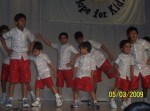
The children and parents of Jeena took the stage yesterday at the India Community Center, Milpitas for their annual show, Jeena Yahaan. Jeena has been a rock for parents of children with special needs. It is a support group and a resource, a community and a refuge; most of all, it is a place families with special challenges go to meet other families like themselves and forge relationships out of  shared common experiences.

The evening began with Pt. Habib Khan’s students singing Panditji’s own compositions created specially for the event. Panditji sat on the side, directing and encouraging the children. Some of the kids sang with gusto, some shrank from the glare of the lights. Unlike a regular children’s event where the parents would be embarrassed by the non-performance of their kids, here there was a serene aura of acceptance, both among the participating parents and the audience.

The acceptance and the love and support that exists among the Jeena community is palpable and almost physical. Audience members shouted words of encouragement to kids on stage. “Go Sanjana,” was the cry when one child froze, overwhelmed by the lights. “You can do it!” was said frequently, as the children overcame incredible odds to present their various talents on stage.

naach-at-jeena1Two dance companies, Selvi Pragasam’s Indian Fusion Dance Academy and Naach, the biggest Bollywood dance company in the US, generously contributed their time and efforts to putting together dance numbers based on Bollywood hits. The joy in the kids’ faces lit up Malavalli Hall, as they waved and twirled to the beat. The audience clapped along, delighting as much in the children’s happiness as the song and dance.


Then there was the play, “Treasure Hunt in TV Land,” which I had written for Jeena. I had to weave in the children’s interests into the play so they would have the patience and enthusiasm to perform on stage and as a result we had Iron Man and Barney rubbing shoulders with Buzz Lightyear, Woody and assorted princesses as the children hunted for treasure with the help of clues.

Whether it was the haunting innocence of a child singing “Shanti Nilava Vendum” with unbelievable purity or the halting exposition of the Gayatri Mantra by a child with cerebral palsy, it was impossible not to be awe-struck by the effort these children put in to perform and the glow in their faces when they had successfully delivered the result of incredible hard work over several weeks.When I saw one child on crutches successfully stomp her weak legs( with little ankle bells attached to them) to the beat of music, I had to work hard not to break down and bawl.

Yes, the set up times between acts was long and yes, some kids just could not perform before a large and loud audience but we knew what challenges they faced and how amazing the whole evening was. There was no fidgeting among the audience and no impatience. If the children could put in the kind of hard work they did, we could show a little patience too.

Jeena Yahaan 2009 has “established a tradition” in the words of Rajni Madan, Jeena’s founder. May this tradition continue for many, many years to come. And may the children continue to astound us with their display of human fortitude and the soaring courage ofthe human spirit.

"99"

Kunal Khemu in 99

There is a scene in the movie Flavors where two software guys on the bench are playing cards to while away their time. One looks at the other and says (and I’m paraphrasing here), “We should do something other than software yaar. Maybe make a movie.” To which the other replies, “Do you think anyone would pay to watch a movie about a couple of software guys on the bench?”

That is pretty much the story of Raj Nidimoru and Krishna DK, two techies from Silicon Valley who got fed up with their careers in the computer industry and decided to make a movie. Flavors was their first full length feature film, a witty movie about a group of connected people in the software industry. (Its sly look at the desi life is so spot on it actually makes for uncomfortable watching at times).

“In the golden days of IT we had so much time, we started thinking and writing a script out of sheer boredom,” explains Raj. The two friends found a camcorder and shot a short film. Being techies, the technical part of movie-making was not hard to pick up. “We did everything,” says Raj, “from writing to editing to sound.” They created a thriller called Just Me, shot on 16 mm, and sent it around to film festivals. The film made waves and opened doors for them.

The film caught the attention of producer Anupam Mittal who suggested they make a full length feature next. The two fledgling film makers pulled in some money from family and friends and made Flavors. The film did excellent business through word of mouth, even though multiplexes were a nascent phenomenon when the movie was released. It was bought by Star TV in India and HBO in Europe. (The economics for movies are such that the big screen take is only a small part of the revenue. Films that succeed on cable and satellite are much better earners for their makers. Raj jokes, “Of course, our viewers in the US saw it on a pirated version! The Indian stores would simple download the movie online and make 10 copies.”)

Now the enterprising team of Raj and Krishna is ready with its second movie, 99 under the banner D2Rfilms. 99, which is intriguingly set in India in the year 1999, is a mainstream Hindi movie starring such well known actors as Boman Irani and Soha Ali Khan.

99-2“Making a movie in India is a totally different experience,” says Raj. “There are a lot of rules you have to work with. You have the unions. Tasks get delegated to professionals. When we were independent film makers we did everything. Now we have to wait for others to finish their part of the job. The dates for the stars have to be managed. It can get overwhelming at times.”

99 is once again being produced by Anupam Mittal, who helped them with flavors. Also starring Kunal Khemu and a bunch of theater actors, the movie is a thriller whose plot Raj is keeping pretty close to his chest. “What we are trying to do is make something fresh and entertaining,” he says. “You can tell from the trailer that there is some talk of betting. There is a reason the film is set in 1999. There are a lots of twists and turns in the movie.” Beyond that he is maddeningly opaque.

Still, the presence of well known actors is reassuring. “Boman and Cyrus( Broacha) liked Flavors a lot,” explains Raj. The main actors of the movie also saw a short film made by D2Rfilms called Shor that was very well received at Cannes and Palm Springs Festivals. “It was easy to convince them to join the project after they had seen our previous work,” adds Raj.

99 releases on May 8th in India, May 15th in UK, US and other locations around the world.

Marghazi Raagam – an interview with T.M. Krishna

By Priya Das

tm-krishnaMargazhi Raagam, the “concert in cinema”, is many things packaged as a movie…It’s a kutcheri/ concert featuring two very popular artistes Bombay Jayashri and T. M. Krishna. It’s a film on digital steroids, with uncompressed six-track sound, audiographed by H. Sridhar, and captured on Red 4K cameras, cinematographed by P.C. Sreeram.  It’s a dream of director Jayendra Panchapakesan come to life- of bringing an evocative, mass appeal to Carnatik music.

Margazhi Raagam is a concert on film, even though an actual concert was not filmed. Seven cameras were used as silent conspirators to capture every nuance as the music was acted out, so to speak. Every expression on the faces of the two main artistes is visible, making the viewing of the movie an intimate dialog between the audience and the musicians. The acoustics are brilliant; all the subtle cadences in T.M. Krishna’s rich voice are brought out in its full glory. Hearing Bombay Jayashri sing is like listening to the breaking of dawn.

I fell in conversation with T. M. Krishna at a press meet recently-

Didn’t the retakes kill the spontaneity of the performances?
T.M.K.: The entire shooting for the film was done in 2 days. Almost every performance was shot uninterrupted, except for one of mine, which we had to shoot in 2 parts because the lights went out! We wound up shooting till 2am that first day.

Have Bombay Jayashri and you performed together before?
T.M.K.:Certainly not for a full-fledged kutcheri. How we first sang together is an interesting story. Jayashri and I were collaborating on a coffee-table book on Carnatic music. We approached the then President of India, Abdul Kalam Azad for the unveiling. He agreed, on the condition that we sing together. It was then that we realized that we hadn’t ever sung together before! So we performed together for an invited audience at the Rashtrapati Bhavan. (The book is called Voices Within, published by Matrka, founded by TM Krishna and Bombay Jayashri, “to create a new platform to present Carnatic music.”)

How did the two of you prepare for Margazhi Raagam?
We didn’t prepare together as such. Jayashri and I have been friends for many years now, and are comfortable in giving each other the space required. We have only 2 duets, incidentally, one of them is without any music, just the two of us singing. Jayendra wanted the music to sound fresh, and gave us a free hand when it came to improvisation. In any case, preparation doesn’t work for me. I like to give in to the mood of the moment and raaga. Jayashri is more organized, on the other hand, and makes for a very appealing contrast in the movie.

Was it difficult to not have an audience during the shoot?
T.M.K.:Singing for Margazhi Raagam was like jamming with friends at home. We did have an audience about a 100, that’s the crew. The set was readied for us beforehand, and then there was a pindrop silence. It was a very intimate setting, very conducive to singing.

How was it to see yourself on film?
T.M.K.:Scary!! (laughs) When Jayashri and I saw the rough cut, I looked at her, nonplussed. I had never before seen myself sing, and this is in close-up! I wasn’t sure how the audience would like it.

And how did the audience like it- how has it been received in India?
T.M.K.:It has been received well. Of course there have been comments all over the spectrum, but I remember one particular incident. I was in Trichy. On a whim, I decided to see Margazhi Raagam in a theater there. When the owner heard that I was in the audience, he called me aside and said to me, “I am in my 70s. I would’ve died never having known the beauty in Carnatic music were it not for this movie, thanks for making it!”

Sarvamangala Mangalye and Jagadodhara are fairly accessible songs- Who selected the content?
T.M.K.:Jayendra, Jayashri and I unanimously selected the songs. Jayendra wanted this to be a common man’s music-movie. So the songs were selected first based on popular appeal, then on composition. We also wanted to choose different composers for each. The choice of the last song was particularly difficult- we felt it needed to hit the right resonance with the common man…our violinist came up with that one- Bharthiyar’s Vande Mataram. You can make the most commonplace song sound exotic and vice versa. It also depends on the rasika and the mood s/he is in- the same music can be enjoyed at 25 different levels.

Is this movie like a much-awaited democratization of Carnatica?
T.M.K.:I think so. I believe that for many centuries, music in South India belonged to the masses. It was during the British Raj that it got closeted into an auditorium, and ticketed, leaving out the common man. In Kerala during the temple season, right to this day, music is sung among the people, in temples, and anybody can come close and ask for requests. I remember a few years ago, there was this drunk rickshaw driver sitting right up front, smoking a beedi. I thought he was in a stupor, and had dismissed him as a serious rasika. Suddenly he gets up and says, “Saami, Todi padangey”! So you see, there is a rasika in every common man.

Margazhi Raagam is set to be released in the US in April and May this year. It was first released in India during the month of Margazhi or the winter month in the Hindu calendar, the time between Dec 15 and Jan 15. Margazhi is the time the Chennai music season is held every year, a time when tens of Carnatic concerts run concurrently, and every concert receives a critique by veteran rasikas and the layman masses. That the movie is named after this season and released first during this time is a gentle nudge to all rasikas to sit up and take notice of this new medium on the block.

Bay Area Dates –

Friday, April 24th at 7 pm, Dolby Labs Theater, 100 Potrero Avenue, San Francisco.  Tickets are $25 and $40.

Sunday, May 31st at 3 pm, IMC6, The Alameda, San Jose.  Tickets are $12 each or $10 if purchased in groups of 4 or more.  For tickets and info contact Aruna Peri : 408.718.5261 | aruna.peri@gmail.com

The trailer can be seen at marghaziraagam.com

Gifts for mom, smiles for children

akshaypatra21The Akshaya Patra Foundation, the world’s largest NGO-run midday meal program, has launched Gifts For Moms, Smiles For Children, a Mother’s Day Campaign that pays tribute to Mothers worldwide.

“That veritable fount of love called Mother does not discriminate.  Putting food on the table is integral to a Mother’s spirit and she is opaque by choice, to whether the mouth that she seeks to feed belongs to her own offspring or someone else’s,” said Madhu Sridhar, president and CEO of Akshaya Patra. “Akshaya Patra’s mission of eradicating hunger and promoting education is based on the vision shared by all Mothers worldwide. Gifts For Moms, Smiles For Children wonderfully blends twin tasks of honoring that often-unsung heroine called Mother and pledging food for a child for an entire year.”

$28 is a wonderful gift on behalf of a mother that a donor wishes to honor. A child somewhere will smile!

It costs Akshaya Patra $28 to feed a child daily for the entire school year.  Donors to the campaign contribute $28 to Akshaya Patra for each Mother they wish to honor. In areas where the Indian government provides a subsidy, $28 can actually feed two children. Once someone has donated, they can either choose for Akshaya Patra to send an email about their gift to the Mother they are honoring, or they can print out a Mother’s Day letter from Akshaya Patra to place in a card.

For more information or to donate to Gifts for Moms, Smiles for Children, please visit http://www.foodforeducation.org.

How To Teach Children Self-Confidence and Self-Worth

By Rennu Dhillon

Self-confidence, self-esteem and self-worth are probably one of the hardest things to teach children, but the most important life skill.

tanay-on-mikeThe reason why it is so hard to teach self confidence to young children is because as they are growing up epically between the ages of 18 months to age 5, children get scolded or corrected for a zillion things. We tend to spend most of the early learning years using the word “No, don’t do that” all the time when in actual fact, we should extend the statement to telling them why they should not do it and try and spend time using and enforcing positive statements.

Not correcting a child  at all  and the mode of free will can result in a spoilt child that will not listen and they become increasingly more difficult to discipline when they get older. Too much restriction and scolding can result in over kill and affecting the self –confidence. So what does one do? It is important to create a balance between the two areas.

Here are some important guidelines and steps to help build self-confidence in your child.

1.    Teach kids to think for themselves – children need to learn to develop their own critical thinking skills so encourage your child to figure out answers. If the child is taking longer than you expect them to answer a question, it is okay. As parents we get frustrated and give the answer to them. This does not help. Encourage them to think and come up with an answer of their own. If the answer is correct or even partially correct, applaud and praise them, If the answer is incorrect, explain to them why it is incorrect and praise them for trying to participate. Children learn by the action of doing.
2.    Teach kids the importance of practical knowledge – being street smart is as important as being book smart. If children learn how to do things by themselves with actual practical experience, they will become more confident in their abilities. Example:  Coloring – many kids like to scribble on their homework and it is easier for the parent to finish off the coloring page and move on to something else. Have your child take pride in their work and praise them when they complete the task properly.
3.    Share as many stories as possible – children love to hear stories and sharing your experiences with them, will help them relate better to you. Effective open communication is the key to a healthy relationship between parents and children.  Children feel more comfortable when they can believe that their parents have had similar experiences to themselves epically in challenging situations such as being bullied at school.
4.    If you first don’t succeed, try again – an important belief to instill in every child. Everyone faces failure at some time or another in their life and some things take longer to grasp than others. Teach your child to accept their failures as an experience and a reason to try again and become better. In school competitions and events, teach the spirit of participation rather than winning. Children should be taught that not everyone can win or come first but everyone can participate and try to win.
5.    Develop the strengths – when growing up children are under immense pressure of excelling in all subjects at school. It is important to teach kids to do their best in all the subjects but to maximize themselves in the areas they excel in. In this way children will develop confidence-becoming experts in certain areas instilling confidence in their abilities.
6.    Etiquette and Manners – instilling etiquette and manners from a young age and teaching children how to behave in a social gathering interacting with other people is very important. Ensure that your child plays with different groups of children and help them learn to make friends by encouraging play dates at your home.

Instilling self-confidence in a child will impact their entire life. People who are self-confident will have better relationships with family, friends and work associates. They are able to set attainable goals and make better decisions in their personal and professional life.

Rennu Dhillon is the founder of Genius Kids and Toto Station.

A Rhythm of Four, A Tribute in Bells: Bay Area dance gurus of Kuchipudi and Bharatanatyam honor two ancient poets

By Lehkikaa

The poet Yeats wrote,
“O body swayed to music, O brightening glance,
How can we know the dancer from the dance?”

yuvabharati1Bay Area dance rasikas had a similar experience when four gurus of Kuchipudi and Bharatanatyam danced at the YuvaBharati concert at the Mission City Center in Santa Clara on Apr 12, 2009. Presented as a tribute in bells to Oothukkadu Venkata Subayyar and Maharaja Swathi Thirunal, it was a heady experience to see four stalwarts on stage together for the first piece: Himabindu Challa, artistic director Nrityananda (Kuchipudi), Jyothi Lakkaraju, artistic director of Natyalaya (Kuchipudi), Shreelata Suresh artistic director of Vishwa Shanthi (Bharatanatyam), and Vidhya Subramanian, artistic director of Lasya (Bharatanatyam).

It was very refreshing to see the oft-presented Pushpanjali in conjunction with Sri Vighna Rajam Bhaje. Along with the dancers, the highlight of this piece was the poses of Ganesha in duplicate. Getting the artistes of similar styles to dance concurrently was a great idea; it brought out the differences in the two art forms.

yuvabharati2For her first solo presentation, Vidhya strung together 3 distinct pieces; Kaliya Nartana, Swagatham Krishna and Taye Yashoda. It would have been such a treat for Vidhya to have danced any one of these for the entire length of her solo. The pieces felt hurried, kind of like watching sunrays dimpled through the clouds, now here, now gone. Certainly, there were flashes of brilliance, both in the dancing (Kasturi tilakam, shame while complaining about Krishna’s kiss to Yashoda) and the vocals (the part in tandem by Asha Ramesh and Madhavi Cheruvu lent a dramatic effect for Kaliya Nartana), but one longed for a long stretch of warm light which Vidhya is otherwise so good at infusing.

Jyothi brought out the nuances of ‘Mani Nupura Dhari’ well. Her left half seemed to be in an engaging conversation with her right half as she danced, she brings a lilting quality to Kuchipudi. At times, the jathis were danced to just music, and it seemed as if the nritta was also doing abhinaya. Jyothi is a treat to watch. Madhavi’s sollukattu here was fire power, she should explore a career in nattuvangam.

Shreelata’s ‘Ati Nirupama Sundarakara’ was a serenade to Delhi Krishnamoorthy’s nattuvangam/sollukattu…or was it the other way around? The recluse in the poet Subbayar would’ve been pleasantly surprised by teasing/ breath-suspending (in a good sense) quality of the vocals; the bhakta in him would’ve been happy with the familiarity which the nayika showed to Krishna. It was intensely diverting for the audience, and one was alternately tapping to the nattuvangam and involuntarily grinning at the sheer joy pulsating in the voice of the singer. Bay Area was fortunate to unexpectedly experience Delhi Krishnamoorthy.

It would’ve been nice to have live orchestra for ‘Marakatha Mani’ by Himabindu. It was an interesting piece that Asha and the Narayanans would’ve brought so totally to life. Himabindu’s use of repeated patterns of nritta served well to punctuate the lyrics. Her finish with the dancing on the plate was ofcourse arresting.

yuvabharati3The conclusion at the end of the first half was: The similarities between Bharatanatyam and Kuchipudi are only in attire; the former seeks to electrify, the latter to enchant. If one were to comment on the style of love each dancer has for her art, Vidhya’s can be defined as a Veera Shringara, she approaches her dance as an equal, with respectful pride. Shreelatha’s is a lover’s shringara, she does not even need reciprocation, she’s enraptured, enamored. Jyothi’s is a mature and masterful Shringara, her path is sure, complete, and transcendental. Himabindu approaches her art with bhakti, willing to be led rather than make a statement.

With such varying styles, the second half was eagerly awaited. True to her bhakti path, Himabindu’s rendition of ‘Paripaahi Ganaadhipa’ was humble and pure. Her use of the Kuchipudi poses highlighted the poetry well. With ‘Paanagendra Shayana’, Shreelata continued her private state of rapture. Keeping a lookout for Padumanabha through the night with her was delightful. She redefines the Araimandi in her nritta, and brings out the drama in her poses. Shreelatha brings in an Ashtapadi-esque emotion to every line of poetry, and commands one’s attention at all times.

Vidhya’s ‘Chaliye Kunjan Mo’ was finally true to her style, and she drew the audience in line by line. The opening was sensual, never has a woman detangling her hair looked so alluring. Krishna one guesses, doesn’t stand a chance from the get go. The lengths she goes to get him into the bower- Water-laden hugs, bird/ feather caresses, the don’t-mistake-the-hold on his arm!

Jyothi’s ‘Sri Ramana Vibho’ was in a word, powerful. She totally mesmerizes the audience, it’s a ticket to the sublime when you watch her. There is an instant resonance in your own heart with each emotion. Her defining take on Putana got one to sympathize with this she-villain for the first time.

yuvabharati4The finale with Dhanasri Thillana was good. It was thrilling to watch them share the stage, and one didn’t know who to look at. The choreography was balanced, but again, not path-breaking and the synchronization slipped in some places. However, one wants to give a long rope to the gurus, it must have been extremely difficult to juggle the schedules and approaches. Thanks though to all of them for seeing it through, the audience appreciates it!

Kudos to Yuva Bharati on this one. Getting 4 gurus together is no mean feat, and whoever made this possible deserves an applause. One hopes that we will get similarly lucky again soon. The only change I’d like to see is that instead of a lengthy intro to each artist at the beginning, they could’ve introduced the orchestra at first, and each dancer before her solo. And ofcourse, if 4 gurus are dancing, then please do get a bigger auditorium next time!

Lehkikaa is a Bay Area dance and drama critic.