 …sign this petition
http://www.thepetitionsite.com/1/abandon-the-elevated-highway-and-save-chennai-beaches
Urban planning has never been one of the Indian government’s strengths, but their latest attempt to build an elevated expressway along the Chennai coastline has found grassroots opposition from a coalition of local residents, activists, and fisher-folk. The latter, in particular, have been mobilized by the project’s cavalier plan to “relocate” them without proper attention to their basic needs. Also, as it happens in many government projects, many loopholes are being exploited to ignore the area’s environmental status. More information on the proposed project and opposition efforts can be found here –
http://saveourbeach.wordpress.com/
http://timesofindia.indiatimes.com/articleshow/4356980.cms
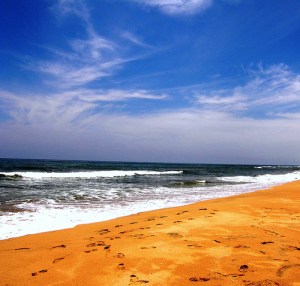
And just a reminder of what’s at stake here.
The entire text of the letter is below.
We, the below-mentioned, are residents, non-resident Chennai-lovers and fisherfolk of Chennai, particularly from Central and South Chennai area such as Mylapore, Santhome, Adyar, Thiruvanmiyur and Kottivakkam.
We are deeply concerned about the Elevated Expressway project proposed by the Highways Department, Government of Tamilnadu, connecting Marina Beach to East Coast Road, near Kottivakkam. Disturbingly, the State Government is seeking to implement the project in two phases, with the first phase running from Marina Beach to 5th Avenue, Besant Nagar, and the second phase running from Besant Nagar to East Coast Road, near Kottivakkam.
We wish to place on record our total opposition to this project, and urge you to drop the project and consider less-disruptive alternatives that prioritise public transport and the safety of bicyclists and pedestrians, rather than yet another subsidy for car and private vehicle owners.
Our concerns are due to the following reasons:
a) Eviction of Coastal Communities and Disruption of Fishing Livelihoods: The proposed highway will cater primarily to the private car owning elite and will come up on the destroyed houses of fisherfolk and coastal poor. The road, in two phases, will run through several major coastal hamlets, including fishing villages such as Nocchikuppam, Nocchinagar, Dommingkuppam, Srinivasapuram, Pattinapakkam, Urur Kuppam, Olcott Kuppam, Odai Kuppam, Odaimanagar, Thiruvanmiyur Kuppam and Kottivakkam Kuppam. The Feasibility Report admits that the project will necessitate “removal of fisherman villages on a temporary basis” The project area admittedly has a population of 1.009 lakhs according to the Wilbur Smith Feasibility report. The Tamilnadu Government’s record of rehabilitation of urban oustees is pathetic. The current relocation sites- in Semmancheri, Kannagi Nagar are all in low-lying areas prone to flooding, and with no sewage, water, educational, transportation or medical infrastructure, and far away from the people’s places of work.
After construction of the highway, use of beach spaces for net-mending, shore-seining etc will be restricted.
b) Violation of Coastal Regulation Zone Notification, 1991: As a project with investment over Rs. 5 crores, this project will require Central Government clearance under Clause 3(v) of the Coastal Regulation Zone Notification, 1991. Further, no application for such clearance can be considered in the absence of an Environmental Impact Assessment, which will reveal the unmanageable nature of the environmental fall-outs of the project. The project has been conceived as an integrated project in two phases, and the environmental and social impacts should not be presented in two separate phases. Rather, the cumulative impact, after considering the existing pressures on the coastal system, and factoring in sea level rise, and extreme weather events, must be assessed and presented. CRZ clearance too should be sought in for the project in its entirety, rather than on a piecemeal basis. The Wilbur Smith Feasibility Report states that “The elevated alignment is proposed to run on wherever existing roads are available and also on the seashore and open land to minimize impact on congested fisherman settlements”
Ever since the project was conceived, there have been numerous attempts at constructing illegal roads on the beach. Currently, Zone 10 of the Corporation has made several aborted attempts at constructing a road on the seaward side of the existing habitation in Urur Kuppam. However, opposition from the Urur Kuppam fisher panchayat has kept this project in check.
The Government of Tamilnadu has shown a remarkable restraint in taking action against CRZ violations and violators. Even worse, public authorities such as Corporation of Chennai and the Public Works Department have frequently violated and continue to violate the CRZ Notification. Evidence of such violations can be found in the construction debris dumped on the beach area, on the southern bank of the Cooum Estuary, the ongoing dumping of construction debris at the Southern end of the Marina beach in preparation for the elevated expressway, the construction of concrete structures (a bathroom north of the swimming pool on Marina, and viewing galleries on Besant Nagar beach) on the beach without CRZ approval, and the wholescale landscaping and alteration of beach ecosystem within the remodeled and expanded Governor’s bungalow on Besant Nagar beach.
The Feasibility Report, drafted by Wilbur Smith Associates, repeatedly refers to Phase 1 of the project as a “Reconstruction of existing road with Elevated Corridor from Light House to Besant Nagar. . .reconstruction of existing bridge across river Adyar with “Signature bridge”
It refers to the Phase 2 of the project as “Construction of Elevated Corridor from Besant Nagar to East Coast Road (ECR) along the coast by making use of the existing road alignments.”
It is noteworthy that the “existing bridge” referred to in relation to Phase 1 is a dilapidated structure of a pedestrian bridge that was washed away in a major cyclone in the 1970s, and has never been reconstructed since. Replacing a broken, unused pedestrian bridge by a 6-lane expressway can in no way be construed as a mere reconstruction. Such mischievous wording is intended to facilitate CRZ clearance for a project that otherwise cannot be accorded such clearance.
Violating the CRZ Notification is not merely a legal infraction. Rather, as a yet another instance of inappropriate land use, the road project will add on to a long list of existing encroachments in the coastal area, and exacerbate the effects of extreme weather events that are anticipated to occur more frequently and with greater intensity in the future.
The Government of Tamilnadu has wrongly designated the entire coast of Chennai as CRZ 2. By notifying even ecosensitive areas including sandy beaches, Olive Ridley turtle nesting grounds and estuaries as CRZ 2, they are opening these areas for unregulated development. This despite the fact that the Ministry of Environment & Forests, through a letter to the Chief Secretary, Government of Tamilnadu, dated 27.9.1996, has issued clear instructions that “In addition to the information already available with the Government of Tamilnadu, all ecologically important and sensitive areas shall be demarcated on the basis of the following sources of information and be classified as CRZ 1”.The suggestive list mentioned by the Ministry in this letter include: mangroves, mud flats, breeding grounds for turtles, areas rich in genetic diversity, and areas of outstanding natural beauty.
The Wilbur Smith report admits that “the first phase of the proposed road project crosses the marine environmtal sensitive place of Adyar estuary. The estuary is also name demarcated as bird sanctuary by the Tamil Nadu Forest Department. Noise generation arising during the construction activity will drive the birds away and cause an ecological imbalance to the estuary and the fish population”.
c) Disruption of Olive Ridley Turtle Nesting Habitat: Marina, Besant Nagar, Thiruvanmiyur and Kottivakkam beaches are known nesting grounds for the Olive Ridley turtles. Ridley turtles are listed in Schedule 1 of the Wildlife Protection Act at par with the Indian tiger. Turtle hatchlings are extremely light sensitive, and strike out towards the moonlit-oceans in the absence of any background light. With a highway running through the beach, the lights are likely to fatally confuse Ridley hatchlings. In 2008-09, about 65 turtle nests, with roughly 100 eggs each, were recovered from the area between Neelangarai and Adyar Estuary.
The Wilbur Smith feasibility report states: “The proposed construction activity has significant impact on fauna. The proposed site is known for the breeding ground of Olive Ridley Turtle (Green Turtle). The construction activities will have major impact on the turtle breeding”.
d) Theosophical Society and Adyar Estuary: At one time, the Government of Tamilnadu had declared the Adyar Estuary as a bird sanctuary. Even now, despite the polluted nature of the waterway, the estuary and the densely wooded grounds of Theosophical Society continue to attract a variety of birds. The developments on the Northern shore of the Theosophical Society (MRC Nagar) and the increased urbanisation since 1989 have already taken a toll on the local bird bio-diversity, which remains impressive for an urban setting despite the beating it has taken. According to a comparative study done in 2009 by EMAI, a Chennai-based registered Trust engaged in environmental monitoring and action, at least 109 birds were spotted in the Theosophical Society and Adyar Estuary area in 2009. This is in contrast to 175 in 1989, before the constructions in MRC Nagar came up, and 124 in 2004. At least two species, listed in Schedule 1 of the Wildlife Protection Act, 1972, have been sighted in the Theosophical Society grounds. The Black Baza (Aviceda leuphotes) and the White-bellied Sea Eagle (Haliaeetus leucogaster) were regi;ar visitors to this area until 1989 and 2004 respectively. The fact that such species frequented this ecosystem underscores the ecological importance of the area, and indicates that the region should be revived to make it hospitable for these and other species.
The Theosophical Society is also a haven for birds, bats and other wildlife and is the last remaining lungspace within South Chennai. Constructing an elevated road along the Society’s edges is bound to disturb the carefully protected ecosystem within the Society grounds.
Indeed, one of the last surviving patches of tropical dense evergreen forests is to be found in the grounds of the Theosophical Society. The TS has a balance of gardens, orchards and forests, and indigenous and exotic tree species. The Saraca Indica [Asoka, not Nettilingam] as well as a graft from the Bodhi (Ficus Religiosa) tree under which the Buddha is said to have attained his enlightenment are to be found within the lands of the Theosophical Society. The Tropical Dense Evergreen Forests within the Society are different from the Guindy National Park in that the latter accommodates large herbivores like the Chital. Absent the grazing herbivore, the ground cover in the Society is intact, rich and abundant, displaying all three layers of vegetation typical of an evergreen forest. The freshwater ponds are home to terrapins, frogs, chameleons, snakes and insects. Jackals and mongoose too are residents of the Adyar-Besant Nagar area.
The edges of the estuary along the Theosophical Society also host the last remaining mangroves, and the state of the estuary calls for massive efforts to rehabilitate the water body, rather than activities that will degrade it further. Reviving the estuary would go a long way in improving fish population in the coastal waters, and improving the local economy of fisherfolk. The Wilbur Smith report too concludes that:”The estuary is also name (sic) demarcated as bird sanctary by the Tamilnadu Forest Department. Noise generation arising during construction activity will drive the birds away and cause an ecological imbalance to the estuary and the fish population.”
e) Disturbance to places of learning and cultural importance: The second phase of the proposed highway will run through or alongside important cultural centres like the Vailankani Shrine, Ashtalakshmi Temple and the Kalakshetra Foundation. The latter, declared ‘an institute of national importance’ by an Act of Parliament, promotes the arts, houses two schools and a unit for weaving and natural vegetable dyes, and is recognized worldwide for its integrity in upholding the highest values of India’s artistic traditions. Phase II of the project, if implemented as fleetingly outlined in the Wilbur Smith feasibility report, will run through the Central Government-owned Kalakshetra Foundation’s estate that stretches right up to the beach.
f) Destruction of one of the last remaining open spaces in Chennai: The beaches of Chennai are the last remaining open spaces available to Chennai-ites. The prospect of losing the beaches as recreational spaces will coalesce not just Chennai residents, but also tourists and other visitors who frequent these areas.
g) Construction debris and workers’ housing: Dumping of construction debris on the beach, even if temporarily, will alter coastal ecology and hydrology and exacerbate the effects of seasonal flooding. Construction of the expressway will also involve the labour of hundreds of workers. Their accommodation needs, and sanitation requirements will put a massive strain on an already stressed coastal environment. Filling in of low-lying areas for construction of culverts and embankments will permanently alter coastal topography and aggravate the effects of flooding on vulnerable coastal residents.
h) Violates Masterplan and National Urban Transport Policy: The Elevated Expressway project was not presented or even mentioned in the Draft Masterplan published for public consultation. As a result, this project has not been subject to any public scrutiny and does not find any legitimate mention in the the 2nd Masterplan. Further, there is no explanation as to how the project meets the stated objective of achieving a modal shift to 70:30 in favour of public transportation. Neither is there any explanation of how the project prioritises public transportation. In fact, the feasibility report says
i) Absence of examination of alternatives: The project fails to examine alternatives, including policy measures and planning interventions such as measures to discourage private vehicles, increasing public transportation capacity, staggering office and college/school hours etc.
For these reasons, we request that this project be abandoned and the State and Central Governments should begin a sincere search for long-term mass transportation alternatives in consultation with the public.
 India Community Center is joining over 73+ non-profit Community partners focusing on service for needy children, elderly, education to the underprivileged, free health services and for providing needed support to people in difficult times in their lives. This event centered on the noble theme of Seva (Service) is free for children to inculcate value of community and community service in them.
 Script! Script! Script! It’s true that there is a dearth of good screenplays in Bollywood, but if the most influential production house in Mumbai cannot attract the right kind of talent, it is a sad commentary on the state of the industry.
 Like many others, Preeti Arora, a resident of Cordova, TN, is a mother of two and a fan of Amar Chitra Kathas (ACKs). Preeti says “The challenge for me as a mom is to constantly add new titles to my Amar Chitra Katha collection for my kids. Because of my busy schedule, I want these comics to be easily accessible and from a reliable source in the US itself.”
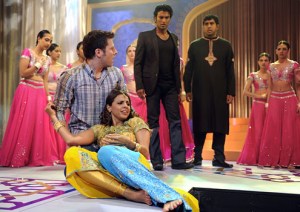 USA Network’s
 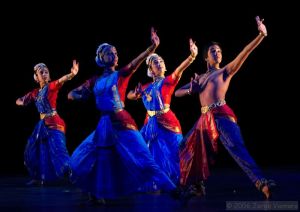 A decent turnout on a Friday evening-Sep 11, 2009 at Cubberly Auditorium, Palo Alto- was ample proof that Mythili Prakash’s debut of the Drishya Kaavyam production was eagerly awaited by the serious rasikas of Bay Area, CA. It was indeed a treat to the eyes; almost every piece had the dancers in different costumes, and every group piece was a visual delight. The pace throughout was…well, Mythili-esque- fast and staccato, a shot of mental caffeine. The lighting and orchestra deserve special mention, as both were outstanding.
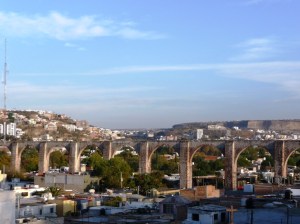
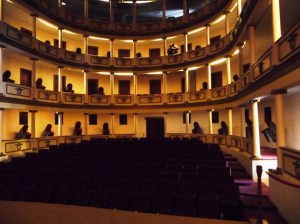
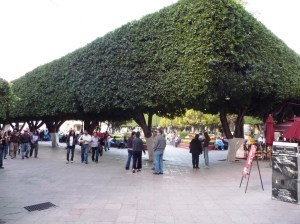 Fantastic ads by Corona, constant in-your-face late night infomercials for Girls Gone Wild videos and the rising toll due to drug violence on the border, fuel a common perception in the United States that Mexico is either too crazy or too unsafe to travel. If you follow a few basic rules and little bit of Spanish, Mexico is one of the most wonderful places to explore, enjoy and experience. Late last year, my wife and I decided to take a slightly less traveled road and took a trip to some historic and colonial towns north of Mexico City. Our destination was going to be the historic and beautiful city of Queretaro, a UNESCO heritage city about 160 miles north-west of Mexico City.
 Water, No Ice