
Monthly Archives: October 2010

US Midterms 2010: Propositions on the ballot: Results Update

web_vote

UPDATE 2: RESULTS..scroll down.

UPDATE: Came across this blog post by Digby. Read the whole thing. Then GO VOTE.

Voting isn’t just about making good things happen for yourself and your family. It’s about voting against things that will make your lives worse. And if this Republican party — at this point in history — wins big over the next two years, the lives of average Americans will definitely be worse.

Midterm elections generate low interest among less partisan voters, who need the excitement of a Presidential election to drag them to the polls. But with the ideological lines being drawn sharper now than any other election in recent memory, and vast amounts of shadowy corporate money flushed into the system courtesy the Supreme Court’s Citizen United ruling, there are real costs and consequences to your decision to abstain. Take 5 minutes and GO VOTE on November 2nd.

Typically, propositions with real teeth are introduced in midterm elections, since there are only a handful of devoted poll-goers with very specific demographic profiles that need to be convinced. Let’s confound those expectations by making sure we all vote, and vote in an informed fashion.


PROPOSITIONS

Summary

Proposition 19 – VOTE YES Result: FAILED

Proposition 20 – Vote YES Result: PASSED

Proposition 21 – Vote YES Result: FAILED

Proposition 22 – Vote NO Result: PASSED

Proposition 23 – Vote NO Result: FAILED

Proposition 24 – Vote YES Result: FAILED

Proposition 25 – Vote YES Result: PASSED

Proposition 26 – Vote NO Result: PASSED

Proposition 27 – Vote NO Result: FAILED

Proposition 19-Broadly speaking, voting YES on this measure allows local governments to regulate and tax the use and sale of marijuana. It also allows people 21 or over to carry and use it for personal use.

It is  a testament to the increasing acceptance of cannabis that the opposition to this proposition is largely on the basis that the proposition is written badly. If that argument sounds familiar, it is because that is often the last resort of opponents who can’t offer any other convincing rebuttal. Is there some merit to the fact that by allowing each local government to set its own rules, there is going to be an enormous amount of bureaucratic confusion generated by this measure? Not really, since counties do set some of their own taxes.

The federal statute still considers the use and sale of marijuana illegal, so there is the added gray space around this proposition, but legalizing personal use of cannabis in California sends a message to the federal governement to start treating this product on par with cigarettes and alcohol.

VOTE YES. RESULT: FAILED
Back to top

Proposition 20 and Proposition 27 – In 2008, sick of districts being gerrymandered, voters passed Prop 11, taking the power of drawing district lines for the state legislature away from legislators themselves and handing it to an independent commission. However, the power to redraw Congressional districts is still in the hands of legislators.

Voting YES on Proposition 20 would mean that even congressional districts would be drawn by an independent commission. Voting NO would maintain the status quo.

However, Proposition 27 aims to rescind Prop 11. Voting Yes on Prop 27 would mean returning the power to redistrict state legislative districts to the legislators. Voting No would keep Prop 11’s provisions for an independent commission in place.

What if both Prop 20 and Prop 27 prevail? Whichever proposition gets more votes will win. If Prop 20 gets more votes, then both state and congressional districts will be handled by an independent commission. If Prop 27 gets more votes, then the power to redraw districts will return to the hands of legislators (members of Congress).

While the sentiment behind Prop 20  seems to be admirable, it is almost entirely funded by Republican millionaire Charles Munger in an attempt to take redistricting away from the Democratic party in California. However, I am going to take a stand based on my opposition to gerrymandering.

VOTE YES on Prop 20 RESULT: PASSED

VOTE NO on Prop 27. RESULT: FAILED

Back to top

Proposition 21 – This ballot measure would fund California’s park system through an $18 increase in the vehicle registration fee; currently, the system is funded through the state’s chronically squeezed general fund. (I am told this is something like a surcharge on televisions to fund the BBC in the UK.)

The new fee would raise roughly $500 million a year, compared to the current annual state park operations budget of $439 million.

In return for paying the new vehicle surcharge, California motorists would get free admission to all state parks, which currently charge a day use fee of $5 to $15 per vehicle.

Voting YES would impose the fee. Voting NO would maintain the status quo.

Our family uses the local State Park at Coyote Hills frequently, and we buy an annual $50 pass for the privilege. Even with 2 cars (total surcharge $36), this measure is a no-brainer.

VOTE YES. RESULT: FAILED
Back to top

Proposition 22- This proposition prohibits the State, even during a period of severe fiscal hardship, from delaying the distribution of tax revenues for transportation, redevelopment, or local government projects and services.

The sentiment is worthy; during this recession, local governments have seen the state appropriate funds derived from local property taxes and fuel tax revenues, usually meant to be used for transportation related services, have been funneled to service debt. Voting YES on this proposition would severely restrict the ability of the state to make these appropriations. Voting NO would maintain the status quo.

However, propositions like these have slowly eroded the state government’s ability to make prudent and flexible budgetary decisions. If prop 22 passes, the state will have no choice but to impose new taxes to generate new revenue streams to make up for the $1 billion fiscal impact the new law will have. Also, richer communities will keep more of their wealth, and poorer communities will have to depend more and more on shrinking state revenues for essential services.

I think it is unfair for us to blame the state government for poor performance and budget woes and then help pass an initiative that hampers its ability to govern effectively.

Vote NO. RESULT: PASSED

Back to top

Proposition 23 – This is the infamous proposition to rescind AB 32, the Global Warming Act of 2006. AB 32, California’s landmark clean air act, required polluting companies to reduce emissions to 1990 levels by 2020.

Voting YES would suspend AB 32 and allow polluting companies to operate under older guidelines.

Voting NO would keep AB 322 in place.

My first opposition to this is that AB 32 was a law passed by the legislature, which is their job. If we disapprove of their actions, we vote them out. Governing by referendum is just not something to be encouraged and exposes the state to the tyranny of a hyper-partisan minority that actually bothers to go to the polls.

Secondly, there is a battle being fought at the national stage to cap greenhouse emissions, prompting the White House to chime in on this proposition. “The president is opposed to Prop. 23 — a veiled attempt by corporate polluters to block progress towards a clean energy economy,” White House spokesman Adam Abrams announced Wednesday. “If passed, the initiative would stifle innovation, investment in R&D and cost jobs for the state of California.” (Source L.A. Times)

If you are concerned about the environment, and interested in encouraging the development of clean technology and alternatives to fossil fuels,

Vote NO. RESULT: FAILED
Back to top

Proposition 24 – Voting Yes on this initiative would stop several corporate tax breaks that are slated to go into effect in 2010 and 2012. The tax breaks include:

* The “single-sales factor”. This allows multi-state corporations to choose whether they will be taxed on property, payroll or sales.
* Loss carry-backs. This allows corporations that are experiencing losses in California’s current economy to get refunds for taxes paid up to two years previously.
* Tax credit-sharing. This allows companies with more tax credits than they can use to distribute the tax credits to affiliates.

These tax breaks benefit only about 2% of California’s businesses , the richest, multi-state corporations in the state. In these poor economic times, repealing corporate tax breaks for the wealthiest corporations makes sense.

VOTE YES. RESULT: FAILED
Back to top

Proposition 25 – Voting Yes on this proposition would end the current requirement in the state that two-thirds of the members of the California State Legislature must vote in favor of the state’s budget in order for a budget to be enacted. It also requires state legislators to forfeit their pay in years where they have failed to pass a budget in a timely fashion.

This is a no-brainer. Requiring two-thirds majority for budgetary decisions has caused tremendous gridlock in Sacramento. And this initiative keeps the two-thirds requirements for any new taxes.

VOTE YES. RESULT: PASSED

Back to top

Proposition 26 – Voting yes would mean that it would require a two-thirds supermajority vote in the California State Legislature to pass many fees, levies, charges and tax revenue allocations that under existing rules can be enacted by a simple majority vote.

The biggest donor to this initiative is Chevron, followed by the California Chamber of Commerce, which should tell you plenty about the motivation behind this amendment. If this Proposition passes, it will make it harder to impose fees on corporations that cause environmental or public health problems. Also, imagine if local governments had to go to the public every time they wanted to impose a fee; the costs of running the decision through the electoral process would be more than the fees levied.!

This is another case of pushing all these decisions into the hands of voters rather than their representatives, and neutering government.

VOTE NO. RESULT: PASSED
Back to top

Proposition 27 – See Proposition 20.

VOTE NO.

CANDIDATES: Normally I would take a serious look at all candidates for office. However, if there’s one thing the last 2 years have illuminated very clearly, it is that the Republican party places a very high value on loyalty and ideological purity. There doesn’t seem to be any room for moderate Republicans with pragmatic ideas.  Instead, the Senate minority leader Mitch McConnell has made it plain that his sole ambition, should the Republicans take the majority, is to take down Obama – not govern well, not reduce the deficit, but take down the President.

I am not going to enable this kind of shamelessness. I will, therefore, be voting Democratic down the line.

Plus, if you wanted a reason to vote for Jerry Brown, see this:

Ha!

CANDIDATES RESULTS:

GOVERNOR: JERRY BROWN

U.S. SENATOR: BARBARA BOXER

LIEUTENANT GOVERNOR: GAVIN NEWSOM

CONTROLLER: JOHN CHIANG

TREASURER: BILL LOCKYEAR

ATTORNEY GENERAL: STILL UNKNOWN AS OF WRITE TIME.

Thank you California voters, for keeping the state Democratic, even if you were quite bone-headed about the various propositions on the ballot!

Picture courtesy Alan Cleaver via Creative Commons.

Commonwealth Games Opening Ceremony: New Delhi

By Geeta Padmanabhan

Commonwealth-GamesAfter being OD-ed by the filth, lies, corruption and the inhuman treatment of Delhi’s poor during the run-up to the Commonwealth Games 2010, I sat down to watch the opening ceremony, waiting for a miracle. It happened  – and exactly for the reasons you would have guessed. Together, India’s music, its art, original artists and artisans have nothing comparable anywhere you’ve been. India’s might is in her soft power.
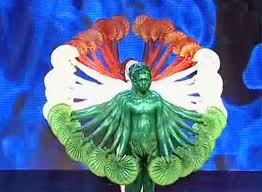
This is what I saw in the spectacular show. Bullet-pointing it is the only way I can keep out the hyperbole.

[1] In shape, variety and sounds, Indian drums have no parallels. Appropriately, the Nagada drummers beat the opening rhythms to start the extravaganza. The Rhythms of India segment had the Pung Cholum from Manipur, the Chenda from Kerala and the Gaja Dhol, Wangala, Dholu Kunitha and the Bhangra. They beat in unison, the resonance of each standing out while blending perfectly with the other sounds. That’s when you felt your heart filling and the gooseflesh jumping.

[2] Among the hundreds of swirling drummers sat seven-year-old Keshav, a prodigy from Puducherry, playingCWGimages the tabla like a maestro. He didn’t miss a beat!
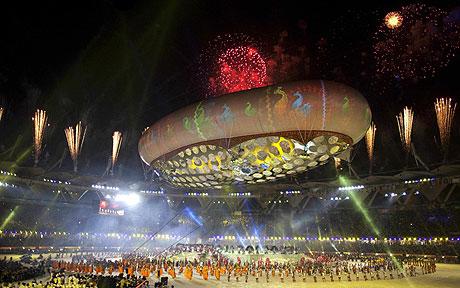
[3] The earliest jaw-dropper was the helium-filled aerostat balloon, the centre piece acting like a giant round television screen. As “snake charmers” played their flutes, it rose, hoisting India’s touch with technology. Through the evening the aerostat floated, reflecting the colours and pictures of the programmes. Words from 18 different languages of India appeared on its surface, all translating to ‘Welcome’. Simply marvellous!

[4] What does one say about the Indian kids’ virtuosity on stage? Hundreds of Delhi school children piled in, swayed to Hariharan’s mellifluous “Swagatham”, changed formations smoothly, switched costumes, and in a mind-boggling sequence, painted mehendi on a cloth held above their heads. As they painted from below, magically the ‘namaste’ gesture appeared on the surface facing the audience. Where can one see something like this?

[5] The yoga sequence was a master-stroke. As hundreds of yogis in their smooth golden costumes performed asanas to soothing music, a shining wire-yogi sitting at Padmasana rose out of the middle of the homakundam-like stage. As explanation flowed in Hindi and English, the kundalini appeared inside the wire-figure as a hologram. It was a spectacle meant to pooh-pooh the sinister propaganda that yoga has nothing to do with Hinduism or India. Ha!

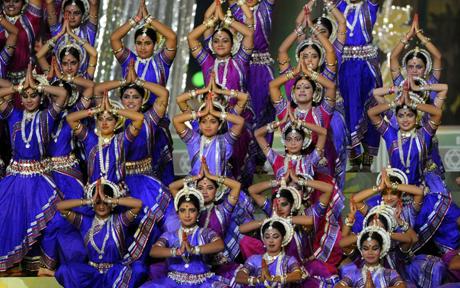
[6] Our classical dances – Kathak, Bharathnatyam, Kuchipudi, Mohiniattam, Manipur had their own striking segment. This is when you realised that experts in the classical arts have been entrusted with the job of putting the show together. The music, the mudras, the formations and of course the costumes were simply out of the world. Colourful, but elegantly so!

[7] And the segment which had even those watching the show on TV stand up, laugh, scream and applaud: The delhi_1731009cIndian train. Our trains symbolise so many things – the British legacy, the aam admi’s life, the railways’ reach to the remotest parts of India. As the bogies rolled across the stadium each carrying its unique merchandise in exaggerated sizes and colours, you saw the India that you grew up in – the India of the masala chaiwala, the banglewala, balloonwala, roadside mithaiwala, highway chandelierwala, street rope-walkers. And scurrying to catch the train were the dubbawalas, the potted women, the coolies and others. In that chook-chook gadi, the true, honest, un-hypocritical India, the endearing India that you see in the hinterland was unveiled. Just think. This is how the ordinary, but extra-ordinarily resilient Indian lives his life. It’s a scene that cannot be replicated anywhere else!
[8] It was a day after Gandhiji’s birth anniversary – and isn’t Gandhi the pillar of our British legacy?  This is how the event organisers saw it. Around a brightly lit table on the stage stood painting artists, and “drew” the picture of the Dandi march in a few minutes by simply removing fine mud from the surface. As their thumbs worked creating white areas on the mud-filled surface, Gandhi, a woman carrying the national flag and followers miraculously appeared. In the background you heard “Vaishnava Janato” played live. There was stunned silence as history unfolded. The spectators had no energy left to suitably applaud this wonder.

[9] AR Rahman’s song was billed to be the last – his CWG signature tune had come into a lot of criticism from our classical dancers who had to accompany the beat. “Too slow, too uneven”, they had complained. He was asked to tweak it. Now he walked in followed by city dancers – women in dervish-like costumes and men wearing gloves in India colours. The dance began, Rahman began singing “Jiyo, Utho, Badho, Jeeto” and all waz well, almost. Our folk dancers bravely caught the rhythm and swayed, the drummers kept time. The hesitation vanished and the stadium pulsated with dance when Rahman switched to Jaiho and took it to its crescendo. That was a clever move.

A word about the spectators. They paid huge amounts – upto Rs. 25,000/- for the seats and filled the 60,000 delhiget_1730915cseats. They were on cue, participating in the show, clapping encouragement. In a wonderful gesture, they cheered, very loudly, the Pakistan contingent. It was a moment that made us world class. We proved we are civilised in a way that only an old culture can bequeath. Well, they booed Kalmadi as he spoke, but that’s discussion for another day.

Summary: Finally, the cameras had something beautiful about the CWG to capture. The most remarkable part of the opening ceremony was that only one complete dress rehearsal had been held at the Jawaharlal Nehru Stadium. For those who count the paisa: The ceremony cost 150 crores – an example that India now speaks in crores.

India’s clout went far in silencing a lot of criticism about the “unlivable” Games village and the apparent racism in allotting rooms, but it didn’t go far enough to acquire the privilege of declaring the games open. Prince Charles held on to the tradition by making the declaration at the end of his reading of the Queen’s speech. In a sort of compromise, the Republican lady shouted a “Let the Games begin!” with a flourish.

The show wasn’t about technology. It wasn’t perfect either. Among the 7000 artists there were a couple without costumes, the movements were a bit chaotic at times, but that just made it all so warm and endearing “unlike the show in Beijing that was so perfectly plastic,” as someone put it. This show was about who we are, what we should be proud of. In putting together a my-own kind of desi event that included a humourous take on our unique aspects of life, we definitely proved something. We Indians are not ashamed of our past. We get along, in our own inscrutable ways. We find our joys in spite of our politicians. That is a true show of maturity.

It is encouraging that the powers woke up to the fact that India’s cultural icons, and not some stiff-necked babus who must be given the task of choosing and organising the events for the ceremony.  India had arrived long ago. It’s the world that wore blinkers.

Will the Games bring us more biz contracts? Quite possible, and I hope it is in our garment designing and handicrafts, not in hard manufacture that strips the poor of land and water.
Will the Games give us a cocky gait? May be. A new accent in our speech? Quite likely.
But I’m living in the euphoria of our ancient cultural artistry. Let the feeling last!

Mickey Mouse Hindus

By Mona Vijaykar

Om signHere we are, ramping up to a season of Hindu festivals which began with Ganapati’s arrival in September. Yet, these occasions have evidently lost their original spiritual significance and are more likely opportunities for  consumption of spirits, instead!  Some Hindus do go through the motions of performing “sacred rituals” but, often, with the attitude of a child who is made to repeat a hundred lines in detention. Even multiple enactments of the Ramayana may have failed to rescue us from our ignorance. Some of us were probably mortified by the inconceivable Vanar Sena!

Apart from a few who have thankfully discovered Hindu wisdom from Masters across the globe, most of us are clueless about the precious knowledge preserved in the scriptures. With the absence of any formal Hindu spiritual education, I am reminded of the hapless “Dhobi ka kutta, na ghar ka na ghat ka.” As a result we have lost out on valuable tools to deal with life’s challenges. Generations of Hindus have grown up totally disconnected from the philosophy, due to what I call, the ‘Disneyfication’ of Hinduism.

A five year old child who wonders how his tooth falls and disappears will bite the Tooth Fairy explanation.  He may even clobber his older brother for challenging his belief, but as an adult he will abandon the Tooth Fairy for the encyclopedia.  The Disney approach to knowledge must lead to the channel of Discovery to acquire a logical, scientific understanding of life.

Yet, we Hindus suffer from a life-long Tooth Fairy syndrome, clinging to bizarre mythological stories from the Puranas, taking them literally, without attempting to delve into their meaning and symbolism as adults. Without decoding the superficial tales, popularized by Amar Chitra Katha and which hold enormous  potential for entertainment, the deeper knowledge remains a mystery. Worse, any attempt to reveal their true meanings, may even invite the wrath of staunch believers like the toothless 5 year old.

I was invited to teach Hinduism to children at a temple in the Bay Area when a parent became incensed over a particular slide.  A picture of Vishnu asleep on the coils of Ananta, titled “Personification of the Living Potential Energy” turned the poor man blue in the face.  Needless to say, my sacrilegious classes were scrapped and replaced by a robotics class instead!

A while ago my friend, Savita, engineered an India in Classrooms’ Divali display at a friendly neighborhood church. In the midst of the buzz of eager visitors, I froze as I overheard an elderly Indian woman loudly describe the interesting phenomenon of Shiva attaching the head of an elephant to his son, Ganesh’s body!  Amused, I listened patiently as she explained to her wide-eyed American audience, with the seriousness of a Roadshow host, demonstrating a wheel installation on TV.  When I dared to interrupt the passionate discourse with polite skepticism, I was impatiently waved silent. So, I did what was best in the circumstance … took a deep breath and continued to watch the curious expressions on the faces of her captive listeners.

But the incident that really knocked the breath out of me was when a high profile attorney of part Indian heritage began her “empowerment” speech at a women’s conference with a reference to “Shiva’s raging testosterone!” She then proceeded to entertain her giggling Indian and American audience with Parvati ‘s gesture of “time out” and other  gory details of the popular Hindu myth; by itself, a story without any redeeming value, yet, passed down as precious cultural inheritance.

Of course, had she known that Shankar and Parvati represent gross and subtle forms of energy; and that their “union” gives birth to all organic life, represented by the elephant and mouse, she would have missed out on all that delicious fodder for public amusement.

A high school student at Harker Academy once asked if Hinduism has evolved. My response was simply, “Hinduism as a practice has regressed…yet Hindu wisdom is the most evolved”.

As the editor of India Currents astutely states,” Being American is an idea…not an ethnicity,” being Hindu too is an idea, not a religion. A Hindu is one who lives in accordance with the laws of nature that govern our existence, (regardless of one’s religious heritage). A Hindu is environmentally consciousness, conserves our resources, helps preserve endangered species, and is mindful of his very intricate connection with all beings in the cosmos. A Hindu acknowledges the power of the indestructible Conscious Energy that is the unifying basis of all life. This pretty much renders a whole lot of us non-Hindu! By the same token, some Buddhists, Christians and Muslims may in fact fit the Hindu profile!

Just as Math principles are universal, yet taught by different Masters , through varied speech and methods, these core  universal Hindu principles have been passed down through the ages by Masters across the globe through different practices and in the language of their times.  Unfortunately, this universal wisdom has been lost in translation and  reappeared in the form of seemingly different religions. eg. Buddha replaced the word Moksha with Nir vahana; Christians use the word “bondage” instead of “bandhana” and Muslims use the word Jihad for the war within.

No wonder, a young second generation Indian American confided in me, “Aunty, Hinduism just doesn’t speak to me.” And why would it, if the language (and I do not mean Sanskrit) that we use to convey the knowledge is so far removed from contemporary grasp? How does an Indian American child relate to, let alone be inspired by a story that was conceived in an ancient, alien context?  How would a child benefit from multiple enactments of the Ramayana apart from gaining stage presence? Children have an incredible capacity to understand subtle concepts without being fed stories of “angry Shiva destroying tigers or chopping off heads.” If Hindu philosophy is taught through practical games and creative workshops, future generations may have the conviction to face adult challenges with faith and courage rather than succumb to confusion and hopelessness locked in blind belief. Let the path of discovery illuminate our minds so we are no longer Mickey Mouse Hindus.

Mona Vijaykar, mother of two global citizens, is committed to intercultural understanding as founder-director of India in Classrooms teacher assistance program (www.indiainclassrooms.org).

Picture by Rohit Markande, Courtesy Creative Commons.

Who to vote for?

us congressIn case you’re among the despondent Democrats or indecisive Independents who doesn’t know which side to pick, I give you the accomplishments of the last 2 years, courtesy Daily Kos poster Thisismytime.

Health Care Reform:

Economy:

  1. The American Recovery and Reinvestment Act of 2009 (ARRA) has worked. The Economy Has Been Growing – take a look at the graph of GDP growth between 2007 thru 2010.
  2. US auto industry rescue plan — Detroit making profits again and at least 1 million jobs saved.
  3. Worker, Homeownership, and Business Assistance Act of 2009 that extended Unemployment benefits up to 20 weeks and more.
  4. Provided $14.7 billion in small business loans increasing minority access to capital.
  5. The $26 billion aid to states package preventing large-scale layoffs of teachers and public employees.

Banking and Financial Reform

  1. Signed a sweeping bank-reform bill (the Dodd-Frank Wall Street Reform and Consumer Protection Act)into law
  2. Managed the $700 Billion Troubled Asset Relief Program (TARP) that Banks have repaid 75% of TARP funds, bringing the cost down to $89B as of June 2010.
  3. Cut Salaries For 65 Bailout Executives
  4. Closed offshore tax safe havens, tax credit loopholes on companies that use the tax laws to ship American Jobs oversees. HR 4213.
  5. Signed into law the Fraud Enforcement and Recovery Act to fight fraud in the use of TARP and recovery funds, and to increase accountability for corporate and mortgage frauds.
  6. Signed the Credit Card Accountability, Responsibility and Disclosure Act

Education

  1. Health Care and Education Affordability Reconciliation Act of 2010 that increased the amount of federal Pell Grant awards and enabled the stripping of banks privileges as intermediaries for student loan servicing.
  2. Created the Race to the Top Fund, a $4.35 billion program to reward States that submit the best proposals for change.
  3. As part of the American Recovery and Reinvestment Act, funded over$100 Billion for reforms to strengthen Elementary and Secondary education, early learning programs, college affordability and improve access to higher education, and to close the achievement gap.

Jobs

  1. The $787 billion economic stimulus package has created or saved nearly 2 million jobs slowing the bleeding
  2. Jobs for Main Street Act (2010)injected $27.5 Billion for Highways, $8.4 Billion for Transit into the country’s transportation system to create jobs and spur economic activity.
  3. A $33 Billion Jobs Packagethat will allow Small businesses to get $5,000 tax credit for new hires.
  4. A $26 billion State Aid Package Jobs Bill saving 300,000 teachers and public workers jobs from unemployment.
  5. The Auto bailout saved 1 million jobs.

Green Energy

  1. Implemented renewable fuels mandate of 36 billion gallons by 2022, four times what we currently consume.
  2. Automakers will be required to meet a fleet-wide average of New Gas Mileage Standards at 35.5 MPH by 2016.
  3. A $60 billion investment in renewable and clean energy.

Housing

  1. $275 billion dollar housing plan – $75 billion dollars to prevent at-risk mortgage debtors already fallen victim to foreclosures and $200 billion to bring about confidence to offer affordable mortgages and to stability the housing market.
  2. Established “Opening Doors” to end the homelessness of 640,000 men, women, and children in the United States in 10 years.
  3. Provided $510 Million for the rehabilitation of Native American housing. ref
  4. Provided $2 billion for Neighborhood Stabilization Program to rehab, resell, or demolish in order to stabilize neighborhoods.
  5. Provided $5 billion for Weatherization Assistance Program for low income families to weatherize 1 million homes per year for the next decade.
  6. Provided grants to encourage states and localities to take the first steps in implementing new building codes that prioritize energy efficiency.


Medicaid/Medicare/Social Security

  1. giving $250 economic stimulus check to 55 million Social Security and Supplemental Security Income (SSI) recipients in 2009.
  2. Cutting prescription drug costs for Medicare recipients by 50% and began eliminating the plan’s gap (“donut hole”) in coverage.
  3. Passing as part of H.R.3962 (Preservation of Access to Care for Medicare Beneficiaries and Pension Relief Act of 2010) a $6.4 billion measurereversing a 21 percent cut in physician payments that would have started a flood of rejections by some doctors of seniors covered by Medicare.
  4. Expanded eligibility for Medicaid to all individuals under age 65 with incomes up to 133 percent of the federal poverty level ($14,400 per year for an individual).

Military Veterans and Families

  1. Implemented a strategic planto increase the hiring of Veterans and Military spouses throughout the Federal civil service.
  2. Provided for the expenses of families of to be at Dover AFB when fallen soldiers arrive.
  3. Passed the Veterans’ Compensation Cost-of-Living Adjustment Act of 2009 increasing the rates of compensation for veterans with service-connected disabilities and the rates of dependency and indemnity compensation for the survivors of certain disabled veterans.
  4. Declared the end of the war in Iraqi bringing back nearly 100,000 U.S. troops home to their families.
  5. Donated 250K of Nobel prize money to Fisher House, a group that helps provide housing for families of patients receiving medical care at military and Veterans Affairs medical centers

LBGT

  1. Extended  benefitsto same-sex partners of federal employees
  2. Signed the Matthew Shepard and James Byrd, Jr. Hate Crimes Prevention Act
  3. Instructed HHS to require any hospital receiving Medicare or Medicaid funds (virtually all hospitals) to allow LGBT visitation rights.
  4. Banned job discrimination based on gender identity throughout the Federal government (the nation’s largest employer)
  5. Signed the Ryan White HIV/AIDS Treatment Extension Act
  6. Extended the Family and Medical Leave Act to cover Gay employees taking unpaid leave to care for their children of same-sex partners
  7. Lifted the HIV Entry Ban.
  8. Implemented HUD Policies that Would Ban Discrimination Based On Gender Identity

Why vote?

US sealThere’s usually a considerable amount of apathy over non-presidential year elections. Democrats, with their party in power, are staying home in disappointment engendered by legislative compromises and a poor economy.Young voters, who came out in droves to support Barack Obama in 2008, don’t feel the same sense of idealistic purpose.

All signs indicate a disastrous election for the Democrats, with some pollsters even suggesting that they may lose both houses of Congress.

Typically, the minority party is much more energized in midterms. Republicans have built on that energy by nakedly appealing to their base, using fear-mongering of President Obama’s origins, xenophobic appeals against the “Ground Zero” mosque (not at Ground Zero and not a mosque!), and health care misinformation (Death Panels!). This has allowed them to divert attention from the fact that they really don’t have any better ideas to offer the country. Indeed, they have spent the last 2 years colluding with lobbyists and corporations, and proudly obstructing every single initiative proposed by the majority party. (If the Democratic party has, at times, displayed similar characteristics, it is due to the Blue Dog representatives from conservative districts, who are but Democrats in name, and who do not represent the progressive values of their brethren.)

Voters not deeply engaged with the political process might have an idealistic belief that a divided Congress would lead to bipartisan and productive decision making. Let me disabuse you of that notion. Many Republican representatives and candidates have proudly stated their intention not just to repeal some of the useful legislation passed with such great difficulty over the last 18 months, but also to bring about a complete government shutdown. One representative from California, much to my shame, has even mad rabid statements about impeaching the President (for reasons that are unknown even to him).

It is my intention, therefore, to write a series of posts leading up to the elections to convince you of how important your vote is. To begin, check out this video courtesy of Steve Benen and Bill Simmons.

And mark your calendar for November 8, 2010.

Do Androids Dream of Item Numbers?

endhiran-poster2As writer Grady Hendrix puts it in this awesome profile, superstar Rajnikanth is a force of nature. Despite never having seen a previous Tamil movie of the man, I put aside precious time this weekend to go see Enthiran in the theater, bravely casting aside the protection of my trusty remote control, knowing I would be stuck in the theater for three hours, unable to fast-forward unwanted scenes and songs.

The movie, which has created hysteria in the otherwise sanguine Indian diaspora, lives up to its hype at first. As we watch Dr. Vasigaran build a robot (technically an android) in his image, the special effects measure up to international standards. Even Rajni’s makeup is marvelous, making the 60-year-old grandfather’s romance with the lovely Ms. Bachchan way more credible and way less creepy than it should have been.

It’s easy to see why fans are crazy about this humble bus conductor from Bangalore. There’s a cheekiness in Rajni’s portrayal of both Vasi and the robot Chitti that suggests the actor is in on the joke—it’s all a big spectacle for the audience’s benefit and not one bit’s meant to be taken seriously. (Memorable lyrics to Rahman’s peppy numbers include comparing the heroine to honey-soaked wasabi, for the express purpose of rhyming with gulabi (rose)).

As Vasi delivers his quips with panache, and Chitti the robot breaks into bharatanatyam moves, the audience claps and howls in appreciation. Even the plot moves along at a fairly crisp clip, as the good doctor enhances his robot to make it more and more humanoid. There’s plenty of opportunity for situational comedy arising from the robot’s literal interpretation of language, and there are a couple of bumbling sidekicks thrown in for good measure. The yawning cultural gap between East and West is never more apparent as when it is revealed that the robot is built for the express purpose of being used in the military, usually the point in Hollywood movies where the hero gasps and resolves to liberate the lovable machine from its nefarious destiny. Instead, the villain in Enthiran has a far simpler, ethically unquestionable motive for stealing the robot; he just wants to sell it for megabucks.

At intermission, an hour and a half later, Chitti has been programmed to have feelings, and the plot has been set up for an exploration of what it means to be human, previously tackled in movies like the darkly thrilling Blade Runner and the sentimental Bicentennial Man.

Except for the unfortunate circumstance that this is a Tamil movie with an apparently bottomless budget.

The second half of Enthiran goes completely haywire, as director Shankar indulges in what can only be his fevered adolescent fantasy of more and more improbable special effects, culminating in an orgy of Chitti clones that stack like Lego pieces to form shapes that the zombie priest in The Mummy would be proud of. The internal logic that exists in the first half (yes, I can live with a futuristic Chennai, even if the cops don’t seem to have evolved) just vanishes in the second, with every scene prompting the question “Why?”

Then there are the dozen or so song and dance sequences, filmed in baffling international locales, with Bachchan gamely peacocked up in bizarre outfits that would have made Telegu heroines from the 80s proud. My thumb furiously savages the cell phone in my hand, vainly searching for the fast forward button.

Only the 20 bucks I have paid for my ticket prevents me from leaving the theater (I believe ticket prices were as high as 30 dollars in some places). The ending, which arrives after about the 500th time I check my watch, is amazingly tame, glossing over the fact that the body count numbers in the tsunamis, and that the robot has destroyed property and technology worth the equivalent of current Indian GDP.

In the end, Enthiran is just a special effects indulgence, sprinkled with enough genuine Rajni to keep the fans coming. It is easy to see why the actor is so beloved; even in the stupidest of scenes he plays it straight and true, with a sincerity and humility that is at odds with his fame.  Despite the challenging characterization and the double roles, the movie uses him and lets him down. Watch the entire movie only if you are a hardcore Rajni fan. If not, leave during intermission, content to have seen an ageing superstar still bring his A game.

Kid advisory: Not suitable for kids under 10.