Yearly Archives: 2012

Parent Talk – Episode 39: Empty Nesters

Saturday July 28: Empty Nesters: What happens to our marriage when the kids leave? How do we find  a purpose in life after being focussed on the kids for so many years? Guests: Dr. Leena Atul Khanzode and empty nester Malini Patel.

Here is the recording of the show for those who missed it.

[mp3player width=150 height=100 config=parent-talk.xml file=https://waternoice.com/wp-content/uploads/Parent-Talk-Episode-39-Empty-Nesters.mp3]

ICC Parent Talk is a weekly radio show sponsored by the India Community Center. It airs on Radio Zindagi, 1550 AM, live on Saturday mornings at 10 a.m. The call in number for the show is 510-7701550.

If you have questions or comments about the show, or if you would like to participate on the show, please drop me a line at radio@indiacc.org. For news about the upcoming shows, check out the ICC Parent Talk page.

Induz Dandiya For a Cause

Since the 1970s school art and music programs across the United States have been drastically cut and the recent downturn in the economy has once again forced the schools to make further cuts in the art and music curriculum.

Induz, a Bay Area non-profit, is collectively working towards addressing this problem. Induz provides free art education for orphan children in India and at 14 low-income schools across San Francisco Bay Area. Induz organizes regular  events in the Bay Area to raise funds for these projects.

The aim is to connect people and cultures through the magic of art. “Art is immensely important yet it seems to constantly take a backseat in today’s society” said Ray Mitra, founder of Induz. ”That needs to change. When people learn about the different forms of art from different cultures; when they are exposed to different communities and really see the beauty and benefit of what these cultures have to offer, lives change.”

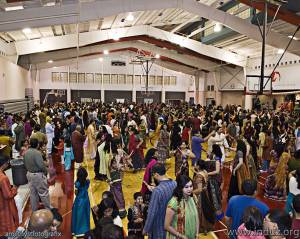
Induz has organized a super exciting “Induz Dandiya” fundraiser evening on October 6th 2012 at Centerville Junior High School in Fremont, to raise funds for projects in both the United States and India. This “Dandiya” event is to celebrate the “Navratri”  (“Nav’=night and “ratri”=nights) festival of 9 nights where, as per the Hindu mythology is believed that “Maa Durga/Ambe” visits the earth  destroy the evil and bring peace, love and harmony to people on earth!

This fundraiser event will enable Induz to raise funds to reach out and offer the Apollo project to more low income schools in Bay Area, and also continue to support the Tulika project for the under privileged children in the orphanages in India. Please visit http://www.induz.org/ for more details on these projects.

Induz Dandiya Induz Dadiya was a sold out event last year, and this year features dandiya with a spectacular laser lights display! The very popular and well-known Bay Area artist, Dimple Patel and Troupe, will be the DJ for the Dandiya/Garba event.

“Dandiya” is a traditional folk dance of India from Gujarat state. It is played with 2 sticks and is very gracious and energetic dance, which has its own form of style and art to it. Ray Mitra said, “Art – all art, be it music, dance, painting or any other form – is a medium for bringing diverse cultures and communities together. That’s our vision. We see the point of connection as being Where Art Meets Heart. If we can accomplish that for our children then the world of their future will be a peaceful and happy place.”

Tickets for Induz Dandiya can be bought online from sulekha.com/Induz or by contacting Ray Mitra at (510) 875-5006 or Sanjay Saxena at (510) 449-8530. Ticket prices are $12 for Adults and $7 for children up to 10 years old. Children under 5 are free.

About Induz

Induz is a 501(c)(3) non-profit organization driven by Silicon Valley professionals with a
passion to promote art and culture across the globe through its mission Where Art Meets Heart
(WAMH). WAMH aims to (1) Nurture artistic talents by exposing individuals to the world of art
and culture (2) Promote and encourage the awareness and aptitude toward art and culture in
children, in particular the underprivileged, by setting up programs through which they can
learn various forms of art, such as visual art, music, and dance (3) Use art as a medium to
bring diverse communities and cultures together and encourage volunteerism and active
participation

Girls and Computers

I might have stumbled on to something…

The spousal unit is big into computers. He believes a working knowledge of computers is absolutely essential for the next Lori on computergeneration, regardless of the profession or career they ultimately choose. ( I suspect some of his enthusiasm is proxy for his own silicon-chip-free childhood!) So when MIT came out with Scratch,he quickly got our 9-year-old daughter on to it, and it then spread like wildfire to her friends.
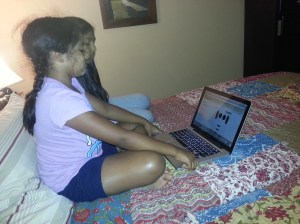
(Scratch is a programming language learning environment enabling beginners to get results without having to learn syntactically correct writing first. Created by the MIT Media Lab, it is intended to motivate for further learning through playfully experimenting and creating projects, such as interactive animations, games, etc. – Wikipedia)

Scratch allowed our daughter to build cute animation with sound from a set of pre-programmed commands. She has been having fun with it, though she hit a wall when she needed some knowledge of programming to go beyond the simple tasks that Scratch allows beginners.

That’s where Khan Academy came in.

We had been trying to get her to work on the math segments in the popular tutorial program and, while she was initially interested in solving the exercises and getting the reward points, she lost interest when she got to the point where she needed to watch the videos to learn the concepts. “Its so boooring,” she whined, and we didn’t push, mystified that Salman Khan’s easy breakdown of concepts was not appealing to her.

Then came the computer science module.  After loooking through the simpler programs she got to a point where she had to watch a tutorial. I figured that would be the end of her interest in this module as well. I was wrong.

“Finally!” she said when the tutorial began, “It’s a girl talking about computers.” The tutorial was not only in a female voice, it was perky, fun, and made my daughter feel comfortable about her ignorance. “I can relate to this,” she said and happily continued with her lesson.

My epiphany is echoed in contemporary attempts to get more women interested in the STEM fields. The AAUW Educational Foundation Commission on Technology, Gender, and Teacher Education found that “…girls are critical of the computer culture, not computer phobic. Instead of trying to make girls fit into the existing computer culture, the computer culture must become more inviting for girls.” In a report entitled “Tech Savvy – Educating Girls in the New Computer Age,” they add that “girls assert a ‘we can, but I don’t want to’ attitude toward computer technology: They insist on their abilities and skills in this area even as they vividly describe their disenchantment with the field, its careers, and social contexts. Although some of this attitude may be defensive, it is important to take a hard look at what these girls are feeling defensive about.”

The current environment is obviously not working. As academic and researcher Vivek Wadhwa points out, “Only 1 percent of high-tech startups have a woman CEO; there are almost no women in the ranks of chief technology officers; and to make matters worse, the proportion of women studying computer science has been steadily declining, from 37 percent in 1985 to 19 percent today, according to the National Science Foundation.”

Luckily, I am not the only one discovering what makes my little girl enthusiastic about computers. Organizations like AAUW and the Anita Borg Institute actively support women in technology and encourage girls to enter fields usually dominated by men. Their mission is to not only create role models to motivate girls but also to determine how to nurture that interest in early education. Social scientist and scholar Jane Margolis explains in a CNET interview, “There’s concern in all computer science departments about the low number of women and low number of African-American and Latino students….What we found is that intervention has to be done at every stage of the education pipeline, and it’s not too late at the stage of higher education.” She and other scholars in the field have found that women approach computing as a mechanism for problem solving, not necessarily as an end in itself. Universities like Carnegie Mellon have begun to provide computer education in an interdisciplinary way, providing social contexts to make the subject interesting and purposeful.

I can only be glad that our daughter still has a couple of years in elementary school. Hopefully, by the time she is in high school, the efforts of these organizations and universities will lead to a better understanding of how to motivate women and girls in technology, and how to provide careers in technology that allow for better work-life integration. Meanwhile, the solution to getting girls into computer education doesn’t seem that complicated – make computers fun, have female teachers, and talk computing in a language that girls can relate to. Bias, after all, is in the eye of the beholder.
Gangs of Wasseypur – Part 1

The bad news about GoW is that it doesn’t tread on any new stuff. The good news is that where it does tread, it does so with a sure and deft touch, showcasing director Anurag Kashyap’s now-undeniable talent.

Movies about gangland empires and their bloody turf wars and successions are pretty common ( and, in my opinion, easy to make). Pick almGoWost any of Ram Gopal Varma’s oeuvre and you’ll see what I mean. The difference here is that instead of setting the confrontations in Mumbai’s dank and fecund underground, Kashyap takes on the coal belt towns of Dhanbad and Wasseypur and the gory butchering industry to craft a multi-genrational saga that has more than a passing resemblance to the Godfather series in its delineation of characters and their relationships.

Family rivalries begin in 1940s India between the Qureshis and the Khans and continue unabated as the momentous events of Indian independence simply translate to a changing of the reins of power without any impact of the lives or fortunes of the poor. British oppression gives way to exploitation by the corrupt politicos of the district, as the protagonists quickly figure out new alliances.

GoW is told from the point of view of the Khans, with a bulk of this first movie focusing on Sardar Khan, the second generation of the Khan family as he hard-scrabbles his way to establish himself as the local goonda. As his life story is revealed, we see the complex dynamics in the power play between the two families, and can see the beginnings of the rivalries that will permeate the next generation.

If the plot sounds familiar, it is, and this tends to make the movie a tad predictable. But it is scripted, directed, and acted amazingly well. If mainstream movies aimed for even 50% of the talent that is on display here, the Indian film industry would be ready to take its place in the ranks of global cinema.

Manoj Bajpai as Sardar Khan is as good as ever, and deals with the complex character with nuance. The script and his fine acting are able to give this cold-hearted killer a sympathetic touch, which is quite a feat considering we see him hacking down rivals in the most gory ways possible.

The supporting cast is equally good, and using lesser-known actors really pays off, as they completely inhabit their characters. The women, as often happens in these gangster movies, are the wives, mistresses and victims, but the terrific writing is able to flesh out each character in the limited time she is given. Kudos to Kashyap for making the fearsome Sardar a hen-peckedcoard at home; this makes for the few laugh-out loud moments in this grim and gruesome movie. Richa Chaddha as Nagma, Sardar’s wife, is pitch perfect, and Reema Sen as his mistress is great too.

As I said before, I happen to think that gangland movies are relatively easy to make because there is so much drama to be exploited. RGV’s success with Satya, Sarkar, and Company, and his appalling failure with other genres (except for Rangeela) sort of illustrates my point. But Kashyap has already proven his mettle with such diverse movies as Dev D, a contemporary remake of Devdas, and That Girl With Yellow Boots, where wife Kalki Koechlin play the eponymous role of an expat masseuse looking for her father. Gangs of Wasseypur feels like an experiment in this particular genre,though a wildly successful one. Here’s hoping that after this saga is completed with GoW2 we’ll see another quirky movie in a different genre from this terrific movie maker.

Oh, the music? I didn’t particularly care for it, but it seemed to appeal to the guys I know a lot. Maybe a gender thing.:)

Kid Advisory: NOT FOR KIDS OF ANY AGE.

Parent Talk Episode 38: Other Tongue

Saturday July 21: Other Tongue: Why is necessary for kids to learn an Indian language? What are the different approaches? What are the challenges? Guests: Madhu Aggarwal of the Madhu Bhasha Kendra and Manoj Empranthiri of the Kerala Club.

Here is the recording of the show for those who missed it.

[mp3player width=150 height=100 config=parent-talk.xml file=https://waternoice.com/wp-content/uploads/Parent-Talk-Episode-38-Other-Tongue.mp3]

ICC Parent Talk is a weekly radio show sponsored by the India Community Center. It airs on Radio Zindagi, 1550 AM, live on Saturday mornings at 10 a.m. The call in number for the show is 510-7701550.

If you have questions or comments about the show, or if you would like to participate on the show, please drop me a line at radio@indiacc.org. For news about the upcoming shows, check out the ICC Parent Talk page.

Parent Talk Episode 37: Resolving Parenting Conflicts

Saturday July 7: Parents and Partners: How to navigate the roads of parenting our children while remaining a couple with different opinions, sensitivities and way of parenting.How to resolve the inevitable conflicts in parenting styles, beliefs, and approaches. Guest: Dolat Bolandi.

Here is the recording of the show for those who missed it.

[mp3player width=150 height=150 config=parent-talk.xml file=https://waternoice.com/wp-content/uploads/Parent-Talk-Episode-37-Parenting-Conflicts.mp3]

ICC Parent Talk is a weekly radio show sponsored by the India Community Center. It airs on Radio Zindagi, 1550 AM, live on Saturday mornings at 10 a.m. The call in number for the show is 510-7701550.

If you have questions or comments about the show, or if you would like to participate on the show, please drop me a line at radio@indiacc.org. For news about the upcoming shows, check out the ICC Parent Talk page.

Amar Seva Sangam: Helping the Disabled Efficiently

By Mahesh Padmanabhan

This summer, I had the opportunity to visit the Amar Seva Sangam. It is an institution that cares deeply about physically and mentally challenged people in India and has the organizational and operational skills to really make a difference to their plight.

My parents had been contributing regularly to this institution – making donations (on my birthday and my sister’sAmar Seva 2 birthday) and getting it more exposure within the media.

I am usually very skeptical about the efficacy of an institution like this in India. With rampant corruption permeating almost every facet of Indian society and virtually no laws or programs in place to address the needs of disabled individuals, I was certain that it would be poorly run and its existence was merely a way to funnel money to its founders and investors.

I resolved to make a trip to Ayakudi, the headquarters of Amar Seva Sangam with a mixture of cynicism and curiosity. Ayakudi is a village beautifully nestled in the foothills of the Western Ghats. The Sangam itself is situated on the outskirts of this idylic village among the ubuiqutous wind farms strewn across the countryside.

I was pleasantly surprised by what I discovered.

Even though the Sangam has grown organically, the tour of the facility made me realize that they had given some thought to planning the growth, resulting in easy access to all buildings within the facility. Wheelchair access sometimes resulted in shorter distances to other buildings.

The Sangam started off as a shed but due to the diligent work of its founders, support staff, donations and sponsorship, has decent facilities now for early childhood intervention, rehabilitation, schooling and vocational training.

Amar Seva 3I had the opportunity to talk to many teachers and administrative staff and I was impressed with their sense of purpose and their enthusiasm for their role and responsibilities. The entire network of people operating and participating in the Sangam felt like a well oiled machine. Many of the teachers and administrative staff come from nearby villages and more
importantly, are products of the Sangam.

The Sangam’s outreach program is equally impressive. Disability, especially in Indian villages, is akin to being a leper so village society shuns disabled individuals. A disabled family member is forced to stay away not just from society but from other family members. This isolation further exacerbates that individual’s psyche and does away with any notion of being a productive member of society.

The outreach program operates in over 600 surrounding villages and takes the hard road of door-to-door education and potentially getting disabled individuals back into the Sangam for rehabilitation and training so that they can make a positive impact to society. The program also has clear structure and guidance on establishing a self-sufficient group comprised of people from the village that can continue the process of education thereby allowing the outreach program to scale.

The Sangam was started as a rehabilitation and training center but has grown to include two things closer to my heart, integrated schooling and early childhood intervention.

Integrated schooling allows normal and disabled children to study and play together thereby increasing tolerance to and understanding of disability at an early age.

Early childhood intervention deals with getting disabled children into the Sangam at as early a stage as possible thereby mitigating the effects of age on self-sufficiency. This is especially true for mental retardation where detecting and starting the rehabilitation program as quickly as possible is critical to the well-being of the child and the child’s progression to
self-sufficiency.

I left Ayakudi uplifted, humbled and determined that I would try my best to keep the Sangam running for years to come. The Sangam relies heavily on donations and sponsorships especially as they are trying to make serious inroads into early childhood intervention, education, continued rehabilation and training.

It is absolutely essential that we do our part in helping this well run institution continue its noble mission. Please check out http://www.amarseva.org or better yet visit the Sangam as a volunteer. Please donate as much or little as you can or get your company to participate in corporate sponsorship of this excellent institution.

Parent Talk Episode 36 – Independent Living Skills

Saturday June 30: This was the last week of College Month on ICc Parent Talk. We talked about teaching kids some independent living skills and financial management skills before going off to college to live on their own for the first time. Guests: Therapist Sushma Trivedi, Financial Consultant Neepa Shah, and Ravi Dev, who recounted his experiences as a freshman in college.

Here is the recording of the show for those who missed it.

[mp3player width=150 height=150 config=parent-talk.xml file=https://waternoice.com/wp-content/uploads/Parent-Talk-Episode-36-Independent-Living.mp3]

ICC Parent Talk is a weekly radio show sponsored by the India Community Center. It airs on Radio Zindagi, 1550 AM, live on Saturday mornings at 10 a.m. The call in number for the show is 510-7701550.

If you have questions or comments about the show, or if you would like to participate on the show, please drop me a line at radio@indiacc.org. For news about the upcoming shows, check out the ICC Parent Talk page.

Sevathon 2012

sevathon 4I’ve been to Sevathons 1 and 2 and to my pleasant surprise, they’ve been getting bigger and better every year. This is the 4th year of Sevathon and if you’re thinking about participating, get off the fence and register – it’s a great way to spend a Sunday morning. The weather is usually perfect, and if running through the Baylands trails is not your thing, bring a friend or two along and join the motley crew of walkers of all ages, sizes, and dispositions – from determined striders to aunties in saris and tennis shoes with pallus over their heads. Kids dart in and around the grown-ups and it feels like a big moving party, with bananas and bottled water thrown in for good measure. This year there’s free food too, courtesy Peacock Restaurant!
Sevathon, a walk/run event organized by the India Community Center, Sevathon Logo - Web 450_1was conceived as an event to bring together and showcase the many Bay Area non-profits that serve both local and international communities. The Sevathon organizers have broken their previous record and registered a whopping 61 non-profits this year, so expect a total carnival atmosphere with all the tents fluttering in the breeze. There’s kite flying, face painting, and live music. Each organization usually sets up something attractive for the kids to do, so it’s great fun to bring the whole family along and make a morning out of it. And you’ll be doing some good too!

Registered runners and walkers can ask friends to support their efforts. 50% of the registration fee goes to the community, and 100% of donations do, so it’s a great way to make your morning exercise count.

Here’s the site to register and learn more about the event.
http://www.indiacc.org/Sevathon
Sevathon 2012
When: Sunday July 15, 2012. Events start 7 am.
Where: Baylands Park, Sunnyvale

“It is health that is real wealth and not pieces of gold and silver.”         -Mahatma Gandhi

Parent Talk Episode 35: College Stress

Saturday June 23: Freshman year can be a source of great stress for college students. To talk with me about the topic were therapist Sushma Trivedi and college student Nisha Marathe.

Here is the recording of the show for those who missed it.

[mp3player width=150 height=150 config=parent-talk.xml file=https://waternoice.com/wp-content/uploads/Parent-Talk-Episode-35-College-Stress.mp3]

ICC Parent Talk is a weekly radio show sponsored by the India Community Center. It airs on Radio Zindagi, 1550 AM, live on Saturday mornings at 10 a.m. The call in number for the show is 510-7701550.

If you have questions or comments about the show, or if you would like to participate on the show, please drop me a line at radio@indiacc.org. For news about the upcoming shows, check out the ICC Parent Talk page.