Category Archives: Blog

Vidya’s blog

New credit card rules take effect today

From AP via Huffington Post – Starting today, Monday February 22, 2010, the credit card act of 2009 signed into law last May will end some of the unfair and deceptive business practices of credit card companies. Here are some of the salient points-

INTEREST RATE

THEN: Banks could raise the interest rate on an account at any time, including the rate on an existing balances, even if you weren’t late on payments.

NOW: The rate cannot be raised in the first year after an account is opened unless an introductory rate has come to an end. After that, cardholders must be notified 45 days in advance of any rate change.

For existing balances, rates can’t be raised unless the account is at least 60 days past due. If payments are made on time for six consecutive months, the original rate must be restored.

There’s still no cap on rates.

DISCLOSURES

THEN: The fine print on cardholder agreements was often difficult to understand. Rates, fees and penalties for other services such as cash advances, for example, could be hard to find. The impact of the interest rate on paying down a balance was hard to compute.

NOW: Cardholders will see how many months it will take to pay off a balance if only minimum payments are made. Statements will also indicate how much needs to be paid each month to pay off a balance within three years.

SERVICE FEES

THEN: Banks could charge as much as they wanted. They could assess annual fees, activation fees and other fees. This was mostly a problem for subprime cards marketed to those with poor credit scores. One popular card, for example, the Premier Bankcard, charged $256 in first-year fees for a $250 credit line.

NOW: Service fees, such as activation and annual fees, will be capped at 25 percent of the credit limit during the first year of use. After that, there is no cap.

GRACE PERIODS

THEN: Some card companies sent out statements not long before payments were due, and sometimes shifted payment due dates from month to month, meaning that payments would not always have enough time to arrive and get processed before being deemed late. As a result, some cardholders ended up getting charged interest or late fees even when they thought they were sending in payments on time.

NOW: The law requires that due dates remain consistent. Statements must be sent out 21 days before the payment due date, and finance charges and fees cannot be applied before that period is up. In practice, about half of card issuers have extended grace periods to as long as 25 days.

OVER-THE-LIMIT FEES

THEN: Banks set credit limits, then routinely allowed charges to exceed those limits. When that happened, though, the customer was charged an over-the-limit fee as high as $39. These fees were often triggered by interest charges or late-payment fees that pushed a balance over the credit limit. What’s more, multiple over-the-limit fees could get charged in a single billing cycle if the balance was paid down and another charge pushed the balance back over the limit.

NOW: The cardholder must specifically agree to permit transactions that exceed the credit limit. Only then can over-the-limit fees be charged. But the fees can’t be triggered by other fees or interest charges. Only one over-the-limit fee may be imposed during a billing cycle. No over-the-limit fees may be charged unless the cardholder has specifically agreed to permit transactions exceeding their authorized credit limit. These fees can no longer be triggered by other fees or interest charges imposed by the card issuer, and only one such fee may be imposed during a billing cycle.

In practice, several of the largest card companies have dropped these fees. Some banks are using pop-up boxes on their Web sites or other methods to obtain consumer authorization.

UNIVERSAL DEFAULT

THEN: If you made a late payment on one credit card or loan, or even late payments for obligations like utility bills, that could trigger interest rate hikes on other credit card accounts.

NOW: Card companies cannot raise interest rates on existing credit card balances. Interest rates can’t rise during the first year an account is open, unless the original agreement spelled out a promotional rate for a limited time.

Consumers with older accounts must be informed of any interest rate increase on new charges at least 45 days in advance. They must also be given a chance to opt out of the hike by canceling the account and paying down the balance at the old interest rate. If an interest rate is increased, the card company must review the account once every six months to assess whether the rate should be dropped.

STUDENTS

THEN: Students arriving on college campuses often confronted a gantlet of credit card marketers handing out T-shirts, pizza and other gifts in exchange for filling out card applications. Credit cards were frequently handed out without checking the applicant’s income sources. In 2008, 84 percent of undergraduates had at least one credit card. Average balances topped $3,100.

NOW: Credit cards may no longer be issued to anyone under age 21, unless the applicant has a co-signer, or can show independent means to repay the debt. Colleges must disclose any marketing deals they make with credit card companies. Banks are not allowed to hand out gifts on or near campuses or at college-related events.

There are still ways for credit card companies to give out loans to cash strapped borrowers in the form of payday loans, prepaid card and subprime credit cards. There was talk of a consumer financial protection agency to deal with these trade practices, but its fate seems uncertain.

The Price of Adventure

statue of liberty

Lakshmi Palecanda

On a vacation in India, I was talking to a family member who was moaning over the family problems she had.  I tried to show empathy by relating some of my problems, when she straight out said, “Oh, you have no problems of this kind there.”  I tried to make sense of this statement.  Yes, we didn’t have problems with gossiping relatives, but we had more serious issues to deal with.

A phone call in the middle of the night is never good news, especially for a desi.  In June 2001, we got such a call from back home: one of my husband’s brothers had died tragically.  He was 45 years old.  My husband desperately wanted to make it back for the funeral, but the cost of purchasing an air ticket was astronomical, even with the hardship concession.  He never got to say goodbye to his brother.  And over the years, I’ve heard many such sad stories.

All of us immigrants have something in us that inspires us to leave the safe confines of our home country and seek to make our lives elsewhere.  Whether it is an urge to make money or a name for ourselves, or even just wanderlust, we feel compelled to experiment with what foreign lands have to offer.  However, we have only a hazy idea of the drawbacks of this adventure of ours.

When we do leave our safety circle, we are faced with loneliness and homesickness when we think our past life, and uncertainty when we contemplate the future.  In my case, it happened when I came over to the US for my studies, over 18 years ago.  During my Master’s program, I had a horrible time of it, since I was brought up in a very sheltered family atmosphere.  Two months after I got here, when it dawned on me that I was totally alone, I just wanted to up and leave.

Gradually, however, we immigrants make it, with new friends, jobs, money and a piece of the American dream, and it is then that we begin to truly enjoy life abroad.  Once we had a decent pay-check, my husband and I began to have a ball.  We had no obligations to anyone, and there was no one to impose stultifying conventions on us, either.  We took crazy risks, and did pretty much what we wanted to do.  If things went well, we mentioned it to our families on our biannual visits.  If they didn’t, we just didn’t talk about them.  If a festival fell on a weekday and we couldn’t do anything special for it, we postponed it to the weekend.  If we were unable to manage even that, we just said a prayer and went on.  On our visits back home, we congratulated relatives and friends on their weddings at the same time as we admired their first-born.  Often, we couldn’t recognize youngsters.

“How you’ve grown!” we exclaimed often.  They said the same to us too; only, it wasn’t complimentary, since all our extra inches were on the equatorial plane.

However, there was a shadowy side to all the bonhomie.  Along with the congratulatory visits, condolence visits had to be made too.  Familiar, beloved faces began to disappear from family gatherings.  Grandparents, uncles and aunts who were in their sixties and seventies, and whom we loved too much to let go, were gone when we went to receive their blessings. In their cases, at least we could cite their age, and console ourselves.

There were shocking deaths, of cousin sisters and brothers, who were way too young to die, who we hoped to grow old with, and friends to whom we had said good-bye on our last trip, not knowing that it would be final.  It was hard enough to come to terms with these events, but they were made more excruciating by the visits that we had to make to their families.  These visits were sometimes a year to a year-and-a-half after the demise of the loved one, and embarrassing for being so delayed.  We often wondered what the relevance of expressing our sorrow was, at a time when the family had already got over the worst of their grief and moved on.  My worst moment was when I had to condole a cousin’s wife on the loss of her husband … at a wedding of all places.  We had tried to visit her, but she wasn’t home.  Even with this excuse on my side, I felt horrible.

But there was no question of the effect of these visits on us.  Even these tardy visits were very valuable to us because that was the only way we could achieve some measure of closure.  Being so far away from the family circle, we cried alone at each bereavement, with only strangers to console us.  When I got the phone call that my grandmother had died, I was at work.  A friend held me when I cried, for which I was grateful.  But I wished I were with my own family that knew how much she meant to me.

This event in particular made me realize that we were living Life Lite as it were.  We had all the perks of adulthood, like unlimited bedtime and no curfew, but none of the responsibilities, like having to represent our own family at happy and more importantly, at sad events.  In Tamil, they have a saying: if you don’t go to a wedding, it’s okay, but you shouldn’t miss a funeral.  I began to understand the ramifications and the truth of this saying.

Something happened in December 2004 that brought this realization even more chillingly close to me: my mother had a heart attack.  I got a phone call the next day from my father, who broke the news gently to me.  When I asked him why he hadn’t called me immediately, he said that he waited until her condition had stabilized because he didn’t want me to worry.  I was upset at the delay until I finally comprehended the truth.

“What an idiot I am!  Of course calling me wasn’t top priority; they were busy saving her life!  That was far more important than keeping me informed.”

Hard on the heels of this thought came the guilt: I wasn’t doing anything to help out my parents at that time, or could I on the days that followed, when she had a relapse.  My sister heroically bore the sole responsibility of the situation.  Luckily my mother made it, but I will never forget my helplessness in that situation.

This event taught me an important lesson.  Previously, I used to get miffed when I felt sidelined by family decisions.  I would fume that I had not been given my due as a member of the family.  However, after my mother’s illness, I quit thinking that way.  When I couldn’t be a part of their daily hardships and sorrows, I really had no right or say in their daily lives or decisions, did I?  It was a plain fact of life, and I had to become mature enough to accept it.

Another aspect of bereavement also came to my attention at about this time.  One of my friends living here lost her father who had been in India at the time, and she couldn’t make it to the funeral. She termed it the ‘sacrifice’ that she had to make for living abroad.  I agreed at the time, but I didn’t see the flip side of this argument until much later.  Yes, she missed her family a lot, but her family missed her too, didn’t they?  What about the ‘sacrifice’ that our family members make because we are away at the time of tragedy?  A family is, after all, a sum of its members.  With families growing smaller, doesn’t one person’s absence matter?  Reminiscing about loved ones is one outlet for grieving.  But in today’s society where neighbors remain strangers, isn’t the one other person that knew the one that passed very important, all of a sudden?

These uncomfortable questions pop up in my mind every time I get news of a loved one’s passing.  As I sit and cry all alone, I wait for answers that can reconcile my need to live the life I want, with fulfilling my responsibilities as a real, not phantom, member of a group of loving individuals, that are part of my history, that know me and care about me, that are at times infuriating, but will always be an integral part of me.

This is the price of adventure.

Lakshmi can be reached at lakshmi.palecanda [at] gmail.com

Picture courtesy David Paul Ohmer.

Help Haiti

haitiIf you’ve been saddened by the devastating earthquake in Haiti, want to help but don’t know how, here’s a really easy way –
Text “HAITI” to “90999” and a donation of $10 will be given automatically to the Red Cross to help with relief efforts, charged to your cell phone bill.

That and other ways to help are outlined in the U.S. Department of State’s website:

http://www.state.gov/p/wha/ci/ha/index.htm

Help.

India observations

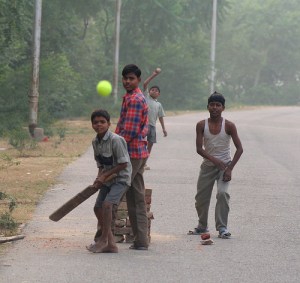
street cricketMore from my India trip –

–    After just a week here, I have realized that it is virtually impossible to watch live TV in India. The greed with respect to ads is just unbelievable. Thanks to owning a DVR, my dad actually figured out the content/ad ratio. It is an incredible 8/22 for every 30minutes of viewing time. Isn’t there some kind of FCC-like organization in India that regulates that? Even live cricket isn’t spared; since the game can’t actually be interrupted, the ads frame the play, something akin to the old days of cable television where ads would bounce and ripple their way along the bottom, top, and occasionally the middle while movies were being screened.

–    The corollary to that is that viewers in India (especially those not owning a DVR) have incredibly low levels of patience. After all, every TV watching experience is fraught with the desire to escape the ads, so you click, click, click the remote all the time, trying desperately to find a channel that has some actual programming. My sample is admittedly pretty low, statistically speaking, but across two cities and several relatives, I noticed that this lack of patience spread to other walks of life as well. Turns out this American citizen, used to things working when and how they are supposed to, actually could deal much better with drivers not showing up, traffic at a standstill, and the generally slower pace of life much better than the Indian residents. (To be fair, it could have been that my family was unhappy at the impression India was making on me and that translated to stress on their part.)

–    Enough has been written about the chaos of Indian traffic and I won’t repeat it here, except to say that I have to believe a force field a few millimeters thick exists around all objects on the road. How else to explain the innumerable number of narrow misses? I saw helmet-less children riding pillion on scooters in a hyper aware state; their legs in a constant dance to keep out of harm’s way.

–    Which leads to the conclusion that driving in India is not for the reflex-challenged. And sure enough, the average age of a motorist on Indian roads appears to be in the 30s. The few grey-haired uncles I saw were keeping cautiously to the edges of the road; not engaging in the typical competitive machismo that defines Indian traffic.

–    That machismo is particularly visible in drivers of two-wheelers (gender be damned). Motorists in India have internalized the adage of being like sugar in milk; they will be rush to fill any empty spots between the larger molecules represented by cars and trucks. I found it particularly inexplicable. After all, the aggressiveness doesn’t mean more than a minute or two saved in the total travel time, but the risk of serious bodily injury (in Chennai the helmet rule is almost universally flouted) is disproportionately high. When I mentioned this to a friend who recently relocated to India, she had an interesting take on this. “Ask anyone of these crazy drivers what they do professionally and you will find that their career choices are almost comically risk-averse. Why don’t they channel their need for risk-taking into their careers instead?”  There is a sociology thesis in here somewhere.

Picture courtesy foxypar4 via Creative Commons attribution license

Giving Thanks

give-thanksLike millions of Americans, it has been a tough year for our family during this prolonged economic downturn. It has been particularly tough in the last couple of months due to family health issues ( hence the absence from blogging) so as I was musing over Thanksgiving traditions yesterday, this line from an old couplet by Kabir popped into my head;

Dukh mein sumiran sab karein, sukh mein kare na koi;

(Everybody remembers ( God) in bad times, none in the good.)

It’s not entirely apropos, but, to paraphrase, it is easy to give thanks when things are going your way and tougher when they’re not, so I am going to count my blessings now.:)

I am thankful for –

– the inauguration of President Barack Obama. Last year there were many doubters; this year the doubts seem to have further coalesced into outright hate and viciousness. But there is no doubt in my mind that the country is moving in the right direction, whether it be in the realm of climate change, health care, nuclear non-proliferation or the economy. Let’s all take a deep breath and pray for patience.

– the career change that allowed my husband to spend more time with our family.

– the financial strength we had that allowed the above-mentioned career change.

– my new job as the editor of India Currents magazine. After years as a stay-at-home mom it felt odd to be back at work and commuting but the last six months have also been the most enjoyable, productive and rewarding period of my life.

– the courage shown by my son in dealing with his unique special needs. It’s an ongoing struggle, but we have discovered a surprising strength in our relationships and in our capacity to persevere.

– my daughter’s quick recovery from the swine flu (!) Are the rest of us immune now? I hope so!

– my wonderful family and friends  (you know who you are), who held our hands and were there when we needed them, every single time.

– the small signs of economic recovery – the decline in jobless numbers, the stabilization of housing prices, and the renewed spirit of optimism in Silicon Valley.

– my upcoming trip to India..my mouth is already watering at the thought of all the good food.

What are you thankful for?

Picture by Dave Parker under creative commons license.

Seeking Citizen Journalists

flip-video-cameraIndia Currents is pleased to announce a new initiative with San Jose Beez, an online collaboration of ethnic media organizations featuring hyper-local news content covering the San Jose area.

In addition to the general interest articles and calendar of events featured in our print magazine, we will be presenting online content of specific interest to the ethnic community in San Jose.

We are looking for citizen journalists who will identify and develop stories with an emphasis on the local Indian American community. In addition to excellent writing skills, applicants must have a lively sense of curiosity and a genuine interest in people.

To apply, please send your resume with a sample of your work to publisher[at]indiacurrents.com. Your work can be in the form of a written piece, photo or video essay.

Surviving 2009

united-states-unemployment-rate-chart-000001There’s a new serial on ABC called Flash Forward where the entire world blacks out for a little over 2 minutes. During the black out they all have a flash-forward of what they will be doing on April 29, 2101. When those crucial moments pass, the world is a state of chaos, of course, but slowly survivors realize there now they have something in common with every other human being in the world. “What did you see,” becomes the new ice-breaker.
As 2009 comes to an end, that ice-breaker may well be “How did you cope?” The global recession affected everybody, whether through immediate personal calamity, or news from a loved one or friend that they had lost their jobs, lost their health insurance, had to move, had to retrench … in a sense  we are all survivors.

For the year-end issue of India Currents magazine, I’d like to feature some of your stories. How did you survive 2009? What tips would you like to share? What are your strategies to cope with the fairly bleak scenario for next year?

Send me your stories via comments here or to editor (at) indiacurrents.com. I’ll put up some of the best ones in the December issue.

Nobel sentiments

obama2It was just a couple of weeks ago that my husband and I were discussing President Obama’s beleaguered situation, over the Sunday papers. The right was going nuts over perceived and imagined horrors of the proposed health care reform; the left was dismayed over Guantanamo prison closing delays; the Israelis were digging in their heels with respect to settlement expansion; and a new nuclear facility had been discovered in Iran.

“Dilettante!” “Narcissist!” “Traitor!” “Communist!” were words freely bandied around, as Obama struggled to implement his policies in a spirit of cooperation, bipartisanship, and consensus.

“That guy deserves the Nobel Peace Prize!” I said in dismay.

Little did I know the Prize committee was eavesdropping that day.:)

Yesterday’s news must have caused the premature demise  of dozens of computer keyboards, as coffee went spraying out of reader’s mouths when they saw the headlines. It almost seemed like a hoax; indeed, one White House staffer is said to have asked if it was April 1st, when informed of the momentous news. Conflicting emotions warred in the hearts of the even the most devoted Obama supporters. Too premature, was the consensus. My Indian American friends muttered darkly about the committee’s snub of Mahatma Gandhi, surely a much more deserving candidate. Of course, conservative heads nearly exploded, and the reactions from the American right-wing were the comic element in a very confusing day, as the US and the world tried to deal with the news.

The dust has settled today, as even the most vicious critics of the president came to the belated realization that it is highly unpatriotic to carp about such an honor. One State Department official’s comment puts it in perspective-“Certainly from our standpoint, this gives us a sense of momentum — when the United States has accolades tossed its way, rather than shoes.”

And that is perhaps as good as explanation as any as to why Obama was given the prize so early in his Presidency. We in the US perhaps do not realize how close the world was to the brink of Armageddon before Obama won the election last year; the war in Iraq seemed endless; there were rumblings among the American neocons about the next war with Iran; the Middle East situation looked highly destabilized; the global economy was in tatters; and the US’s refusal to sign the Kyoto treaty had removed any credibility it had with respect to climate change.

Yes, Obama may not have signed any significant legislation yet. “What has he done so far?” is the familiar refrain. But here’s what the world looks like after the short 9 months that he’s been in office-

– There is renewed hope for negotiations with rogue nations like Iran.

– There is improved cooperation with Russia after the missile program was modified.

– A climate change bill is in the works in the US, giving impetus to similar efforts around the world

-The global economy is sending out green shoots of recovery.

It is easy to criticize Obama as the guy who just makes pretty speeches, but words have power. There is a sense today, that mistakes notwithstanding, the most powerful nation in the world has its heart in the right place; that the direction the world is taking is the right one. By repeating the mantra of cooperation and consensus over and over, this President has sought to reassure the rest of the world that America is no longer an empire-builder; by admitting America’s mistakes, he is opening the door to  a new era of global coaction.

The dynamics of both internal American politics and overseas realpolitik may not permit quick decision-making, but as Obama himself put it, the kind of change he was expected to deliver required him to steer a massive ship; the directional changes can only be slow and incremental, but they will happen.

The Peace Prize committee may have jumped the gun on this one, but the more I think about it, the more I see their point of view. This is a man who has de-fanged Al Qaeda by welcoming and acknowledging the right of Muslims to self-governance; within the US, despite intractable resistance from the opposition and special interests, he has managed to get several bills passed to correct some of the damage done by the previous president.

Yes, these efforts have not always been perfect, and there is much, much more work to do, but the sincerity is unquestionable, as is the genuine desire to make the world a better place. 9 months ago the world was in cardiac arrest; perhaps the prize was given to Obama for being the “defibrillator.”

And before you mock the Prize committee too much, just imagine what would have happened had John McCain won. Then take a deep breath and let the sense of unfairness out as you exhale.

Less summer, more school

school-bus2For the last month the refrain in the Pradhan household has been something like this:
“What did you learn today?” I ask my 7-year-old.
“Not a thing,” she replies.

It’s the beginning of October, a month after school started, but it seems we are still in revision mode, designed for those kids who spent summer assiduously forgetting whatever they learnt in 1st grade.  Not that my daughter spent summer swotting; she has just managed to retain whatever she knew 3 months ago.

It’s frustrating for a parent, even if school is free (well, paid for only indirectly by my property taxes, anyway). While it is fine to treat school as a place where 7-year-olds go to socialize, one wishes they would get on with the program- it’s not reassuring when I get bombarded with data everyday that show kids in other countries doing better in every educational metric than kids in the US.

So the announcement last week that the Obama administration is going to propose longer school hours/more school days is very welcome. Education secretary Arne Duncan even dared to make the announcement on The Colbert Report; if that isn’t serious talk, I don’t know what is.

Geetha Venkatraman, a parent in Raleigh, North Carolina, concurs. “More school days would mean subjects get taught in more depth,” she says. “For instance, if kids are learning about electricity, there would be time to visit the local plant as a field trip.” Her kids are already on an experimental track system at their school. Instead of having the holidays all bunched together in the summer, they have 9 weeks of school followed by 3 weeks off. The number of instructional days is the same as the rest of the country ( a miserly 180 days or so), but the staggered holidays mean

a) there is less chance of kids forgetting what they’ve learnt and

b) teachers use the intervals to give struggling kids extra work and extra help to catch up with the class.

Kids also use the break to de-stress and pursue their hobbies. “My kids and I love this system,” says Geetha, who concedes that it can be tough on parents who both work and have to arrange for child care several times a year. (Camps in the county run throughout the year helping out working parents.) On the other hand, travel to India would be a lot easier as vacationers would not have crowd the airlines, lemming-like, in the months of June and December.

I asked a teacher friend in the local school system whether the long summer break was indeed a problem for kids. “Absolutely! I have to begin with alphabets and blending all over again because kids have forgotten everything.” (She is a first grade teacher.) Her school has more kids from poorer homes. One of the effects of the long summer holiday is the exacerbation of the rich/poor gap, as kids from upper middle class homes retain learning better through reinforcement in the form of either enrichment camps during the summer or a lot more reading at home.

This friend is in favor of more school days even though it would mean more work for her. Would other teachers feel the same? “I’m sure there would be some resistance,” she admits. Long time teachers (and thanks to tenure, most teachers have been around for a while) are used to a pattern of work on/work off that may be hard to give up. But there are some definite advantages for teachers too. Presumable one is looking at higher pay levels, but there is also more time to get the curriculum into unwilling heads. There’s time, as Geetha said, to get into a subject in more depth, and there would be the whole month of September to devote to the grade-appropriate curriculum instead of wasting on revision.

For homes with 2 working parents, the concept of more school is particularly attractive. Less summer=fewer summer camps=more savings. Given that school is free, summer is a big drain on the wallet as we scramble to find alternate arrangements for kids.

Gone are the days of my childhood where we just lounged around in the torpid heat, content to re-read our books and be bored till the cooler evenings when we would hang out with our friends. Kids today spend summer in camps (usually with an academic component), given the busy schedules of their parents and the isolating patterns of housing development. So if more school also means more time to learn and less homework per day, the idea sounds like a win-win for just about everybody.

Picture courtesy Lone Gunman via Creative Commons.

The Sevathon experience

sevathon1First, the good news:

The intentions were honorable. The idea of Sevathon, an India Community Center project, was to celebrate Mahatma Gandhi’s birthday by hosting a walk/run where participants would have the opportunity to find sponsorships for their various charities by getting pledges. The format is not unlike many other runs and marathons. In addition, ICC put together several booths with non-profits offering information and services to get the word out and keep the participants entertained while doing so.

We reached the Sunnyvale Baylands park around 8 on Sunday morning. According to the flier, the event was supposed to start at 8:30 and we hung around for a while, getting our registration bibs and t-shirts. Bollywood music blared in the background as participants milled around, trying to find the starting point for the race and getting a sense of the trail. Tables were set up with water, protein bars and bananas. We hung around the health tent, where organizations like the South Asian Heart Center had set up testing stations.

Around 8:30 we were invited to a warm up session, conducted by one of the dance instructors at ICC. After we had finished stretching to the peppy “Jai Ho” there was still some confusion about when and where the race was about to start. Finally there was an announcement that the race would start at 9 and we went to our car to put away our jackets. When we returned in a few minutes, we found to our dismay that the race had already started, without any official announcement of the same. The runners in our family took off while my daughter and I started briskly walking. At this stage, I was still not sure where the official start point of the race was. We just followed the crowd and eventually wound our way back after 5 kms.

Our runners were not so lucky. They missed a crucial sign marking a turn on the path and went off in the wrong direction. Eventually, they just used their pedometers to mark out 2.5 kms and returned from that halfway point.

Ultimately, the ambiguity about the start and finish times didn’t quite matter, because there was no clear finish line either. We just sauntered back to the tents that had been set up and left a few minutes later. According to the flier there was supposed to be a mela of some sort but there was no excitement created around it, no announcements, and we saw many others leaving along with us.

Given that this was the first year of the event, the chaos was perhaps understandable, though why a simple knowledge transfer from experienced organizers like the India Literacy Project was not done is puzzling. The idea of a run followed by a fair was good, but the execution left much to be desired. One of the first rules of creating a memorable run event is to make it attractive to serious runners; that creates a buzz around it that brings the rest of the crowd. Without a clean run experience, it becomes a casual day in the park which leaves future participation to the whims of ICC supporters.

My two bits on improving the experience?

– Have clear start and finish lines. If possible, arrange to time the runners and give prizes based on the times.

– Have a fixed start time and do not deviate from it, even if participants are sauntering in on Indian Standard Time.

– Mark the trail out immaculately and arrange to have volunteers at every point of confusion, at least for the first few years.

– Have barkers to constantly make announcements about the fair and drive traffic to the booths.( This is my opinion, was the biggest shortcoming of the event, since the fair was its USP)

– Instead of letting kids run free, charge a discounted rate for them so they can have their own bibs. Have separate prizes for the kids.

Sevathon was a noble idea. Here’s hoping the kinks get ironed out by next year.