
Category Archives: Features

Who to vote for?

us congressIn case you’re among the despondent Democrats or indecisive Independents who doesn’t know which side to pick, I give you the accomplishments of the last 2 years, courtesy Daily Kos poster Thisismytime.

Health Care Reform:

Economy:

  1. The American Recovery and Reinvestment Act of 2009 (ARRA) has worked. The Economy Has Been Growing – take a look at the graph of GDP growth between 2007 thru 2010.
  2. US auto industry rescue plan — Detroit making profits again and at least 1 million jobs saved.
  3. Worker, Homeownership, and Business Assistance Act of 2009 that extended Unemployment benefits up to 20 weeks and more.
  4. Provided $14.7 billion in small business loans increasing minority access to capital.
  5. The $26 billion aid to states package preventing large-scale layoffs of teachers and public employees.

Banking and Financial Reform

  1. Signed a sweeping bank-reform bill (the Dodd-Frank Wall Street Reform and Consumer Protection Act)into law
  2. Managed the $700 Billion Troubled Asset Relief Program (TARP) that Banks have repaid 75% of TARP funds, bringing the cost down to $89B as of June 2010.
  3. Cut Salaries For 65 Bailout Executives
  4. Closed offshore tax safe havens, tax credit loopholes on companies that use the tax laws to ship American Jobs oversees. HR 4213.
  5. Signed into law the Fraud Enforcement and Recovery Act to fight fraud in the use of TARP and recovery funds, and to increase accountability for corporate and mortgage frauds.
  6. Signed the Credit Card Accountability, Responsibility and Disclosure Act

Education

  1. Health Care and Education Affordability Reconciliation Act of 2010 that increased the amount of federal Pell Grant awards and enabled the stripping of banks privileges as intermediaries for student loan servicing.
  2. Created the Race to the Top Fund, a $4.35 billion program to reward States that submit the best proposals for change.
  3. As part of the American Recovery and Reinvestment Act, funded over$100 Billion for reforms to strengthen Elementary and Secondary education, early learning programs, college affordability and improve access to higher education, and to close the achievement gap.

Jobs

  1. The $787 billion economic stimulus package has created or saved nearly 2 million jobs slowing the bleeding
  2. Jobs for Main Street Act (2010)injected $27.5 Billion for Highways, $8.4 Billion for Transit into the country’s transportation system to create jobs and spur economic activity.
  3. A $33 Billion Jobs Packagethat will allow Small businesses to get $5,000 tax credit for new hires.
  4. A $26 billion State Aid Package Jobs Bill saving 300,000 teachers and public workers jobs from unemployment.
  5. The Auto bailout saved 1 million jobs.

Green Energy

  1. Implemented renewable fuels mandate of 36 billion gallons by 2022, four times what we currently consume.
  2. Automakers will be required to meet a fleet-wide average of New Gas Mileage Standards at 35.5 MPH by 2016.
  3. A $60 billion investment in renewable and clean energy.

Housing

  1. $275 billion dollar housing plan – $75 billion dollars to prevent at-risk mortgage debtors already fallen victim to foreclosures and $200 billion to bring about confidence to offer affordable mortgages and to stability the housing market.
  2. Established “Opening Doors” to end the homelessness of 640,000 men, women, and children in the United States in 10 years.
  3. Provided $510 Million for the rehabilitation of Native American housing. ref
  4. Provided $2 billion for Neighborhood Stabilization Program to rehab, resell, or demolish in order to stabilize neighborhoods.
  5. Provided $5 billion for Weatherization Assistance Program for low income families to weatherize 1 million homes per year for the next decade.
  6. Provided grants to encourage states and localities to take the first steps in implementing new building codes that prioritize energy efficiency.


Medicaid/Medicare/Social Security

  1. giving $250 economic stimulus check to 55 million Social Security and Supplemental Security Income (SSI) recipients in 2009.
  2. Cutting prescription drug costs for Medicare recipients by 50% and began eliminating the plan’s gap (“donut hole”) in coverage.
  3. Passing as part of H.R.3962 (Preservation of Access to Care for Medicare Beneficiaries and Pension Relief Act of 2010) a $6.4 billion measurereversing a 21 percent cut in physician payments that would have started a flood of rejections by some doctors of seniors covered by Medicare.
  4. Expanded eligibility for Medicaid to all individuals under age 65 with incomes up to 133 percent of the federal poverty level ($14,400 per year for an individual).

Military Veterans and Families

  1. Implemented a strategic planto increase the hiring of Veterans and Military spouses throughout the Federal civil service.
  2. Provided for the expenses of families of to be at Dover AFB when fallen soldiers arrive.
  3. Passed the Veterans’ Compensation Cost-of-Living Adjustment Act of 2009 increasing the rates of compensation for veterans with service-connected disabilities and the rates of dependency and indemnity compensation for the survivors of certain disabled veterans.
  4. Declared the end of the war in Iraqi bringing back nearly 100,000 U.S. troops home to their families.
  5. Donated 250K of Nobel prize money to Fisher House, a group that helps provide housing for families of patients receiving medical care at military and Veterans Affairs medical centers

LBGT

  1. Extended  benefitsto same-sex partners of federal employees
  2. Signed the Matthew Shepard and James Byrd, Jr. Hate Crimes Prevention Act
  3. Instructed HHS to require any hospital receiving Medicare or Medicaid funds (virtually all hospitals) to allow LGBT visitation rights.
  4. Banned job discrimination based on gender identity throughout the Federal government (the nation’s largest employer)
  5. Signed the Ryan White HIV/AIDS Treatment Extension Act
  6. Extended the Family and Medical Leave Act to cover Gay employees taking unpaid leave to care for their children of same-sex partners
  7. Lifted the HIV Entry Ban.
  8. Implemented HUD Policies that Would Ban Discrimination Based On Gender Identity

Why vote?

US sealThere’s usually a considerable amount of apathy over non-presidential year elections. Democrats, with their party in power, are staying home in disappointment engendered by legislative compromises and a poor economy.Young voters, who came out in droves to support Barack Obama in 2008, don’t feel the same sense of idealistic purpose.

All signs indicate a disastrous election for the Democrats, with some pollsters even suggesting that they may lose both houses of Congress.

Typically, the minority party is much more energized in midterms. Republicans have built on that energy by nakedly appealing to their base, using fear-mongering of President Obama’s origins, xenophobic appeals against the “Ground Zero” mosque (not at Ground Zero and not a mosque!), and health care misinformation (Death Panels!). This has allowed them to divert attention from the fact that they really don’t have any better ideas to offer the country. Indeed, they have spent the last 2 years colluding with lobbyists and corporations, and proudly obstructing every single initiative proposed by the majority party. (If the Democratic party has, at times, displayed similar characteristics, it is due to the Blue Dog representatives from conservative districts, who are but Democrats in name, and who do not represent the progressive values of their brethren.)

Voters not deeply engaged with the political process might have an idealistic belief that a divided Congress would lead to bipartisan and productive decision making. Let me disabuse you of that notion. Many Republican representatives and candidates have proudly stated their intention not just to repeal some of the useful legislation passed with such great difficulty over the last 18 months, but also to bring about a complete government shutdown. One representative from California, much to my shame, has even mad rabid statements about impeaching the President (for reasons that are unknown even to him).

It is my intention, therefore, to write a series of posts leading up to the elections to convince you of how important your vote is. To begin, check out this video courtesy of Steve Benen and Bill Simmons.

And mark your calendar for November 8, 2010.

MySahana: Creating awareness for mental health issues

mysahana_thumbThe South Asian community in the United States may be super successful, but mental health issues are our Kryptonite. The stressors of leaving our support systems behind, adapting to a different culture, and redefining success and prosperity are very real, but our approach and response to mental health issues remains one of avoidance.

This fact was brought home to clinical psychologist Parijat Deshpande when she attempted to set up a study on South Asian mental health. Puzzled by the lack of participation, she probed further by conducting informal surveys, and came to the conclusion that there was profound misinformation and ignorance about these issues in the community. “The most common responses were, ‘I don’t think I need help to deal with my problem,’ and ‘What I am feeling is completely normal.’”

“Behind closed doors, we face just about the same problems as any other community; depression, disorders, marital problems,” adds Deshpande, citing recent cases of murder/suicides in middle class Indian American families.

Deshpande has taken it upon herself to educate and bring awareness of mental health issues and has set up MySahana.org (sahana means “patience” in Sanskrit), a website that offers readers insight into the problems they may be facing in a culturally relevant and culturally sensitive manner. Asked to provide an example, Deshpande offers the following – “In our culture, public displays of affection are not considered acceptable, so how can partners show affection to each other?” The website deals with this question, among others.

mysahana_abstract_darkgrayThe website busts several myths, the first being that mental health is not as important as physical health. A section on food is unusual, but sets a warm and welcoming tone to make readers comfortable with the site.Typical mental health queries are answered in the blog section. The content is entirely written by Deshpande, who credits her cultural background and clinical training with helping to establish a good connection with readers.

While the content primarily deals with relationship issues at present, this is only the beginning as far as MySahana is concerned. The non-profit has found several willing volunteers around the SF Bay Area to help with marketing, research, and administration, and the idea is to grow this fledgling site to a destination for South Asian mental health discussions and help. In progress is collaboration with doctors and service providers to tackle a wide variety of subjects.

The response from the community to MySahana has been extraordinary, reflecting, perhaps, the underserved needs of the community. “It has been my experience that the community really responds when we show an understanding of the culture,” says Deshpande. “I was contacted by a couple who went through a very stressful period at the beginning of their marriage. Divorce wasn’t an option, and both partners felt trapped. Couples therapy helped for a while, but before long they had slid back to the old patterns of behavior. A friend suggested they read some of the articles on the website. They did, and recognized some of the hurtful patterns of their relationship. The couple decided to try couples counseling again, and I heard from them that they are in a much better place today.”

“There is a special set of needs that separates the immigrant population. These needs are unique and need to be addressed accordingly,” she adds.

Check out MySahana for help or to volunteer. It’s time to begin talking about mental health issues openly and honestly. We are the model minority when it comes to professional success, let’s be the model minority for mental health as well.

Bay Area Dandia Events 2010

events_dandia

As Dandia season rolls around, I’ve decided to compile all the local events for easy reference. Let me know if I’ve missed some of the smaller events and I will update this post.

UPDATE 3: Garba Workshops: The Mona Sampath Dance Company is organizing a couple of garba workshops to get you in Navratri mode.

October 2nd: Dublin – 4:00 – 5:00 pm. Milpitas – 12:00 – 1:00 pm
October 13th: Cupertino – 7:30 – 8:30 pm

Locations:
Cupertino ACPA:1009, 1015-1019,S. De Anza Blvd,San Jose, CA 95129
Dublin Fitness 2000:7373 Village Pkway, Dublin,CA 94568
Milpitas – ICC:525 Los Coches Street,Milpitas,CA 95035

Cost: $15 (includes a pair of dandiyas for you to keep).

UPDATE 2: SEWA Dandia: Sewa International USA presents an evening of Garba-Dandia with the melodious group of Dimple Patel. Free lessons for Dandia.
Subsidized food and drinks will be available.

All proceeds will go towards Sewa International service projects. Details can be found at sewausa.org.

Where:Sunnyvale Temple Hall,420, Persian Drive,Sunnyvale,California,94089

When: October 8, 2010 8:00PM to Midnight

Tickets: 10 $. Buy here.

Contact:Yagnesh Pathak Phone : 510-364-6095

UPDATE: IFDA Navratri Hungama 2010: The Indian Fusion Dance Academy has a Navratri Party on October 24th. Part of the event ‘s proceeds benefit Evergreen Elementary Education Foundation (EEEF). There will also a Bone marrow drive.
Garba workshop will be conducted by the experienced and talented Shaivalee Desai between 6:30pm and 7:30pm.

Date: Sunday, Oct 24th
Time: 6:00pm to 9:00pm
Venue: East Valley YMCA Gym.1975 South White Road ,San Jose ,CA 95148

SEF Dandia: The Sankara Eye Foundation’s Dandia event has been sold out every one of the last 6 years. Events start at 7 p.m.

October 9th: Santa Clara Convention Center. Music: PreetySha and Troupe.

October 16th: Alameda County fairgrounds, Pleasanton. Music: Dhol Baje Entertainment

October 23rd: Santa Clara Convention Center. Music: PreetySha and Troupe.

Free Dandia Lessons. Kids 5 and under free. Free teak dandia sticks for the first 500 ticket holders.

Tickets at sulekha.com/SEF.

SSF Dandia: Small Steps Foundation has a big Dandia night in Fremont every year. It is a kid-friendly event with music by Sharvari Dixit and her group. Dandia timings are 7:30p.m. to 11:45 p.m.

October 30th: Centerville Junior High School Fremont.

Tickets: Tickets are available at India Cash and Carry in Fremont or can be bought online at Sulekha.

Early Bird (Until Oct 10th) :Adult – $10, Child (5-12) – FREE

Regular (After Oct 10th) :Adult – $13, Child (5-12) – $5

At the Gate :Adult – $15, Child (5-12) – $5

Vibha Dandia: Vibha has organized this highly energetic and popular event in the Bay Area with tremendous success for over 10 years. Dandia timings are 7 p.m. to 11:30 p.m.

October 2nd: Centerville Junior High, Fremont

October 9th: Centerville Junior High, Fremont

October 16th: Centerville Junior High, Fremont

Tickets are available at DesiClub.com and Sulekha

Early bird Discounts

Early bird tickets: $10

[Early bird ends a week before the event date]

• Regular price: $13
• Kids aged 10 and under: FREE
• Door price: $15 (if available)
• Free Dandia/Raas/Garba lessons will be provided by experienced dancers to all ticket holders
• Dandia sticks, Food and beverages can be purchased at the venue

Readers, please alert me to any other dandia nights in the Bay Area and I will update.

Gifts for Moms, Smiles for Children

mother and childThe Akshaya Patra Foundation has launched Gifts For Moms, Smiles For Children, a Mother’s Day campaign that pays tribute to Mothers worldwide while helping to feed and educate children throughout India. Akshaya Patra is an organization with the vision that no child shall be deprived of education because of hunger. The campaign is a way for people to celebrate their Mother, Grandmother, Sister or Aunt by giving them a gift for Mother’s Day that actually gives back.

“The unfaltering love that a Mother invests into raising her children enhances a person’s life in a myriad of ways. The Gifts for Moms, Smiles for Children campaign is a great way for people to honor those Moms that have made an impact in their lives, by giving a gift with a real impact,” said Madhu Sridhar, President and CEO of Akshaya Patra. “Akshaya Patra’s mission of eradicating hunger and promoting education is based on the vision shared by all Mothers worldwide. $28 is a wonderful gift on behalf of a mother that a donor wishes to honor. A child somewhere will smile.”

Donors to the campaign contribute $28 to Akshaya Patra for each Mother they wish to honor.  Once someone has donated, they can either choose for Akshaya Patra to send an email about their gift to the Mother they are honoring, or they can print out a Mother’s Day letter from Akshaya Patra to place in a card. Akshaya Patra’s midday meal program feeds 1.2 million underserved children daily in 7,000 schools in eight states in India. It costs $28 to feed a child daily for the entire school year.  With an average government subsidy of 50 percent, $28 feeds two children.

For those who wish to purchase a different gift for their Mom while still giving back, they can do so by shopping through CafeGive, a website that brings together hundreds of online stores that donate part of their proceeds to charity. When someone makes a purchase through CafeGive, up to 20 percent of the purchase price is donated to Akshaya Patra by the vendor, at no cost to the consumer. Some of their vendors include Macys, Best Buy, 1-800-Flowers and See’s Candies.

To donate to Gifts for Moms, Smiles for Children, learn more about the One World Cuisine partnership or to shop through CafeGive, please visit http://www.foodforeducation.org.

The Legend of Vraz

LegendofVraz01

By Vidya and Naren Pradhan

The rich Hindu mythic pantheon of rajas, rakshasas, and apsaras lends itself well to quest-style video games, so it is a bit surprising that no one has seriously attempted one till now. Kids weaned on Amar Chitra Kathas will be interested in “The Legend of Vraz,” a computer game that is inspired by the panoply of heroic characters that Indian mythology provides.

The story of the game, very reminiscent of Indian fairy tales, revolves around prince Vraz who wishes to marry his beloved princess Avi and win her hand in marriage. He has to perform 5 tasks set by her father. This takes Vraz on an epic quest where he must make his way through 15 exotic locations, avoid the tribal warlord Mani and battle with the evil lovelorn Vizier and his shrewd accomplices. He will also have to collect gold and keys, skillfully navigate dangerous traps, operate objects and find his way out of near impossible terrain.

Abhi_14-1Says developer Abhinav Chokavatia, “The game’s look and style is derived from Indian Miniature paintings. I had always been fascinated by miniature paintings ever since I was young. While visiting the temple of Nathdwara I came across detailed miniature paintings and thought it would be a great idea if we can somehow take this art form forward. That’s how the game style and game idea was born.”

The game is targeted at the teen male audience, though the developers believe adults play it too. “We’ve had players tell us that it reminds them of the earlier Mario games,” says Abhinav. “You might say that Prince of Persia + Mario * India – Violence = Legend of Vraz!”

The game launches in India via retail in a month or so and is already available for online purchase. Buyers can try out the demo on the website of Zatun Games, the developers of “Legend.”

I had Naren, who, at 14, falls bang in the middle of the target segment, try out the game. Here is his review –

So far, there have been many good ideas for video games based on mythologies from around the world that have ended up as excellent gaming experiences. Players can hack their way through monsters from Greek mythology, carve a path through hell, or use magic and martial arts to fight hordes of Chinese soldiers. However, so far, nobody has thought about a game based on Indian mythology. Well, the wait is over, thanks to a pay-to-download game called The Legend of Vraz.

The Legend of Vraz is a side-scrolling platformer based on Hindu mythology, especially The Ramayana. Indians around the world would be excited at such a thing. One would say, “Finally, game developers are taking notice of the lore of India!” Of course, I immediately took notice of it, being an avid gamer myself. So I downloaded the game demo, and this is what I found.

The story has no audible dialogue, and is presented through comic panels and missions. It involves prince Vraz, who resembles an Indian hero, doing five difficult tasks in order to win the hand of the lovely Princess Avi. The game play takes many of its elements from classic platforms such as The Prince of Persia, Super Mario Bros, and Sonic the Hedgehog. In each level, you are given a certain mission, either to get an amount of gold, defeat a number of enemies, or simply get to the end. On the way you can jump, fight enemies, collect gold, and discover secret areas, all vital to the overall platform game experience.

Perhaps the most interesting part of the game is the bow and arrow. Just like Rama, Vraz’s signature weapon is the famed projectile weapon of the ancient times. There are five types of arrows you can shoot including normal, particle and fire arrows. However, the enemies move quite fast, and the limited directions you can shoot in make the bow hard to use. Also, there is little variety in the types of enemies. There are bugs, fish, more bugs, more fish, a boar here and there, soldiers, and annoying little cheeky monkeys that make you lose health after you destroy them, which is annoying since you have to destroy them in certain levels.

Overall I didn’t really enjoy this game. However, I can tell it was meant for small children, who will enjoy it when they get the hang of it. The difficulty will provide a good challenge for them and the platform action a thrilling experience. I would call this game average. But if Indian mythology is your thing and quest-style games are fun for you, then do give The Legend of Vraz a try.

End review.

To seasoned gamers like Naren, who has played real time strategy games like Starcraft and Warcraft 3, the game may seem a little retro and inadequate but kids newer to the world of online gaming may enjoy the game. Also, parents can be reassured that there is nothing bloody or gory in this game. According to Abhinav, the initial response has been tremendous.

Here is a video teaser of the game –

Naren’s blog is here.

A Few Godmen

godman logo

By Gaurav Rastogi

It is divine intention, then, that as I started my blog-meditations on the subject of “belief”, I am blessed by the coming out, so to speak, of several all-too-familiar shock-news stories about Godmen in India. And thus, this post was written, by the will of the creator!

I recently had a deep resoaking in traditional India. There, I realized just how deep is our urge to connect with something divine, and how far each of us is willing to go to believe. In my many recent trips to India, I have continued to be surprised by the prodigious rise of the Godman culture. There are TV channels, billboards, posters, pocket-calendars, internet darshans, blogs, temples, satsangs, and Youtube channels that proclaim the divinity of an alarming number of self-styled Babas, Gurus, Mahants, surplus Shankaracharyas, Swamis and other ochre-robed manifestations of divinity.

Not one to make fun of someone’s faith- and risk eternal hellfire and internet flames, I kept my opinions to myself so far. However, I suspect it’s well within reasonable limits to think about the reasons behind this phenomenon. What is driving it?

Believing in something is easier than knowing everything: First off, there is too much information in the world around us. I’ll research just how much in a future post, but we know that the scientific and information revolution in the last couple centuries has expanded the “information quantity” by several orders of magnitude. The human brain, unfortunately, has not kept pace. Hence, we have to limit ourselves to knowing only a fraction of the stuff that’s out there, and we have to believe the rest. That means, if someone is simplifying reality for me, he’s doing me a favor, and I must call him my Guru. Problem solved, no!

Everyone’s doing it: Belief is like the swine flu- it’s infectious. If my neighbors have it, and their neighbors have it, then I would be foolish not to have it! I start believing partly to fit in, and partly because it helps simplify my life (see above). Then, I become a vector of this belief and through my inspired anecdotes and miracles, I infect others with my belief.

A few good Godmen: Like honest politicians, not all Godmen are out to cheat, swindle, and defraud (Gawd! I love the Thesaurus). There are quite a few Godmen who are honest, and are interested in the public good. That’s what keep the engine moving. I think.

The long tail of spirituality: Think about it- with so many channels of information, you can find just the guru that you were looking for. You can get a north Indian guru, a south Indian guru, a pan-hindu guru, a post-hindu guru, a cancer-curing guru, a cute kid guru. There are all types of gurus out there, and with the information distribution that’s possible with TV and internet, each small niche will be fulfilled.

GodMan-liness is a scale business- big is better: If you read the news articles about the fake gurus, you will conclude-as I did- that there is a lot of money and power at stake here. All those lavish ashram’s need money to build, and all those news channels need content that they can play. The bigger a guru’s following, the more money they have, and the more they are likely to attract new followers and crowd out the smaller, local types. You know, the ones who cared about spirituality and other soft stuff!

Escalation of commitment: And finally, once you have taken a ride on a guru band-wagon, there’s no getting off. You have learnt their lingo, you have got into their community, you have attained the Guru’s blessings, and you have brought your friends and family into this circle. Now, what would you do if you found your Guru was a fake? You’d hush it, because there’s no way you can get off that juggernaut without getting trampled. You’ve joined into the lie.

Mo’ Money: As India gets richer, people (a) have more money to spend on spirituality (!), and (b) have more reason to try to prevent a slide back into the cesspool of poverty they recently climbed out of. This means good business for those that promise continued good fortune because, ahem, they have a direct line into you-know-who.

In sum, I would say this whole business is a Ponzi scheme. Think about it.

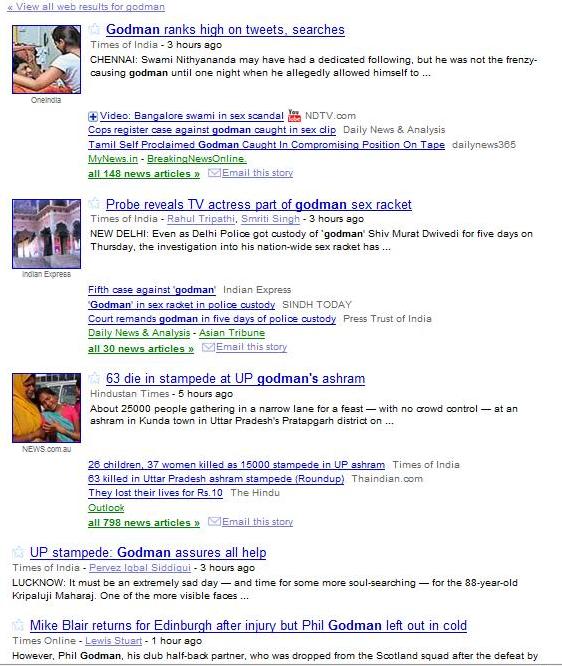
Here’s some news feeds to tell you more about the state of this business. No peeking, kids. This stuff is PG-13.

godman newsfeeds

(Originally posted on http://rustus.blogspot.com. Check it out for more on Godman-liness and associated stories.)

The Story of Genetically Modified Brinjal

By Geeta Padmanabhan

eggplantOn October 14, 2009, the Indian government’s Genetic Engineering Approval Committee (GEAC) cleared the commercial cultivation of genetically modified (GM) brinjal (eggplant, aubergine, baingan). For the first time a GM food crop was approved in India.

GEAC is an ad-hoc 30-member committee. Its members are mainly bureaucrats and scientists from state institutions. There is no other regulatory agency.

A huge uproar followed the announcement all across the country. Before we go into that, here are some basic facts.

The vegetable originated in India. Half a million hectares go under an annual baingan crop for an output of 8.4 million tonnes. We have a choice of nearly 200 varieties. The transgenic brinjal was developed by Mahyco (Maharashtra Hybrid Seeds Company) in collaboration with the US-based transnational, Monsanto. It involves the insertion of a gene from the soil bacterium Bacillus thuringiensis into the DNA or genetic code of the vegetable to produce pesticidal toxins in every cell.

You can imagine what the GEAC clearance meant. Once Bt brinjal was approved for commercial cultivation, there’s nothing to stop other GM food crops like rice, maize, soybean and sorghum from coming in through the open door. Bt brinjal means directly introducing a genetically engineered vegetable into India’s food chain. The silver lining was Environment Minister Jairam Ramesh had publicly opposed GM foods only months ago.

Do we have experts talking on this? Yes, one is Professor P M Bhargava, biologist, GEAC’s only independent expert, appointed by the Supreme Court. Another is Biotechnologist Sultan Ismail of Chennai. They both say that a majority of the necessary bio-safety tests were skipped before the clearance was given. That in itself is a strong reason for refusing to approve Bt brinjal. We don’t know enough about the effects of insertion of alien genes on the recipient organism, about the risk of transfer of those genes to human organ systems or viruses and hence about the impact on human and animal health and the environment. (Read article by Praful Bidwai)

Intense opposition for Bt. brinjal came from several NGOs and state governments (Kerala, Karnataka, Andhra Pradesh, Madhya Pradesh, Chhattisgarh, Orissa, West Bengal and Bihar). Two weeks ago, the government put on hold commercial cultivation of GM brinjal till such time independent scientific studies established, to the satisfaction of both the public and professionals, the safety of the product on human and animal in the long-term.

Why do we oppose it?
THREAT TO BRINJAL DIVERSITY
Genetic engineering should not be allowed in the “centre of origin” (of brinjal) as it could lead to the loss of original varieties by transgenic cross-pollination .
Counterview from Mahyco: “The origin of cultivated brinjal is uncertain, with differing views put forward by scientists . South America and Indo-China are thought to be areas of origin. India is considered a centre of diversity.”

TOXIN PUT IN BRINJAL NOT SAFE FOR HUMAN CONSUMPTION
Bt brinjal is fatal to a pest called fruit-and-shoot borer. Some scientists question the premise that the Bt gene acts only in the alkaline environment found in the gut of insects. For, the human digestive system is acidic only in the stomach while the rest of it is alkaline. The study done by Mahyco on rats allegedly does not address possible human dangers such as cancer, infertility and kidney damage.
Counterview: The Bt gene breaks down during digestion into common amino acids, which are part of the normal diet and are neither toxic nor allergic.

PRECAUTIONARY PRINCIPLE
Bt brinjal has been developed for the first time anywhere in the world. Precautionary principle requires that its clearance should have been withheld because of the uncertainty and irreversibility of its long-term implications for health and environment .
Counterview from Mahyco: There is no cause for alarm over Bt Brinjal as Bt cotton, the GM crop introduced in India in 2002, “is already in our food chain” . For, about 11 lakh tons of Bt cotton oil is consumed annually by people, directly or through vanaspati. “As the Bt gene present in cotton is identical to that used in brinjal, there is a strong precedence for safety of the gene itself.”

NO LABELING AND LIABILITY REGIME
It is a matter of consumer choice. Introduction of Bt brinjal be put off till a mechanism of mandatory labeling is put in place. But then, how will GM food be labeled in a country where vegetables are not sold only in supermarkets? And how feasible is it to maintain the segregation from the field to the market? Worse, there is no law fixing liability in the event of contamination of non-Bt brinjal by the GM variety.

LEGALLY UNTENABLE

GM products, without proper labelling, was illegal and attracted penal action under the Foreign Trade (Development and Regulation) Act, 1992.

SPURIOUS SEED TRADE
Asked about the possibility of spurious Bt brinjal seeds making their way into India, Ramesh said it was up to state governments to check this. “I hope we don’t see a repeat of Bt cotton where spurious and illegal Bt cotton seeds found their way into the market.”

“A moratorium implies rejection of this particular case of release for the time being; it does not, in any way, mean conditional acceptance,” said Jairam Ramesh. The decision followed his month-long public consultations in seven cities across the country. The opposition was loud, dramatic and acrimonious.

“I am not getting into any timeframe . . . the moratorium will continue for as long as it is needed to establish public trust and confidence,” JR said. He admitted that the current standards followed by GEAC in coming to its decision on Bt brinjal did not match with the global regulatory norms. “GEAC processes need to be changed and made more transparent,” he said.

A little bit of Google search will reveal the murky details of GEAC’s work with Bt brinjal. A PIL was filed by activist Aruna Rodrigues seeking a moratorium on GM crops. The Supreme Court was appalled to discover that the GEAC was rubberstamping recommendations made by the Review Committee on Genetic Manipulation (RCGM), a part of the Department of Biotechnology, promoter of GM crops.

I am not going into the details now, but it is enough to say that GEAC was pulled up for contempt of court. And Bhargava’s view on the incompleteness of the safety assessment was vindicated by the GEAC’s disclosure of another installment of raw data on the bio-safety of Bt brinjal on November 17, more than a month after it had already cleared the crop.

The moratorium is confined to Bt brinjal. It would not cover the issue of genetic engineering and biotechnology in agriculture. Still, it was a victory for the farmers and concerned NGOs who had opposed it.

Now we realize we breathed easy too early. The battle starts all over again. Science and technology minister Prithviraj Chavan is our opponent now.

Mr. Chavan seems to be fuming over the public rejection of Bt Brinjal. He will be introducing a GM bill to make it easy to legalize cultivation of bt. brinjal, rice, etc. What is interesting is the letter he has written in support of the GM crops. It in he has copied word for word paras from a study funded by biotech seed companies, including Monsanto. He has not included any public inputs in it. This letter representing commercial interests is now a part of the official documents being referred to by the Prime Minister’s office. Why has he done it?

And here is the alarming part:
Chavan’s bill would create a Biotechnology Regulatory Authority of India (BRAI), a small body of technocrats whose decisions cannot be questioned. If passed, this bill will deny the State governments’ rights to say no and BRAI will escape the purview of the Right To Information Act – both of which helped stop Bt Brinjal. The citizens of this country will never be able to stop genetic contamination of rice or any of the other food crops in the pipeline.

Check out http://epaper.expressbuzz.com/NE/NE/2010/02/26/ArticleHtmls/26_02_2010_001_010.shtml?Mode=1

Here’s something you can do about it.

Sign the petition to the Prime Minister of India and save our food from genetic contamination:

http://greenpeace.in/safefood/chavan-petition/

UPDATE: A message from Greenpeace India

More than 23,000 have signed the petition asking Prime Minister Singh to stop Prithviraj Chavan’s unconstitutional bio-tech bill.

We’ll deliver the petition to the PM, but now he needs to be pressurized further to get him to kill this bill.

Can you give the Prime Minister a call and ask him to stop Chavan’s bio-tech bill? When you call, you can say something like: “Minister Chavan has betrayed the public trust by doing the dirty work of bio-tech giants. The Prime Minister should throw out Chavan’s corrupt GM bill.” Here’s the number.

Prime Minister Manmohan Singh
Phone: +91-11-23012312

Then click here to let us know you called. Tracking the number of calls is key:

http://greenpeace.in/safefood/thanks-for-calling-the-pm/

You don’t need to be an expert to call. Just speak from the heart, and tell the PM’s office your opinion.

Mr. Chavan wrote a letter supporting Bt Brinjal, copied word for word from reports funded by bio-tech corporations like Monsanto, and now he has drafted the GM bill to cater to their interests.

In just the past week, Monsanto admitted that Bt Cotton — the only GM crop in India — has failed to stop pests,[1] but Chavan is still pushing for the BRAI bill.

Here’s how the bill would make it easier to approve Bt Brinjal and other genetically modified foods:

* The bill would create a small body of technocrats who take the final decision on the genetic tampering of brinjal, rice, and more. There is no place for public opinion, State governments, other ministries, or any elected representatives like panchayats.[2]
* The science and technology ministry is already responsible for promoting GM crops. It would be a conflict of interests for the same ministry to regulate GM crops.
* The bill has provisions to imprison and fine people who raise concerns on GM crops.[3]
* The National Campaign for People’s Right to Information states that the bill subverts the Right to Information (RTI) act by letting the authority decide what information can be disclosed to the public, instead of the Central Information Commission of the RTI act. The bill thus overrides the powers of the commission which is an impartial body to decide public interest.
* The biotech corporations automatically get a seat in the advisory councils of the very body that’s supposed to regulate them.

Give Dr. Singh a buzz and tell him to save your food and your rights. The Prime Minister is accountable to all citizens of our country, so your voice can create change. Call him now:

Thanks a billion!

Picture courtesy woodleywonderworks via creative commons.

Enjoying it

By Isheeta Sanghi
delhi foxypar

A lot of readers have said, ‘Ok so you moved to India, and you’ve told us it’s not that bad. Great, so what?’ They’ve asked me how I’ve coped, how I handle the poverty around me, how I adjust to the social scene here, and how I’ve adapted in the work environment.

I have done all of the above, but it has taken time, more time than I could have imagined. How I’ve managed to do it? With a positive attitude. It sounds cliché, but that’s the honest to God truth. I won’t be able to answer how I accomplished all of those things in one go, but here’s one for starters.

When I started college I quickly realized all of the people in my school were your typical rich Delhi folk. They drove around in fancy cars, wore huge sunglasses, were probably a few years older than me, and never came to class. Needless to say I really didn’t have many friends in college. The few students that did end up coming to class once in a while, either conversed in Hindi (and my Hindi is probably as good as Katrina Kaif’s in her first few movies- no offense, I’m a fan, I love her) or thought I was a total weirdo/loser since I attended each and every single class without fail.

So yes it was tough, and initially I thought, I was going to be such a loner and my only friends in college would be my professors. Luckily that didn’t happen. I managed because I found people that I could relate to – outside of college.

I joined the American Women’s Association in Delhi (men have no fear; you are allowed to join as well.) It’s an organization that allows you to interact with other Americans who are working, or going to school mostly in the NCR area. Being part of the organization makes you feel at home, because you’re doing things that you would do if you were in the States. They organize all sorts of activities from 4th of July BBQs, to Easter Egg Hunts, as well as events for a cause, like the annual ‘Walk For Life’ which I was privileged to have been part of.

All your major cities will have some sort of expat community. In Bangalore there’s the Overseas Women’s Club, in Mumbai there’s the American Women’s Club – yes they all have the word ‘Women’ in it, but men can and do join as well.

I’ll also go ahead and say that though some of my really close friends are parts of these organizations- I can’t spend all of my time in the expat community. For starters, you’ll go broke, because they tend to wine and dine at the five star hotels and restaurants, and secondly you can’t always relate entirely because at the end of the day they may not have any sort of cultural ties to this country, but you do.

India is not the same place we use to visit as kids; there are plenty of people like us working, volunteering, studying or just living life here. You just have to make the effort to find them, and when you do you’ll be able to talk to them and share stories and frustrations – which funnily enough will make your stay here enjoyable.

Also, you really need to start looking at the whole experience as one big adventure. That’s how you will get through this, and that’s how you will be able to have happy memories of India. I’m not saying that life isn’t serious, and that there aren’t serious issues that you will eventually have to deal with, but if you look at it from a different angle, you’ll relieve some of the stress you’ve started to carry with you.

Yes the infrastructure isn’t ideal, and there are cows on the road, there are huge buses with way too many people in them, there is pollution all over, there are places that smell bad, there are drivers that drive like maniacs (how many drivers have you seen with glasses on- you’re telling me they all have 20-20?), there are people who cross the road when they shouldn’t, vagera vagera. Seriously, my advice is to look at it as one big game of Mario Kart.

I’ll never forget one winter morning in Delhi. My Mom and I were taking our daily stroll around the building and we saw my brother walking towards us. Apparently he had missed his bus. Now, my brother is like me, he enjoys going to school and getting full attendance. We decided to follow the bus route and catch it ahead.

We call my Dad from the lobby and tell him to bring the keys to the car. We get into our inherited dark blue Maruti 800 (which if you ask me, really does look like one of those cars in Mario Kart), and were on our way. First road block, the water tanker, conveniently unloading water when we need to get out. After twiddling our thumbs for 2 minutes we’re on our way. Next road block, traffic light, which refused to turn green, “Come on man, come onnnnnnnn,” another 3 minutes, and we’re on our way again. Driving, driving, bumpy road – no shock absorbents on this baby! Watch out for the pothole, Dad I think we lost a wheel! Now we see the bus! Yes, we’re almost there, hmm why is the traffic moving so slow? A big, brown cow!  Can anything be more clichéd?

Jai Ho, now get out of the way, ah we see the bus it’s pulling into someone’s building, we made it!! Brother goes to open door- but the door doesn’t open (really really old Maruti 800.) Mom opens door up and there goes brother, on his way to school, backpack, brown bag lunch and all.

See, there were two ways of looking at the situation. With my backseat commentary the full way, I’d have to say that this experience is probably one that my family and I will take with us for a long time, and we can look back and laugh at it. We could have looked at it as a problem. Mom and I didn’t get to do our exercise, Dad didn’t get to have his morning tea, the car probably got a few extra dents in it, the roads were bad, and we were driving around in this crappy car when we were used to driving around in Fords and Toyotas our whole life, but that was all irrelevant at that time.

Be IN the moment, as a wise guru once said. You have to enjoy it – live it and be there- nowhere else. Stop comparing. In America it may be like this or that, and that’s great, but you live in India right now, focus on that. Philadelphia cream cheese costs about 500 rupees, which is insane; it’s however also the same amount that I believe people pay in the States for a bag of namkeen.

There are days where you will curl up into a ball and just cry your heart out- think about how life used to be, where your life has taken you now. If you didn’t have those days I’d wonder a little about you, it’s only human to have those feelings. Crying helps, but I get up the next morning or maybe it takes me a few days, and I realize not everyone gets to do this. Not everyone gets to move to a place like India and live life, heck not many people even get to see India.

You can go on living life here and constantly imagine how wonderful your life would be in the States. How you’d go out and party at night, how you’d be able to drive around by yourself, how easy it would be to get work done and how customer service is excellent, how your apartment would look, and how you’d have a dishwasher. Try to live IN India – with your mind and body. Life isn’t exactly a cake walk in the States either.

Give it time, let it grow on you, and only then will you be able to finally find your comfort zone. How you manage also depends on you, and your personality. But yes, being positive and making lemonade when life hands you lemons, in my view, will help your journey be all the smoother.

Picture courtesy Foxypar via Creative Commons

The Yucatan Peninsula – rich and "cheesy"

By Rhishi Pethe

chichen itza“Amigos, it’s not chicken pizza.” That was the first thing our guide Vincent told us when we reached the ancient Mayan town of Chichen Itza. Chichen Itza is about 30 minutes from Valladolid in the state of Yucatan and just a couple of hours drive from the tourist hotspots of Cancun and Playa del Carmen. Valladolid was one of the first towns established by the “Conquistadores” and you can tell that they used a lot of stone from Mayan structures to construct their buildings and churches.

Chichen Itza is a testament to the scientifically advanced Mayan civilization. Mayan astronomy was very well advanced and they knew about the revolution of earth around the sun and did very accurate calculations about it. The pyramid is a living example of that fountain of knowledge. As can be seen from the picture, each side has 91 steps, which makes it 364 steps for all the four sides. There is an additional step on the north side corresponding to 365 (364 + 1) days of the year. Each side has 9 levels and the steps split each side into two parts giving 18 separate levels on each side. The Mayan calendar had 19 months, with 18 months of 20 days each and a 19th month of 5 days. The Mayan calendar is believed to have been created sometime between 16th and 6th century BC, compared to the Julian calendar which was introduced in 46 BC. The Mayan calendar is considered to be more accurate than the Gregorian or Julian calendars.

The central attraction of Chichen Itza is the massive pyramid which forms the center of a large city occupied by the upper classes that covered almost 25 square kilometers. The lower class lived outside the main town.
We were lucky to be at Chichen Itza on the day of the Spring Equinox. On the equinoxes, a shadow representing a serpent comes down the pyramid and meets the snake statue at the base of the north side of the pyramid. The serpent represents the Mayan feathered serpent deity of Kukulkan. It is amazing to know that this structure was built around 600 AD with such precise astronomical knowledge.

Towards the west of the pyramid is the ball court in the shape of an “I”. The Mayans believed that humans went to heaven in their after-life and so it was an honor to get sacrificed. Typically the captain of the ball team (either winning or losing team) was sacrificed at the end of the ball game. The way the stones have been laid on the walls of the ball court also allowed for excellent acoustics on and around the court. This was in sharp contrast to the announcements being made at Cancun airport.

cenoteAnother interesting feature of the Yucatan peninsula of Mexico is its geology. The ground of the Yucatan peninsula is like cheese. There are a lot of natural holes (called cenotes) in the ground and a lot of them are filled with fresh natural ground water. We had the chance to visit a very popular cenote in the town of Ik-kil, which is very close to the ruins of Chichen Itza and the town of Valladolid. You have to go down winding stairs to the get to the water level. A platform has been created for people to jump into the cenote and then swim around. Going up the platform (about 20 feet from the water level) and jumping into the water after so many years from such a height, caused me to skip a beat.

A lot of people start and end their tour of the Yucatan peninsula in Cancun and Playa del Carmen, but there are a lot of other side tours like Chichen Itza, Tulum, Mayapan, Uxmal etc which are also very interesting and are highly recommended. I would highly encourage everyone to look beyond the beaches to soak up the local culture and get acquainted to the rich history of the place as well.

Rhishi Pethe works in supply chain management consulting and is currently pursuing a part time MBA at the University of Chicago. His interests outside of work are spending time with his wife, travel, reading, economics, jazz, good food and blogging.