India observations

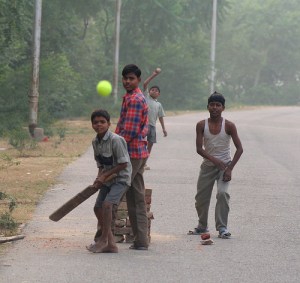
street cricketMore from my India trip –

–    After just a week here, I have realized that it is virtually impossible to watch live TV in India. The greed with respect to ads is just unbelievable. Thanks to owning a DVR, my dad actually figured out the content/ad ratio. It is an incredible 8/22 for every 30minutes of viewing time. Isn’t there some kind of FCC-like organization in India that regulates that? Even live cricket isn’t spared; since the game can’t actually be interrupted, the ads frame the play, something akin to the old days of cable television where ads would bounce and ripple their way along the bottom, top, and occasionally the middle while movies were being screened.

–    The corollary to that is that viewers in India (especially those not owning a DVR) have incredibly low levels of patience. After all, every TV watching experience is fraught with the desire to escape the ads, so you click, click, click the remote all the time, trying desperately to find a channel that has some actual programming. My sample is admittedly pretty low, statistically speaking, but across two cities and several relatives, I noticed that this lack of patience spread to other walks of life as well. Turns out this American citizen, used to things working when and how they are supposed to, actually could deal much better with drivers not showing up, traffic at a standstill, and the generally slower pace of life much better than the Indian residents. (To be fair, it could have been that my family was unhappy at the impression India was making on me and that translated to stress on their part.)

–    Enough has been written about the chaos of Indian traffic and I won’t repeat it here, except to say that I have to believe a force field a few millimeters thick exists around all objects on the road. How else to explain the innumerable number of narrow misses? I saw helmet-less children riding pillion on scooters in a hyper aware state; their legs in a constant dance to keep out of harm’s way.

–    Which leads to the conclusion that driving in India is not for the reflex-challenged. And sure enough, the average age of a motorist on Indian roads appears to be in the 30s. The few grey-haired uncles I saw were keeping cautiously to the edges of the road; not engaging in the typical competitive machismo that defines Indian traffic.

–    That machismo is particularly visible in drivers of two-wheelers (gender be damned). Motorists in India have internalized the adage of being like sugar in milk; they will be rush to fill any empty spots between the larger molecules represented by cars and trucks. I found it particularly inexplicable. After all, the aggressiveness doesn’t mean more than a minute or two saved in the total travel time, but the risk of serious bodily injury (in Chennai the helmet rule is almost universally flouted) is disproportionately high. When I mentioned this to a friend who recently relocated to India, she had an interesting take on this. “Ask anyone of these crazy drivers what they do professionally and you will find that their career choices are almost comically risk-averse. Why don’t they channel their need for risk-taking into their careers instead?”  There is a sociology thesis in here somewhere.

Picture courtesy foxypar4 via Creative Commons attribution license
In Chennai

chennai-airportYou know you’re in Chennai when the pocket of the passenger in front of you starts blaring “Palaniappa, Swami Palaniappa.” The heavy set gentleman on the seat in front of me could have been straight out of central casting for the role of the villain in a Tamil movie (or hero, in Tollywood you can’t often tell the difference). His wards were a gaggle of elderly ladies, diamonds dripping from noses and ears, though if you had met the bunch on a Chennai street sans their jewelry, you might have compassionately pressed 20-rupee notes into their palms. Hey, I was pretty scruffy too, after 20-odd hours on the plane!

The airport looked very different from my visit a year ago. Apparently a major renovation had happened in the meantime, though already there were cracks in the off-white tiles (seriously, who picks off-white for a highly traveled concourse) and betel stains on the bottom of the steel columns hiding the wiring (at least, I hoped they were betel stains).

The gleaming conveyor belt had not started up when we arrived at the baggage claim and we took our positions right next to the tube which dropped the luggage on to the belt. “Dropped” is a mild word for what our poor suitcases had to go through; the design of the chute is closer to that of a ski slope and the bags came hurtling down to the guardrail. More than once we flinched and reflexively braced for a collision and pitied those poor suckers who had “Fragile” signs on their stuff. Even the address labels painstakingly duct-taped to the suitcases were not spared; many caught the lip of the sharp steel blades of the belt and ripped right off.

Outside, a sea of humanity bubbled and swelled. A bunch of flights with returning Hajj pilgrims had landed just a few minutes ago. Entire families had come to receive the lucky pilgrims, grandmas, kids, all waiting for a glimpse of the now-sanctified members of their brood.

As we maneuvered around the multitudes, I realized that it took very little to rip off the veneer of civilization that had taken me years to acquire in the orderly suburbs of San Francisco. It had taken years of conscious training to curb my tendency to jump in front of queues and jostle to the head of lines (I am a veteran of Mumbai locals) but within minutes of arriving in India I was ready to ignore pesky stop signs and run over troublesome two-wheelers.

For all that Chennai is still a bastion of culture; the last refuge of the bibliophile, theater aficionado, and classical music lover. Within hours of arrival we had attended a book launch; author Roopa Pai read from her fantasy book for kids, Taranauts and the Shyn Emeralds and conducted games for kids. We made tentative plans to see Little Theatre’s production of Shylock, Merchant or Menace and, of course, this is kutcheri (concert) season.

More later.

Picture courtesy Julian Limjl under a Creative Commons attribution license.

Giving Thanks

give-thanksLike millions of Americans, it has been a tough year for our family during this prolonged economic downturn. It has been particularly tough in the last couple of months due to family health issues ( hence the absence from blogging) so as I was musing over Thanksgiving traditions yesterday, this line from an old couplet by Kabir popped into my head;
Dukh mein sumiran sab karein, sukh mein kare na koi;

(Everybody remembers ( God) in bad times, none in the good.)

It’s not entirely apropos, but, to paraphrase, it is easy to give thanks when things are going your way and tougher when they’re not, so I am going to count my blessings now.:)

I am thankful for –

– the inauguration of President Barack Obama. Last year there were many doubters; this year the doubts seem to have further coalesced into outright hate and viciousness. But there is no doubt in my mind that the country is moving in the right direction, whether it be in the realm of climate change, health care, nuclear non-proliferation or the economy. Let’s all take a deep breath and pray for patience.

– the career change that allowed my husband to spend more time with our family.

– the financial strength we had that allowed the above-mentioned career change.

– my new job as the editor of India Currents magazine. After years as a stay-at-home mom it felt odd to be back at work and commuting but the last six months have also been the most enjoyable, productive and rewarding period of my life.

– the courage shown by my son in dealing with his unique special needs. It’s an ongoing struggle, but we have discovered a surprising strength in our relationships and in our capacity to persevere.

– my daughter’s quick recovery from the swine flu (!) Are the rest of us immune now? I hope so!

– my wonderful family and friends  (you know who you are), who held our hands and were there when we needed them, every single time.

– the small signs of economic recovery – the decline in jobless numbers, the stabilization of housing prices, and the renewed spirit of optimism in Silicon Valley.

– my upcoming trip to India..my mouth is already watering at the thought of all the good food.

What are you thankful for?

Picture by Dave Parker under creative commons license.

Book review: One Amazing Thing

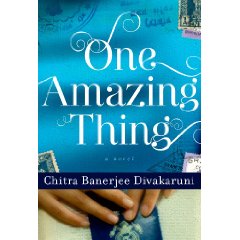
one-amazing-thingI remember being blown away by Chitra Banerjee Divakaruni’s Arranged Marriage. At that point in my life, it seemed to perfectly capture the cross-generational conflicts that were swirling around people my age. After that it became a ritual to grab a copy of her newest book at the library or bookstore.

But, eventually, her writing palled. Exposed to other diasporic writers whose craft was leaner and less florid, Divakaruni’s gushy style grew a little tiresome. I think I must have stopped reading after Unknown Errors of Our Lives (though I did read the Conch Bearer aloud to my child).

With One Amazing Thing, though, Divakaruni returns to a crisp, almost minimalist, style of writing that reminds one of all the reasons why she was so popular in the first place. It is a slim tome, barely 250 pages or so, and so absorbing that the words whiz by at warp speed, not even allowing one to pause to admire the literary style.

A motley group of would-be travelers waits for visa approvals at an Indian visa and passport office in an unknown city. When a massive earthquake strikes, they are thrown together in a struggle for survival. Quickly, roles are delineated; the leader, the caregiver, the rebel. After an abortive attempt at escape, the group realizes they are better off waiting for rescue. As water slowly seeps into their safe haven and  oxygen levels deplete, they decide to share the tale of one amazing thing in their lives to keep their minds off impending doom.

Not all the stories are equally compelling, but Divakaruni makes a capable attempt at creating the voices of a varied cast-there is an old white couple, a punk Chinese teenager and her grandmother, a black army vet, an Indian graduate student, Indian visa office bureaucrats, and an angry Muslim young man. The voices are credible and the stories interesting. As they tell their stories we get a glimpse into these diverse lives, only to witness the common thread that makes every human story recognizable and familiar.

With One Amazing Thing, Divakaruni gets her writing mojo back; fans will be delighted with the book and new readers will be appreciative.

This is an early review. The book arrives on the shelves in February 2010 and is available to pre-order at Amazon.

Seeking Citizen Journalists

flip-video-cameraIndia Currents is pleased to announce a new initiative with San Jose Beez, an online collaboration of ethnic media organizations featuring hyper-local news content covering the San Jose area.

In addition to the general interest articles and calendar of events featured in our print magazine, we will be presenting online content of specific interest to the ethnic community in San Jose.

We are looking for citizen journalists who will identify and develop stories with an emphasis on the local Indian American community. In addition to excellent writing skills, applicants must have a lively sense of curiosity and a genuine interest in people.

To apply, please send your resume with a sample of your work to publisher[at]indiacurrents.com. Your work can be in the form of a written piece, photo or video essay.

Swine Flu – Prevention Tips

swine-fluNow that President Obama has declared swine flu a national emergency, I thought it made sense to put up these simple tips to help protect you. These are courtesy a chain mail from a friend via India, not the best of sources, I know, but the advice seems to make a lot of common sense, so here goes –

In a global epidemic of this nature, it’s almost impossible to avoid coming into contact with H1N1 in spite of all precautions.

While you are still healthy and not showing any symptoms of H1N1 infection, in order to prevent proliferation, aggravation of symptoms and development of secondary infections, some very simple steps, not fully highlighted in most official communications, can be practiced (instead of focusing on how to stock N95 or Tamiflu):

1. Frequent hand-washing .

2. “Hands-off-the-face” approach. Resist all temptations to touch any part of face (unless you want to eat, bathe or slap).

3. Gargle twice a day with warm salt water (use Listerine if you don’t trust salt). H1N1 takes 2-3 days after initial infection in the throat/nasal cavity to proliferate and show characteristic symptoms. Simple gargling prevents proliferation. In a way, gargling with salt water has the same effect on a healthy individual that Tamiflu has on an infected one. Don’t underestimate this simple, inexpensive and powerful preventative method.

4. Similar to 3 above, clean your nostrils at least once every day with warm salt water. Not everybody may be good at Jala Neti or Sutra Neti (very good Yoga asanas to clean nasal cavities), but blowing the nose hard once a day and swabbing both nostrils with cotton buds dipped in warm salt water is very effective in bringing down viral population.

5. Boost your natural immunity with foods that are rich in Vitamin C (citrus fruits). If you have to supplement with Vitamin C tablets, make sure that it also has Zinc to boost absorption.

6. Drink as much of warm liquids (tea, coffee, etc) as you can. Drinking warm liquids has the same effect as gargling, but in the reverse direction. They wash off proliferating viruses from the throat into the stomach where they cannot survive, proliferate or do any harm.

And here’s the CDC page for more information: http://www.cdc.gov/H1N1FLU/

Picture courtesy Artifex via Creative Commons attribution license.

Blue – all wet

blue-1206The camera lovingly follows the contours of an underwater paradise. Incurious fish gently swim away from the light as the camera glides over sting rays, around coral and through populous grottos. As the credits roll, Shreya Ghoshal’s powerhouse voice begins the opening notes of the Bondesque song “Rehnuma.” It is a promising start for an underwater adventure, but when Shreya crescendos to “Katilana Adaaa” and it is not accompanied by a similar visual crescendo on screen, you first get the stirring of doubts about the competence of the filmmaker.

Set in the Bahamas, the titular Blue is the Lady in Blue, a British ship carrying Indian treasure that sank off the coast immediately after India’s independence. Sagar, a happy go lucky fisherman( Sanjay Dutt), is pressurized by his friend Aarav(Akshay Kumar) to help him look for the treasure. When Sagar’s young brother Sam gets into trouble with some Thai goons and has to come up with 50 million dollars ( an absurd sum that even the character demanding it seems to realize he’s pulling out of thin air) Sagar agrees to go on the treasure hunt.

The movie inexplicably spends only about 15 minutes on the actual treasure hunt; the rest is spent on motorcycle chases, boxing bouts and completely unnecessary songs and dances. This is especially true of the item number with Kylie Minogue, whose taut stretched face and body belie her age(41). (Farah Khan was probably busy enjoying the island atmosphere-the choreography is uninspiring.)

Director Antony D’Souza  was surely born with a silver spoon in his mouth; getting over a 100 crores to indulge in for one’s debut movie is an amazing achievement. Like a kid sent into a candy store with unlimited money, D’Souza just keeps gorging on the goodies. Like motorcycle chases? Here’s two. How about a bunch of helicopter shots of the beautiful Bahamas? And here’s a scene with jet-ski stunts.

But the phenomenal budget (Blue is reportedly the most expensive Hindi movie to make) obviously wasn’t enough. By the time the underwater scenes and the stunts were shot, and the stars paid, obviously there was no more money left over to pay for a good script or a screenplay writer. The actors seem to be improvising dialogues on the spot. Seriously. In one scene Aarav asks a Bahamanian hottie for a ride home. “Can I ride you,” he asks, a deliberate double entendre. Then he apologizes and asks, “Can you ride me home?” a Punjabi-ism if I’ve ever heard one. Other inane dialogues like, “Don’t worry, everything will be all right,” and “Just give me a gun, I will kill him” abound. The budget also apparently ran out before the props for the precious Indian treasure were purchased; there is, believe it or not, a trunk with gold coins and jewelry spilling out of it that could have been assembled in the local craft store.

One can tell the passion of the director was reserved for the cinematography; there are several scenes in the movie that stand out as visual works of art (one, in particular, is the scene of the red motorcycle in a sepia forest) but as a moving picture there is no connectivity between the scenes and no drama to engage the viewer. It feels as though D’Souza composed the movie entirely as a series of pictures and ignored the sound and fury that make a photo gallery a movie.

The actors just try their best to look good and swim well. Lara Dutta looks amazingly hot. Her toned derriere is just one of the many that D’souza lovingly pans over. Akshay is a good male equivalent, though Lara is inexplicably paired with the dissipated and unfit-looking Sunjay Dutt, whose spreading abdominal girth is just barely constrained by his wetsuit. Katrina Kaif makes a special appearance for which one hears she was paid an obscene amount of money.

The songs have been mostly panned by reviewers, but I think they grow on you. Blue is not A.R. Rahman’s best work, but “Rehnuma” and “Shara ra ra” and even the poorly choreographed “Chiggy Wiggy” sound appealing after repeat listening.

Blue will appeal to an audience unfamiliar with classic underwater adventures like The Deep and The Abyss but I am still surprised at its success in India. Unfortunately, the box office success of movies that are all style and no substance only spawns a dozen more copycats. Don’t be surprised if an Indian Jones-style jungle adventure is in the works as we speak. They can always call it Green.

Surviving 2009

united-states-unemployment-rate-chart-000001There’s a new serial on ABC called Flash Forward where the entire world blacks out for a little over 2 minutes. During the black out they all have a flash-forward of what they will be doing on April 29, 2101. When those crucial moments pass, the world is a state of chaos, of course, but slowly survivors realize there now they have something in common with every other human being in the world. “What did you see,” becomes the new ice-breaker.

As 2009 comes to an end, that ice-breaker may well be “How did you cope?” The global recession affected everybody, whether through immediate personal calamity, or news from a loved one or friend that they had lost their jobs, lost their health insurance, had to move, had to retrench … in a sense  we are all survivors.

For the year-end issue of India Currents magazine, I’d like to feature some of your stories. How did you survive 2009? What tips would you like to share? What are your strategies to cope with the fairly bleak scenario for next year?

Send me your stories via comments here or to editor (at) indiacurrents.com. I’ll put up some of the best ones in the December issue.

Akshaya Patra helps flood victims

akshaya-patra-floodThis past week, torrential rains in Karnataka and Andhra Pradesh caused flooding, rendering hundreds of people homeless and thousands of others unable to travel or find food. The local governments approached Akshaya Patra and asked the organization to provide meals to displaced victims of the natural disaster.

Akshaya Patra answered the call to service in Bellary, Hubli, Hyderabad and surrounding areas, delivering meals for 57,000 people, despite poor road conditions and the heavy downpours. Akshaya Patra also provided an additional 42,000 packets of food to be airdropped by the Indian Air Force.

“We wish to make all the facilities of Akshaya Patra available to supplement the flood relief operations of the government,” said Madhu Pandit Das, Chairman of Akshaya Patra India. “In all these kitchens we have capacity to cook thousands of meals in a short time and we have volunteers available to distribute the food.  The government can count on us to provide these services for as long as they are needed.”

Helping a million kids

Akshaya Patra, the organization that provides meals for underprivileged kids,  has reached a triumphant moment by crossing the one million mark and is now feeding over a million children in 17 kitchens in seven states in India.

To commemorate the milestone, come celebrate with luminaries like Narayana  Murthy at a benefit event at the India Community Center in Milpitas.

When: October 25, 6:00 p.m.

Where: India Community Center, 525, Los Coches St., Milpitas

Tickets: $140. Get your tickets here.

akshaya-patra