Winning with the spoken word

rachana1It felt funny to be on the other side of the table.

Last Saturday, two other judges and I watched in amazement as kids from the age of 3, barely potty trained, to kids in their preteens, took the stage to wow us with their elocution.

The event was “Win With Words”, an annual public speaking competition conducted by Rennu Dhillon of Genius Kids at the Sunnyvale Hindu Temple. Unlike previous years, the contest was open to the public this time and almost 60 kids enthusiastically took the stage to compete for trophies.

According to the Book of Lists, the fear of public speaking ranks above the fear of death or disease, prompting comedian Jerry Seinfeld to observe, “( At a funeral)..most of us would rather be in the casket than delivering the eulogy.” Having participated in several such competitions in my childhood, I can testify to the panic that envelops a participant when he or she is on stage, facing a set of bright lights and a group of strangers.

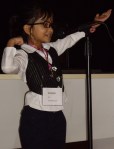
siri2But it is to Miss Rennu’s credit that even the youngest and tiniest participants bounded up to the stage with confidence, eager to deliver their lines( most of the kid were Genius Kids students or alumni.) Yes, those lines were often forgotten and mummy or daddy had to stay on the sidelines, prompting their children with audible whispers, but not once did I see a child show fear or nervousness. Many showed creativity (or, at least, their parents’ creativity!) by dressing up in costumes and using props to deliver their message.

anisha1The topics were restricted to about a dozen, and a few like “What I want to be when I grow up” and “Eating healthy” were popular, though judging by the responses we are going to have a preponderance of healthy doctors and basketball players in the next generation! Two participants spoke on the importance of dance, illustrating the topic beautifully with hand gestures, or mudras. One decided to give a speech on the pros and cons of cell phone use, using a banana as a substitute.

All were impossibly cute, which made the judges’ job impossible. Still, we scored away diligently, with occasional “aha” moments when a child was outstanding. At the end, some kids won trophies and others went home with certificates of participation, but to my eyes, each and every child showed amazing courage by braving the stage, something I can safely bet few of their parents would attempt.

A public speaking competition like “Win With Words” is an incredibly important part of the many extracurricular offerings that enrich a child’s education and it is my hope that next year so many more kids will participate that the Genius Kids team has to stretch the competition over two days. I know how competitions like these added to my confidence and speaking skills as a child and want that experience for every child who would like to compete.

Here is a list of the winners –

Category 2 – ages 3 to under 4 years old

1st Place –          Sanah Bhardwaj – My Favorite Book
2nd Place –         AbhinavJoshi – Endangered Species
3rd Place –          Deeta Ganapathy – What I Want To Be When I Grow Up

Category 3 – ages 4 to under 5 years old

1st Place –          Siri Basavaraj – If I could be an animal, what I would be and why
2nd Place –        Rachana Aithal – What I Want To Be When I Grow Up
3rd Place –        Abhay Acharya – What I Want To Be When I Grow Up

Category 4 – ages 5 to under 7 years old

1st Place –          Lara Panda – Importance of Eating Healthy
2nd Place –           Viraj Verma – My Favorite Book
3rd Place –          Rithika Susarla – Is there any value in homework

Category 5 – ages 7 to under 10 years old

1st Place –          Rahul Joshi – How films impact our lives
2nd Place –           Sanjana Aithal – What I Want To Be When I Grow Up
3rd Place –          Sarnesh Raj Arul

Category 6 – ages 10 to under 12 years old

1st Place –           Anisha Upadhya – Importance of Dance
2nd Place –          Sohil Kshirsagar – Importance of cell phones
3rd Place –          Madhukar Muralidhara  – You must be the change you want to see – Mahatma Gandhi
Abhay Varshney – Importance of the Internet

Another hat to wear

Folks,

May-09Starting Monday, June 1st, I take over as editor of India Currents, the general interest magazine for Indians and Indo-philes based in California.  If you are a Bay Area resident, chances are you have come across the magazine sometime, perhaps at your neighborhood grocery store or community center.

India Currents, which began publishing in 1987, has a long and proud history in the community. Started mainly as an event calendar and classified ad publication, the magazine has steadily built a portfolio of high quality editorial content, featuring writers who have gone on to become published authors in their own right. While the content is not specifically local to the Bay Area, the varied subjects featured in the magazine are of enduring interest to diaspora. I hope to continue the proud editorial tradition of featuring an impeccable quality of writing that is also engaging and thought-provoking.

What of Water, No Ice, you may ask. Since WNI is much more hyper-local in nature, I do not anticipate a conflict of interest with my new responsibility. I have had the opportunity to work with some very talented writers at WNI and hope they will continue to support WNI with their work. I also hope to continue featuring local events, personalities and entrepreneurs.

Of course, none of this will be possible without your support, dear readers. I hope you will continue to bring to my attention topics that you think I should cover, both for India Currents and Water, No Ice and keep me on my toes with your astute comments.  Do follow me to India Currents and check out the excellent work its writers are doing as well..your feedback will be invaluable in making the magazine more sensitive to the needs of its readers.

In an age where digital media are replacing traditional print offerings, India Currents forms part of the bulwark of the printed word. Unlike the online experience, which has tended to become more and more narrowly focused, general interest magazines  like India Currents open your eyes to a variety of subjects, some that may not have directly come to your attention. I hope to keep doing more of the same and if you join me on this exciting adventure, I am sure we can build a quality product that we can continue to be proud of.

To readers and writers interested in being a part of India Currents, I can be reached at editor at indiacurrents dot com.

Psychedelic Pancham

sandeep-khuranaAt first it feels odd to listen to childhood favorites like Chura Liya Hai Tumne (Yaadon ki Baraat) and O Maajhi Re( Khushboo) set to meditative music. Then you think, “Pancham Da would have approved!”

This interpretation of R.D. Burman’s oeuvre is the work of Sandeep Khurana, a prolific Bay Area composer, who specializes in new age albums, from yoga music to Reiki albums, from Shiva Mantras to psychedelic versions of Hindi hits.

An IT professional (can there be any other kind in the Valley?) Sandeep took courses in music at the Ali Akbar Khan College of Music here in the Bay and classes in film production and the media arts before deciding to pursue his dreams of a career in music full time. 11 quick albums have been the result since Sandeep started composing in 2002, some in collaboration with local artists like Rita Sahai and Renoo Nathan.

Ethereal Chakra

“Record companies are always willing to listen to a new concept,” say Sandeep, whose music is currently available in digital formats. In the US, Sandeep tied up recently with Songcast, which distributes his music on various digital download sites like Amazon and Itunes. The downloads are picking up but Sandeeps’s aim is to get a record label interested in producing CDs and have it on store shelves.

It’s not easy being a professional musician in a world filled with wannabes but Sandeep’s music has slowly been finding a market. “I just want people to give me a chance,” says the musician, confident that his work will do the rest of the speaking for him.

Check out some of Sandeep’s wide range of music here. One album that might be of interest is R.D. Burman – The Digital Way, volume one. Another one called “Celebrating Pancham” featuring Bay Area singers is in the works.

Movie review – "99"

99-21“It’s a crime comedy, it’s a thriller,” equivocated Raj Nidimoru, the co-director of 99, refusing to reveal the plot of his first Bollywood movie on a phone conversation a few weeks ago. But what 99 is first is an entertainer, with the plot a loose device to string together a host of funny moments and clever dialogue.

Sachin (Kunal Khemu) and Zaramud (Cyrus Broacha) are a couple of Mumbai hustlers who find themselves indebted to a gangster AGM ( a very funny Mahesh Manjrekar) after they crash his car. He puts them to work collecting the gambling debts of Rahul Vidyarthi ( Boman Irani) in Delhi after the latter absconds with 20 lakhs of AGM’s money.

That’s pretty much it for the story; the rest is an exploration of the unique cultures of small-time villainy in Mumbai and the pervasive dishonesty of Delhi. Match fixing in cricket is examined, as is the gambling subculture that ripples under every metropolis.

The Laurel and Hardy duo of Sachin and Zaramud bumble and stumble their way through the simple job, clearly at a loss as to what is expected of them but with great bonhomie and good humor, even while they are cracking heads or getting beaten up. Along the way they meet a host of engaging characters who manage to be instantly recognizable without being reduced to stereotypical caricatures.

99 is not a perfect movie. Despite having a thrumming background score that suggests a brisk pace, there are many dead zones. A whole subplot about Rahul’s marital problems could have been excised without making one iota of difference to the overall movie. (I can see why the directors succumbed to the temptation of leaving the scenes in. Boman Irani is just so good in every scene he appears in.) Making the movie shorter by about 30 minutes would have dramatically improved its pacing.

But to the viewer who is patient, the movie offers crackling dialogue, great acting and many screwball comedic moments that make you laugh out loud in a way few Bollywood movies these days do. The cast is just terrific. Kunal Khemu’s unconventional looks don’t detract from the fact that he has impeccable comedic timing and Cyrus is a great foil. Boman Irani steals every scene he is in and Mahesh Manjrekar disappears into his role as the gangster with an ego as big as his paunch. Only Soha Ali Khan as Sachin’s love interest disappoints; she looks washed out and tired, with the Pataudi nose in sharp relief. She doesn’t have good lines and she is unable to bring the effervescence required to stand out in the company of some very fine actors.

Why name it 99? For one, the movie begins in the year 1999, which allows for some technological snafus that move the plot along that would not have been possible today. But the movie’s name refers to the disappointment of getting out at 99 runs, as Sachin and Zaramud keep falling just a little short of hitting that century and making their humble dreams come true.

99 is a treat for the discerning viewer even if there are moments when you wish the movie would hurry along and get to the point. Like Flavors, the directing duo’s first full length feature, this is a sly, smart and witty movie that does not insult the viewer’s intelligence.  If you’ve missed its big screen release in the US, be sure to catch it on DVD.

The Last Word

A disgruntled voter

May 18th, 2009

Sonia and Manamohan Singh - picture from NDTV.Com

Sonia and Manamohan Singh - picture from NDTV.Com

I’m writing this after a lot of soul searching. On a day when stock trading had to be suspended after it reached the upper circuit and was ballooning out of control, on a day when LTTE chief Prabhakaran, his son and aides were declared as “shot dead while trying to escape”, when TV channels are on overdrive “celebrating” Congress victory and Rahul Gandhi’s leadership, maybe my voice will sound churlish.

Today, I lost a whole lot of my faith in TV reporting. PTI said Prabhakaran was shot dead while trying to escape in a “jeep”. IBN Live said while trying to escape in an “ambulance”. Strangely, after 3 years of relentless war against the LTTE, President Rajapakshe was in Jordan when the final assault was mounted and the area left to capture kept shrinking. Why would he go away? Why did he say, “When I return, it will all be over?” It is too much of a coincidence that there was no progress in the war during the gap of three days between the last day of polling and the day of the results.

The new government doesn’t have to deal with a messy war. It just has to send supplies to the displaced Tamils. Busy with national elections, it could not have done anything to enforce a ceasefire. Did it really want to?

With Prabhakaran out of the picture (he became too ambitious), one can only hope that the Tamils are lucky enough to find an activist dedicated to their cause.

Back to the elections:  Tamil Nadu went through large scale rigging and tempering of electronic voting machines – a reason why the machines have been rejected by the US and Japan? What could not be fixed by EVMs was done by officers in the pay of the government. Everyone knows about it but they all feel powerless to interfere. The print media published a sanitized version of the story. TV channels were deafeningly silent on it, choosing rather to say that there was big support to a government that was responsible for power cuts, increase in all food prices, unprecedented violence, bandhs, land grabbing and sand theft and it won because of its populist policies is to mock at the people who are suffering.

And the news channels didn’t raise a whisper about the way P Chidambaram got elected.

At about 12 noon on May 16, the counting got over and the results were announced. AIDMK’s candidate was declared as winner at Sivaganga. For three hours after that, the certificate to that effect was not issued. There was no round by round declaration of results either. There was a flurry of phone calls, PC was taken to a backroom and issued the certificate. After more delay, paramilitary forces amounting to 5000 arrived and the announcement was made: PC had won by the same number of votes that his opponent had won earlier. The Chief Electoral Officer was consulted and he said that his hands were tied since the District Magistrate of the area had used his discretionary powers to “recount” and had made the correction. This man, who is now being described as “squeezed through the election” may soon be our finance/home minister.

Today, PC went on air thanking the CM of this state for his help in his election.

Yes, the Congress won a lot more seats this time and will provide a more stable government. Without having to depend on the Left (there’s international relief that the communists are out of the government) the party can speed up reforms and bring in more FIIs, more MNCs, more food imports and more cash to the party’s coffers. But behind that “stability” are candidates who muscled and moneyed their way in.

There are criminal charges against three Tamil Nadu ministers in the previous cabinet. They will get berths this time too. In addition there will be one more from Madurai who set a newspaper office ablaze over the family feud. It killed three workers inside.

Come volunteer for Narika – it's easy!

narika-womenNarika, the domestic violence advocacy organization, has been doing stellar work in the Bay Area for several years now. The non-profit started by offering a help-line and advocacy services but in recent years the dedicated staff and volunteers have expanded their scope to helping victims of abuse and disadvantaged women re-establish their lives and become financially independent. Their SEED program(South Asian Economic Empowerment Development) teaches women life skills and helps them get back on their feet.

Now Narika needs your help. Can you speak English fluently? Then you can become a volunteer for Narika and make a difference in just two or so hours a month.

Narika has launched a language exchange program to help women with spoken English practice. Volunteers are paired with graduates from the SEED program in Fremont and practice speaking English one-on-one for an hour a month and then follow up via phone to continue practicing for 20 minutes a week.

Narika is looking for at least 5  volunteers to help with this program. The total time involved is very, very reasonable and perfect for stay-at-home moms who have an hour or two to spare here and there.

Contact Atashi Chakravarty at 510.444.6024 if you are interested. If you think you can spare some more time on other volunteer activities, more information can be found here.

Here are the dates for the one-on-one meetings. Meetings will take place at the Fremont Resource Center at 3:30 on the first Saturday of each month. 39155 Liberty St # A110, Fremont, CA 94538. (510) 574-2000

June 13, 2009
July 11, 2009
August 8, 2009
September 12, 2009
October 10, 2009
November 14, 2009
December 12,2009

Special Election Tuesday May 19th – Go vote

Picture by cjc4454 under Creative Commons

Picture by cjc4454 under Creative Commons

Now that that exuberance and the excitement of the Presidential elections are over, it is tempting to sit back and relax for the next 4 years. As Californians however, we cannot be unaware that the state is going through a tremendous financial crisis. Even though a messy budget was hammered out by the Californian legislature in February, cracks in the system are already evident with loss of revenues already increasing the budget deficit.

Governor Schwartzenegger is proposing a few stopgap measures to ease the problem. Unfortunately, the way the state’s Constitution is framed, a lot of the changes cannot be made without the support of voters. We may be apathetic to the changes being proposed out of Sacramento, but these changes impact our lives in a very real and immediate way.

Take a few minutes to go over the Propositions on the ballot and if you have a vote, go and exercise it tomorrow. Whether you have kids in school or a family member in need of mental health services, or you are just a resident of California, thse measures will make a difference in your life.  Take the time to read up and go do your civic duty. If nothing else, it gives you the right to complain about how your government is not working for you.

Read here for a short explanation of the various propositions and my recommendations. If you have an opinion on any one of them, add them to the comments. Any light that can be shed on our confusing political process is welcome.

California Special Election – Propositions on the ballot

UPDATE: Propositions 1A, 1B, 1C, 1D, 1E – Defeated. Proposition 1F – Passed.

The Californian budget process has always been a mess. Faced with an unprecedented financial crisis, Republican Governor Arnold Schwarzenegger and the Democratically-controlled State Legislature passed an austerity budget in February that closed California’s $42 billion shortfall through a combination of cuts to social services and education, and tax hikes.

The peculiarity of California is that the state constitution places an extraordinary burden on voters to make legislative decisions. Some of the budget measures passed by Sacramento have to be voted on by the electorate in order for them to take full effect. On Tuesday, voters will head to the ballot box to decide the fate of Propositions 1A through 1F.

Despite an aggressive push by the governor, turnout is expected to be low even though these propositions directly and immediately affect Californian residents and impact the ratings of California state bonds. If you are a registered voter and have not yet cast your vote, I urge you to read through the following information and make the trip to your polling place tomorrow.

Here is a summary of my recommendations on the various propositions on the ballot in November.

Proposition 1A – Vote YES
Proposition 1B – Vote YES
Proposition 1C – Vote YES
Proposition 1D – Vote YES
Proposition 1E – Vote YES
Proposition 1F – Vote YES

Proposition 1A – This measure changes the state budgeting practices. In a complicated way it attempts to do the following –

– Increase the size of the “Rainy Day” fund: This makes it possible for the legislature to divert more funds from the General Fund into a reserve when revenues are good. The idea is to stabilize the spending over lean and good years. The state would look at historic trends in revenue and when the current year’s revenue went over those trends the money would have to be put in the reserve fund.

– Spending out of the reserve fund would be restricted to certain causes.  If Prop 1B passes some of the reserve fund would go to education to ameliorate some of the cuts to K-12 spending this year. After spending on education or if Prop 1B fails those funds would be used to pay down debt or spending on infrastructure.

– The Governor gets the authority to make further spending cuts without legislative approval on two matters – spending on general state operations and cost-of-living adjustments to programs in the budget( not salaries.)

– State tax increases that were put in place in February would not expire in 2010-2011 but would continue till 2012-2013.

Arguments: Opponents argue that the proposition is full of loopholes and there was not enough transparency in the drafting process. They also suggest that this measure gives the Governor too much power to cut spending, even in good years. However, the status quo has hardly been working for California. Any attempt to even out revenues over good and bad years can only be beneficial to residents. Also the emphasis on restoring funding to education outof the reserve fund has this mother of two cheering.

My opinion: VOTE YES.

Back to top

Proposition 1B: Currently, Proposition 98 establishes a minimum funding level for education. However, loopholes in the law allow for the minimum funding to be calculated by a different formula if revenues are low. The legislature can also override Prop 98 in bad years and provide less than is required by law. When spending is less than mandated, a future obligation (called a “Maintenance factor obligation” ) is created to provide those funds. As of now, this obligation is around $1.4 billion.

Prop 1B allows for the creation of a “Supplemental Education” obligation of $9.3 billion starting 2011-2012. Funds for these come from Prop 1A. These payments are supposed to take care of the Maintenance Factor Obligation that will keep increasing for the next couple of years becaue of the cuts in education spending.

Arguments: The measure does not deal with the underlying problems in Maintenance Factor Obligation calculation or the ability of the legislature to override prop 98. What it does is restore some of the cuts that have been made this year in education, with payments starting in 2011-2012. The idea is that some money will be diverted to the “Rainy Day” fund under Prop 1A and can be used for education in the future.

It is not a well-written law but provides for immediate help ( even if it starts 2 years from now!) to schools and community colleges providing Prop 1A passes.

My opinion: VOTE YES.

Back to top

Proposition 1C: Changing the state’s operation of the lottery. Under current law, 50% of the state’s lottery revenues have to go back as prizes and spend no more than 16% on operating expenses. 34% of the funds go to educational institutions ( a very small part of overall education funding). Funds cannot be used for any other purposes.

This measure allows the state to give away a higher percentage to winners ( presumably to attract more lottery revenues), reduce the operating expenses to 13% and no longer dedicate the remaining funds to education( the shortfall would be made up from the General Fund).

More importantly, the measure would allow the state to borrow against future profits from the lottery, upto $5 billion of which is already in the state’s budget right now. The borrowing would be paid off by future lottery profits.

Arguments: This measure does not impact education funding as the shortfall is supposed to be made up by the General fund. In a time of financial crisis, this is a simple way to get some much needed funds right away against the hope that the economy will improve in future years. The success of the measure hinges on the improvement in lottery ticket sales due to the higher payout.

My opinion: VOTE YES.

Back to top

Proposition 1D: Protects Children’s Services funding and helps balance the state budget. There is a law on the books ( Proposition 10) that allows for diverting a portion of tobacco taxes towards the First % program that deals with development programs for children up to the age of 5. The funds go to state and county commissions every year and any unspent amount is carried over to the next year.

As it happens the commissions are sitting on an unspent fund of about $2.5 billion which as of now cannot be used for any purpose other than the First 5 program.  What this new proposition does is allow for a temporary redirection of these unspent funds to other state health and human services for young children that do not fall under the First 5 program. This ensures that those vital services don’t get cut at a time of economic uncertainty.
Arguments: The biggest argument against this proposition is that it diverts money from the First 5 program. However, since these are unspent funds that the various commissions are sitting on, there is no reason why these funds cannot be used right away in other places where they are needed. This is also a temporary measure whose effects will disappear after 2013-2014.

My opinion: VOTE YES

Back to top

Proposition 1E: Temporary reallocation for Mental Health Services funding. Helps balance state budget. Currently, Proposition 63, also known as the Mental Health Services Act, provides state funding for mental health programs through an income tax surcharge of 1% of income over $1 million. The funds are used for a variety of mental health services such as care, education and early intervention and cannot be reduced or diverted as the law stands now.

The new proposition allows for temporary redirecting ( 2009-10 and 2010-11) of some of the funds towards the Early and Periodic Screening, Diagnostic and Treatment program (EPSDT), which services Medicare beneficiaries under age 21. That way, funds for EPSDT don’t have to come form the General Fund at a time of fiscal crisis.

Arguments: While this proposition takes money away from the Prop 63 beneficiaries, currently unspent funds of $2.5 billion are sitting in state coffers under Prop 63. The idea is to temporarily be able to use this money at a time of fiscal crisis to fund another mental helath services program that would otherwise suffer.

My opinion: VOTE YES.

Back to top

Proposition 1F: Prevents increases in salaries of elected officials during budget deficit years. Salaries of elected officials in California are set by the California Citizen’s Compensation Commission based on several factors. The financial condition of the state is not one of them. in addition Proposition 6 prevents reduction of salaries during lean years.  This Proposition amends the Constitution to prevent the commission from raising the salaries during a deficit year( when the General Fund ends the year in a deficit.

Fiscally, the proposition does not have a huge impact. However, it is hoped that the potential impact of lower salaries for elected officials will  make them work harder towards balancing the budget!

Arguments: This is a largely symbolic gesture that ensures that politicians will not continue to get wage increases while their constituents suffer. If it makes you feel good, by all means vote for it.

My opinion: VOTE YES

Back to top
Fifth and last phase of polling

By Geeta Padmanabhan

I cast my vote today

I went out and voted in the fifth and last phase of elections (2009) to the Lok Sabha. I thought I would be there before the 107*F summer heat kicked in and reached the polling booth at 7 am , the opening hour. Many, I found, had had the same idea. Each entrance had at least thirty voters. Only the election staff wasn’t ready. We had to wait at least a half hour before they opened the proceedings.

“Will they extend the timings?” asked the man behind me. “They weren’t expecting a crowd,” said a woman. “Anyway, they are adept at cramming the votes into the last hour (a reference to what happened in Thirumangalam).”

The large voter turn-out wasn’t really a surprise. In the last week, wherever I went, I had a flyer thrust into my hand. They all had this one message. “Go out and vote.” Each carried the name of an outfit – Liberal Association, Ekta, Election Watch – loosely constituted NGOs whose only aim seemed like they wanted to stir “public conscience.” Musical bands have been belting out similar messages on TV. There were celebrity endorsements for voting. The general slogan was “If you don’t vote you have no right to criticize”.

Mine is a very middle class constituency. So what does the higher voter turnout mean? A sense of despondency? Anger? (Plenty to be angry about, price-rise, power cuts, lack of a proper garbage removal system, construction of bad and unnecessary overhead roads, shrinking of walking spaces and sidewalks). They might be thinking: “If I don’t vote, I’m doomed. I’ll have no voice in what’s being done to my environment.” Voting out of anger is not a new phenomenon. If that brings them to the polling stations, it is very welcome.

Considering the magnitude (mind-boggling numbers) the Election Commission had done a decent job. There were ramps and voting papers in Braille. Policemen were helping voters find their way. Names and symbols of candidates were prominently displayed. Form 49-0 was easily available. The print media have been carrying regular reports on the “How to” of using the electronic voting machines.

But there are serious problems – systemic ones – in the voting process. To set them right, we need electoral reforms.

Voting is not compulsory and the day is a paid “holiday”. People just take off. Why should it be a holiday?

I have no say in who the political parties choose as their candidates. On what basis are they given “tickets”? Caste? Influence? Money power? Winnability? I am forced to vote for the party (and its supremo) and not for the candidate. This limits my choice.

I could vote for an independent candidate. My constituency has Sarat Babu, an IIM-A guy whose mom educated him on the earnings of her small roadside idli shop. Another independent is Venkatraman who has a long history of working for the disabled in these parts. But then, there are 35 others contesting for this south Chennai seat. Do they stand a chance at all? Do people even know about them?

My neighbour and his family were turned away because their names were missing from the voters’ list. They had voted in the last elections. If it is any consolation actor Kamalhasan wasn’t allowed to vote because his name went missing too. How did this happen?

A couple of days ago, my husband and I were given a “voting slip” by an anonymous caller. The slip carried our names, the name of the voting venue, and our voting register number. Those who did not carry this slip were barred from voting, even if they had voter IDs. No slip, no vote.

The shocking part is that the slip was not a plain innocuous one. It had, prominently printed on it, the election symbol of the ruling party. A pamphlet highlighting the “achievements’ of the party was attached to it. We almost looked for the pinned cash. Why is this piece of paper indispensable for voting?  Why would a political party spend on it and the election officials insist that we have it at the time of voting?

We also saw those infamous black-trousered-white-shirted guys around the polling station. They were constantly on their cellphones. We heard a guy say, “The bundles are with so-and-so.” We thought of the worst. Why can’t we cancel the candidatures of the contestants caught distributing cash or kind?

It will be good to have an age limit for the contestants. It will be good to make voting compulsory and open a “help booth” to sort out problems at the venue. It will be good to see 100% voting. Good to see proper vetting of “independent” candidates. Why would they contest, knowing well they would lose their deposits?

Each candidate is allowed to bring two observers. It is an open secret that many independents are dummy candidates to facilitate the presence of musclemen.

But I voted and I’m happy about it.

All in the eyes

By Isheeta Sanghi

Picture by Antonio Milena - Wiki Commons

Picture by Antonio Milena - Wiki Commons

Staring – isn’t it something that we can all agree Indians know how to do best? When you’re a kid, you feel it and you think it’s weird, but you get along. When you become a young adult and you feel other people’s eyes on you, for no apparent reason, you get irritated and want to yell “What the heck are you staring at?” When you get to the point in life where you realize you simply cannot teach an old dog new tricks, you learn to try and meditate when people stare, or try to completely disregard the fact that they are even alive and looking at you.

I don’t stare at people, so when people stare at me, I find it highly offensive and my blood pressure reaches levels it probably shouldn’t reach. I hate when nosey in-laws (in particular) ask questions that I am uncomfortable answering, because I don’t ask those questions, not only because I don’t care, but also because I have no room for that information in my head. I’ve got enough going on in my own life for me to process and analyze what other people are doing or not doing or buying or not buying.

I hate when trash pickers go through my trash because I don’t go through anyone’s trash, and I feel that on some level it is an invasion of privacy. When you throw something in the trash in the US you know that it’ll end up in some recycling plant somewhere and that’ll be the end of it. But in India someone will go through your trash and if you have even a diminutive amount of cream in a bottle, they’ll take it and use it. And please don’t get me wrong, I wish there was less poverty in the world, and I wish I could help, but for the love of God, please don’t go through my stuff, even if it is my trash, it’s just plain creepy.

I also hate when Indian men (in particular) stare at me because I’m showing off about a quarter of my leg, because hey, let’s be honest unless John Abraham is walking down the “street”, Lord knows, I’m not looking at any Indian man. On top of that, I’m wearing more clothes in order to avoid being stared at as is, that I find it completely ridiculous that they stare, because you’re trying your hardest to cover up.

I recently noticed, however, that it’s not only this particular type of staring that exists in India.There’s a totally separate form of eye etiquette that people follow when they drive. A heavy stare from someone driving a “big” car, to a cab driver driving some bashed up yellow licence-plated vehicle can do magical things. When the stop sign isn’t working (and even when it is) eyes become a form of traffic policing.

People will look at each other and inch forward, and based on the type of stare you get back, you move, or, you don’t. Note also, that none of the staring is nice staring. In the US people usually acknowledge one another, and offer the other to go first, waving a friendly smile while they’re at it. Here, if you tried that, you’d be in the same place, probably forever, because friendliness in India, for the most part, is actually a form of vulnerability and when people think you are vulnerable, they will take you for a ride.

There are also those who don’t use their eyes, as a form of traffic policing. These are the people who simply will not look at you and will keep going, so that they have the right of way. This seems to be the latest trend with many drivers, and it’s a miracle that the number of potential accidents remains only potential.

It’s funny how things of India always seem to rest on that fine line between ridiculously insane, and absolutely hilarious. The driving gets to everyone, it gets to the newcomers, and it gets to people who have been here for years, and there are days when you can make light of things and laugh, but there are days where you just wish that with the flick of a wand you could organize all the cars in neat tidy lanes, have the trucks in one, motorcycles in one, autos in one, bullock carts, cows the occasional camel or elephant, and bicycles in another, and a separate lane for all the cars. But seeing as how the wand thing isn’t likely in this lifetime, I guess the best bet is to practice your best heavy stare, and hope to get safely to your end destination.