Yearly Archives: 2008

"I vote nobody" – Rule 49-O

In the wake of the Mumbai terrorist attacks, frustration over government inaction and incompetence has boiled over among India’s educated class. In a sick sort of way, the terrorists’ deliberate attempt to target upper income and foreign nationals, done to give them more visibility in the global arena, seems to have had an unexpectedly beneficial side effect- that of waking up the apathetic Indian elite.(Here is an interesting article in the NYT about it.)

Hundreds of protests and vigils have been organized in the last week and calls for reform have been ringing across the nation. One such well-intentioned but misguided email doing the rounds is “I vote nobody”, a viral mail exhorting voters to demand a form that allows him/her to vote for “nobody” at the polling booth.

Why should you go and say “I VOTE NOBODY”… because, in a ward, if a candidate wins, say by 123 votes, and that particular ward has received “49-O” votes more than 123, then that polling will be cancelled and will have to be re-polled. Not only that, but the candidature of the contestants will be removed and they cannot contest the re-polling, since people had already expressed their decision on them. This would bring fear into parties and hence look for genuine candidates for their parties for election. This would change the way; of our whole political system… it is seemingly surprising why the election commission has not revealed such a feature to the public….

First, let’s see what 49 O really says-

Rule 49-O of The Conduct of Elections Rules, 1961 (as amended) reads:-
“49-O.   Elector  deciding  not  to  vote.-If  an  elector,  after  his electoral  roll number has been duly entered in the register of voters in  Form-17A and has put his signature or thumb impression thereon  as required  under  sub-rule (1) of rule 49L, decided not to  record  his vote,  a remark to this effect shall be made against the said entry in Form  17A  by  the  presiding  officer  and  the  signature  or  thumb impression of the elector shall be obtained against such remark.”

Unlike in the US, there is no room on the Indian ballot to write-in a candidate. With a paper ballot, it is easy to waste your vote by just marking multiple candidates. Since you can’t do that on an electronic voting machine, you can ask for a separate form ( which most voting locations don’t have, as Geeta Padmanabhan found out) to mark your protest vote. But then your vote is no longer secret. It appears that the Election Commission recommended in 2004 that “the law should be amended to specifically provide for negative / neutral voting.” This hasn’t happened yet.

Either way, it is a wasted vote. Contrary to the claims of the email, the interpretation of 49-O as it stands appears to be vague enough to allow the winning candidate’s election to stand regardless of the number of protest votes. (In the US there have been some notable write-in candidates but mostly the space is used by mischievous voters to write in their own name or characters like Mickey Mouse!)

What is ironic that an entire class of people who have chosen not to exercise their vote for many, many years should want to make their first foray into the voting booth as a protest move. Maybe if everyone who was well educated and well informed actually bothered to participate in the political process, the look of Indian government would be very different today. Basab writes in an excellent post

In India we need our own political revolution. This has to be led by educated voters who are more discerning, wherever they are. They need to roll up their trousers (or sarees) and wade into the murky waters of Indian politics. They don’t have to become politicians but they must become more engaged. Politics is a contact sport. You can’t bring about change by shouting advice from the stands.

Instead of futile grandstanding like “I vote nobody”, what educated and well-off people in India should be doing is take that risky but crucial plunge into politics. Maybe the best way to do it is to start a new party, like Loksatta . Maybe the solution is to start at the bottom rung of existing parties and slowly work your way up and reform the system that way. Either way, channel your energies into participation, not rejection. What matters is you get your feet wet. If enough people resolve to never forget Mumbai, you can trust in the power of a mass movement.

Holiday gift ideas from the WNI family

For those of you tired of rooting around at the mall and toy stores for your holiday shopping, we bring you unique gift ideas from some of the enterprising businesses featured in Water, No Ice over the past two years –

Succulents in decorative pots:Laxmi Natarajan at Bagicha is introducing a new product line called Succulent Creations (succulent gardens in pots/containers) which she will be showcasing for the first time at her studio in Redwood City on Dec 13th and Dec 14th. ( Succulents are hard to kill and need infrequent watering.) These containers are put together as art products that can be used in offices, indoors and outdoor gardens at residences, as centerpieces, gifts, party takeaways, special occasions and the list is endless. This event will be part of an holiday Art and Craft Sale at the Redwood City Art Center (15 artists are participating and will have lots of gifts -hand made handbags, shawls,scarfs, jewellery, pots and of course paintings)  There will be food, drinks and music festivities and even a Raffle. This event is open to the public and is at Redwood City Art Center, 2625 Broadway Street Redwood City, CA 94063. Special offer – anyone mentioning Water, No Ice will get a 10% discount.

Naina’s adventure – The beautifully illustrated children’s book, ‘Naina’s Adventure’ by Enakshi Choudhuri is a great gift for the elementary school child on your holiday gift list. The story revolves around Naina, who embarks on a magical journey to visit her grandparents in India. Along the way she learns that day and night occur at different times in different parts of the world owing to the Earth’s rotation on its axis. Naina’s Adventure is written in English and is sold in 4 Indian language versions. Each version of the book incorporates words and phrases from one of four Indian languages namely Bengali, Hindi, Gujarati or Tamil. The book is currently on a 50% sale at http://www.orbolo.com/page/page/4191086.htm If you would like to learn how to obtain free copies for your child’s school please contact books@orbolo.com for more information.

Parrots Books Parrots Books aims to put puzzles, activities, and quality books in the hands of avid language learners. Products are available in Hindi and other Indian languages. To check out their products locally, visit their open house on Sunday December 20th from 2pm to 5 pm. at 45847 Bridgeport place in Fremont. Special Offer – Water No Ice Readers will get 20% off on their purchase total ( exclusive of tax and shipping.) The discount will be offered as a rebate check along with the book delivery. Be sure to mention Water, No Ice in the comment section of your order.

Beginner Hindi Language Kit – from Meera Masi. Includes five great learning tools including:

·         Khushe Manao Series: Five nursery rhyme board books with A CD.
·         Varnamala Geet: A catchy Hindi Varnamala song and chart.
·         Magnets: Colorful Hindi alphabet magnets.
·         Counting: A Counting book for beginning vocabulary.
·         Opposites: An Opposites book for beginning reading.
ALL of the above for only $35 at www.MeeraMasi.com

Mantra Mom’s Om gift bag – Mantra Mom’s OM Gift bag is a special gift that Moms can share with their children for years to come.
The ‘OM’ Gift Bag includes:
1. A ‘Mantras for my children and yours’ mantra CD including an insert with English translations of each mantra.
2. A set of 108- count Rakta Chandan Mala that Mantra Mom will personally heal with Reiki energy.
3. All wrapped in a beautiful green organza gift bag embellished with crystals.
4. PLUS- FREE SHIPPING and PAY NO SALES TAX* (Except TX residents).
Order at www.mantramom.com. Hurry, only a limited supply available!

Book review – a good indian wife

If Marrying Anita was a look at the changing mores in arranged marriages in India, a good indian wife by Anne Cherian is a throwback to a social construct that feels anachronistic. I had to check to see if the book was indeed published this year and not a couple of decades ago.

Neil Sarath is an Indian anesthetologist living the American dream in San Francisco, complete with sports car and Caucasian girlfriend. On a visit to India, he gets emotionally blackmailed into marrying hometown girl Leila. Fully planning to divorce her at the first opportunity and leave her in India, he gets manipulated by wily family members into bringing her to “Amrika”. How the newlyweds cope with a relationship that has been thrust on them forms the story. Left to her own devices most of the time by a husband who did not want her in the first place, Leila slowly creates her own identity and earns Neil’s respect.

It is true that I have been away from India for nearly 2 decades now, but this kind of arranged marriage seems out of touch with what’s happening in India today. The social situations, the attitudes of relatives and assorted busybody aunties, all ring false.  Neil’s grandfather and other relatives talk in a lingo that I have not heard outside the movies. Also, as far as I am aware, girls in India today are far more wary of being sent off with a stranger to the US giving up career and creature comforts than they were a generation ago. There have been enough horror stories of abuse and neglect for even the most foreign-obsessed parents to pause before yoking their daughters to an uncertain future. Yes, the situations in this story could have happened but not in this century( or I am completely mistaken and small town India is still stuck in a score-long stasis.)

Despite the implausibility of the plot, what a good indian wife really is is a thinly disguised Indian-American Mills & Boon story. Picture Neil as the “bored Duke” and Leila as the “shy debutante” and you have a perfectly good romance on your hands. Anne Cherian, who grew up in Jamshedpur and graduated from Berkeley, is a competent writer who turns out a competent book. But non-Indians will have a much greater appreciation for this look at how arranged marriages used to be.

Kindness Kitchen

“It is all about the heart,” says Jagmohan(Joy) Kapur, owner of the Maharani Reastaurant in San Francisco. A survivor of 2 open-heart surgeries, Joy has found a way to communicate his belief that cosmic laws operate on the purity of one’s heart and not on wishful thinking. Starting this Sunday, Maharani Restaurant offers “Kindness Kitchen”, a weekly meal where visitors are presented with a bill with a big zero on it and a note that says – “In the spirit of kindness and generosity, someone who dined before you made a gift of your meal. You are free to leave whatever you like when you are done. All of us are working here as volunteers and are providing this in the spirit of service. We wish and hope you will continue the cycle of generosity in your own way.”

Inspired by Karma Kitchen, Kindness Kitchen hopes to encourage the concept of paying it forward. “There is a faintly negative tone about “karma”,” says Joy. “There is an aspect of punishment to it.” Instead he wants his program to be about unconditional service and compassion towards our fellowmen.

While Maharani is not a vegetarian restaurant, the free meal served on Sundays will be vegetarian with some vegan dishes. Joy is enthusiastic about spreading the good word about vegetarianism. he reels off statistics about the environmental impact of meat. He is a reformed quasi-vegetarian himself ( fish is ok!) and hopes other people will be motivated to do the same.

Should some patrons decide to pay( what they wish), 9% of the gross take will go to Home of Hope, an organization that executes projects in India and is dear to Joy Kapur.

Check out Kindness Kitchen at the Maharani restaurant this Sunday or any other Sundays to come. The Kindness Kitvchen is open from 11:30 a.m. to 3 p.m. every Sunday this December. The menu for this weekend( it will change each time) is as follows –

ENTREES
Mixed veggies
Tofu saag
Aloo masala
ACCOMPANIMENTS
Basmati Rice
Lentil (Dal) soup
Naan (Special Bread)
Raita (yogurt/cucumber)
DESSERT (Ask your server for today’s special)

As Joy puts it, “the vegetarian and vegan dishes are served with love, kindness and offered as an unconditional gift by the volunteers at the restaurant. They know that the joy they spread will come back to them manifold. “

Maharani Restaurant

1122 Post Street( between Van Ness and Polk)

San Francisco, CA 94109

(415) 775-1988

What about the 177 people who died in Tamil Nadu?

The Press Trust of India reports that 177 people have died so far in the aftermath of cyclone Nisha’s torrential rains that hit Tamil Nadu. The news did not come as a complete surprise to me because I have family in Chennai who reported of flooded roads and downed power lines. If people living in one of the better areas of the capital city were without water and power for 5 days, it stands to reason that people in the outlying rural areas were worse off – sure enough, casualty reports are coming in now.

Why are we not outraged about this? For the last week, the media have been dominated by the events in Mumbai and understandably so, but the situation in Tamil Nadu is as much a failure of governance as the carnage in Mumbai.

We seem to have given up on expecting anything from our government, whether it be basic amenities, infrastructure or protection. If our governments cannot fulfill their core obligation to look after their constituents, why are we tolerating them like parasitic beings who feed off of our efforts and give nothing in return? It is a common saw that “India thrives inspite of its government.”

I see that there is a tremendous movement in Mumbai in the wake of the terrorist attacks to hold the government accountable for its ineptitude and force them to be proactive about these kind of situations in the future. There is talk of a federal intelligence agency and enhanced attention to the needs of our police and armed forces. My hope is that a similar movement demands that the government be as proactive when it comes to natural disasters, urban planning and basic infrastructure.

My expectation though? Unlike Mumbai. the deaths in Tamil Nadu were of poor farmers and villagers who have never had a voice – I don’t believe they ever will.

Mumbai

By Isheeta Sanghi

There isn’t one emotion that I am feeling that’s significantly more overbearing the others. I feel hurt, angered, sad, disappointed, and awestruck. What happened last week in the financial capital of India was horrific.

As the events unfolded all the news channels sparked debates, calling in significant Mumbaikers to come and speak on behalf of the city. Everyone was outraged. And why shouldn’t they be? These attacks took place in such significant places; such prominent symbols of Mumbai were attacked.

Of course the finger is always pointed to a particular sect and a particular country even before hard evidence is available. Then the finger pointed towards certain members of the government. The inexcusable remark made by Maharashtra’s RR Patil ‘Such things happen in big cities like Mumbai’ only made people’s anger and resentment grow deeper for the ever corrupting government.

Then you have Vilasrao Deshmukh bringing his Bollywood star son and notorious filmmaker Ram Gopal Varma to the scene of the siege- and people’s anger grew even more. His defense is that Ritesh is his son- it’s the famous line that all politicians use and why the Indian government is so corrupt. Civilians were not allowed in the hotel and Ritesh and RGV are civilians- they are not above the law of the land.

The home minister very conveniently retired upon the news of this attack- he enjoyed the benefits of being a Minister, of having high security and all. When it came down to doing his job which is ensuring the safety of a population of over 1.5 billion people, he failed, he failed miserably. This is not the first attack to happen in India. We’ve been targeted many times before, 1993 the Mumbai blasts that claimed the lives of so many. In 2008 itself we had blasts in Bangalore, Delhi, Ahmedabad and Malegaon. It’s no secret that these were all overlooked- probably because they happened in ‘less significant’ areas. The burning of the hotel by the bay, where the most prominent dignitaries, politicians, actors and socialites all convene hits closer to home for most.

How was it that these terrorists came in on little boats? How could the Indian coast guard not have seen these men carrying so much ammunition, grenades, RDX and guns on a small little boat? Needless to say it’s time for change. It’s time to clean up the political structure that has for too long now reeked of corruption- all the way from the top down. Prominent players must step down in order for a more useful system to be put in place. It is not only Mumbai that has been attacked- it is India. It is not only Mumbai that is bleeding- it is India that has those very same wounds.

It’s very easy to say change, change, change but in the end action must take place. I think it’s a very good sign that certain politicians have stepped down, I think it’s a very good sign that we’re still talking about this days after the attack, I think it’s (sadly) a very good sign that celebrities are taking part in discussions. This is the world we live in- where if Amitabh Bachchan has a gun, everyone will want a gun. If John Abraham says smoking is bad, people might just stop smoking. Sadly, this is what it takes for us to get the message. And if in the end this is what it takes to secure the nation’s boarders- air, land- and sea, then so be it.

Isheeta Sanghi moved back from San Diego to New Delhi recently.

Home Street Home

10-year old Nikita Shetty of San Jose wrote the following short poem on a visit to India. A small reminder of the forgotten people of Mumbai.

Home … to you and me, a home means a house, and that’s all it could
mean
A dusty old road, thats all it would be
Well we’re wrong
A dusty old road , is a home, to so many
A dusty old road, is all they ever seen,
And for some..
Its Home Street Home.

NIkita lives with her parents in San Jose, California. She attends fifth grade at Simonds Elementary School.Nikita enjoys writing, sketching, and playing soccer.
When Nikita grows up she wants to become a Sketch Artist and an Author.

Egypt – a clash of civilizations

Enakshi Choudhuri

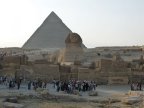
Sphinx and the Great Pyramid

“Ahlan wa sahlan! Welcome to Cairo,” intoned the flight steward as our Egypt Air flight touched down at Cairo International Airport. It was late evening and light smog shrouded the airport buildings.  We climbed down the unsteady staircase onto the hot tarmac and threaded our way to the waiting buses. Our representative from the travel agency, Mustafa, met us once we alighted at the terminal building. As we would find out during the course of the week, Mustafa was our main link to the agency; he practically worked 24 hours a day and would often catnap in the car or in various hotel lobbies to catch up on much needed sleep. His dedication to his job was commendable.

We moved through immigration and customs very smoothly, thanks to Mustafa, and were soon outside waiting for the agency van to come pick us up. Cairo, a sprawling metropolis of over 15 million people, is a city that never sleeps. The traffic and smog hit you right away and immediately transport you to India. For many Western travelers the chaotic traffic and beeping horns, patched up cars filled to capacity, buses that stop anywhere and everywhere and the run down buildings with large colorful billboards represent a strange, exotic and potentially alarming spectacle. But to travelers with roots in South Asia, Cairo is like home. Everything is familiar and yet strangely unfamiliar in an indescribable way.

Cairo Marriott

Cairo Marriott

We spent 7 incredible days in Egypt which, in retrospect, seemed too short. Egypt’s magnificent history and culture overwhelms the senses and yet leaves one begging for more. Since we were traveling with a child (our daughter is seven), we were notably concerned about how much she would be able to do on any given day. One of the best decisions we made, as first time visitors to Egypt, was to have one travel agency organize all our tours, hotel accommodations and travel arrangements within the country so we only had to contact one person in case of any problems.

The other decision we patted ourselves on the back for was our request for private tours. These are a little more expensive than group tours, but doing so helped us set up our own itinerary and allowed us the luxury of a having a private air-conditioned minivan with unlimited stops along our way to various tourist sites. A guided tour is very valuable as many of the guides have degrees in history and archeology, have actually been on digs and are a fount of knowledge you can depend upon.

Avenue of the Rams

Avenue of the Rams

Egypt recognizes that tourism is its biggest industry and most tourist sites and cities are very well prepared for tourists. There is a special Tourism and Antiquities police force who only deal with tourist concerns. Arabic is the main language, although most people have a working knowledge of English and French, a throwback to Egypt’s European colonial past.  ATM’s are plentiful and most good hotels will exchange dollars for Egyptian pounds (1 US dollar = approximately 5 Egyptian LE). What’s even more convenient is that at the end of your stay your hotel will exchange any left over pounds for dollars at a very reasonable rate. Credit cards, dollars and euros are acceptable at all tourist sites so one does not need to carry large quantities of local currency.

Most areas in and around Cairo seem to be quite safe at all times. We noticed women and children walking on the streets of Cairo at 2 a.m. in the morning and families socializing in the wee hours of the morning by the Nile.  As far as getting to bed at a reasonable hour, anarchy appeared to prevail for both kids and adults, and nobody appeared too worse for the wear in the morning.
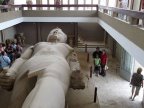
Statue of Ramses at Memphis

Statue of Ramses at Memphis

Egypt is an amalgamation of old traditions and conservative values and modern westernized beliefs. Women wearing the traditional hijab or in some cases, the full length burkha, mingle freely with others in western attire.  Many Egyptian guidebooks and internet travel sites caution women travelers to cover up fully and be modest in their attire. Although I went fully prepared I found that I need not have adhered to such strict guidelines. Our guide, a modern Muslim woman, did not cover her hair, wore short-sleeved shirts and calf length pants and definitely believed I was ‘over dressed’ for many of our tours. At one point, she asked me incredulously, “Didn’t you bring any shorts?”  I shook my head, wishing for the umpteenth time that I had packed a pair of bermudas or even capri pants instead of baggy trousers or long ankle length skirts.
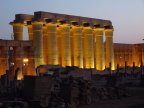
Luxor

Luxor

My wardrobe deficiencies notwithstanding, we did manage to see quite a bit of Cairo and its surrounding areas and make quick trips to Luxor and Alexandria. To give you a quick snapshot of our itinerary – we started with a trip to the Egyptian Museum in Cairo and a dinner cruise on the Nile on Day 1 and followed that by a tour of the pyramids and ruins of Saqqara, Dahshur, Memphis and Giza on Day 2. On Day 3, we toured historic Jewish, Coptic Christian and Islamic sites in Cairo and on Day 4 we winged our way to Luxor, about 600 km south of Cairo and explored the temples on the east bank (Karnak and Luxor). The next day (Day 5), we visited the magnificent necropolis at the Valley of the Kings, Queen Hatshepsut’s temple and the Colossi of Memnon. We flew back to Cairo that night and spent the next day, Day 6, in Alexandria exploring Greco-Roman catacombs, a Roman amphitheater and a fort built on the site of the original Lighthouse of Alexandria. On Day 7 we relaxed, did some shopping and closed out our trip by heading to Cairo airport late in the night for our flight back to the US.

Egyptian Museum

Egyptian Museum

The Egyptian museum is definitely worth visiting early on in your trip as it gives you an excellent overview of the history and culture that you will encounter on your tours to actual sites. The Tutankhamen exhibit halls are magnificent as well as the Amarna collection of Akhenaten. My daughter found the animal mummies fascinating, although she was quickly restless with the endless statuary and displays that we found so interesting. The Mummy room, for which you pay extra, contains about 21 mummies of ancient royals including that of Ramses II.

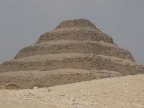
Step Pyramid at Zosur

Step Pyramid at Zosur

The Saqqara pyramids are among the first pyramids in Egypt. The Step pyramid of Zoser at Saqqara and the Bent pyramid at Dahshur are the forerunners of the later pyramids of Giza. There is no shortage of pyramids in this area, discovered or undiscovered; in fact, during our meanderings, we wandered onto an archeological dig which, after we returned to the US, was announced to be the site of the latest pyramid discovery in Saqqara. Our 15 seconds of proximity to fame and we didn’t even know it!

Red Pyramid of Sonfru

Red Pyramid of Sonfru

If you want to go inside a pyramid, it may be better to see the Red pyramid at Dahshur rather than the Giza pyramid where the challenge of having to deal with hordes of fellow tourists is compounded by the chagrin of having to buy a separate ticket for entrance. To get inside most pyramids you climb half way up one of the faces (about a 100 feet up) and then climb down a steep narrow shaft (about a 150 feet down), hunched over almost double at some points, leading to one or more burial chambers. The pyramids themselves are empty and most are quite musty as there are very few air shafts. If you are unused to much climbing or generally out of shape, it is probably best to avoid the cardiovascular and musculoskeletal distress associated with entering a pyramid.

Hanging Church

Hanging Church

Coptic Cairo is a pilgrimage for many tourists as it contains not only the legendary site where Moses was found in the rushes but also some of the places that Joseph, Mary and Jesus visited in Egypt while in exile. The Hanging Church, so called because it has no real foundation and built over one of the towers of the Babylon fortress, is worth visiting. We were mesmerized by the carved wooden ceilings at the Coptic Museum, ceilings that had been salvaged from various crumbling monasteries around the country. In Islamic Cairo the Alabaster Mosque built inside the 12th century Citadel of Saladin is a landmark destination. Even those unfamiliar with early Christian or Islamic history will appreciate the significance of these sites. A unique area that we passed on our way to Islamic Cairo was the City of the Dead, an erstwhile cemetery that, untransformed, has been home to the poorest citizens of Cairo for countless decades. The Egyptian government is now trying to relocate these families living among the graves and inside the mausoleums, many of whom have been living there for generations and refuse to move.

Queen Hatshepsut's Temple

Queen Hatshepsut

In ancient Egypt, the domain of the living was on the east side of the Nile and the domain of the dead on the west. The temples at Karnak and Luxor on the East Bank were storehouses of wealth during the time of Ramses II. The six soaring statues of Ramses II guarding the temple of Luxor are a sight to behold.  The Valley of the Kings on the West Bank houses the tombs of over 65 pharaohs in deep caves carved into soft limestone rock, many of which still haven’t been found. The tombs here date back to the New Kingdom (1570-1070 BC) when the pharaohs realized that the pyramids were beacons to grave robbers. The tourist sites around Luxor entail a fair amount of walking and the ground is quite uneven. Sturdy shoes and lots of drinking water are a good idea as the actual tombs are quite far away from the main ticket offices. No photography is allowed inside the caves which is a pity as the frescoes are amazing. This was one of the few places where our daughter decided to sit with the guide in the shade while we braved the scorching hot sun and armies of tourists to explore some the tombs. The heat and the crowds make it impossible to see more than four or five tombs in a morning but whatever you can see is highly worth it.

Mediterranean Sea

Mediterranean Sea

We found Alexandria to be a pleasant seaside town with a few Roman and Greek sites. The catacombs were worth visiting but paled in comparison to the other tombs that we had seen before we got to this city, Egypt’s second largest. The Mediterranean Sea was a breathtaking azure blue and the sail boats bobbing in the breeze were picturesque. For history buffs, Alexandria may be a bit of a letdown, given that much of the original wonders of the ancient world no longer remain and have been replaced with fairly recent structures as markers where these monuments once stood. In retrospect, we feel that we could have easily skipped this tour and chosen to go either to the temple of Abu Simbel or to one of the historic sites in the Sinai Peninsula.

Now no traveler’s tale is complete without a mention of the local cuisine and this is no exception. We enjoyed typical Egyptian dishes like kushari (a lentil, pasta and rice dish with red sauce), fuul (mashed refried beans), kebabs, hummus, grilled pigeon, chicken and fish tagines or stews, fetir (sweet or savory stuffed pancakes) and a delicious baladi bread similar to a tandoor roti. Being vegetarian would be very hard in Egypt if you had to subsist on traditional food but in most places American or European food is readily available.  Be careful of fresh cut vegetables and fruits unless you want to spend most of your time “resting”; although we were not affected, we found that it was a constant topic of discussion wherever there were tourists. Fresh fruit juices such as lime, mango, guava or strawberry were surprisingly good and very refreshing. Alcohol is served primarily in big touristy restaurants or hotels. Egypt Air, the national airline is totally ‘dry’ and no alcoholic beverages are sold even on trans-Atlantic journeys.

We found that many tourist sites do not allow photography inside the monuments or buildings and would recommend buying the postcards being sold by vendors so you can hold on to some memories. Tour guides will also stop for ‘refreshments’ at carpet factories, perfume factories, papyrus institutes and other handicraft industries. In a private tour it is much easier to avoid such places than on a large guided tour. Bargaining is a must if you plan to buy. We started with one third the quoted price and worked our way up to what we thought was an acceptable upper limit for us.

Bottled water is essential as is sunscreen for the sun can be brutal at midday. Weather- wise the best time to visit is probably October to March, when temperatures are manageable. Also, tipping or giving baksheesh is a way of life in Egypt. Keep plenty of one pound notes (notes are more acceptable than coins) as even when you go to a public restroom you need to tip the attendant before you can get a small strip of toilet paper to use. People will ask for tips to take photographs of you at most tourist sites.

If you are traveling with kids, the additional expenditure of staying in four or five star hotels is worth considering. Smoking is very common in all public places including hotel lobbies. A non-smoking room in a 5 star hotel is like paradise if you are not used to cigarette smoke.  When traveling with children take the usual precautions you would take when traveling to India or other countries in the subcontinent with respect to food, restrooms, over the counter medicines etc. Egyptians love children and will often take the time to interact with them or bring special treats.

As we boarded our flight back to the US, the words of P.B Shelley came to mind:

“I met a traveller from an antique land
Who said: “Two vast and trunkless legs of stone
Stand in the desert. Near them on the sand,
Half sunk, a shattered visage lies, whose frown
And wrinkled lip and sneer of cold command
Tell that its sculptor well those passions read
Which yet survive, stamped on these lifeless things…
…Of that colossal wreck, boundless and bare,
The lone and level sands stretch far away.”

For us, Egypt is now a collage of pillars and pyramids, monasteries, churches, mosques and temples, some shattered by the march of Time and History, as Shelley describes, yet others still standing, proud and desolate and endlessly fascinating. It is a canvas of the clash of civilizations, the ancient and modern saga of humankind in all its grandeur, its hubris, its compassion and its frailty, and the enduring bonds that tie us all together. We can’t wait to find our way back.

Mumbai terror attacks – what needs to be done

From a friend in the IPS who asks that his name be withheld, a list of suggestions in the wake of the terror attacks in Mumbai –

The general idea –
1. Terrorism, an organized case of mass murder, requires much higher grades of police/intelligence infrastructure.
2. Police to population ratio is less than 200 per lakh in India compared to more than 500 in most countries.
3. Intelligence operatives to population ratio in India is less than 5 per lakh in India compared to above 40 in many countries.
4. This, despite India being beset with 6 types of terror – Islamic, Kashmiri, Hindu, Sikh, north-east and Naxals – much more than only Islamic terror threat for the west, Russia, China etc.
5. We kept Maulana Masood Azhar in our jails as an under-trial for 6 yrs and released him to the Kandahar hijackers – he is the current big boss of the LeT( Lashkar-e-Toiba) in Pakistan. Why did the judiciary take so much time? At that time we had the strictest of laws – TADA, in currency.
6. In 2000, post-Kargill a Group of Ministers made a report to realign and resolve India’s security infrastructure – red tape has killed it
7. To get over the red tape, the PM in 2005 announced the Police Mission to reform the police system – red tape killed that too.
8. IB and R&AW have suffered 40% vacancies in top level supervisors (IPS officers) for more than a decade now and 50% vacancies in levels of SI and Inspector!
9. Post-9/11 the US and UK networked their communication and financial data so that security agencies could check on their computer screens on any terror suspect – India is nowhere near that nor are we even thinking of it.
10. When the terrorist started hijacking planes and entering through the Indo-Pak border, post facto we enhanced checking at airports and fenced the border. So he shifted to hotels and the sea route; post facto we shall make all our hotels and sea ports and coastlines secure. When he shifts to malls and microlight aircraft, post facto we shall make malls and the air space more secure and so on……….
11. Why was Karkare’s BP jacket inferior to the NSG BP jacket in this age and time when India pays Rs 5 trillion in taxes?

You can see how his frustration has leaked through. He hopes that if the word spreads, there may be a grassroots-driven effort ( with some corporate outrage) to fix at least points 1, 2 and 3. If you have a voice in the media, do your bit and let it be heard on behalf of the hard-working Indians in uniform who have been constrained for so long by the ineptness of their political masters.

Somber reflections at a shocking time – the Mumbai terrorist attacks

Thanks to the Blackberry, reality intrudes even when you’re in the middle of San Diego Zoo with your kids, watching the pandas be cute. It is a testimony to the desensitization on (ex)Mumbaikars that my first reaction was “Oh, another bomb blast?” I had been in the thick of things in 1993, racing home in a taxi after the stock exchange explosion, unaware that many other bombs had gone off in various parts of the city. It was a time before the 24-hour news cycle.

15 years later we returned to the hotel to find non-stop coverage from CNN and the laptop spewing out news from NDTV, but there were still more questions than answers. It has been almost 48 hours since the first attack and I suspect that Indians the world over have become forensic scientists for the last two days, poring over the bits of information and piecing together what really happened from blogs, eyewitness accounts and pure conjecture, while the networks stay mesmerized by the “movie-like” picture of commandos descending on Mumbai rooftops.

It is a failure of information at a vulnerable time for the country, and it is failure of information of another sort that brought India to its knees on Wednesday night. For all that criticism that has been levelled at the Indian police and armed forces for their delayed response, getting their top commanders killed and the long drawn out sieges at Mumbai landmarks, there is not much any defenders can do against an attack with AK-47s and grenades without incurring loss of life and limb.

The best defense against attacks like this is preventing them before they happen and it is surprising and dismaying that such a large body of terrorists were able to plan a meticulous plan with redundancies built into it without so much as a whisper of it being known to Indian intelligence. One report I heard out of the many disjointed ones suggested that security had actually been downgraded at the Taj a couple of weeks ago. Take it with a pinch of salt, but it certainly seems like nobody had a clue.

Unfortunately, this sad episode will only renew demands for reinstallation of POTA and crackdown on certain communities. An angry Indian even said, “George Bush may have been a rotten President but at least you didn’t have another terrorist attack since 9/11.” I put it down to shock, since I hope nobody would like to create an Abu Ghraib or Guantanamo in India, but it is a sentiment I suspect many Indians have thought or voiced in the last two days. It seems almost inevitable that the Congress will lose the upcoming elections and the forces of Hindu fundamentalism will be resurgent. Xenophobic goons like Raj Thackeray will be emboldened to single out foreigners( I cut a broad swathe with that term) without fear of punishment.I shudder to think of the long term implications of these events.

What is really needed, IMHO, is not a emotion-driven vendetta ( though with Narendra Modi prowling around Mumbai, I have my fears) but a cleansing of the police and counter-terrorism organisations. Hire the best people and give them a great deal of autonomy. Our space program has been successful because of those reasons and there is no reason why our intelligence and counterterrorism departments couldn’t be as well once the pernicious influence of politics is removed. I know from firsthand knowledge that there are some really talented people in the IPS – they work under tremendous constraints and would be much more effective if given the freedom to use thir talents without interference.

“This is not a time for appeasement,” you say. Certainly in the wake of these attacks there are questions about why the convicted criminals of previous attacks are still in jail despite their death sentence – there is a thirst for blood in the Indian populace that has not been allowed to die down because of lack of closure. But there is also a  danger of overreaction. Economic prosperity in India has not been well distributed and race relations have always been a tinderbox, only waiting for an excuse to set them off. I do  not mean in any way to minimize the horror and suffering of Mumbai, but the answer is not a witch hunt. Terrorism is less a war than a crime and sovereign nations like Pakistan that breed terrorism without sanctioning it have to be coopted to defeat this Hydra.

Meanwhile here are my questions and observations about the unfolding events –

– It is commendable that the Indian authorities have decided that they will not negotiate with terrorists; I wonder if the people held as hostages feel the same way. The numbers seems to be confusing – one report put the number of hostages at 200 yet only 30-35 had been rescued. The mind keeps skittering away from the conclusion that those numbers draw.

– Why were senior members of the Mumbai anti-terrorism units in the line of fire? One theory suggests that they were specifically targeted but it has not been supported by any real news. Yet.

– News networks have been pathetic at bringing the big picture. Tabloidism has pervaded every piece of visual journalism. For several minutes last night, I watched the drama unfold at Nariman House but not one time did any of the channels give us an update of what was happening elsewhere. There were also reports on a gun battle at the Ramada – completely ignored by the networks. Every channel keeps reporting 10 places targeted but none gives a list.  I expect eventually print media will put together a comprehensive report with time lines. The shallowness of broadcast media has been blindingly exposed.

– Expect a much more furious response to these attacks as opposed to previous bomb blasts. For one, it has exposed how vulnerable our cities are to armed conflicts. For another, this time the terrorists targeted rich people.

– I think the term “Deccan Mujahiddeen” was made up 5 minutes before the terrorists landed. This well planned attack cannot be the work of a fledgling organization – or this says something dreadful about the competence of Indian counter-terrorism.

– Expect life to get a whole lot more complicated and uncomfortable if you live in , work in or visit Mumbai. What needs to be done is to institute a system of identification for Indians to allow easy travel across the country. But this is such a daunting task and so prone to corruption and hacking that the political will will quickly evaporate. Instead, the knee-jerk response will be to install metal detectors everywhere. Airport security will increase exponentially. The stable door will be triple-bolted and locked.

My thoughts and prayers are with Mumbai at this dreadful time. It has risen like a phoenix from the ashes several times and I have no doubt it will do so again. I just hope the collateral damage is minimal.

Basab has his take on the attacks here.