
Monthly Archives: August 2010

Glo Adventurer

TigerCoverAs the school year gets going, kids rarely have time to read for pleasure, so to bring out yet another magazine aimed at educating and entertaining kids seems like a fool’s errand. But literature is a passionate subject for bibliophiles, and that passion is very evident in Glo Adventurer, a magazine that, as the creators describe it, “helps children discover and connect with India in a fun and engaging way.”

Though the mission is somewhat schlocky, the magazine is anything but. I had the opportunity to look over the first two issues of the magazine, one on the Bengal tiger and the other on Indian railways, and the two issues were just wonderfully done. Filled with information and facts and games, the books are perfectly targeted to the young reader segment, perhaps children between 7 and 12. Each issue is like a highly entertaining encyclopedia entry, giving the interested child a depth of information on the topic without making it boring or complicated.

Glo Adventurer is the brainchild of Deepa Bala in Seattle and Swami Ganesan in Chennai, with a variety of contributors around the world, testifying to the new publishing world where physical proximity is no longer necessary. Like many other similar ventures ( MeeraMasi immediately comes to mind) this one too was born out of a mother’s need to communicate Indian culture and history to her children. When Deepa could not find anything existent that was suitable for a child used to high quality materials like Zoobooks and National Geographic for kids (which Glo Adventurer most resembles), she decided to create a magazine of her own.

Much thought has gone into Glo Adventurer, not just in terms of content but also long term focus, which is why RailwaysCoverthe team has set up a Kids Advisory Board that provides ideas and feedback. Apart from the regular team, a review team looks over the magazine just before it goes into print to make sure everything is perfect. Such attention to detail is visible in the high production and editorial quality of the magazine and each issue feels like a keeper.

While the creators have got down the production part absolutely right, the marketing is quite another matter. Having seen many such endeavors bite the dust, I was more than a little curious about how the Glo Adventure team planned to tackle the sales. After all, our family is one of the very few I know who subscribe to more than one kid’s magazine.

Deepa acknowledges that this is a challenge. One interesting approach the team has taken is to treat Glo Adventurer not so much as a periodical but a series of published books, each of which can sell on its own merits. The issue on Bengal tigers, for example, is sure to be attractive to zoos and natural history museums across the world, while the one on Indian railways would be attractive to other kids of museums. Both are library quality so that would be another source of sales. Making sure the issue is not dated in any way ensures its longevity. Though the book has created an early buzz in India, the primary market is outside India, and the team is keen to be a part of the mainstream book distribution here in the U.S., not an easy task by any means.

Says Deepa, “The business model took us a while to figure out. Our confidence arises from the sense that we have found the right timing. There is so much buzz about Indian and so much interest in learning more about it. We think the economics will definitely work.” A free sample on the site encourages new readers to try out the book. Given the quality, the team is confident that trials will lead to subscriptions.

Adds Deepa, “I have a vested interest in this, since I feel I am leaving a legacy for my son. But this, hopefully, is a wonderful journey for other kids too.”

A one year subscription to the magazine (10 issues) costs $35.95 (shipping included). And of course, there is the free sample. If you have a kid in that age range, do check it out. It might be just the thing to entice your child away from the computer.
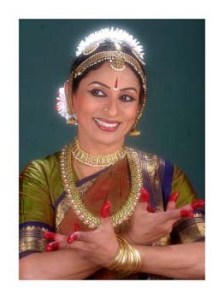
Samarpanam II

vishal ramani“Samarpanam” or the art of giving back, takes on a new meaning and form this fall of 2010.

Originally conceived by the students of Shri Krupa Dance Company over a decade ago, this dedication is now taking shape for the second time with renewed gusto and enthusiasm in garages and living rooms across the Bay area. All that effort will culminate in a simple yet elegant evening of exquisite dance on September 11, 2010 at the McAfee Theater, in Saratoga, California.

“Samarpanam-I” was a “Giving” and a dedication by nine Shri Krupa Company Dancers who offered their learning to their Guru Vishal Ramani – to a packed Montgomery Theater in September 1999, in San Jose.

And this fall, we will see an exuberant group of over 50 Shri Krupa Company Dancers coming together from all walks of life in a majestic production (with live music) entitled “Samarpanam II – The New Generation.”

These young dancers who have designed, sought funding, and produced this gala performance on their own come from many walks of life: doctors, lawyers, students, homemakers, teachers, and researchers.

Shri Krupa Company Dancers are students who have finished up to 7 years of rigorous training and have graduated through the Arangetram process,  a guru-shishya (teacher-student) tradition where learning is handed down generation after generation by a guru to his/her students. The student continues the lineage by passing on this knowledge to the next generation.

Guru Vishal Ramani – the Founder and Artistic Director of the Shri Krupa Dance Foundation, received rigorous training in the Thanjavur style of Bharatanatyam from Guru Mahalingam Pillai and Guru Govinda Raj Pillai of Shri Raja Rajeshwari Bharata Natya Kala Mandir of Bombay. Her dance debut (Arangetram) was at the age of 6 at the Poddar College in Bombay and a genius was born. Vishal has won much acclaim for her own performances in India, the United Kingdom and the United States. Creative vitality and vivid imagination mark her choreography, which is strictly kept within the confines of the style as set by the Tanjore tradition.

The tradition continues……….

Samarpanam II

Where: McAfee Performing Arts Center, 20300 Herriman Avenue, Saratoga, California, 95008
When: Sep 11 2010 4:00PM
Contact Details: Raja Renganathan
Phone : 408 605 6249

Shri Krupa dancers reminisce

“I have been a part of Shri Krupa for 30 years – including my arangetram and participation in numerous dance ballets over the years, so dancing and participating in Samarpanam II was a simple decision.  It gave me great opportunity to dance again after a 10 year break, to dance for my guru,  and to dance with my friends – we share a special bond with a 20 year history of dancing together and our current practices have brought back great memories of our past dances and shows.  Many of us have not danced in numerous years, and we were pleasantly surprised to find that our feet, hands, and minds have remembered as much as our hearts fondly have.

As an adult, I can now appreciate what being a student of dance and of Shri Krupa has provided me – a love and appreciation for  Bharathanatyam, an ability to view/appreciate and understand other art forms – whether they be Indian or non-Indian, and knowledge of Indian mythology, languages and music.”

Swapna Venkateswaran – Graduate1984

I have been with Guru Vishal Ramani since 1980.  My whole life was and still is filled with dance.My older sister and I attended weekly classes, performed at various cultural events and supplemented our understanding of bharatanatyam through music and Bala Vihar classes. Our summer vacations were also filled with practices for dance programs.  As an adult, I was able to take my involvement in the art form to a higher level due to the training and guidance of my Guru. I continued to perform in Shri Krupa productions and also gave many solo performances in Chennai and the Bay Area, and now in Seattle, WA, where I currently live.  However, as I continued on in dance, many from my dancing cohort, including my older sister, went on to pursue their own careers and studies. Performing in Samarpanam II not only gives me a platform to showcase my love for this artform and pay respects to my Guru, I get the chance to reunite with old friends. Not only has bharatanatyam given me a link to Indian culture and instilled qualities of dedication and perserverance,  it has also given me life long friends that were forged in the practice room and on the stage. I also can connect with the new generation of Shri Krupa graduates and hopefully forge bonds with them as well. Even though the face of Shri Krupa changes as the student body grows and evolves, Samarpanam II gives the community the chance witness the generations of dancers who’ve graduated from Shri Krupa. Samarpanam II is a testament of the love and dedication for Bharatanatyam instilled by our Guru.

Nitya Venkateswaran – Graduate1984

Participating in Samarpanam II is a coming home for me.  Bharatha Natyam is in my heart, my mind and my body.  Though it has been a long time since I have trained, the art has always been with me, and the question of when I will next dance is never far from my mind or my feet.  Samarpanam presented an opportunity to come back to the art and honor my teacher.

The art form itself, and Vishal Aunty in particular, have shaped who I have become, what I think about and how I think about things.    Aunty, I am so very grateful for the numerous gifts you have given me.

Sita Chokkalingam – Graduate1992

I met Vishal Aunty when I was 16 years old and had just come from India. It was a tough time in my life and having something to hang on to from my culture was a life savior. I have now been with Vishal Aunty for 26 years of my life and have had the great pleasure of seeing my three daughters go thru her and have their arangetram under her guidance. Aunty’s dedication and love for this art form inspires my love for this art form.

Sheetal Singhal – Graduate 2001

I have been learning Bharatanatyam from Vishal Aunty since I was 9 years old and I had my arangetram at 16. Over the years, Aunty has taught me how to express myself creatively and has always encouraged me to step out of my comfort zone to become a better dancer. Her dedication and comittment to the dance form and to each and every student in our school has been inspiring.   After taking a brief hiatus from dancing to attend law school and begin my legal practice, I recently returned to classes because I realized how much Bharatanatyam had become a part of me and that I could not stay away for long! I am so pleased to see the next generation of dancers rising to the challenge of Samarpanam II, and I am certain it will be just as meaningful
of an experience for them as Samarpanam I was for me and my classmates. I am also grateful that they are giving us “old folks” a chance to participate in the program!

Neha Marathe – Graduate 1997

Revoking the 14th Amendment

14th amendmentAs the election approaches, the Republicans have predictably raised a hot button issue that they hope will drive their voters to the polls, now that gay marriage is no longer as inflammatory as they would like. Their latest boogieman is the 14th amendment which, among other things,  gives anyone born in the United States the right of citizenship automatically. The proposal is to amend the Constitution so that children of illegal immigrants can no longer be citizens.
At first glance, this seems reasonable. After all, why give illegal immigrants a reward for their behavior.  Even people with somewhat liberal proclivities have confessed to thinking this is not such a bad idea. But, apart from the history behind the reason for the Amendment in the first place ( see Wikipedia article here) this is a pretty bad idea.

I wasn’t quite able to explain coherently why, but the Intertubes came to the rescue, as usual. In a blog post in Swampland (the Time magazine blog) blogger Kate Pickert asks these questions, which provide a great deal of clarity to the debate. Read and realize, as I did, the consequences of revoking the 14th Amendment

If their U.S.-born children wouldn’t become automatic citizens, would illegal immigrants choose not to have children in America? Would revoking this American right under our current Constitution actually really change anything on the ground? Hospitals that now care for undocumented immigrant women would most certainly still do so, even if their babies were similarly illegal. Would states, which control their own schools, disallow non-citizens from attending? What would be the social consequences of having an entire generation of these children grow up in the U.S. without being educated? What if a child was born to an undocumented father and a U.S. citizen mother? What about an undocumented mother and a citizen father? How do you prove this? Will the federal government require paternity tests before granting citizenship?

The central question that comes to mind is – do we really want an uneducated, unemployable sub-class of citizens a generation from now? And just imagine the bureaucracy ( and, consequently, money) involved in determining who can be a citizen and who cannot. For people who decry big government and want no part of any kind of governmental intrusion in their lives, this is a pretty big hypocrisy.

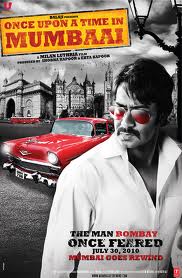
Once Upon a Time In Mumbai

OUATIMThe Mumbai underworld has been fertile soil for gritty Bollywood movies. Directors on a slump often return the well to reestablish their credentials; indeed, there are some directors like Ram Gopal Verma who have found success almost exclusively in this genre. The familiar territory of the Mumbai underbelly and its colorful characters have made it easy for scriptwriters to capture authentic gangster dialect and mannerisms and set up gripping conflicts, all the way from Parinda in 1989 to Kaminey in 2009.

Director Milan Luthria, known previously for pale Bollywood remakes of Hollywood B movies ( Chori Chori, Kacche Dhaage), also reaches for the real life drama of the Mumbai mafia to give his sagging reputation a boost, and the magic of the underworld rubs off on this movie as well.

But Once Upon … is no Satya. Rather, it is a somewhat sanitized version of the conflict between Haji Mastan and Dawood Ibrahim that played out against the backdrop of the Bollywood industry in the 1970s, a period brought out with great care by the film’s designers. The dialogues are cleaner, and a touch florid, as in a play. The violence is muted and the characters larger than life. The plot is quite predictable to anyone familiar with the story arcs of mafia movies, but the editing is tight, and this makes the movie less tiring than you think it would be. Competently directed, Once Upon is a far more palatable movie for the family audience than previous movies on the subject have been.

Adding to its mainstream value is a stellar cast  – Ajay Devgn plays Sultan Mirza, the gangster with the heart of gold , with his usual panache. Kangana Ranaut, as his movie star love Rehana, displays her amazing chameleon-like ability to look entirely different in different roles. Her diction and voice modulation need work, as do those of most Bollywood heroines, but she is well cast and performs competently. Emraan Hashmi is perfect as Shoaib Khan, the young upstart, chafing at the constraints set up by Mirza, and itching to prove his worth and supersede the king. Randeep Hooda as ACP Agnel Wilson, the police chief who unwittingly sets off a train wreck of events, is excellent as ever.

But because of the conscious attempt to create an epic of sorts, the movie ends up losing a little bit of the grit and the dirt that give Mumbai movies their realism. Instead, as the name suggests, Once Upon a Time in Mumbai is a fairy tale, albeit one without a happy ending.

My rating : 3 out of 5 stars.

Note: I’ve heard that Haji Mastan’s children have tried to stop the screening of the film. Given how positively the film treats the Sultan Mirza character, that is a bit of a mystery.

ICC's Teens For Others

icc teens for othersIndia Community Center’s Teens for Others (TFO) program gives high school students in the Bay Area the opportunity to come together and participate in different community service events.  The program was founded by local high school students to engage their peers in being active contributors for their community.  TFO will expose questions such as:

*       What have we done?
*       What do we want to do?
*       And how do we do it?

Teens for Others is designed to accommodate the schedules of  high school students by allowing participants to choose when to partake in various volunteer opportunities.  Once a month, TFO members will convene for a meeting and decide which projects to work on.  While creating a challenging program that requires time and effort, students will have the chance to meet new friends within the Bay Area community.

For more questions, email teens@indiacc.org

Asha for Education – Work an Hour Campaign

Asha for educationAsha for Education (AFE) is an entirely volunteer-run non-profit organization dedicated to bringing about socio-economic change in India by improving access and quality of education.

AFE is conducting its biggest fundraising event of the year – the 13th annual Work an Hour campaign, popularly known as WAH.

Work An Hour, is AFE’s global online fundraising event. Every year thousands of donors from all over the world come together and contribute towards the empowerment of underprivileged children in India through education. Participants in the event work an hour towards this cause symbolically, by donating an hour’s worth of their salary or more to Asha for Education. Since the cost associated with running this entirely online campaign, outside the time and effort spent by our volunteers, is zero, they are able to route 100% of the funds raised to our supported projects.  Their low overheads, transparency and efficiency in monitoring their projects have enabled them to develop an extremely enthusiastic individual donor pool in the past.

WAH 2010, the 13th such campaign begins on July 15th 2010 and concludes on September 15th 2010. Last year the campaign raised close to $156,000, all of which was used towards improving the quality of education through different projects spanning India. These funds were used in improving study materials and build infrastructure, train teachers, and last but not the least, create a consciousness about health and hygiene in underprivileged communities.

By helping pioneer and support bold new initiatives in the field of education, AFE is making a difference in the lives of underprivileged children in India.

Charity Navigator, the premier independent evaluator of charities in the United States, has awarded Asha for Education with its highest rating this year and has named AFE in their “Top Ten Charities Worth Watching” and “Top Ten Slam Dunk Charities” list in the past. A lot of credit for getting here goes to AFE’s low overheads, efficiency in fund disbursement and donor privacy policy.

Asha for Education is requesting your support in educating potentially a few thousand more children. Visit last year’s WAH campaign website to learn more about the organization: http://www.ashanet.org

Adorn My Hair With His Blood! and other stories- Lasya's “Navarasa” promises gore, wonder, love, fear and more

By Priya Das

lasya1Adorn my hair with his blood” cries a crazed-with-revenge Panchali, and an equally wild Bhima lovingly crowns her with the bloody innards of Dushasana. One can almost smell the blood. This is the highlight of “Bhibhatsam”, the second rasa to be highlighted in Lasya Dance Company’s “Navarasa-Her Choice.” Bhibhatsam, meaning revulsion, promises to get a significant percentage of the audience gasping and the rest turning away in disgust, exactly the reaction Vidhya Subramanian, artistic director of Lasya Dance Company is gunning for.
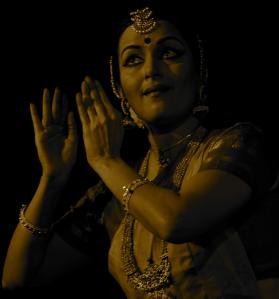
“Women are complex creatures,  we can inspire and cause life around us to be energized through anger, love, and bravery- the entire gamut of emotions, sometimes in one day, or an entire lifetime such as in the Mahabharata! Every woman is intense, there’s so much to explore, evoke, and express,” says Vidhya, who has a penchant for cutting-edge women-related themes.

“Navarasa-Her Choice” comes after a gap of 2 years, during which Vidhya has been busy reclaiming her solo-dancing career in earnest, especially in India in the interim. Known for her fire-brand style, one looks forward to seeing new visages to traditional themes and altogether new ideas being presented. She will start the evening with a stunning solo, and will be joined on stage by senior dancers for a sort of introduction to the nine emotions being presented- in order, Shringara/love, Bhibhatsam/ revulsion, Veeram/bravery, Bhayanakam/fear, Hasyam/laughter, Karunyam/ pity, Adbhutam/ wonder, Roudram/ anger, and Shantam/peace. Vidhya herself will elaborate on 3 rasas- Love, Wonder, and Laughter.

Each senior dancer was tasked with owning one of the other rasas.  Anger is played by Vinidhra Mani, embodied by Kannagi, a character from the Tamil Silapadikaram, whose husband is unfairly behaeaded after being falsely accused of thievery by an irresponsible King. Enraged at the injustice, Kannagi curses the King and burns down his city. “I understand Kannagi’s anger, but getting under her skin of righteousness enough to want to burn down a city took some doing. With only a few days to D-day, I’m frequently looking to rev myself up and stoke my anger, looking for a reason to get angry, so I can play Kannagi convincingly when the time comes- I only get 8 minutes!” says Vinidhra, a junior at college working in the bio-medical field when not dancing. Her solo dance of destruction will be a sight to behold.

Given the intense spotlight on drama, Vidhya has designed the costumes to ease instant-immersion into the mood. The senior dancers are all in black, with a single layer of color signifying the mood. Not surprisingly, Kannagi will wear red. The live orchestra is sure to sweep the audience into a heady emotional continuum, via always-evocative vocals by Asha Ramesh, mridangam by  Narayanan, violin by Shanthi Narayanan, tabla by the young Vikas Yendluri, flute by Ragavan Manian, and sollukattu (dance notes) by Madhavi Cheruvu.

lasya2Vidhya’s portrayal of Wonder promises surprise from the get-go, her portrayal of Surphanakha’s attempts to seduce Rama sure to regale. ShriVidhya Shrinivasan, another senior dancer and a PhD in Molecular biology, plays  a Kunti fearful for her sons on the eve of the Kurukshetra war. “I now hear stories of war in Iraq with a new sensitization. I feel a new connection with Indian mythological stories…Kunti was just a character before, now I realize that she’s a mother, like me.”

Reprieve from the intense drama comes in the form of superlative dancing by other dancers. Vidhya’s choreography progresses from a 2-beat piece right on up to a 9-beat rhythm, forming pure-dance interludes in between the stories.  “I’ve never seen choreography this unique – Vidhya (Auntie) has made it so that each dancer feels like s/he has a significant role. To know that I’m a part of this magic is truly humbling.” – Sushmita Shrikanth

A unique perspective is shared by Maya Seshadri, a also Bollywood-dancing member of the Mona Sampath Dance troupe, featured in NBC’s America’s Got Talent in July- “Having dabbled in different styles of dancing since I was five, I’ve come to appreciate my roots and the core of my dancing in Bharatanatyam. It grounds me when I perform Bollywood.”

Like the character I will be portraying- Tagore’s Chandalika, who’s liberated by Buddhism from her state-of-outcaste and cries out that she’s reborn, the audience is sure to emerge feeling a surge of intense involvement, an emotional cleansing.

www.lasya.org
Sunday, Aug 8, 2010, 4pm.
McAfee Theater, 20300 Herriman Ave, Saratoga.
Tickets $15, Group of 4 (must arrive together) $50