Yearly Archives: 2008

Diwali musings

Apparently, according to the disgruntled old Punjabi lady at the sweet shop, the Livermore temple got it wrong when it “declared” the 27th of October as the date for Diwali. And so, ironically, a lazy agnostic like me trumped the devout yesterday!

Diwali as a day for celebration has been creeping up on the Bay Area for the last few years. Of course Indian Americans have been doing their best to observe it at home, replicating the customs of their childhood with the help of lamps and sweets bought at price-gouging desi stores. But it has been slowly entering the larger public consciousness.

Credit to this must go to a few pioneers like jeweler Mahesh Nihalani and his friends, who successfully persuaded the Cupertino city council a few years ago to allow an official celebration. From all accounts the last few celebrations, including artistic performances and food fairs, have been great successes and the 10 percent Indian population of that city has managed to bring Diwali into the mainstream.

I experienced this first hand when my daughter’s 1st grade teacher ( in Fremont) approached me to do ‘something fun’ for the kids for Diwali. Bucking the general trend in the semi-Indian-ghetto neighborhood where we live, her class has only 3 Indian American kids, so any event would be novelty for the majority.

We dressed in our best Diwali morning and arrived at school carrying our supplies. The kids sat in a circle expectantly. The teacher, who has been encouraging the kids to learn how to say “good morning” in various languages, asked my daughter to go around the room greeting her friends in the traditional way. I had a lump in my throat as I watched her circle the carpet. “Namaste Anthony,” she began, folding her hands and bowing. “Namaste, Lori,” he replied, doing the same. “Namaste Clarissa.” “Namaste Lori.” “Namaste Sammy.” “Namaste Lori.”

I then read the Diwali story(ies) to the kids. It was a learning experience for me too as I had quite forgotten that there were so many stories associated with the long celebrations. The kids then colored the clay pots and rangoli designs I had brought with glitter and sequins. We ended with a small snack that one of the other Indian moms had supplied.

Back home, in the evening we drew and decorated a rangoli with colored chalk and lit lamps. The kids met their friends for some bootleg fireworks saved from July 4th, praying like we do every year that the neighbors wouldn’t rat us out. Our prayers continue to be answered, though there was a tense moment when a new firecracker unexpectedly exploded, making the classic rat-a-tat sound. We all held our breath for a moment as we watched the clouds of noxious smoke pollute the sky.

It is not hard to see why Diwali can capture the imagination of the open-minded American. Sitting between July 4th and Christmas, it captures the best of both events, combining the fireworks with the lights to make a memorable  event that bridges the celebratory gap. Maybe one day we will see public fireworks on the scale of independence day celebrations and more houses will be lit up on our street. (After all, the lights put up now can stay on the house till Christmas – what a labor saver!)

Till then, a very Happy Diwali and good wishes for the year ahead to all.

Missing India

By Isheeta Sanghi

After a visit to the FRO in Bangalore, a speedy two day trip to Delhi’s Ministry of Home Affairs, many police reports, thousands of copies of birth certificates and passports, and a penalty fee of 2000 Rupees, I was finally all set to make my journey out of the country, back to America.

I could not help but sense some excitement; after all it had been two years since I had left the country. New York has been my dream, (I think it is a lot of people’s dream – hence the crowds.) I wanted to live my life in NYC, meet the perfect guy, and live a perfect life. Ask any of my high school friends and they will tell you that I was the crazy girl that was willing to give up the San Diego sun for New York snow. I came to New York a few months ago, full of expectations, interning (for free!) with a magazine.

But I think things in the US have changed quite drastically or maybe it is just me. I find myself missing something. For the longest time I could not understand what it was. It’s not like I was missing my parents or was homesick, it was not that I was missing home cooked food (ok maybe it was that a bit); I was not missing the easiness of school life, lord knows I wasn’t missing the BSNL internet connection. It was something else, and I did not quite figure it out until a few weeks ago.

I was missing that excitement, that craziness that only India has. Do not get me wrong, New York is pretty crazy- but it is not India-crazy. I still can not believe that I am saying it and admitting it quite openly, but I guess I have come quite a long way. I miss India! I miss the smells, the crazy dogs, the crazy traffic, the noise and of course the everyday tamasha. I miss it all. I miss arguing with the auto rickshaw guys, I miss staring back at all those Indian men that stare and seeing them realize that I know they are looking. I even miss the annoying kids that wake me up in the mornings yelling at each other with their accented English as they play soccer outside my balcony. I miss it all!

I am waiting to get back so that I can just sit out on my balcony and drink a cup of coffee in the cool Bangalore breeze. I could stick it out longer here, and make a life for myself, but I know that I will be missing something- and that something is India. It is contagious, and once you get over the dirtiness, you realize that you are much closer to reality- dealing with problems like poverty, hunger, lack of electricity in the villages.

I am not going to go all Swades or anything, but I want to go back because I think I can live a much happier life in India. Here I see people of Indian heritage in New York that are shop owners in the subways, or that wheel around a kebab cart, or that are selling newspapers on the street wearing their salwar kameezes. And I am not going to lie; my heart breaks a little bit. Because I know that that is not what they had planned; those women who were once girls had not dreamed of getting married, moving abroad and selling newspapers on the street. Likewise, I did not forecast graduating, and coming to the States only to intern for free and go order people’s Starbucks. How long can you do it for?

My Dad and I (whom most all will agree) rarely see eye to eye, but recently it is been very different. So many things happened prior to me leaving India that said ‘Stay! Stay! Stay!’ and I remember feeling frustrated that I would never be able to get out of the country. I did not realize that I had already achieved the one thing I wanted in life, contentment. The supersize everything is not exciting anymore. I can not believe I am saying this but Starbucks really is not worth what you pay at all, and even though I still haven’t found the GAP factory in India, I can no longer justify spending $50 on a ‘Made in India’ shirt. I figure I’ll just go to Shankar Market, find the left over material roll and get it made from my favorite tailor.

For anyone moving back or thinking of moving back- give India a chance. It is a beautiful place, and the people are amazing. You need to give it time, look at things with humour (even in the toughest of situations) realize that even if one of your expensive wine glasses broke in the process of moving that you’re not going to take those wineglasses with you in your afterlife, and also, it is not India’s fault that it broke. Realize that what you should take with you are the memories of where you have been more than the material itself. I have finished up my internships, and am excited about heading home to India the cows, my roots, my family, and of course the craziness that truly makes India such a uniquely beautiful place.

HAPPY DIWALI!

Isheeta Sanghi lives in India but is spending a few months in the US interning in NY.

Why you should vote NO on Proposition 8

I’ve heard that some of my socially conservative friends are voting YES on Prop 8, the proposition that seeks to overturn the California Supreme court’s decision to allow gay marriages. This is my last ditch effort to convince them otherwise. I’m trying the Socratic method of Q &A to see if I can get my argument across.

“Why aren’t they happy with civil unions? Why do they want to call it marriage?”

Contrary to what you may believe, civil unions and domestic partnerships do not confer the same rights as marriage. Defining the contract between two people as marriage (and yes, marriage is a contract) allows the couple to be legally joined in the eyes of the Federal Government, which means they have the same rights as the rest of us when it comes to sponsoring the immigration of a spouse, filing joint tax returns and many other benefits that are available for married couples. Here is a good page on about.com which goes into these differences in detail.

“My kids are going to learn about gay marriage in school.”

This is a stupid smear with about the same amount of credibility as that anti-Obama ad that accused him of promoting sex education in kindergarten. Prop 8 has nothing to do with education and in California, parents have the right to opt their kids out of any education on health and family issues. I know this because the first time the subject of human biology and reproduction came up was when my son was in 5th grade and I was allowed to review all the materials beforehand to decide if it was appropriate.
The incident referred to in the scurrilous ad is as follows – A teacher in Massachusetts read a kid’s book about same sex marriages to her kids in an effort to promote diversity.  After parents objected, a bill was proposed to allow parents to opt out, a law that already exists in California. Notice that the California Teachers Association and the California School Boards Association both agree that Prop 8 has nothing to do with teaching in public schools.

“A decision like this should not be taken by the courts but by the people.”

Decisions that have to do with discrimination and equality cannot be taken by majority vote for obvious reasons. The Constitution of this country was founded on equality and over the years, judges have interpreted it in ways that ended discrimination one step at a time. One such decision allowed inter-racial marriages; another allowed African Americans to vote and be a part of the electoral process. If you are voting for Senator Obama for President, ask yourself – would it have been possible today if the courts had waited for the will of the majority to prevail?

“I am concerned that such open acceptance of homosexuality will encourage licentiousness.”

On the contrary, allowing gay people to marry and raise children binds them with the same social mores as the rest of us, encouraging the concept of long-term commitment and family. It lets children grow up in a loving two-parent relationship sanctioned by society that is more stable and harder to get out of, just like the rest of us.

Finally, imagine if the Luce-Celler Act of 1946( look it up) were put up to a vote today. It is within the realms of possibility that furious Americans, upset by the fact that their jobs are going overseas to India and China, could overwhelmingly vote to repeal it. And, if you were an Asian-American, that would be the end of your citizenship in this country.

The right of gays to marry is a right that has already been granted by the courts which recognized discrimination against a segment of the population and sought to correct it. Do not take away that right. As an immigrant, discrimination is an issue that you should be sensitive about and fight to end, even if those discriminated against make you uncomfortable.

Vote NO on Prop 8.

Ashwin Madia – Congressional Candidate from Minnesota

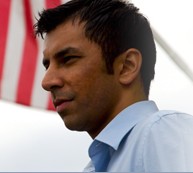
For the son of Indian immigrants, Ashwin Madia’s story is quintessentially American. A graduate from the University of Minnesota and New York University Law School, Ashwin enrolled in the US Marine Corps and served 2 of his 4 years there in Iraq. After returning from Iraq Ashwin worked as an attorney with a respected law firm in Minneapolis before deciding to run for Congress from the Third District of Minnesota against Republican Erik Paulsen, a very strong opponent.

His already close race received another inadvertent jolt recently. In the Sixth District, Republican Michelle Bachmann’s campaign was badly hurt when she made a statement asking for “media investigation” into members of Congress for their “Pro” or “Anti” American views. The National Republican Congressional Committee (NRCC) decided to pull money out of her campaign and flood the neighboring districts instead.

I spoke to Ashwin on a hurried phone conversation squeezed into the candidate’s tight schedule.

Given your on-the-ground experience in Iraq, what is your sense of what we should do there?
AM: I think there are many brave people on both sides building a better country. The Iraqi judicial officers and soldiers were the bravest people. The US bears some responsibility to leave Iraq in a better shape than when we went in and not abandon it. I favor a strategic and gradual withdrawal from Iraq. I am not happy about a fixed timetable like other people but we don’t have the resources to stay there indefinitely. We should be responsive to conditions on the ground.

What is the climate for immigrants in Minnesota?
AM: I was born in Boston and moved all over the country growing up till the family settled in Minnesota. The people in Minnesota are decent and kind. Minnesota is accepting of people from all different backgrounds.

What is your biggest challenge this election season?
AM: The biggest challenge is taking complicated ideas about complex issues and trying to transform them into 30 second sound bites; trying to share my ideas in the kind of mass media-driven market that exists today.

Tell me, in a 30 second sound bite, why you are running for office.:)
AM: I am running because we have the greatest country in the entire world. We need the courage to come together and courage to change; change the economic policy, restore oversight over the financial policy, balance the budget, aim for energy independence. We need investments in education and a responsible end the Iraq war.

What is the most important issue for your constituents?
AM: The economy is the only issue in this state.

Are you being helped by the coattails of the Democratic grassroots movement this election?
AM: My district is kind of unique in that it is very educated. The coattail effect is very minimal.

What are your internal polls showing?
AM: That we’re up by 4. It is going to be a very, very tight race.

If the $150 million raised by Senator Obama is making you leery of any more donations to the Presidential race, help out Ashwin Madia by donating at http://madiaforcongress.com. Down ballot races help elect more Democrats to Congress and give the president a clear mandate to achieve a progressive agenda.

Community Calendar – October 24 – October 30, 2008

-Those of you living in Fremont have an opportunity to meet some of the candidates up for local elections today. Genius Kids and Swagat Restaurant in Ardenwood are sponsoring a Meet and Greet. They are inviting you and your family and friends to a complimentary wine and appetizer evening being sponsored by Genius Kids and Swagat Restaurants on Thursday October 23 from 6pm – 7pm.
Swagat Restaurant at the Ardenwood Plaza.

Meet Trisha Tahmasbhi (standing for city council), Ravi Johal and  the Honorable Mayor Bob Wasserman, Council woman Anu Natarajan and discuss what improvements you would like to see happen in your city.

GiveIndia is sponsoring an essay contest for kids with great prizes.Details here. Deadline is October 31, 2008.

AICON Gallery presents – Pakistan Contemporaries

Upcoming Events:

My MIT experience

By Rahul Joshi

There I was, sitting in the front row of the MIT Theatre waiting for my name to be called.  We were at MIT for the National Vocabulary contest sponsored by North South Foundation, a non-profit organization that raises funds for underprivileged children in India (www.northsouth.org). MIT is in Boston, Massachusetts, and is a very famous and prestigious institute of technology.  When I saw how big it was, I thought to myself, “Wow, this is HUGE!”

The verbal round began. “Rahul, please come on stage,” called out the announcer.  I got really nervous.  My legs started staking more and more.  “The word is ‘insulate’,” the judge said.  The noise of my teeth chattering echoed on the microphone.  I heard some people laughing.  I accidentally bit my lower lip.  I thought I screamed but the there was no sound.  Everybody was just starting at me like I had just said the president was a chimpanzee.  There were so many people there that I started to sweat!

I thought the meaning of ‘insulate’ was ‘insult’.  My toes were wiggling a lot.  I was about to say ‘insult’ but then I thought some more.  Then, it popped right into my mind.  The meaning wasn’t ‘insult’, it was ‘segregate’!  “The meaning is ‘segregate’”. I said a little too loud.  “Sorry,” I squeaked.  I don’t think anyone heard me though.  I prayed that I would get the answer right.  “That answer is right,” the pronouncer said.

I felt so proud of myself.  “Whew,” I said right into the microphone.  “Whoa,” I thought to myself, “didn’t see that coming!”

Some people want to experience this kind of excitement and some don’t. I have experienced this kind of energy and excitement and I think all the stress was worth it!

Rahul Joshi, 8 years old, is a 4th grader at Pioneer Elementary, Union City, CA. He is a prodigy of Genius Kids where he started reading at the young age of 2 years 4 months old. He was promoted and skipped 2nd grade, heading right into 3rd grade. He was won and ranked in several local and national competitions, the most recent being 2nd Place in the North South Vocabulary Regional Competition. He is also an avid singer and dancer and recently competed in the Northern California Sony Television Asia Boogie Woogie finals.

Rahul did not place in the competition but this is his second time making it to the Nationals.

Pt. Jasraj at the India Community Center, Milpitas – A review

By Jaya Murthy

Pandit Jasraj performed at India Community Center on Sunday evening. If you have never heard him sing live, this was a chance to get up close and personal with the maestro and the divinity of vocal Hindustani music. And if you have had the good fortune of listening to him before, you would still be amazed that not much has changed!
I last heard him in India 15 years ago and at age 78 now, he was just as energetic, mellifluous and dexterous in his seemingly effortless movement over all three and a half octaves. Even his appearance was remarkably the same – the long flowing white hair in the back of his otherwise balding head, the same slender frame, twinkling but dark circled eyes and gorgeously outfitted in a light wine colored kurta and pleated dhoti. He looked quite “royal”, as he greeted his audience with the hallmark ‘jai ho’ and reminding us all that parmatma resides in each and every one of us.

He began the evening with a long rendition of Madhuvanti; explored fully and patiently through a long alaap followed by the vilambit and drut gat in teen taal. He followed that with maayi mero man mohiyo in Raga Hori Saran. Tripti Mukherjee, (his student who runs the Pt.Jasraj school of music in New Jersey) accompanied his singing melodiously and on the harmonium. The harmony of the male and female voices – the Jasrangi jugalbandi, which is Panditji’s major innovative contribution to Hindustani music, was such a treat. Both Samir Chatterjee and Aditya Banerjee provided solid and clean tabla support. Samir is very accomplished and with his various projects, worthy of another whole article dedicated to him exclusively. (watch this space!)

Although Panditji sang in his customary classical style with intricate laya, beautiful lyrical taans and great voice control …my favorite part was his telling of a little fable.

Apparently one of Emperor Jehangir’s daughters (with a Hindu mother) wanted to learn Sanskrit. He had a renowned Sanskrit scholar named Jagannath Pandit in his court. The daughter was assigned to his tutelage and eventually fell in love with him and asked to marry him. Jehangir considered Jagannath a master of his subject and greatly respected him. His Islamic ministry was horrified when he gave his blessings for the wedding. Needless to say the Hindu intelligentsia was dead against the match too. The matter dragged on and they asked the scholar to find a way to prove his purity. So Jagannath Pandit sat on the banks of the river Ganga and recited some verses. With every verse, the river rose higher to meet him. That 52nd and last verse was what Pandit Jasraj sang for us; vibhushita nanda from the Ganga lehari.

Putting that song in context greatly enhanced the musical experience of it. This is why live concerts are higher musical experiences than audio CDs! And this is where the beauty of the guru-shishya parampara lies. Our modern 30 and 60 minute class formats do not always allow the history, stories, poems, rumors and gossip to be shared. Especially with the kids.  My biggest worry is that these tales will quietly be forgotten in times to come. As it is the mystery and secrecy around the non patented compositions of gharanas is quite deep.
By the end of the evening, when Pt. Jasraj sang Vraje vasantham navaneeta choram in praise of Lord Krishna, set to raga Piloo he had the audience completely enraptured and seemed quite bathed in a divine sort of glow himself. I later heard that many people were moved to tears. With his soothing voice, he reminded us that music begins with the basic voice from within – all instruments are but limited imitations.

The evening began late (so what’s new you ask?) by almost an hour – though in all fairness it was not his fault! The accompanying singer’s flight was late and so the whole party came late and the sound checks took a long while. The crowds were lined up outside from 4 pm and getting quite restless at not being let into the hall. Still, with the very first notes of the taanpura and the maestro’s lower octave alaap, everybody’s nerves were soothed and all was forgiven!

The concert was organized by Prabha Gopal of Bay Area Performing Arts (www.bapa.org) in co-operation with ICC. The Malvika Hall at ICC is quite a beautiful room with its airy, well lit and high ceiling décor of flowing fabric. Pt.Jasraj is famously fond of communing with his audience and likes to see them; so the lights were left on throughout the performance!

One hopes that with the inauguration of this superlative classical concert, the pace has been set for many more to come at ICC. Needless to say, we left with a song in our heart!

Local ballot measures – Measure MM and Measure WW

UPDATE: Both Measure MM and Measure WW passed.

In addition to the Californian Propositions, there are also a couple of local measures on the ballot in Fremont.

Measure MM – if passed by a majority of the electorate (50% + 1), this measure will increase the City’s Transient Occupancy Tax (TOT) rate from the current rate of 8% to a new rate of 10%, effective January, 1, 2009.
The proposed tax is a general tax, which means the monies raised will be used for general governmental purposes, including such essential services as police, fire, and street and park maintenance. Hotel/motel visitors who stay in the City’s hotel and motels for a period of 30 days or less pay the tax in addition to the room rate.
Based on the current estimates, a 2% increase could generate approximately $800,000 in new revenue for the General Fund for a full fiscal year. Anu Natarajan, Fremont City Council member, is one of the sponsors of this bill.

“This is an easy fix for our budgeting problems and long overdue,” says Anu. “Fremont is still at 8% whereas cities around us have moved to a 10% Transient Occupancy Tax(TOT). 90% of the revenue is likely to go to fund public safety programs.”

The only argument submitted against this measure is whether the city can be trusted to use the monies properly. Given the budgetary constraints every city is facing in this economic environment, it seems like a poor argument and given that even the Fremont Marriott has no problems with this tax, this should be a no-brainer.

My recommendation – Vote YES.

Measure WW – Measure WW, an East Bay Regional Park District (“District”) bond measure, seeks voter approval to authorize the governing Board of the District to cause general obligation bonds to be issued and sold in a principal amount not to exceed $500,000,000 at interest rates within the statutory limit.

The measure’s purposes are to finance the District’s completion of its Regional Park District Master Plan by acquiring and improving regional parks, trails and recreation facilities.

Opinion – On the face of it, anything that increases park land sounds like a good idea to hikers and nature lovers. However, a couple of issues give me pause. One is that 25% of the bond amount goes, not to the EBRPD,  but to places like the Oakland Zoo and municipalities. It also puts a future interest and principal repayment burden of a billion dollars without any proposal to generate revenue.

Also, I hear rumblings of discontent from hikers and environmentalists who complain about the stewardship of the EBPRD and the bloated salaries of the officers. ( the starting salary of a gardener us supposed to be $50,000!) One comparison I read about was that the EBPRD spent 143 million dollars in 2006 compared to the 344 million dollars spent by the entire California Park System. Also, of the 153 square miles under the control of the EBPRD, a very small percentage is open to the public now.

My recommendation – being unsure of the value of this measure, I am going to go for default option on any such measure or proposition – NO.

Propositions on the ballot in California in November

I do this so you won’t have to!

This is my take on the various propositions on the California ballot on November 4th. While most of us are pretty sure of our vote for the Presidential candidate, these various measures are equally important and impact our lives in a more immediate and significant way. Do take the time to read up on them.
Here is a summary of my recommendations on the various propositions on the ballot in November.

Proposition 1 – Vote YES
Proposition 2 – Vote YES
Proposition 3 – Vote NO
Proposition 4 – Vote NO
Proposition 5 – Vote NO
Proposition 6 – Vote NO
Proposition 7 – Vote YES
Proposition 8 – Vote NO
Proposition 9 – Vote NO
Proposition 10-Vote NO
Proposition 11-Vote YES
Proposition 12-Vote YES

Proposition 1: Prop. 1 asks voters to approve the issuance of $9.95 billion of general obligation bonds. This would partially fund a $40 billion, 800-mile high speed train under the supervision of the California High-Speed Rail Authority. ( Matching funds from the federal government is a possibility.)

The train would run between San Francisco and Los Angeles, with Anaheim, California, designated as the southern terminus of the initial segment of the high-speed train system. Estimates are that the train system would be completed in 2030, and that it would take passengers between San Francisco and Los Angeles in about 2 hours and 40 minutes.

Voting YES would give the state the authority to sell bonds for the amount of 9.95 billion dollars and use the funds to begin construction of the high-speed rail system. The state is likely to ask voters for the remaining funds in later years.
Voting NO means the state cannot sell these bonds.

Opinion: The two main objections to this bill, to which the opposition has been quite half-hearted, seems to be as follows –
–         Given the current state of the economy, we shouldn’t be spending money on a rail system rather than education, health care etc. And anyway, what makes you think the California government is capable of handling a project like this?
–         Environmental concern over the fact that the path of the proposed system might take away some parks and refuges.
However, the taxpayers do not take a direct hit because the state is selling debt which will be picked up by lenders throughout the world. The taxpayer impact will be during the servicing of the loan.

Also, proponents argue that early adoption of a high-speed rail system means getting to be ahead in line to get the state’s share of matching funds from the federal government.
The project is also sure to generate thousands of jobs, a major positive given the current state of the economy. It is also good for the environment in the long run. Here is a good site to get more information about this project.

My recommendation: Vote YES.

Back to top

Proposition 2: Requires certain farm animals to be allowed, for the majority of every day, to fully extend their limbs or wings, lie down, stand up and turn around. Limited exceptions apply.

Voting YES would mean that beginning 2015, these laws would apply to pregnant pigs, calves raised for veal and egg-laying hens.

Voting NO would maintain the status quo.

Opinion: The opposition to this proposition is that Californian producers will not be able to comply and so our meat and eggs will start being imported from Mexico and therefore we have a higher likelihood of being sickened by salmonella. Ridiculous.

My recommendation: This is a no-brainer. Vote YES.

Back to top

Proposition 3: Authorizes $980,000,000 in bonds, to be repaid from state’s General Fund, to fund the construction, expansion, remodeling, renovation, furnishing and equipping of children’s hospitals.

Voting YES would allow the state to sell bonds for this amount.

Voting NO would maintain the status quo.

Opinion: The main opposition to this, as before, is that this more debt that California cannot afford and would impact the taxpayers when the loan principal and interest have to be repaid. Also, the way this proposition is worded, the money may go to any acute hospital so long as it treats children. There is an emotional argument to be made to support this bill. But there is some evidence that Prop 61, with the same goal, that was passed in 2004 to the tune of $750 million, still has to finish disbursing the entire amount. Given that, it seems unfair to taxpayers that they should have to take on another loan.

My recommendation: Vote NO.

Back to top

Proposition 4: The initiative would prohibit abortion for un-emancipated minors until 48 hours after physician notifies minor’s parent, legal guardian or, if parental abuse has been reported, an alternative adult family member.

Voting YES would put this law into the state constitution.

Voting NO would preserve the status quo.

Opinion: As the parent of a young girl, there is enormous temptation to say yes to a law that would force my child to let me know in case she needs to take the drastic step of having an abortion. But I found this excellent op-ed in the L.A. Times where the author took the trouble to read through the entire proposition and consulted with legal experts.  This is the conclusion she came to –

Here is my version of how an honest summary of Proposition 4 should read:

Proposition to Curtail Abortion for Teenage Girls:
* Do not allow minors to obtain abortions behind their parents’ backs.
* Create an undue burden on physicians, with miles of red tape and severe repercussions for a misstep in filing notifications, reports, etc.
* Make sure pregnant teens go through humiliation and exposure.
* Create a pretext for taking the matter of abortion to court.
* Add vague clauses regarding “court relief” and “coercion,” which could warrant further litigation.

While I did not delve into the proposition myself, I did take the time to read her long and detailed article and agreed with her conclusions. I do not want girls to be afraid of going to doctors on their own and seeking medical advice rather than rely on backdoor abortions. I do not want girls in situations where there has been abuse within the family to be coerced by parents into making one kind of decision. This particular proposition keeps coming up in ballots under various avatars and has always been defeated.

My recommendation: Vote NO.

Back to top

Proposition 5: Allocates $460,000,000 annually to improve and expand treatment programs for persons convicted of drug and other offenses. Limits court authority to incarcerate offenders who commit certain drug crimes, break drug treatment rules or violate parole.

Voting YES would mean less people would be imprisoned for minor drug offences and granted parole earlier if incarcerated. Possession if less than 28.5 grams of marijuana would have a lesser penalty than under current law.

Voting NO would keep the status quo.

Opinion: Even though the basic premise of the law sounds like it is letting recreational drug users get off with a slap on the wrist, it seems like the text of the law makes it possible for judges to let criminals off easy if the crime was a result of drug use. That, to me, is a significant difference. Also Proposition 5 expands on Proposition 36, passed in 2004, which has proved to be not particularly successful. Only 24 percent of people “completed treatment; 42.7 percent were re-arrested on a drug charge within 30 months. Overall, treatment-eligible offenders were more likely to be re-arrested for new drug, property and violent crimes than similar offenders in the pre-36 era, UCLA researchers found.” Proposition 5 also makes it easy for criminals to claim to the court that the crimes were the result of drug use and therefore be eligible for treatment programs instead of incarceration. Check out this editorial in the L. A. Times.

My recommendation: Vote NO

Back to top

Proposition 6: Requires minimum of $965,000,000 each year to be allocated from state General Fund for police, sheriffs, district attorneys, adult probation, jails and juvenile probation facilities. Some of this funding will increase in following years according to California Consumer Price Index. Makes approximately 30 revisions to California criminal law, many of which cover gang-related offenses.

Voting YES will increase spending on law enforcement as per the bill.

Voting NO will maintain the status quo.

Opinion: This is a huge funding initiative at a time when California is suffering a fiscal crisis. Two things stand out – the fact that the bill has a CPI index-linked increase built in and that the revisions to the criminal law make it possible for judges to sentence prisoners for even longer stays in prisons, driving up costs further. The money for this proposition would have to be diverted from other social programs.

My recommendation: Vote NO.

Back to top

Proposition 7: Requires utilities, including government-owned utilities, to generate 20% of their power from renewable energy by 2010, a standard currently applicable only to private electrical corporations. Raises requirement for utilities to 40% by 2020 and 50% by 2025. Imposes penalties, subject to waiver, for noncompliance.

Voting YES would mean that all electricity providers in California, whether private or public, would have to produce a certain percentage of their electricity from renewable energy sources.

Voting NO would mean preserving the status quo.

Opinion: On the face of it, it seems eminently reasonable. So why have I been seeing so many No on 7 ads? Turns out the biggest opposition to this bill is from, you guessed it, utility companies who have put in big bucks to defeat this proposition.

This is a complex bill that can be looked at from two aspects –

Centralized production vs. distributed production of renewable energy – Does it make more sense for utility companies to be the vanguard for renewable energy production or should we look at localized use of solar panels on roofs which would eliminate future chokepoints of energy transmission?

Global impact vs. local impact – Putting the utility companies’ feet to the fire would force them to move to alternative sources of energy which is good on a global scale. Opponents argue that this proposition is not good for small business owners because it would forbid projects that generate less than 30 megawatts of power from inclusion in the utilities’ requirement. That is, if a small business owner put solar panels on his rooftop and sold the power to the utilities, they couldn’t count it towards their 20% goal; which in turn would make them less inclined to support such initiatives by giving rebates and leasing rooftops.

The proponents of Prop 7 argue that that objection only arises from a misinterpretation of the law. They are happy to go on record in court documents stating that the initiative’s authors and supporters have no intent to change current law on energy producers.

Perhaps the confusion arises because the bill is not well written. But it is still an effort in the right direction.

The fact that utility companies are opposing this bill gives me pause. The fact that this bill specifically prohibits utility companies from passing on any fines from non-compliance to the customers makes me cheer.

My recommendation: Vote YES.

Back to top

Proposition 8:: Changes the California Constitution to eliminate the right of same-sex couples to marry in California. Provides that only marriage between a man and a woman is valid or recognized in California.

Voting YES means amending the California Constitution to invalidate same-sex marriage.

Voting NO means preserving the status quo and allowing the marriage of same-sex couples in California.

Opinion: Gay marriage is one of those issues which are trotted out every single election year. I’ve always been suspicious that it is one of those mechanisms by which the party faithful (and no prizes for guessing which party) are motivated to show up at the polls. Ever since the California Supreme Court recognized gay marriage, the alarm and agitation is much more pronounced and real. It has been impossible to avoid the ads on television which allege that very little kids will be taught that marriage means “daddy marrying daddy” and “mommy marrying mommy” in school.

The irony is that because of the media blitz of the anti-gay-marriage crowd, my own little daughter is now exposed to this issue, which otherwise she absolutely would not have in school or home.

Is the allegation true?

Here are the facts –

There’s not one word in 8 about education. In fact, local school districts and parents—not the state—develop health education programs for their schools. No child can be taught anything about health and family issues against the will of their parents. California law prohibits it. I know this as a parent of 2 children in public schools. And nothing in state law requires the mention of marriage in kindergarten.

The ads are pure smear, which does more to put me off this proposition than anything else. By forcing their smears down my kids’ throats ( before I was ready to have a conversation with her at the appropriate time)by advertising in family-friendly TV programming, they have earned my disgust.

Voting yes on Proposition 8 takes a right away from another human being, a right that in no way diminishes the rights of fellow human beings or harms them in any way. Voting yes means children of existing gay families could lose the right to health care. Voting yes means existing gay families could lose the legal protections afforded married couples, including the right to visit their spouse in the hospital, the right to take over the legal affairs of their spouse if they become incapacitated, etc. Voting yes is a step backwards from the civilized notion of equality. To those who espouse “family values” I have this to say – by opposing gay marriage, you are preventing a whole section of society from entering into the same bond of commitment that you consider so important.

My recommendation: Vote NO.

Back to top

Proposition 9::Among other provisions, this requires notification to victim and opportunity for input during phases of criminal justice process, including bail, pleas, sentencing and parole. Establishes victim safety as consideration in determining bail or release on parole.

Voting YES means crime victims would have additional rights.

Voting NO means preserving the status quo.

Opinion: The rights proposed in Prop 9 are already in the law. These would now be enshrined in the California constitution. In addition, the law would mean that prisoners could not, under any circumstances, be released before their sentence was over. Given the overcrowding in California’s prisons, this would further increase the burden on the state’s prison system. The rights demanded for victims in this bill can also be granted by the legislature without going to this level.
In a twist that can happen only in America, the proponent of this bill( and Prop 6.) is a man named Henry Nichols, who is facing drug and fraud charges in a stock-backdating scandal that could land him in prison.

My recommendation – Vote NO.

Back to top

Proposition 10: Provides $3.425 billion to help consumers and others purchase certain high fuel economy or alternative fuel vehicles, including natural gas vehicles, and to fund research into alternative fuel technology. Provides $1.25 billion for research, development and production of renewable energy technology, primarily solar energy with additional funding for other forms of renewable energy; incentives for purchasing solar and renewable energy technology.

Voting YES means the state could sell bonds for the amount of $5 billion for this purpose.

Voting NO preserves the status quo.

Opinion – T. Boone Pickens is the brains behind this bill. T. Boone Pickens, the oilman turned greenie is the driving force behind this bill which gives 58% of the money collected as rebates to hybrid and natural gas-using vehicles. T. Boone Pickens is also the primary investor in Clean Energy Fuels, a publicly traded company that spent $3 million to put Proposition 10 on the ballot. The company is the nation’s largest provider of natural gas for transportation. Many of the natural gas vehicles would fill up at its stations.
The conflict of interest in this bill makes me very uncomfortable. Also this seems to be a gambit to make taxpayers cough up some more money to give rebates to people driving fuel efficient cars. In this era of high gas prices, it seems like an unnecessary reward.

My recommendation – Vote NO.

Back to top

Proposition 11: Changes authority for establishing Assembly, Senate, and Board of Equalization district boundaries from elected representatives to 14 member commission.
Requires government auditors to select 60 registered voters from applicant pool. Permits legislative leaders to reduce pool, then the auditors pick eight commission members by lottery, and those commissioners pick six additional members for 14 total.

Voting YES means boundaries for state senate, assembly and board of equalization districts would be drawn up by a new commission made up of California registered voters.
Voting NO means preserving the status quo.

Opinion – Gerry-mandering, or drawing up electoral districts to suit particular constituencies and particular politicians is a pernicious fact of politics. In many states it is the Republicans who do it, in California, it is the Democrats. Making the process more open and reflective of the real situation on the ground would mean that moderates would have a better chance at winning some of the local races.

My recommendation – Vote YES.

Back to top

Proposition 12: This act provides for a bond issue of nine hundred million dollars ($900,000,000) to provide loans to California veterans to purchase farms and homes. Appropriates money from the state General Fund to pay off the bonds, if loan payments from participating veterans are insufficient for that purpose.
Voting YES means the state would be able to issue $900 million in bonds to provide for veterans’ farm and home purchases.
Voting NO means preserving the status quo.
Opinion – The state is responsible to pay back the bond loan but it in turn gives low-cost loans to veterans and previous such loans have had a history of being paid back in time. The state has never incurred a bad debt in such programs in the past.
My recommendation – Vote YES.

Back to top