
Category Archives: Entertainment

Kaminey – violent, vivid, rocking

kamineyThe ethos of the Mumbai underground is like compost – full of discarded peels and cracked eggshells, ripe-smelling and treacherous underfoot – but rich fodder for the imagination of talented directors. Vishal Bharadwaj is one such wunderkind, and he uses the steaming, stinking pile to fashion yet another cinematic gem.

Kaminey is the story of twin brothers Charlie and Guddu; the former lisps and the latter stammers. Charlie is a small time hoodlum who dreams of one big score which will fund his ambition to become a bookie in the crooked Mumbai race business. Guddu is a hapless NGO worker who gets involved with the sister of a thug-turned-politician. The two brothers loath each other and the busy metropolis gives them the space to avoid any interaction. One day however, Charlie’s greed sets up a train of events that lead to the intersection of their lives in a brutal and bloody finale.

Shot in large part with a hand-held camera in an in-your-face style, Kaminey is a frenetic, raw, and edgy piece of work. It’s not just Charlie’s dreams that are Dali-esque; the cocaine-hazed shootout at the end is equally surreal, as various characters blunder around madly discharging their weapons, not entirely sure whether they are hitting friend or foe.

Kaminey does not insult the viewer’s intelligence for one minute. Towards the beginning of the movie there is a scene in a hotel where multiple territorial interests collide, but the director does not lay out the characters neatly, preferring to let the audience figure it out as the movie evolves. The characters speak a melange of languages, from Marathi to Bengali to some kind of French-Angolan patois and I wonder how the audience in India would follow along without subtitles. This is a movie where you have to pay close attention to figure out all the wheels and angles, and you are richly rewarded for your interest.

The ensemble cast is terrific, as usual, and you figure out how many talented actors there are in Bollywood who never see the light of day except in these occasional gangster movies. Shahid Kapur does a great job as the twins and it is easy to believe that these are two completely different people. His efforts to create a ripped body (there is another surreal scene where the muscles are on display as Shahid races alongside horses) have made his face a little haggard, which feels completely appropriate for the movie.

Priyanka Chopra is a revelation as the fiercely protective Sweety, who will fight like a tigress to preserve her relationship with Guddu. Special mention must be made of Amole Gupte as her dada Bhope Bhau.

Vishal Bharadwaj writes the screenplay and scores the music as he usually does for his movies and it is unobtrusive, melodious and appropriate (the lyrics are opaque, which is a good bet that they are by Gulzar!). The background score is excellent too, as it builds up to a crescendo in key scenes (one, involving a game like Russian roulette is predicted by the music but still painful to watch).

Kaminey’s black comedy had me nervously chuckling throughout the movie, even as I stayed glued to the seat. It is not for viewers who want a feel-good Bollywood masala experience, but fans of Omkara will be delighted.

Kid advisory – Not suitable for kids under 13.

Kaminey

Directed by Vishal Bharadwaj

*ring Shahid Kapur, Priyanka Chopra

My rating : 4 out of 5 stars.

Explosion 2009: really, really loud

explostion-2009Sonu Nigam, sorry, Sonu Niigam, is a consummate showman. His musical riffs, his banter with the audience, his creative mash-ups of old and new Bollywood numbers are part of a shtick he has perfected. Yesterday, at Explosion 2009 in Oracle Arena in Oakland, CA, that showmanship was our in full force, even if his voice sounded a little tired and stressed out.

Unfortunately, for people who had faithfully arrived at the listed opening time of 7:30 p.m., the wait was a looong 2 hours before the performer appeared.

When I had picked up the tickets from the local grocery store a few weeks ago, I was puzzled by a competing poster announcing a Global Bhangra competition on the same day, same time, same venue. Well, that mystery got solved when we arrived at the Arena and saw the competition announced on the screen. Whispers went around the audience as we asked our neighbors if we were at the right place; sure enough, everyone was here for Explosion 2009.

Nevertheless, the announcers began with the bhangra contest. At first the audience was quiet (which desi can pass up a freebie?) but after 45 minutes of the competition, the poor bhangra teams began to get booed. The announcer repeatedly assured us that the main act was just on its way, and then there would be yet another performance of bhangra. The crowd, by now, had started exhibiting some signs of turning into a mob, not a good omen for the headliners.

Finally the bhangra competition ended and the prizewinners exited the stage. The emcee for the bhangra competition had been irritating us with his spiel, but the emcee for Explosion was truly awful. After a few platitudes about the upcoming performances, the opening act came on, a truly awful singer named Ayub ( a payoff for some favors?). The crowd just listened in disbelief (at this point I was grateful the chairs were nailed to the ground).

Mercifully, after a couple of songs, the tone-deaf Ayub left and Sunidhi Chauhan took the stage. Her powerful vocals and peppy song selection calmed the restive crowd and eventually brought the house down with a fabulous rendering of “Desi Girl.” I could have listened to her for much longer, but the crowd clearly wanted Sonu and Sunidhi ceded the stage to him at around 9:45 p.m.

Sonu performed some of his own compositions before launching into a spirited version of a medley from Salaame Ishq, Rab Ne Bana Di Jodi and Om Shanti Om. Spirited competition in the Bollywood music industry has prevented domination by any one singer, unlike the days of Mohammad Rafi and Kishore Kumar, and the trend towards pop and rock numbers has sidelined soulful singers like Sonu in the last few years, but he still has sung the occassional chartbuster.

Sonu kept the tempo up for about half-an-hour, even with a audibly tired voice. We left when Hard Kaur came on, ears deafened by the decibel level, and wondering, as we always do after concerts in the Oracle Arena, if we wouldn’t have been better off listening to our CDs at home.

A few years ago we had attended a much more intimate performance by Sonu in a San Jose City Hall venue. There were only about 500-800 people in the audience and the acoustics were perfect. Sonu’s performance then was mind-blowing, and we often jumped up out of our folding chairs to applaud and sing and dance along. (It is ironic that he performed at a much smaller venue when his star was on the ascendant in Bollywood and at the much, much, larger Oracle Arena when his popularity is on the wane.)

I guess we expected the same experience as that memorable night from a few years ago, and we were disappointed. Though the sound guys were talented enough to provide echoes and tremolos and crescendos to enhance the singer’s voice, it seems to me that these guys always make the mistake of thinking the crowd wants it loud, and never get the balance between the treble and bass right. I would have been happy if Sonu and Sunidhi had just stood there and sung a capella. Unfortunately, what we mostly got was an assault of cacophony and I won’t be repeating the experience.

A Royal Pain: Reshma Shetty breaks the stereotype of Indian actors on American TV

divya-and-hankRoyal Pains is a new summer series on USA Network. Despite having a medical theme, the show is more of a fairy tale, a light-hearted look at the life of the super-rich. Recently unemployed( and unemployable) Dr. Hank Lawson finds a gig ministering to poor little rich people and discovering that the very rich are also human, after all. In tone and treatment, Royal Pains is closer to USA’s other popular serials Psych and Monk rather than medical dramas like E.R. and House.

divya-and-hank2Reshma Shetty has a starring role on the show as Divya Katdare, who finagles a job as the reluctant Hank’s assistant in Episode 1. Not much is known about her character, except that she is well connected in the Hamptons and despite having some medical knowledge, does not fall into the typical Indian TV stereotypes of doctor/7-11 clerk.

So what is Divya’s back story?
RS: We’re going to learn her back story so I can’t give too much away. Around episodes 8 and 9 we should be getting more of the story. I hope a lot of people are curious. There are some things we do know. Divya has obviously grown up internationally. Her family moved around a lot. Her father is a businessman who works in Mumbai, London and New York. Her family is very well connected in the Hamptons. She is very much a girl who has a dream and you’ll find out more details later.

Did the writers take your own history into account while developing the character?
RS: The really great part about a new show is that the writers and the actors are always collaborating. They welcome my input. I suggest sometimes that “this is not how Indians would think, or how they would act or behave”; what are the expectations from an Indian character beauty wise and career wise.
The character was not specifically written for a British girl and I auditioned in an American accent. They enjoyed my natural speaking voice. So they changed the character so I could speak in my normal voice. Every new script you get to know her better.

Katdare is a hard name to pronounce.
RS: It is, it is. The original name of the character was Divya Sharma but I was not comfortable with it. I suggested but my boyfriend’s ( Deep Katdare, from American Desi) last name. His family had anglicized it to be pronounced as “cat dare”. (The irony is) that when we picked Katdare as my character’s last name, the pronunciation was changed to “Kuhdaaray” which is a lot closer to the original.

divyaHow did the role in Bombay Dreams happen?( Reshma played the role of Priya in the touring version of the play).
RS: I was in opera school in Cincinnati. I had heard about Bombay Dreams while I was still in school. When it went on Broadway, I sent in my materials to David Grindrod who was casting for the London replacements. His partner office in New York asked me to audition, just to be heard. I flew in from Cincinnati, saw the show and I auditioned for the ensemble track though I couldn’t dance, because (eventually) I wanted to try out for Priya. I didn’t make it then but once I graduated, I auditioned again and got it. It was one of those surreal things. Life is very funny … everything happens at the time it’s supposed to happen. I am a big believer in watching out for signs.

It seems like your perseverance made it happen, though.
RS: I believe that if you work hard at your craft and respect your craft, talent rises. Persistence is a big thing and as long as you try to be the best you can be, you’ll make things happen.

Has music taken a back seat?
RS: It has. People don’t get the fact that even in musical theater or in opera, you have to take acting classes. I always wanted to be an actress as an undergrad. It is not a big leap but a different asset being brought to the surface. I do miss singing on the stage. You have people’s reactions in a moment. But it wasn’t what I ultimately wanted to do.

Is it easier for an Indian actress to get a role in television these days?
RS: I played in Rafta Rafta off Broadway and Sarita Choudhury played my mother. Her  Mississippi Masala was the first time I had seen an Indian face in an American movie. We always work in the footsteps of our ancestors. What I’m doing will help an Indian actress 10 years form now. There are lots of Indian faces on television these days. There’s Parminder Nagra( E.R.), Sendhil Ramamurthy( Heroes). I have a good friend called Zahf Paroo, who’s in an upcoming show called  Defying Gravity on ABC. There seem to be more interesting character parts for men, though.

Why?
RS: Indian women easily fit into roles requiring ethnicity and exoticism. Men seem to find roles that are less ethnic and stereotypical. But Divya Katdare’s character is based on one of the writers’ best friends from college so the role was specifically written for a smart Indian woman. I think it’s getting better.
The role I have in Royal Pains is not very common. The family is (made up of) wealthy, attractive smart people. They don’t fall into the stereotypes of an Indian family. I hope that it continues and manifests in more roles and leads to better roles. I am proud of being Indian but I don’t want to get roles because of that.
Divya Katdare has gone to business school. She is a different kind of girl.  I think it is changing, slowly and we are the ones who are doing it.

How is the show doing?
RS: We are doing well. Our pilot was highly rated. Our ratings actually increased the second week and kept going up.

Has the show been picked up for next year?
RS: I don’t know. We are still filming. The cast and the crew are one of the best I’ve ever worked with. I loved every single person on the show. It is an absolute honor and delight to go to work every day.

Love Aaj Kal: surrender to the charm

love-aaj-kalI remember waiting to see Jab We Met on DVD, reasoning that a debut film with a hokey, polyglot title was not worth wasting $9.50 on. Boy, was I wrong. JWM was funny and charming, a crazy train ride through Indian suburbia (albeit a pretty glossy one), so watching Love Aaj Kal on the big screen was a foregone conclusion.

It is always a little nerve-wracking to see a successful debut director’s second movie; there’s all the hype, even when you try to discount it.. There’s the memory of previous let-downs(there was really no way Farhan Akhtar could top Dil Chahta Hai-Lakshya was oookay and Don was puzzling). In this case, though, while Love Aaj Kal is no Jab We Met, it doesn’t disappoint.

Director Imtiaz Ali doesn’t break any new ground in terms of plot. It’s a When Harry Met Sally storyline, already plumbed to some success by Kunal Kohli in Hum Tum, also starring Saif. What Ali brings to it is the refreshing treatment that made audiences gush over JWM. For instance, can you recall any recent Bollywood movie where the leads sat staring at each other for a few seconds, the silence speaking volumes for the two of them? Such poetic moments recur through the movie, with Deepika Padukone’s expressive eyes doing all the talking for her, while Saif(playing Jai Vardhan Singh)  babbles like the man-child character he’s perfected in mainstream Bollywood fare. Watch out for another such scene towards the end, at the wedding.

What is it with Saif and these roles anyway? I can count over half-a-dozen movies where he’s essentially playing the same character, a shallow, self-centered jerk who gets reformed at the last minute by the redeeming power of love. He performs his usual schtick without breaking a sweat and is mainly a foil to the lovely ladies on screen.

One of the lovely ladies is, of course, Deepika, whose leggy, coltish grace illuminates the screen. She is a very young actor, but improving with each movie. If she can survive the next five years in Bollywood, she is going to be a very fine performer..she has great potential. Here her eyes and smile cover for her  lack of experience, though she is miles ahead of other female actors her age in Bollywood. Deepika is like the chrysalis of a future Grace Kelly-like actor and I look forward to seeing her grow and develop into the fine thespian she can be.

The other lovely lady is Simran Giselle Monteiro. Jai’s misadventures in love are sympathetically observed by Veer(Rishi Kapoor), who  narrates the love story of his youth to teach the modern Jai a thing or two about what it means to love deeply. His story is told in flashback with Saif playing the younger Veer , and Simran Giselle, his love interest  Harleen.( updated, thanks to friends in India..her credits don’t appear in the film and imdb.com doesn’t mention her either. Giselle, apparently, is a Brazilian model who can’t speak a word of Hindi. Hmmm… that might explain why she has no dialogues in the film!)

Harleen has the simple girl-next-door beauty that makes Veer’s obsession with her completely understandable. Her sepia-toned story is where Imtiaz Ali’s talent truly shines; there are many touching scenes that play like a silent movie, where just the actors’ glances and small movements tell the story.

Pritam’s music, while foot tapping, is actually a bit of a distraction in this gentle movie. The songs break the narrative in a discordant fashion, though I suppose it’s not possible to completely omit them in a mainstream Bollywood movie. Pritam has become somewhat known for being “inspired” by previously composed music, and here the big number “Twist” lifts its base melody from the snake charmer’s theme in Nagin. The song sequences are where you really miss Shahid Kapoor( the hero of JWM) because Saif can’t dance, sala.

The heavily Punjabi Love Aaj Kal spans the NRI globe, staying the longest at Bollywood-friendly UK, with stops at San Francisco( go Bay Area!), Delhi, excuse me, Dilli and Kolkata. I guess we now know which community brings in the most ticket moolah . In a sense, Imtiaz Ali is the true inheritor of the Yash Raj brand of entertainer, though this movie was produced by Saif’s company. And like the better Yash Chopra movies, Love Aaj Kal leaves you in a good mood as you exit the theater. The song “Yeh Dooriyan” stays with you, and even its melancholy lyrics can’t stop you from feeling the satisfaction of being well entertained.

Book review – Six Suspects

six-suspects

The corrupt politician

The manipulative bureaucrat

Swiss bank accounts

The well-connected guruji and his numero-astrology

The item bomb and the casting couch

Crazy movie fans

Film shooting in Switzerland

Rigged award ceremonies

The oppressed Andaman tribal

Police brutality and corruption

The Mumbai underworld

Drug deals gone bad

The honest cop and his inevitable transfer

The khadi-clad activist

The intrepid journalist

The Bhopal gas disaster

The earnest documentary maker

Call centers

Dynastic rule

Mail order bride scams

The North Indian wedding and its excesses

Pakistani terrorists

Hellfire missiles

Construction sites rife with corruption and hazard

Prayag, Sangam and naked sadhus

Rajasthani forts and Rajput honor

The dumb Texan (who spawns his own set of clichés)
27 Indian stereotypes

1 incredulous reader

6 suspects

Six Suspects has been optioned by British producer Paul Raphael’s Starfield Productions and BBC Films.

Funding a movie – Filmmaker Onir tries the Facebook way

abhimanyuFinancing for Bollywood movies has always been a murky, subterranean business. Not long ago, the funds came from dubious overseas investors, reportedly with ties to the mafia in the Middle East. Threats and coercions to stars were common and directors often modified their casting and their scripts to pander to the investor’s whims.

Lately, things have been much better. Film studios have adopted a more professional attitude, registering as public limited companies and making their books more transparent. In return, they have been able to attract funding from banks and venture capital firms, in recognition of the enormous potential for success of the Bollywood industry.

However, the small budget film-maker still has to have a powerful script and well known actors to attract funding. Like any other business, the plan has to be, as they say, “solid.” So what happens if the subject of the movie happens to be controversial and the actors unknown? Filmmaker Onir( My Brother Nikhil, Bas Ek Pal), perhaps encouraged by the success of social networking and community organizing in other spheres, attempts to fund his new project through the internet. His first short movie is Abhimanyu, which deals with the story of a survivor of sexual abuse. He spoke to WNI from Mumbai.

First let me ask – how much does it take to make a movie?
Onir – It depends on the scale of the film. It could take about  a crore and a half to 40-50 crores. My aim is to make a collection of 5 short stories for 30 lakhs each. The reason for making 5 movies is that each is a short and it is not possible to screen a short movie by itself on screens in India. The films are interlinked but also stand on their own. For each movie, I am putting in 50% and hoping raise 50% through the public.

Abhimanyu, one of the movies, is about a survivor of child sexual abuse. Is there a market for movies like these?

O: One has to always experiment. At the end of the day if the stories are engrossing there will an audience. When I made my first film (My Brother Nikhil,) people were worried that its subject (AIDS) was controversial, but it found its audience.
Sometimes we get are too scared to try but audiences are quite bored by the usual run-of-the-mill Bollywood movies. The world is also getting smaller and we can find receptive viewers around the globe.
Yes, it has to be made within a certain budget to make money for its investors.

Have your movies done that?
O: The last one (Sorry Bhai) didn’t because it was released after the Mumbai attacks last year. The entire release got very badly affected. It made money for the producer but the distributors lost money. But one has to note that last year it is the small movies like A Wednesday and Welcome to Sajjanpur that made money when big budget movies like Chandni Chowk to China were flopping.

Is it the multiplex phenomenon?
O: Partly. The fact is that big cities like Mumbai have only multiplexes, so good or bad, small or big, all movies get released in multiplexes. Yes, I would not release a movie like My Brother Nikhil on a single screen. In smaller towns, you still have single screens but these kind of movies would not have released there before and they would not be released there now.

What about the international audience?
O: Till now the international audience for a Bollywood movie has been the NRI population. And these are typically attracted to big budget movies with well known stars. Small movies generally get only a DVD release. But there is a wider international audience that is interested in movies from India, just like they would be interested in movies from Korea or Iran.

How do you reach these audiences?
O: Film festivals. Festivals typically attract a discerning crowd. Only films of quality get picked up the local markets. I traveled with My Brother Nikhil to many of these festivals. In that instance, I was hampered because I had already sold the overseas distribution rights and was not able to take advantage of the demand for the movie in , say, the German cable television market or Canadian distributors who saw the movie in the San Francisco festival. This time I am keeping the overseas rights for the movie.

Why did you decide on this unique method of finance?
O: I’ve been wanting to make a movie on these unconventional subjects for a while but traditional finance has just not been there. My movies have no big names, and uncomfortable issues. All my stories are inspired by  real-life events. Abhimanyu deals with the story of a survivor of sex abuse. Omar, the next one is about the nexus between the police and male sex workers to entrap gay men. Afia is about a girl working in an NGO who discovers how deep the corruption in the system is. I am still developing the 4th and 5th stories called Megha and Rudra, respectively.

It sounds like the NFDC-financed movies of the 70s like Ankur, Nishant, Manthan. Has that source of financing disappeared?
O:
The difference is that those movies dealt with corruption at the individual level whereas mine deal with endemic and systemic corruption in the government. I am shining a light on dated sex abuse laws and asking for them to be changed, for instance. That is out of the comfort zone for governmental sources of funding

So how is the funding coming along for your first project?
O: Facebook has been a tremendous source. We have a page for each movie and details on how to contribute. It is a new thing and the response has been great. I’ve already raised the money needed for Abhimanyu and shooting starts in mid-July. Of course, I am also helped by the many people working on the movie as volunteers.

How does the contribution system work?
O: There are different categories. The first is a  student category-1000 rupees; that is about the money they would spend on one weekend going to a nightclub. These contributors get credit on the movie. Yes, it is a little bit of sacrifice for them but they get a sense of community and the recognition that they had a hand in getting this movie made.

People contributing between 25,000- 1,00,000 get their money back. Contributions  over that get a share of the profits. We’re not a real big company. If I do profit sharing for everybody, I’ll go crazy doing the accounts.

What kind of a cast have you been able to get for your movies?
O: Fortunately, I have a good relationship with the actors I’ve worked with in the past. Juhi(Chawla), Sanjay Suri and others are very happy to be part of the project. I am also launching many new faces.

I did approach some of the big names, arguing that given their interest in animal rights they should be interested in human rights too. But I did not get any response.

What has the reaction in the industry been to this novel way of funding?
O: When I went public with my idea people called and told me I was spoiling my reputation and making a cheap movie. But I don’t care. I feel people will be involved with the movie. They will have ownership in the movie and will encourage friends and family to see the movie. In a sense it is a community project.

A lot of people thought I was slotting myself. But I have an identity and I treasure it. I want to have the independence to make the kind of movies that interest me, not 20-crore extravaganzas.

How does one become a part of this project?
O: Facebook members can look up “Abhimanyu” and they will find directions. Others can check out http://iamabhimanyu.blogspot.com where there is an online donation system. I will thank and recognize everyone who is kind enough to support this project.

Where has your biggest support come from?
O: Facebook. The response has touched me and left me speechless. A lady in New York who was an early investor called to ask about the status of the movie. I told her we were still 5 lakhs short. She sent me a mail saying, I am sending you 5 lakhs, can you start shooting, I want this film to happen. I actually had to tell her to hold back because there were other people who were interested in being a part of Abhimanyu too.

Movie review – "99"

99-21“It’s a crime comedy, it’s a thriller,” equivocated Raj Nidimoru, the co-director of 99, refusing to reveal the plot of his first Bollywood movie on a phone conversation a few weeks ago. But what 99 is first is an entertainer, with the plot a loose device to string together a host of funny moments and clever dialogue.


Sachin (Kunal Khemu) and Zaramud (Cyrus Broacha) are a couple of Mumbai hustlers who find themselves indebted to a gangster AGM ( a very funny Mahesh Manjrekar) after they crash his car. He puts them to work collecting the gambling debts of Rahul Vidyarthi ( Boman Irani) in Delhi after the latter absconds with 20 lakhs of AGM’s money.

That’s pretty much it for the story; the rest is an exploration of the unique cultures of small-time villainy in Mumbai and the pervasive dishonesty of Delhi. Match fixing in cricket is examined, as is the gambling subculture that ripples under every metropolis.

The Laurel and Hardy duo of Sachin and Zaramud bumble and stumble their way through the simple job, clearly at a loss as to what is expected of them but with great bonhomie and good humor, even while they are cracking heads or getting beaten up. Along the way they meet a host of engaging characters who manage to be instantly recognizable without being reduced to stereotypical caricatures.

99 is not a perfect movie. Despite having a thrumming background score that suggests a brisk pace, there are many dead zones. A whole subplot about Rahul’s marital problems could have been excised without making one iota of difference to the overall movie. (I can see why the directors succumbed to the temptation of leaving the scenes in. Boman Irani is just so good in every scene he appears in.) Making the movie shorter by about 30 minutes would have dramatically improved its pacing.

But to the viewer who is patient, the movie offers crackling dialogue, great acting and many screwball comedic moments that make you laugh out loud in a way few Bollywood movies these days do. The cast is just terrific. Kunal Khemu’s unconventional looks don’t detract from the fact that he has impeccable comedic timing and Cyrus is a great foil. Boman Irani steals every scene he is in and Mahesh Manjrekar disappears into his role as the gangster with an ego as big as his paunch. Only Soha Ali Khan as Sachin’s love interest disappoints; she looks washed out and tired, with the Pataudi nose in sharp relief. She doesn’t have good lines and she is unable to bring the effervescence required to stand out in the company of some very fine actors.

Why name it 99? For one, the movie begins in the year 1999, which allows for some technological snafus that move the plot along that would not have been possible today. But the movie’s name refers to the disappointment of getting out at 99 runs, as Sachin and Zaramud keep falling just a little short of hitting that century and making their humble dreams come true.

99 is a treat for the discerning viewer even if there are moments when you wish the movie would hurry along and get to the point. Like Flavors, the directing duo’s first full length feature, this is a sly, smart and witty movie that does not insult the viewer’s intelligence.  If you’ve missed its big screen release in the US, be sure to catch it on DVD.

"99"

Kunal Khemu in 99

There is a scene in the movie Flavors where two software guys on the bench are playing cards to while away their time. One looks at the other and says (and I’m paraphrasing here), “We should do something other than software yaar. Maybe make a movie.” To which the other replies, “Do you think anyone would pay to watch a movie about a couple of software guys on the bench?”

That is pretty much the story of Raj Nidimoru and Krishna DK, two techies from Silicon Valley who got fed up with their careers in the computer industry and decided to make a movie. Flavors was their first full length feature film, a witty movie about a group of connected people in the software industry. (Its sly look at the desi life is so spot on it actually makes for uncomfortable watching at times).

“In the golden days of IT we had so much time, we started thinking and writing a script out of sheer boredom,” explains Raj. The two friends found a camcorder and shot a short film. Being techies, the technical part of movie-making was not hard to pick up. “We did everything,” says Raj, “from writing to editing to sound.” They created a thriller called Just Me, shot on 16 mm, and sent it around to film festivals. The film made waves and opened doors for them.

The film caught the attention of producer Anupam Mittal who suggested they make a full length feature next. The two fledgling film makers pulled in some money from family and friends and made Flavors. The film did excellent business through word of mouth, even though multiplexes were a nascent phenomenon when the movie was released. It was bought by Star TV in India and HBO in Europe. (The economics for movies are such that the big screen take is only a small part of the revenue. Films that succeed on cable and satellite are much better earners for their makers. Raj jokes, “Of course, our viewers in the US saw it on a pirated version! The Indian stores would simple download the movie online and make 10 copies.”)

Now the enterprising team of Raj and Krishna is ready with its second movie, 99 under the banner D2Rfilms. 99, which is intriguingly set in India in the year 1999, is a mainstream Hindi movie starring such well known actors as Boman Irani and Soha Ali Khan.

99-2“Making a movie in India is a totally different experience,” says Raj. “There are a lot of rules you have to work with. You have the unions. Tasks get delegated to professionals. When we were independent film makers we did everything. Now we have to wait for others to finish their part of the job. The dates for the stars have to be managed. It can get overwhelming at times.”

99 is once again being produced by Anupam Mittal, who helped them with flavors. Also starring Kunal Khemu and a bunch of theater actors, the movie is a thriller whose plot Raj is keeping pretty close to his chest. “What we are trying to do is make something fresh and entertaining,” he says. “You can tell from the trailer that there is some talk of betting. There is a reason the film is set in 1999. There are a lots of twists and turns in the movie.” Beyond that he is maddeningly opaque.

Still, the presence of well known actors is reassuring. “Boman and Cyrus( Broacha) liked Flavors a lot,” explains Raj. The main actors of the movie also saw a short film made by D2Rfilms called Shor that was very well received at Cannes and Palm Springs Festivals. “It was easy to convince them to join the project after they had seen our previous work,” adds Raj.

99 releases on May 8th in India, May 15th in UK, US and other locations around the world.

Heaven on Earth : Unsatisfying

heaven-on-earthDeepa Mehta’s latest is a classic example of what happens when a respected and capable director gets so famous and achieves such international recognition that nobody around is willing to speak the truth to him/her. The intentions of Heaven on Earth( titled Videsh in India) are honorable; domestic violence, espectially in immigrant homes where the bride arrives from India without support systems in place, is a serious issue. The director herself introduces the subject in the opening sequences of the movie.
Chand Grewal ( Preity Zinta) comes to Canada as a new bride, never having met her in-laws before the day she arrives from India. At first her new family seems welcoming and normal but the relationship turns abusive almost immediately. Shocked by her circumstances and powerless to change them, Chand retreats into a sort of fugue state in times of stress, muttering lines from a fairy tale her mother told her as a child. She is put to work in a local garments factory ( the pay of course goes right to her husband) and befriends a Jamaican co-worker who recognizes the signs of abuse and tries to help her out.

At this point the movie veers into fantasy territory. I don’t want to give away too much of the plot but viewers familiar with Girish Karnad’s play Nagamandala will figure out what’s coming without any trouble. Chand’s ordeal gives her the strength to leave the marriage.

Preita Zinta gives the performance of a lifetime and surely deserves an award for this. She subsumes herself in the role better that the mainstream Bollywood star can ever hope to do and projects a vulnerability that will bring tears to your eyes. Sadly, the movie does not do justice to the issue she represents. The film has many scenes reflecting Chand’s powerlessness and the lack of support from her family back home, yet suddenly at the end Chand packs up and leaves, passport in hand. Where will she go? Who’s helping her?

Deepa Mehta makes a plea to victims of domestic abuse to reach out for institutional help ( WNI has featured Narika among the prominent advocates for such women in the Bay Area) but nowhere are these important organizations mentioned in the movie. Ultimately Chand finds the courage in herself and breaks away from her situation on her own, a choice not available to many women terrorised by their husband’s families and financially dependent on them.  Also the scenes with the snake are just too far-fetched for this movie which touches upon a real, contemporary and relevant subject..domestic abuse is no fantasy.

Heaven on Earth feels like an indulgence on the part of the director. There is no doubt that Deepa Mehta is competent. Each scene is shot with sensitivity and she is really good at portraying disfunctional families and cruel behavior. But overall the movie does not work. It seems hastily made and feels like it is pandering to the issue of domestic violence.

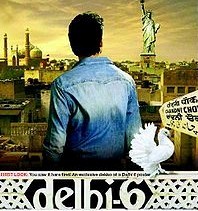
Delhi 6: Quixotic

delhi-61With Rakeysh Omprakash Mehra, one is never quite sure what one is going to get. The former ad maker directed the successful and critically acclaimed Rang De Basanti in 2006 but it took a good five years before that for us to forget the wildly experimental Aks, a nightmarish movie featuring long Hamlet-style soliloquies and body-swapping killers.

Delhi 6 falls somewhere between the two. It has somewhat of an activist message like RDB and uses totems and symbols like Aks. The storyline is thin. NRI Roshan( Abhishek Bachchan) returns with his grandmother to the crowded Delhi district where generations of his family lived, wall-to-wall( literally) with many old friends and neighbors. He gets to experience the chaotic, claustrophobic and closely-knit community his parents left behind when they moved to America and to decide whether he belongs there.

That is about it. The movie is a series of snapshots of life in Delhi( Zip Code 6); the interfering neighbors, the family squabbles, the communal relationships that, despite the avowals of harmony can change from love to hate in a flash.

The film is heavy with symbolism; Roshan is the new India – western-oriented but with a yearning to connect with his roots. His love interest Bittu(played by a charming Sonam Kapoor) is the middle class girl struggling to break free of the shackles of her culture and environment. That she attempts to do so by auditioning for a reality show is a piece of delicious irony. (Television is considered to be one of the driving forces in creating the appetite for material goods that could propel the apathetic suburban India into the new century.) Grandmother Annapurna( Waheeda Rehman) represents the conservative India – affectionate and loving but also religious and superstitious, she is content with letting the status quo be, whether it is treatment of untouchables or communal tensions. “Stay out of it” is her guiding principle.

Then there is the “Black Monkey”. It is a mythical figure that is referred to from the first scene of the movie yet no one ever sees it. The monkey functions as a potent symbol of all the amorphous fears that divide and separate Indians from each other, a mirror to the evil that lies in all of us, a point the filmmaker drives home without subtlety in the form of a madman who carries around – you guessed it – a mirror. The monkey, a source for many comedic moments, is also the catalyst for the shocking denouement of the film. (SPOILER ALERT: Squeamish viewers can rest assured that all is well at the end.)

Delhi 6 is an experimental film and I applaud the fact that movies like that, with no coherent narrative but lots of style can find financing in these times. Perhaps the producers were expecting another Rang De. If so, they (and you) will be disappointed. It is not a film made for box-office success. Rather it is a meandering, nostalgic trip down memory lane, a director’s indulgence that really doesn’t care if you like it or not. The only concession to the audience is the presence the two leads and an ensemble of excellent actors, many of whom have just one or two lines.

Abhishek Bachchan is at his relaxed best. His chemistry with Sonam is great though the relationship is not fully developed in the movie. Vijay Raaz as the abusive local law enforcement is pitch-perfect. Other art-house stalwarts like K.K.Raina and Atul Kulkarni give the movie a polished professional touch.

Delhi 6 is a very well-produced, well-directed and well-acted movie. But those expecting a conventional film with a beginning, middle and end can skip it. It is meant for audiences with the patience and curiosity to explore a different kind of artistic vision.

My Rating: 2.5 stars out of 5.