Category Archives: Parent Talk

Sound Experiments

By Rennu Dhillon

Craft 1

Goal: To develop your hearing senses and identify between sounds.
Materials: Plastic eggs (available at the Dollar Store), rice, dried beans,
popcorn, cereal, salt.
Procedure:
1. Take 3-5 plastic eggs.
2. Number each egg.
3. Fill each egg with different items e.g. Egg 1 – dried beans, Egg 2 – rice,
Egg 3 – cereal, Egg 4 – salt, Egg 5 – popcorn.
4. Now try and identify what is in each egg by shaking the egg and listening
to the sounds it makes.
5. Repeat the exercise with a friend and have them guess what is inside
each egg. Show them a list of items which they can guess from.
Additional Experiment: You can repeat the experiment using different amounts
of rice in different cups and listening to how the sounds differ depending on
the quantity of the item in the cup.
Explanation of what is happening:
Sound is made when the air around us is pushed and creates a sound wave. This
sound wave causes our eardrums to vibrate. Our brain can decide what sound
we just heard depending on how fast the ear drum vibrates or moves back and
forth.

Craft 2
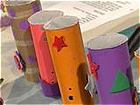
Goal: Make a Kazoo or a Humming Flute
Materials: wax paper, cardboard tube ( from a left over kitchen towel or toilet
roll), tape or rubber band, pencil.
Procedure for a Kazoo:
1. Cut a small square of wax paper about 1 inch larger than the end of the
cardboard tube.
2. Wrap one side of the tube with the wax paper using a rubber band.
3. Poke a small hole near the covered end of the wax paper.
4. Decorate the tube with colors or stickers.
5. Now hum or sing a tune through the open end of the tube and feel how
the kazoo will vibrate depending on how loud your sound is.
6. Make different tunes by humming loud and soft into the tube and create
music.
You can repeat the same exercise using a toilet roll to make a flute.
Procedure for a Humming Flute
1. Using a pencil, poke 3-4 holes in the cardboard roll about 1 inch apart.
Now repeat the steps 1-6 above.
Using these techniques, people have created music over the years. Music can
be made using different things such as cans, wires, cardboard tubes, craft
sticks and bells.

Rennu Dhillon is the founder of Genius Kids Inc, “Never 2 Little 2 Learn”.
Dhillon has a BSc. in Pharmacy, DSc. Naturopathy. She has combined her
education and experience to develop an award winning curriculum at Genius
Kids, a very hands on learning program incorporating a full academic
curriculum to include public speaking, drama, science, art and cartoon art to
children ages toddlers to K.

The Great Mathematics Experiment – III

By Enakshi Choudhuri

Is there change on the cards?

Change may be here at last and it is not the “change” that the different presidential candidates have been expounding upon everyday for the past few weeks and months. The change I am talking about is taking place in the corridors of the U.S. Department of Education, which has awakened from its deep slumber and realized that the new ‘fuzzy math’ is not working as well as they had thought it would.  It has taken twenty five years of math wars between parents, teachers and school administrators and repeated international trend studies indicating that American students are “mediocre at math”  to spur into action a National Mathematics Advisory Panel that put together their report after examining over 16,000 research publications and studies. Continue reading

Celebrating your child

By Piya Mitra

Piya Mitra is an event planner. Under the banner of her company “Elegant Eventz” she has organized theme and birthday parties for both kids and adults.

If I ask you about your plans for this weekend most of you are going to say you have a birthday party to attend. Most of those parties will either be held at restaurants/banquet halls or crowded children’s birthday party places.
Birthday parties in the South Asian community are used as opportunities for socializing and networking for adults. The parties fall into two broad categories –

Restaurant/Banquet hall/Home – Food is the big factor here. A magic show thrown in for entertainment or a bouncy house. The rest of the time the children just run around the tables & chairs while the parents are busy chatting about work or catching up with each other. At the end of the party the kids get a favor bag full of candy and little toys that are thrown away or lost in a day. Continue reading

Gifted children in the classroom

By Geeta Padmanabhan

Call it the Matilda syndrome. A bright child, far ahead in reading, writing and in thinking compared to kids of her age. Not a prodigy, just very bright. Hold that “wow” for a second. It’s hard to believe, but she/he can be a “problem” kid in the classroom. Ask any teacher.

This is why in the B Ed. syllabus in India there is a complete unit on “How to handle the exceptionally bright in the classroom”.

On July 25, 2008, S Chandrasekar, 17 became the youngest postgraduate from IIT-Madras when he received his degree at the convocation. The teenager topped his class. Born on September 25, 1990, Chandrasekar was dubbed a “precocious” child.  "His teachers used to complain that he would finish his work quickly and disturb other children, so we asked them to give him some books to read," said his father. Continue reading

Summer crafts for kids: Mixing Colors

By Rennu Dhillon

Craft/Experiment 1

Goal: To learn about primary and secondary colors.
Materials: food coloring (red, yellow, blue), corn syrup, 2 paper plates (not
the plastic plates but paper plates)
Procedure:
1. Mix each food color with the corn syrup so you have 3 colors – red,
yellow, blue in 3 separate dishes or bowls.
2. Take each plate and using a pencil divide the plate into 4 parts or
quarters – e.g. like an apple into 4 parts.
3. Using finger painting techniques you will spread the paint in each
fractional part.

Plate 1 – finger paint red into one part. Now mix red and blue and paint thisinto the other part and see what color you make. Now mix red and yellow
paint into the 3rd quarter. See what color you make. Now mix all 3 colors
into the 4th quarter and see what color you make.
Repeat the steps using blue and then yellow.
Look at the different colors you have created. To be really adventurous, take
some white paint and mix in to create different shades or tints of the same
color. Write down the colors you make.
Yellow + Blue = Green
Red + Blue = Purple
Red + Yellow = Orange

Craft/Experiment 2


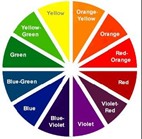
Goal: Make a Color Wheel using primary and secondary colors
Materials: Paper plate, red, blue, yellow paints, brushes, water.
Procedure:
1. Take a paper plate and draw a circle about the size of the plate. Now
divide the circle into 12 sections or slices.
2. Color code each section as shown in the picture.
R- red
RO –red Orange
O- orange
OY – orange yellow
Y – yellow
YG-yellow green
G-green
BG – blue green
B- Blue
BV- blue violet
V- violet
VR – violet red
3. First paint the main primary colors into the sections – Red, Yellow
and Blue.
4. Then mix equal part of red and yellow into the RY section and see
what color you get? It should be orange. Take that new color and paint
it into the section labeled O.
5. Repeat the exercise with each color and color combination.
6. You will create a color wheel that you can dry and keep forever.
Bonus: Experiment mixing several colors and create your own shades
and tints.

Rennu Dhillon is the founder of Genius Kids Inc, “Never 2 Little 2 Learn”. Dhillon has a
BSc. in Pharmacy, DSc. Naturopathy. She has combined her education and experience to
develop an award winning curriculum at Genius Kids, a very hands on learning program
incorporating a full academic curriculum to include public speaking, drama, science, art
and cartoon art to children ages toddlers to K.

An en'chant'ing CD for your kids

By Vidya Pradhan

For Hindus, the single syllable “OM”, repeated the right way, represents the creation of the universe and the sum of all existence. Om is a mantra, a hymn( shloka) or phrase that is supposed to raise consciousness when recited over and over. Mantras have power and meaning independent of the understanding of the person chanting them if chanted the right way, so say the scriptures. Nina Patel has experienced this for herself.

Continue reading

Teaching kids public speaking

By Rennu Dhillon 

Speaking confidently and having the confidence to speak in public is a
critical life skill to survive in today’s competitive society. To be able to
verbally communicate clearly and effectively to other individuals and groups
is essential in schools, business and your own personal life.

As a successful recruiter for many years, one of the things I ran into as I sent
my clients out for interviews was that many people lacked clear
communication and the confidence to interview. Just having a great resume
or a collection of degrees from ivy colleges is not suffice to advance in your
career or improve your business. It is now as important for people to be able
to make effective presentations and the knowledge and skills to speak to
others. Continue reading

Ask the grammar expert – Capital letters and family relationships

Reader Seema asks:

My students mess up in their writing using capital M for Mom and D for dad in all places. How can I teach them (first graders) when to capitalize mom and when not to. How can I make it easy for them?

Geeta Padmanabhan answers: 

Family relationships are capitalised when used as proper names.

I sent a thank-you note to Aunt Sarah, but not to my other aunts.

Here is a present I bought for Mother

.Did you buy a present for your mother?

If the kids are capitalizing “mom”, they can do it in two situations.

1] When they are addressing “mom”. For example:

Mom, are you there?

[2] When they use it as a proper name.

You know who is in that room? It is Mom. Here the kid thinks her mother’s name is Mom. That’s how the kid has always known her.

You will notice there is no ‘whose’ marker (my, your, his, her, their) before the word “Mom”. If the sentence establishes the relationship with that marker, “mom” starts with a lower case letter. Once the relationship is established, she is just my/your/her/his/its “mom”.

Example: “Is that your mom?” 
So if a kid writes:
“Mom makes me do all the work” or “I buy a gift for Mom” we have to accept it as right.
It becomes wrong only when the sentence goes, “My Mom drives me to school.”

Children learn through drill work. Some of the work we have for beginners:
[1] Write your name on the corner of every page of your workbook.
[2] Your city, district
[3] Names of parents, friends
[4] Then move on to sentences. The sentences are simple first and then have proper names.
Example: River Nile flows through Africa.
Exercises could be
[a] Fill in the blanks
[b] Correct the sentences.
[c] This simple letter has mistakes in capitalization. Can you fix it? Kids get familiar with letters as well.
[d] Game of tic-tac-toe for capitalization
[e] Kids pick a capital letter from a box of cards. Then write a word using it as the first letter.
[f] Make it clear there are no capital letters in the middle of a word. Give a list (fish, fiSh). Which one is right?
[g] Building sentences. Break sentences into three parts. Put them in three columns. Ask kids to form sentences using capital letters as clues.

Hope this helps. 

Community Ambassadors graduate

By Barry Shatzman

Something wasn't right. The woman filled out the forms to start receiving Social Security benefits, and the money began to flow into her bank account. Yet she still was borrowing from friends for her day-to-day expenses.  
 
Not understanding English well, she didn't realize that she could withdraw the money.  
By the time Pragna Dadbhawala, a member of the city's Community Ambassador Program for Seniors (CAPS), stepped in to help, things had gotten even worse for the woman. The Social Security Administration noticed she wasn't using the money, so they cut off her payments altogether.     "She was depressed. A volunteer had helped her fill out form to get the Social Security, and then this happened. I helped her with her appeal. I spoke in her native language," Dadbhawala said.

Continue reading

The Great Mathematics Experiment: ‘Real World’ Math

By Enakshi Choudhuri

Do you find yourself staring at your third graders math homework wondering what it is all about, even though you have an advanced degree in mathematics? Does your child jump from topic to topic in math without ever being able to master anything?  Do the words spiraling, lattice multiplication, everyday math or conceptual math seem familiar? If you answered ‘yes’ to any of those questions your child may be part of one of the most lamentable education experiments ever conducted in the past 25 years. An experiment, that has parents, students and teachers up in arms in multiple states across the nation.

Yet, for many years, no one thought to conduct a randomized controlled study to understand whether this new ‘fuzzy’ math actually helps children learn mathematics. That is, no one until Dr. Kaminski and her colleagues at Ohio State University decided to challenge the common practice in many classrooms across the country of teaching mathematical concepts and facts by using “real-world” concrete examples. Continue reading