Acting and Creative Writing Workshop for Tweens

teen workshopEmpowering Teens comes together at least once a month for fun and interactive workshops (for 8-13 year olds) where kids are in a safe, structured and nurturing environment and they can have some fun.  Each workshop is led by a professional.   We play games, and learn fun things like how to better interact with others, how to focus better and sometimes do some yoga even.

Act It Out, Write It Down: Imagine-Nation Workshop (8-13 yrs)
Sunday, May 2, 2010 at 3:00PM

A secret code flashes onto your iphone screen.
“Yes? ….Ok, I’m on it.”
Then you slip into the nearest empty elevator. You throw on your body suit, cape and mask before the elevator reaches the ground floor.
You dash outside, and fly off into the sky, toward the danger zone….
Are you a fan of Superman, Batman or the Incredibles?
Would you like to create stories with true-to-life good guys and bad guys?
Have you ever imagined what it would be like to play the hero or villain of your own story?
If Yes, then here’s your chance to be in the limelight!
Bring some props and join our workshop, where you’ll get to Act It Out and Create your Own Story!
Our workshop includes:
* an Act It Out warm-up game
* creative writing time
* time to read your stories out loud
* brain-boosting snacks
Please bring:
* a prop (hat, glasses, scarves, cape, etc.)
* a spiral-bound paper notebook/pencils & erasers
* your own bottle of water
* your enthusiasm & creativity
See the full event details, including location, at  http://www.meetup.com/Milpitas-EmpoweringTweensMeetup/calendar/13011391/.

Love, Sex Aur Dhoka

films_love sex aur dhokaWhat is cinema? Is it storytelling, technique, or performance? And what is its objective? To entertain, inform, or just shake the viewer out of celluloid apathy? Dibakar Banerjee (Khosla Ka Ghosla, Oye Lucky Oye Oye) takes on these questions with the noirish Love, Sex Aur Dhoka (LSD).

Shot entirely with handheld cameras, LSD is quite a trip (pun unintended). Three stories from Indian suburbia are loosely knit together, each story told from the point of view of the characters holding the camera; some for reportage, some for digital immortality, some for voyeurism. The stories are hardly unique; one deals with romantic love, one with a Tehelka style sting, while the third capitalizes on the lurid MMS scandals that periodically pop up in the midday tabloids. The plots are familiar, the endings sometimes predictable; it is the filmmaking style that invests them with urgency and credibility. The use of long single shots, necessitated when the characters are not moving and there is only a single camera covering them, challenges the actors to deliver amazingly convincing performances.

Wisely casting unknowns for the movie, Banerjee manages to invest the film with a documentary feel—the characters are completely believable. When bad stuff happens to them, the viewer is jolted by the realism, as if one stumbled on to this cache of home movies and discovered the deep dark secrets within.
The other quality that gives LSD its kick is its authenticity. People fed on a steady diet of Bollywood may find it hard to believe, but LSD is the real India, sometimes gritty, mostly grimy, usually banal. The banality sometimes makes the movie drag, but the performances are good to the point of being hypnotic. You want to know what happens to these flawed souls, much in the way you would follow the lives of your friends from college. The characters represent modern India in a way the Polo-wearing, Gucci-adorned Raj and Simran do not.

The connections between the three stories are not immediately apparent, and the diligent viewer will have quite a few “aha” moments as characters from one story show up in another.

Viewers looking for escapist fare can give it a wide berth—it is just too real and too disturbing—but lovers of serious cinema just have to watch LSD. I guarantee you will be haunted by the movie for days afterwards.

Kid advisory: If you can be called a kid, you better not be watching this movie.

Love Sex Aur Dhoka

*ring

The Legend of Vraz

LegendofVraz01

By Vidya and Naren Pradhan

The rich Hindu mythic pantheon of rajas, rakshasas, and apsaras lends itself well to quest-style video games, so it is a bit surprising that no one has seriously attempted one till now. Kids weaned on Amar Chitra Kathas will be interested in “The Legend of Vraz,” a computer game that is inspired by the panoply of heroic characters that Indian mythology provides.

The story of the game, very reminiscent of Indian fairy tales, revolves around prince Vraz who wishes to marry his beloved princess Avi and win her hand in marriage. He has to perform 5 tasks set by her father. This takes Vraz on an epic quest where he must make his way through 15 exotic locations, avoid the tribal warlord Mani and battle with the evil lovelorn Vizier and his shrewd accomplices. He will also have to collect gold and keys, skillfully navigate dangerous traps, operate objects and find his way out of near impossible terrain.

Abhi_14-1Says developer Abhinav Chokavatia, “The game’s look and style is derived from Indian Miniature paintings. I had always been fascinated by miniature paintings ever since I was young. While visiting the temple of Nathdwara I came across detailed miniature paintings and thought it would be a great idea if we can somehow take this art form forward. That’s how the game style and game idea was born.”

The game is targeted at the teen male audience, though the developers believe adults play it too. “We’ve had players tell us that it reminds them of the earlier Mario games,” says Abhinav. “You might say that Prince of Persia + Mario * India – Violence = Legend of Vraz!”

The game launches in India via retail in a month or so and is already available for online purchase. Buyers can try out the demo on the website of Zatun Games, the developers of “Legend.”

I had Naren, who, at 14, falls bang in the middle of the target segment, try out the game. Here is his review –

So far, there have been many good ideas for video games based on mythologies from around the world that have ended up as excellent gaming experiences. Players can hack their way through monsters from Greek mythology, carve a path through hell, or use magic and martial arts to fight hordes of Chinese soldiers. However, so far, nobody has thought about a game based on Indian mythology. Well, the wait is over, thanks to a pay-to-download game called The Legend of Vraz.

The Legend of Vraz is a side-scrolling platformer based on Hindu mythology, especially The Ramayana. Indians around the world would be excited at such a thing. One would say, “Finally, game developers are taking notice of the lore of India!” Of course, I immediately took notice of it, being an avid gamer myself. So I downloaded the game demo, and this is what I found.

The story has no audible dialogue, and is presented through comic panels and missions. It involves prince Vraz, who resembles an Indian hero, doing five difficult tasks in order to win the hand of the lovely Princess Avi. The game play takes many of its elements from classic platforms such as The Prince of Persia, Super Mario Bros, and Sonic the Hedgehog. In each level, you are given a certain mission, either to get an amount of gold, defeat a number of enemies, or simply get to the end. On the way you can jump, fight enemies, collect gold, and discover secret areas, all vital to the overall platform game experience.

Perhaps the most interesting part of the game is the bow and arrow. Just like Rama, Vraz’s signature weapon is the famed projectile weapon of the ancient times. There are five types of arrows you can shoot including normal, particle and fire arrows. However, the enemies move quite fast, and the limited directions you can shoot in make the bow hard to use. Also, there is little variety in the types of enemies. There are bugs, fish, more bugs, more fish, a boar here and there, soldiers, and annoying little cheeky monkeys that make you lose health after you destroy them, which is annoying since you have to destroy them in certain levels.

Overall I didn’t really enjoy this game. However, I can tell it was meant for small children, who will enjoy it when they get the hang of it. The difficulty will provide a good challenge for them and the platform action a thrilling experience. I would call this game average. But if Indian mythology is your thing and quest-style games are fun for you, then do give The Legend of Vraz a try.

End review.

To seasoned gamers like Naren, who has played real time strategy games like Starcraft and Warcraft 3, the game may seem a little retro and inadequate but kids newer to the world of online gaming may enjoy the game. Also, parents can be reassured that there is nothing bloody or gory in this game. According to Abhinav, the initial response has been tremendous.

Here is a video teaser of the game –

Naren’s blog is here.

Hindi Gym

lala the monkeyIt seems like the desi population in Silicon Valley has reached some sort of critical mass, if one can go by the explosion in Hindi classes in the area. Once the domain of religious groups, who combined language lessons with cultural and spiritual offerings, teaching Hindi has become the basis for at least two professional organizations that I know of in the area.

Then there are those who just want to disseminate the language for the love of it. The daycare provider at my daughter’s public school offers free classes to any child who is interested, and she has quickly built up a sizable student body (Free + Hindi? What’s not to like!).

Another such altruist is Aarti Chandnani, who is the founder of Hindi Gym, a website providing largely free resources for Hindi teachers.

“I began with wanting to teach my own kids Hindi,” say Aarti, who is a computer engineer by profession. “I began scouting for language materials in India, but found that they were quite outdated and my kids could not relate to it.” The India Community Center found out about her interest in the language and asked her to start classes in San Francisco, another reason for her to look for appropriate teaching materials.

hindi gym workbookSo Aarti began designing Hindi worksheets on her own. “I tried to make them appealing to kids growing up here.” She created a monkey character called Lala who anchors the material.

The response to the worksheets was outstanding and Aarti was inspired to come up with an entire workbook. She contacted publishers in India but found there was little interest in publishing exclusively for the U.S. market. She found an illustrator in Chennai and a printer in Hong Kong and ended up self-publishing the books.

Amazingly, Aarti has managed to price her workbooks extremely reasonably, at 7.99 for an 80 page illustrated soft cover. “My idea was that parents shouldn’t have to think twice before picking up the book.” The workbooks have been picked up both by organizations and home teachers.

hindi gym board gameHowever, the worksheets are still free and there are plenty of them on the website for teachers and parents who just want a resource for their lessons. There are also wall posters and board games that can be printed out. Aarti constantly updates the material and adds new worksheets. A new addition is the free e-books that parents can download for use at home.

“The idea is not to make a ton of money,” insists Aarti. “It is about spreading the language. Mandarin and Spanish have become so mainstream, why not Hindi?” She adds, “I want Hindi Gym to be the one-stop shop for people wanting Hindi language resources. Parents wanting to teach their kids Hindi can just pick up stuff for free.”

Aarti also collaborates with ispeakhindi, a website which offers podcasts for conversational Hindi lessons. The podcasts reference Aarti’s worksheets and vice versa. In the works are also plans for new products like a Hindi mobile app and added sections on Hindi grammar and reading comprehension.

“I am not an educator,” says Aarti. “I was just inspired by my kids to start this. Now I find that it is something I am passionate about.” She invites members of the community to contribute their own ideas for teaching Hindi here.

Check out Hindi Gym. As a parent of child learning Hindi, I found the worksheets charming and accessible. The quality is as good, if not better, than some of the similar English language workbooks in the market, and Lala is just irresistible.

Yes We Can

health care leoncillo sabinoThe House passes HCR 3590, the health care reform bill. As I write this, the vote for the reconciliation fixes is due. Then the reconciliation fixes go to the Senate, and finally the whole bill goes to the President for signature. Even without the reconciliation fixes being approved, the President can simply sign into law the Senate bill.

Why is this important to you? See this post for how the bill affects you.

Why is this important for the nation? At long last, a developed country has agreed that access to affordable health care is a right of its citizens, not a privilege. The bill is not perfect, in fact, it is closer to the Republican vision of 1993 than feels comfortable. But it is a start.

The end feels anticlimactic, given the overwrought rhetoric and media-induced drama. But there is no doubt that this is a momentous event. And given how the media played it to be the defining moment of Barack Obama’s presidency, it has validated the President’s last minute push and given him the victory he needs to push through many other legislations in the pipeline, like education and immigration reform.

To all of you who bothered to pick up the phone and speak with your representative or Senator, thanks! Just like the historic election of Barack Obama, this was the success of the collective efforts of tens of thousands of humble individuals, who pressured and cajoled and threatened their congressmen and their senators to do the right thing. I was one of those, I am proud to say, and this underscores the importance of each and every voice and vote.

Let’s celebrate tonight. And get back to work on making this bill better tomorrow.

A Few Godmen

godman logo

By Gaurav Rastogi

It is divine intention, then, that as I started my blog-meditations on the subject of “belief”, I am blessed by the coming out, so to speak, of several all-too-familiar shock-news stories about Godmen in India. And thus, this post was written, by the will of the creator!

I recently had a deep resoaking in traditional India. There, I realized just how deep is our urge to connect with something divine, and how far each of us is willing to go to believe. In my many recent trips to India, I have continued to be surprised by the prodigious rise of the Godman culture. There are TV channels, billboards, posters, pocket-calendars, internet darshans, blogs, temples, satsangs, and Youtube channels that proclaim the divinity of an alarming number of self-styled Babas, Gurus, Mahants, surplus Shankaracharyas, Swamis and other ochre-robed manifestations of divinity.

Not one to make fun of someone’s faith- and risk eternal hellfire and internet flames, I kept my opinions to myself so far. However, I suspect it’s well within reasonable limits to think about the reasons behind this phenomenon. What is driving it?

Believing in something is easier than knowing everything: First off, there is too much information in the world around us. I’ll research just how much in a future post, but we know that the scientific and information revolution in the last couple centuries has expanded the “information quantity” by several orders of magnitude. The human brain, unfortunately, has not kept pace. Hence, we have to limit ourselves to knowing only a fraction of the stuff that’s out there, and we have to believe the rest. That means, if someone is simplifying reality for me, he’s doing me a favor, and I must call him my Guru. Problem solved, no!

Everyone’s doing it: Belief is like the swine flu- it’s infectious. If my neighbors have it, and their neighbors have it, then I would be foolish not to have it! I start believing partly to fit in, and partly because it helps simplify my life (see above). Then, I become a vector of this belief and through my inspired anecdotes and miracles, I infect others with my belief.

A few good Godmen: Like honest politicians, not all Godmen are out to cheat, swindle, and defraud (Gawd! I love the Thesaurus). There are quite a few Godmen who are honest, and are interested in the public good. That’s what keep the engine moving. I think.

The long tail of spirituality: Think about it- with so many channels of information, you can find just the guru that you were looking for. You can get a north Indian guru, a south Indian guru, a pan-hindu guru, a post-hindu guru, a cancer-curing guru, a cute kid guru. There are all types of gurus out there, and with the information distribution that’s possible with TV and internet, each small niche will be fulfilled.

GodMan-liness is a scale business- big is better: If you read the news articles about the fake gurus, you will conclude-as I did- that there is a lot of money and power at stake here. All those lavish ashram’s need money to build, and all those news channels need content that they can play. The bigger a guru’s following, the more money they have, and the more they are likely to attract new followers and crowd out the smaller, local types. You know, the ones who cared about spirituality and other soft stuff!

Escalation of commitment: And finally, once you have taken a ride on a guru band-wagon, there’s no getting off. You have learnt their lingo, you have got into their community, you have attained the Guru’s blessings, and you have brought your friends and family into this circle. Now, what would you do if you found your Guru was a fake? You’d hush it, because there’s no way you can get off that juggernaut without getting trampled. You’ve joined into the lie.

Mo’ Money: As India gets richer, people (a) have more money to spend on spirituality (!), and (b) have more reason to try to prevent a slide back into the cesspool of poverty they recently climbed out of. This means good business for those that promise continued good fortune because, ahem, they have a direct line into you-know-who.

In sum, I would say this whole business is a Ponzi scheme. Think about it.

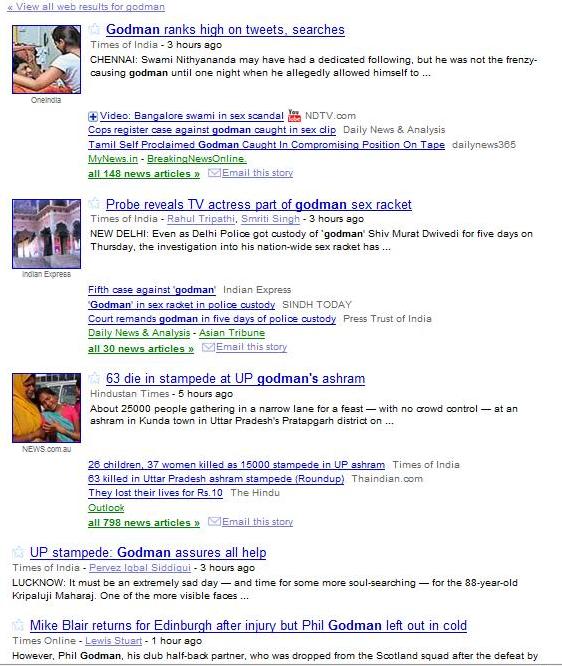
Here’s some news feeds to tell you more about the state of this business. No peeking, kids. This stuff is PG-13.

godman newsfeeds

(Originally posted on http://rustus.blogspot.com. Check it out for more on Godman-liness and associated stories.)

What will Health Care Reform mean for you?

health care“I HAVE INSURANCE THROUGH MY WORK.”
Keep your doctor and plan if you like it, but your plan willbe strengthened and you’ll be protected from insurance company abuses.

• According to the independent and non-partisan Congressional Budget Office,
people who get coverage through their employer today will likely see lower premiums.
• If you like the health plan you have, you will be able to keep it.
• The President’s proposal will strengthen the coverage you get at work by reining in the worst insurance company abuses.
• Nothing about the President’s proposal will interfere with the choice of doctors you have today, or cause you to change the coverage you have at work today.

“I OWN A SMALL BUSINESS.”
You won’t be required to provide health insurance to your employees, but if you choose to, new tax credits will make covering your employees more affordable.
You will also have access to a new insurance exchange to find the best deal, and the entire process will be simpler.

• The President’s proposal provides tens of billions of dollars in new tax credits to small businesses to make it easier for them to provide coverage if they choose to do so.
• You will be protected from sudden, arbitrary rate hikes because a worker gets sick; under the President’s proposal, insurance companies will no longer be permitted to base the cost of coverage on health status.
• The President’s proposal gives small business owners the leverage that big
businesses enjoy by allowing them to buy coverage through the exchange.

“I HAVE MEDICARE.”
Health reform protects Medicare. The President’s proposal makes Medicare
more financially secure and seniors who hit the prescription drug “donut
hole” will be protected from high costs for their medicines.

• Your guaranteed Medicare benefits will not be cut, and the Medicare Trust Fund will be extended for more than 9 years.
• In addition, you will have benefits you don’t have today: Preventive services like cancer screenings at no cost, and a substantial reduction in prescription drug prices if you fall into that gap in coverage known as the “donut hole.” Over time the proposal closes this coverage gap completely.
• Health insurance reform will not affect the choice of doctors you have today and it won’t affect your relationship with your doctor. The President’s plan aims to increase the number of primary care providers, giving you greater access to doctors than you have today.

“I DO NOT HAVE INSURANCE.”
You will have access to new insurance choices in the same insurance marketplace where all members of Congress will buy their insurance, receive tax credits to help you afford coverage if needed, and enjoy protections from insurance company abuses.

• For the first time in history, there will be limits on how much anyone will have to pay to receive health care coverage.
• If you need it, you will receive a tax credit to help pay for your coverage – part of the largest middle class tax cut for health care in history.
• Insurance companies will no longer be allowed to simply tell you “no.” They will be required to offer coverage regardless of your health status or because of pre-existing conditions, and they cannot jack up rates or drop you from your coverage when you get sick.

“I BUY MY OWN INSURANCE.”
There will be new protections from insurance company abuses, and tax credits will make coverage more affordable. You will have access to new insurance
choices in the same insurance marketplace where all members of Congress will buy their insurance.

• You will likely pay less—perhaps much less—than you do currently.
• In addition, many Americans buying coverage in the individual market will qualify for tax credits that reduce their premiums by an average of nearly 60 percent – and they will get better coverage than what they have today.
• Health insurance reform will limit what you have to pay out of pocket, a protection that does not exist today.
And for the first time, no one will be required to pay more than a set percentage of their income on health care coverage.

If you like what you see in the President’s plan above, spread the word and support reform.

Alisha's World

AlishaAnyone who has ever tried to penetrate the world of children’s book publishing will tell you what a daunting task it is. A few fortunate ones, like Pooja Makhijani ( Mama’s Saris) and Uma Krishnaswami (Monsoon) make it to the mainstream, but there are scores more who bravely undertake the project, knowing their chances of breaking through are slim, with every likelihood of their book being consigned to a vast slush pile at the publisher’s desk.

Perhaps we immigrants are inspired by the challenges our children go through to assimilate into this new culture and want to share stories from the war zone. (It certainly isn’t to become the next J.K. Rowling.)

Sanjiv Sinha took a techie approach to the problem of finding a publisher.

A father of 2 daughters from Dallas, Texas, software professional Sinha recalls making up stories for his 4-year-old a few years ago. The stories touched on the common issues faced by desi children in the US – joining a preschool where no one looks like you, bringing lunch that invokes laughter from your classmates, and so on.

alisha's worldThe stories were the inspiration for Alisha’s World, a charming picture book revolving around the eponymous Alisha, perhaps a composite of Sinha’s kids Riya and Shibani, who the book is dedicated to. The book has 3 stories revolving around the third-grader Alisha and her experiences at school. Joining a new school at the start of the book, Alisha faces the typical cultural challenges of a second generation Indian American. She navigates them with the help of a loving family, understanding teachers, and good friends. The glossy book is illustrated beautifully by Archana Sreenivasan.

After exploring options of finding a US publisher or using an American self-publisher like Lulu or Amazon, the software professional eventually settled on outsourcing! Alisha’s World is illustrated and printed in India and sold in the US for $17.99.

The books have been a hit at local schools, where teachers have used them to teach valuable lessons on multiculturalism and diversity. To help things along, Sinha set up the Alisha’s World website, which features information about the book, fun games, and a way to purchase the book.  A Facebook page keeps fans updated on Alisha and her adventures.

The quality of the book notwithstanding, finding a mainstream audience has been difficult. Says Sinha, “I need to sell just 20,000 books per year to break even.” He is looking at the library and school market rather than individuals who, he admits, might be reluctant to dish out over 15 dollars for the 40-page book.

Sanjiv, Riya and Shibani

Sanjiv, Riya and Shibani

In the works is the second book of Alisha’s adventures. A typical story deals with Alisha’s request for a sleepover and her parents’ misgivings about this quintessential American ritual.

“I find this endeavor just so much more creatively satisfying than my day job,” laughs Sinha.

The Story of Genetically Modified Brinjal

By Geeta Padmanabhan

eggplantOn October 14, 2009, the Indian government’s Genetic Engineering Approval Committee (GEAC) cleared the commercial cultivation of genetically modified (GM) brinjal (eggplant, aubergine, baingan). For the first time a GM food crop was approved in India.

GEAC is an ad-hoc 30-member committee. Its members are mainly bureaucrats and scientists from state institutions. There is no other regulatory agency.

A huge uproar followed the announcement all across the country. Before we go into that, here are some basic facts.

The vegetable originated in India. Half a million hectares go under an annual baingan crop for an output of 8.4 million tonnes. We have a choice of nearly 200 varieties. The transgenic brinjal was developed by Mahyco (Maharashtra Hybrid Seeds Company) in collaboration with the US-based transnational, Monsanto. It involves the insertion of a gene from the soil bacterium Bacillus thuringiensis into the DNA or genetic code of the vegetable to produce pesticidal toxins in every cell.

You can imagine what the GEAC clearance meant. Once Bt brinjal was approved for commercial cultivation, there’s nothing to stop other GM food crops like rice, maize, soybean and sorghum from coming in through the open door. Bt brinjal means directly introducing a genetically engineered vegetable into India’s food chain. The silver lining was Environment Minister Jairam Ramesh had publicly opposed GM foods only months ago.

Do we have experts talking on this? Yes, one is Professor P M Bhargava, biologist, GEAC’s only independent expert, appointed by the Supreme Court. Another is Biotechnologist Sultan Ismail of Chennai. They both say that a majority of the necessary bio-safety tests were skipped before the clearance was given. That in itself is a strong reason for refusing to approve Bt brinjal. We don’t know enough about the effects of insertion of alien genes on the recipient organism, about the risk of transfer of those genes to human organ systems or viruses and hence about the impact on human and animal health and the environment. (Read article by Praful Bidwai)

Intense opposition for Bt. brinjal came from several NGOs and state governments (Kerala, Karnataka, Andhra Pradesh, Madhya Pradesh, Chhattisgarh, Orissa, West Bengal and Bihar). Two weeks ago, the government put on hold commercial cultivation of GM brinjal till such time independent scientific studies established, to the satisfaction of both the public and professionals, the safety of the product on human and animal in the long-term.

Why do we oppose it?
THREAT TO BRINJAL DIVERSITY
Genetic engineering should not be allowed in the “centre of origin” (of brinjal) as it could lead to the loss of original varieties by transgenic cross-pollination .
Counterview from Mahyco: “The origin of cultivated brinjal is uncertain, with differing views put forward by scientists . South America and Indo-China are thought to be areas of origin. India is considered a centre of diversity.”

TOXIN PUT IN BRINJAL NOT SAFE FOR HUMAN CONSUMPTION
Bt brinjal is fatal to a pest called fruit-and-shoot borer. Some scientists question the premise that the Bt gene acts only in the alkaline environment found in the gut of insects. For, the human digestive system is acidic only in the stomach while the rest of it is alkaline. The study done by Mahyco on rats allegedly does not address possible human dangers such as cancer, infertility and kidney damage.
Counterview: The Bt gene breaks down during digestion into common amino acids, which are part of the normal diet and are neither toxic nor allergic.

PRECAUTIONARY PRINCIPLE
Bt brinjal has been developed for the first time anywhere in the world. Precautionary principle requires that its clearance should have been withheld because of the uncertainty and irreversibility of its long-term implications for health and environment .
Counterview from Mahyco: There is no cause for alarm over Bt Brinjal as Bt cotton, the GM crop introduced in India in 2002, “is already in our food chain” . For, about 11 lakh tons of Bt cotton oil is consumed annually by people, directly or through vanaspati. “As the Bt gene present in cotton is identical to that used in brinjal, there is a strong precedence for safety of the gene itself.”

NO LABELING AND LIABILITY REGIME
It is a matter of consumer choice. Introduction of Bt brinjal be put off till a mechanism of mandatory labeling is put in place. But then, how will GM food be labeled in a country where vegetables are not sold only in supermarkets? And how feasible is it to maintain the segregation from the field to the market? Worse, there is no law fixing liability in the event of contamination of non-Bt brinjal by the GM variety.

LEGALLY UNTENABLE

GM products, without proper labelling, was illegal and attracted penal action under the Foreign Trade (Development and Regulation) Act, 1992.

SPURIOUS SEED TRADE
Asked about the possibility of spurious Bt brinjal seeds making their way into India, Ramesh said it was up to state governments to check this. “I hope we don’t see a repeat of Bt cotton where spurious and illegal Bt cotton seeds found their way into the market.”

“A moratorium implies rejection of this particular case of release for the time being; it does not, in any way, mean conditional acceptance,” said Jairam Ramesh. The decision followed his month-long public consultations in seven cities across the country. The opposition was loud, dramatic and acrimonious.

“I am not getting into any timeframe . . . the moratorium will continue for as long as it is needed to establish public trust and confidence,” JR said. He admitted that the current standards followed by GEAC in coming to its decision on Bt brinjal did not match with the global regulatory norms. “GEAC processes need to be changed and made more transparent,” he said.

A little bit of Google search will reveal the murky details of GEAC’s work with Bt brinjal. A PIL was filed by activist Aruna Rodrigues seeking a moratorium on GM crops. The Supreme Court was appalled to discover that the GEAC was rubberstamping recommendations made by the Review Committee on Genetic Manipulation (RCGM), a part of the Department of Biotechnology, promoter of GM crops.

I am not going into the details now, but it is enough to say that GEAC was pulled up for contempt of court. And Bhargava’s view on the incompleteness of the safety assessment was vindicated by the GEAC’s disclosure of another installment of raw data on the bio-safety of Bt brinjal on November 17, more than a month after it had already cleared the crop.

The moratorium is confined to Bt brinjal. It would not cover the issue of genetic engineering and biotechnology in agriculture. Still, it was a victory for the farmers and concerned NGOs who had opposed it.

Now we realize we breathed easy too early. The battle starts all over again. Science and technology minister Prithviraj Chavan is our opponent now.

Mr. Chavan seems to be fuming over the public rejection of Bt Brinjal. He will be introducing a GM bill to make it easy to legalize cultivation of bt. brinjal, rice, etc. What is interesting is the letter he has written in support of the GM crops. It in he has copied word for word paras from a study funded by biotech seed companies, including Monsanto. He has not included any public inputs in it. This letter representing commercial interests is now a part of the official documents being referred to by the Prime Minister’s office. Why has he done it?

And here is the alarming part:
Chavan’s bill would create a Biotechnology Regulatory Authority of India (BRAI), a small body of technocrats whose decisions cannot be questioned. If passed, this bill will deny the State governments’ rights to say no and BRAI will escape the purview of the Right To Information Act – both of which helped stop Bt Brinjal. The citizens of this country will never be able to stop genetic contamination of rice or any of the other food crops in the pipeline.

Check out http://epaper.expressbuzz.com/NE/NE/2010/02/26/ArticleHtmls/26_02_2010_001_010.shtml?Mode=1

Here’s something you can do about it.

Sign the petition to the Prime Minister of India and save our food from genetic contamination:

http://greenpeace.in/safefood/chavan-petition/

UPDATE: A message from Greenpeace India

More than 23,000 have signed the petition asking Prime Minister Singh to stop Prithviraj Chavan’s unconstitutional bio-tech bill.

We’ll deliver the petition to the PM, but now he needs to be pressurized further to get him to kill this bill.

Can you give the Prime Minister a call and ask him to stop Chavan’s bio-tech bill? When you call, you can say something like: “Minister Chavan has betrayed the public trust by doing the dirty work of bio-tech giants. The Prime Minister should throw out Chavan’s corrupt GM bill.” Here’s the number.

Prime Minister Manmohan Singh
Phone: +91-11-23012312

Then click here to let us know you called. Tracking the number of calls is key:

http://greenpeace.in/safefood/thanks-for-calling-the-pm/

You don’t need to be an expert to call. Just speak from the heart, and tell the PM’s office your opinion.

Mr. Chavan wrote a letter supporting Bt Brinjal, copied word for word from reports funded by bio-tech corporations like Monsanto, and now he has drafted the GM bill to cater to their interests.

In just the past week, Monsanto admitted that Bt Cotton — the only GM crop in India — has failed to stop pests,[1] but Chavan is still pushing for the BRAI bill.

Here’s how the bill would make it easier to approve Bt Brinjal and other genetically modified foods:

* The bill would create a small body of technocrats who take the final decision on the genetic tampering of brinjal, rice, and more. There is no place for public opinion, State governments, other ministries, or any elected representatives like panchayats.[2]
* The science and technology ministry is already responsible for promoting GM crops. It would be a conflict of interests for the same ministry to regulate GM crops.
* The bill has provisions to imprison and fine people who raise concerns on GM crops.[3]
* The National Campaign for People’s Right to Information states that the bill subverts the Right to Information (RTI) act by letting the authority decide what information can be disclosed to the public, instead of the Central Information Commission of the RTI act. The bill thus overrides the powers of the commission which is an impartial body to decide public interest.
* The biotech corporations automatically get a seat in the advisory councils of the very body that’s supposed to regulate them.

Give Dr. Singh a buzz and tell him to save your food and your rights. The Prime Minister is accountable to all citizens of our country, so your voice can create change. Call him now:

Thanks a billion!

Picture courtesy woodleywonderworks via creative commons.

Enjoying it

By Isheeta Sanghi
delhi foxypar

A lot of readers have said, ‘Ok so you moved to India, and you’ve told us it’s not that bad. Great, so what?’ They’ve asked me how I’ve coped, how I handle the poverty around me, how I adjust to the social scene here, and how I’ve adapted in the work environment.

I have done all of the above, but it has taken time, more time than I could have imagined. How I’ve managed to do it? With a positive attitude. It sounds cliché, but that’s the honest to God truth. I won’t be able to answer how I accomplished all of those things in one go, but here’s one for starters.

When I started college I quickly realized all of the people in my school were your typical rich Delhi folk. They drove around in fancy cars, wore huge sunglasses, were probably a few years older than me, and never came to class. Needless to say I really didn’t have many friends in college. The few students that did end up coming to class once in a while, either conversed in Hindi (and my Hindi is probably as good as Katrina Kaif’s in her first few movies- no offense, I’m a fan, I love her) or thought I was a total weirdo/loser since I attended each and every single class without fail.

So yes it was tough, and initially I thought, I was going to be such a loner and my only friends in college would be my professors. Luckily that didn’t happen. I managed because I found people that I could relate to – outside of college.

I joined the American Women’s Association in Delhi (men have no fear; you are allowed to join as well.) It’s an organization that allows you to interact with other Americans who are working, or going to school mostly in the NCR area. Being part of the organization makes you feel at home, because you’re doing things that you would do if you were in the States. They organize all sorts of activities from 4th of July BBQs, to Easter Egg Hunts, as well as events for a cause, like the annual ‘Walk For Life’ which I was privileged to have been part of.

All your major cities will have some sort of expat community. In Bangalore there’s the Overseas Women’s Club, in Mumbai there’s the American Women’s Club – yes they all have the word ‘Women’ in it, but men can and do join as well.

I’ll also go ahead and say that though some of my really close friends are parts of these organizations- I can’t spend all of my time in the expat community. For starters, you’ll go broke, because they tend to wine and dine at the five star hotels and restaurants, and secondly you can’t always relate entirely because at the end of the day they may not have any sort of cultural ties to this country, but you do.

India is not the same place we use to visit as kids; there are plenty of people like us working, volunteering, studying or just living life here. You just have to make the effort to find them, and when you do you’ll be able to talk to them and share stories and frustrations – which funnily enough will make your stay here enjoyable.

Also, you really need to start looking at the whole experience as one big adventure. That’s how you will get through this, and that’s how you will be able to have happy memories of India. I’m not saying that life isn’t serious, and that there aren’t serious issues that you will eventually have to deal with, but if you look at it from a different angle, you’ll relieve some of the stress you’ve started to carry with you.

Yes the infrastructure isn’t ideal, and there are cows on the road, there are huge buses with way too many people in them, there is pollution all over, there are places that smell bad, there are drivers that drive like maniacs (how many drivers have you seen with glasses on- you’re telling me they all have 20-20?), there are people who cross the road when they shouldn’t, vagera vagera. Seriously, my advice is to look at it as one big game of Mario Kart.

I’ll never forget one winter morning in Delhi. My Mom and I were taking our daily stroll around the building and we saw my brother walking towards us. Apparently he had missed his bus. Now, my brother is like me, he enjoys going to school and getting full attendance. We decided to follow the bus route and catch it ahead.

We call my Dad from the lobby and tell him to bring the keys to the car. We get into our inherited dark blue Maruti 800 (which if you ask me, really does look like one of those cars in Mario Kart), and were on our way. First road block, the water tanker, conveniently unloading water when we need to get out. After twiddling our thumbs for 2 minutes we’re on our way. Next road block, traffic light, which refused to turn green, “Come on man, come onnnnnnnn,” another 3 minutes, and we’re on our way again. Driving, driving, bumpy road – no shock absorbents on this baby! Watch out for the pothole, Dad I think we lost a wheel! Now we see the bus! Yes, we’re almost there, hmm why is the traffic moving so slow? A big, brown cow!  Can anything be more clichéd?

Jai Ho, now get out of the way, ah we see the bus it’s pulling into someone’s building, we made it!! Brother goes to open door- but the door doesn’t open (really really old Maruti 800.) Mom opens door up and there goes brother, on his way to school, backpack, brown bag lunch and all.

See, there were two ways of looking at the situation. With my backseat commentary the full way, I’d have to say that this experience is probably one that my family and I will take with us for a long time, and we can look back and laugh at it. We could have looked at it as a problem. Mom and I didn’t get to do our exercise, Dad didn’t get to have his morning tea, the car probably got a few extra dents in it, the roads were bad, and we were driving around in this crappy car when we were used to driving around in Fords and Toyotas our whole life, but that was all irrelevant at that time.

Be IN the moment, as a wise guru once said. You have to enjoy it – live it and be there- nowhere else. Stop comparing. In America it may be like this or that, and that’s great, but you live in India right now, focus on that. Philadelphia cream cheese costs about 500 rupees, which is insane; it’s however also the same amount that I believe people pay in the States for a bag of namkeen.

There are days where you will curl up into a ball and just cry your heart out- think about how life used to be, where your life has taken you now. If you didn’t have those days I’d wonder a little about you, it’s only human to have those feelings. Crying helps, but I get up the next morning or maybe it takes me a few days, and I realize not everyone gets to do this. Not everyone gets to move to a place like India and live life, heck not many people even get to see India.

You can go on living life here and constantly imagine how wonderful your life would be in the States. How you’d go out and party at night, how you’d be able to drive around by yourself, how easy it would be to get work done and how customer service is excellent, how your apartment would look, and how you’d have a dishwasher. Try to live IN India – with your mind and body. Life isn’t exactly a cake walk in the States either.

Give it time, let it grow on you, and only then will you be able to finally find your comfort zone. How you manage also depends on you, and your personality. But yes, being positive and making lemonade when life hands you lemons, in my view, will help your journey be all the smoother.

Picture courtesy Foxypar via Creative Commons